

Import RBD Coconut Oil from Indonesia – Complete Guide for International Buyers
IEC | INDONESIA EXPORT CENTER
CONNECTING INDONESIAN PRODUCTS TO THE WORLD
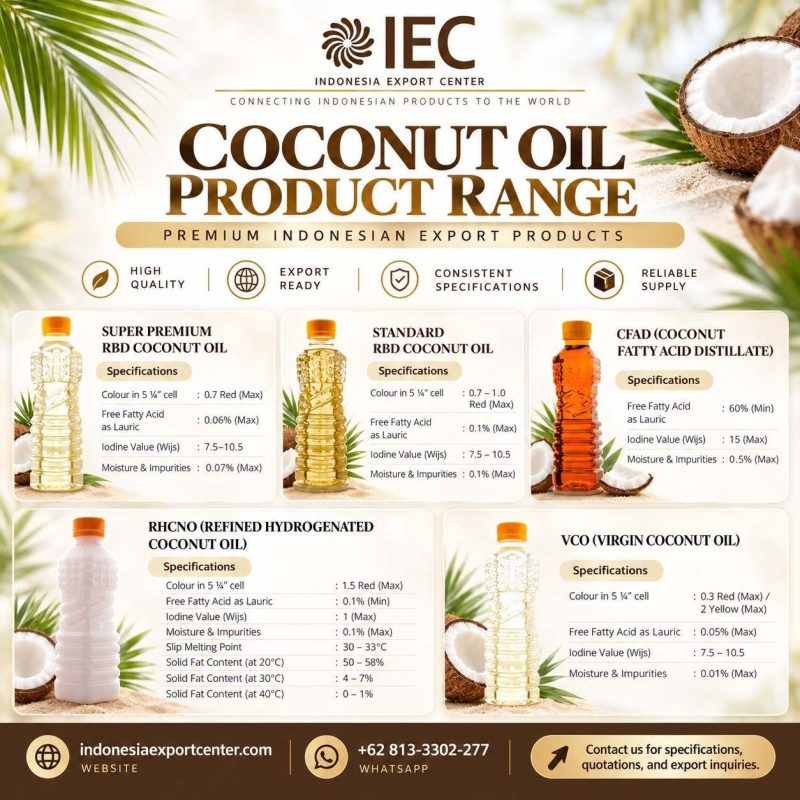
COCONUT OIL PRODUCT RANGE
PREMIUM INDONESIAN EXPORT PRODUCTS
HIGH QUALITY | EXPORT READY | CONSISTENT SPECIFICATIONS | RELIABLE SUPPLY
Your Guide to Importing RBD Coconut Oil from Indonesia
Are you planning to import RBD coconut oil from Indonesia for food processing, edible oil distribution, industrial manufacturing, or international wholesale?
Indonesia is an important sourcing destination for coconut-based products, including Refined, Bleached, and Deodorized (RBD) Coconut Oil. For international buyers, selecting the right product grade, verifying supplier capabilities, confirming shipping terms, and reviewing export documentation are essential steps toward a successful transaction.
Indonesia Export Center (IEC) helps connect international importers, distributors, wholesalers, and procurement teams with potential Indonesian suppliers and export partners.
Whether you require Standard RBD Coconut Oil, Super Premium RBD Coconut Oil, or other coconut oil derivatives, IEC can assist with supplier introductions, specification inquiries, quotation coordination, and preliminary sourcing discussions.
Looking for RBD Coconut Oil from Indonesia?
Contact IEC to discuss your required specifications, purchasing volume, packaging preferences, destination port, and shipment requirements.
Website: https://indonesiaexportcenter.com/
WhatsApp: https://wa.me/628133302277
Why Import RBD Coconut Oil from Indonesia?
Indonesia offers sourcing opportunities for businesses seeking refined coconut oil and coconut-derived ingredients for international markets.
1. Coconut-Based Product Availability
Indonesia has an established coconut processing industry producing coconut oil and a range of downstream coconut products.
International buyers can explore multiple product grades depending on their intended applications and technical requirements.
2. Suitable for Different Industrial Applications
RBD Coconut Oil is used in various sectors, including:
- Food processing and edible oil manufacturing
- Bakery and confectionery production
- Non-dairy creamer manufacturing
- Margarine and specialty fat formulations
- Soap and detergent manufacturing
- Personal care and cosmetic formulations
- Oleochemical processing
- Industrial ingredient distribution
Suitability depends on the grade, actual laboratory results, applicable regulatory requirements, and intended formulation.
3. Multiple Product Specifications
Buyers can source different grades of refined coconut oil based on parameters such as free fatty acid content, moisture and impurities, iodine value, and color.
Comparing these specifications helps procurement teams identify products that align with their manufacturing requirements.
4. International Procurement Opportunities
Indonesian coconut oil producers and trading companies may support different shipment volumes, packaging configurations, and international delivery arrangements.
Actual availability, minimum order quantities, production schedules, and export capabilities must be verified for each supplier.
Standard RBD Coconut Oil Specifications
Standard RBD Coconut Oil is a refined coconut oil product intended for buyers seeking commercially defined quality parameters for suitable food or industrial applications.
The following reference specifications are provided for preliminary purchasing discussions.
| Specification | Value |
|---|---|
| Product Name | Standard RBD Coconut Oil |
| Origin | Indonesia |
| Colour in 5 ¼” Cell | 0.7–1.0 Red (Max) |
| Free Fatty Acid as Lauric | 0.1% (Max) |
| Iodine Value (Wijs) | 7.5–10.5 |
| Moisture & Impurities | 0.1% (Max) |
| Product Form | Refined Coconut Oil |
| Packaging | Subject to supplier availability |
| Minimum Order Quantity | Upon confirmation |
| Lead Time | Upon confirmation |
| Export Terms | Subject to quotation and agreement |
Important: These are reference specifications rather than verified laboratory results for a specific shipment. Final quality acceptance should be based on the agreed contract specifications and applicable batch-specific Certificate of Analysis (COA).
Super Premium RBD Coconut Oil Specifications
For buyers requiring tighter quality parameters, Super Premium RBD Coconut Oil may be considered.
| Specification | Value |
|---|---|
| Product Name | Super Premium RBD Coconut Oil |
| Origin | Indonesia |
| Colour in 5 ¼” Cell | 0.7 Red (Max) |
| Free Fatty Acid as Lauric | 0.06% (Max) |
| Iodine Value (Wijs) | 7.5–10.5 |
| Moisture & Impurities | 0.07% (Max) |
| Packaging | Subject to supplier availability |
| MOQ | Upon confirmation |
| Export Availability | Subject to supplier confirmation |
Super Premium specifications may be relevant to buyers seeking lower FFA and moisture levels.
The selection between Standard and Super Premium grades should depend on production requirements, commercial considerations, and supplier documentation.
How to Import RBD Coconut Oil from Indonesia: Step-by-Step Guide
Importing refined coconut oil requires coordination between the buyer, supplier, logistics providers, financial institutions, and customs representatives.
The following process provides a practical overview for international procurement teams.
Step 1 – Define Your RBD Coconut Oil Requirements
Before contacting suppliers, establish your purchasing specifications.
Key information includes:
- Product grade: Standard or Super Premium RBD Coconut Oil
- Intended application: food, industrial, cosmetic, or oleochemical
- Required quantity in metric tons
- Product quality parameters
- Preferred packaging
- Destination country
- Destination port
- Required delivery schedule
- Preferred Incoterms
- Payment requirements
Clearly defined specifications reduce misunderstandings during supplier evaluation and quotation preparation.
Step 2 – Identify Potential Indonesian Suppliers
Search for companies capable of supplying refined coconut oil according to your technical and commercial requirements.
Potential sourcing partners may include producers, authorized distributors, exporters, and established commodity trading companies.
Before selecting a supplier, determine its role in the transaction.
A manufacturer may handle production directly, while an exporter or trading company may coordinate supply from a separate processing facility.
IEC helps international buyers establish preliminary contact with relevant Indonesian supply partners.
IEC operates as a sourcing and business-matching intermediary and should not be assumed to be the manufacturer or exporter of record.
Step 3 – Conduct Supplier Due Diligence
Supplier verification is a critical part of international commodity procurement.
Before making financial commitments, buyers should request and review appropriate company and product information.
Supplier Due Diligence Checklist
- Verify the company’s registered legal name and business address.
- Request applicable company registration documents.
- Confirm whether the company is a manufacturer, distributor, trader, or exporter.
- Verify production or sourcing arrangements where relevant.
- Request the product specification sheet.
- Review an available Certificate of Analysis.
- Confirm applicable food safety or quality certifications.
- Review export experience and supporting references where available.
- Confirm the proposed loading port and shipping arrangements.
- Verify the legal entity named in the sales contract and invoice.
- Independently authenticate payment beneficiary details.
- Consider an independent inspection for significant purchases.
Certifications, company documents, and supplier statements should be independently checked wherever practical.
Supplier introductions do not replace buyer due diligence.
Step 4 – Request a Formal RBD Coconut Oil Quotation
After identifying a potential supplier, request a written commercial offer.
Your Request for Quotation (RFQ) should include the complete purchasing requirements.
A formal quotation should clarify:
- Product name and grade
- Specification reference
- Quantity and unit of measurement
- Unit price and currency
- Packaging configuration
- Minimum Order Quantity (MOQ)
- Production or preparation lead time
- Loading port
- Destination port
- Applicable Incoterms and named place
- Payment terms
- Offer validity
- Inspection arrangements
- Relevant documentation
RBD Coconut Oil prices are subject to supplier confirmation and market conditions.
IEC does not publish a fixed international selling price because actual quotations depend on transaction-specific variables.
Step 5 – Confirm Packaging and Shipment Requirements
Packaging selection can influence handling, transportation cost, product protection, and receiving operations.
Depending on supplier capabilities and product compatibility, possible packing arrangements may include:
Flexitank Containers
Potentially suitable for larger shipments of liquid food-grade coconut oil when container compatibility, temperature control, and carrier approval are confirmed.
IBC Tanks
An option for buyers requiring intermediate bulk quantities and easier handling within suitable industrial distribution systems.
Steel Drums
May suit distribution networks that require smaller industrial packaging units rather than a single bulk liquid shipment.
Bulk Tank Arrangements
May be evaluated for suitable high-volume trade where facilities, equipment, shipping availability, and product handling conditions support the arrangement.
Packaging choices should be confirmed in the contract, including material suitability, net weight, cleanliness, sealing, labeling, and relevant food-contact requirements.
Step 6 – Agree on International Shipping Terms
International trade contracts commonly use Incoterms to define the allocation of transportation responsibilities, costs, and delivery risks.
FOB – Free On Board
For suitable vessel-loading arrangements, the seller delivers the goods on board the vessel nominated by the buyer at the specified port.
The buyer generally arranges the principal ocean freight and associated arrangements following delivery.
CIF – Cost, Insurance and Freight
The seller arranges and pays for carriage and the required cargo insurance to the named destination port.
Under CIF Incoterms 2020, delivery risk generally transfers when the goods are loaded on board at the shipment port, rather than upon arrival at the destination.
For containerized shipments delivered to a terminal before vessel loading, buyers should also assess whether FCA, CPT, or CIP would be more appropriate.
Always identify the specific Incoterm, named port or place, and applicable rules version in the contract.
Step 7 – Review Export and Import Documentation
Before shipment, buyers should confirm which documents are required by both the exporting and importing countries.
Common trade documents include:
| Document | Purpose |
|---|---|
| Commercial Invoice | Records the commercial transaction and product value |
| Packing List | Identifies packaging, quantities, and shipment details |
| Bill of Lading | Provides evidence of the sea carriage arrangement |
| Certificate of Origin | Supports origin verification and, where applicable, preferential treatment |
| Certificate of Analysis | Records product test results |
| Insurance Certificate | Documents applicable cargo insurance coverage |
| Inspection Certificate | Records independent inspection where required |
| Health or Food Safety Documentation | Supports destination requirements where applicable |
| Customs Declarations | Support export and import customs procedures |
Not every document is mandatory for every shipment. Requirements depend on the product, destination country, contractual conditions, and applicable authorities.
Step 8 – Arrange Inspection and Quality Verification
Before final shipment acceptance, buyers may request sampling, testing, or third-party inspection.
Relevant quality verification may cover:
- Free Fatty Acid (FFA)
- Moisture and impurities
- Iodine value
- Color
- Peroxide value, if contractually specified
- Packaging integrity
- Weight and quantity
- Product identification and batch traceability
Inspection scope, sampling methods, acceptance limits, laboratory methods, and responsibility for inspection costs should be agreed in advance.
Step 9 – Coordinate Payment and Shipping
Payment terms should be documented in the sales contract.
Depending on supplier acceptance and transaction circumstances, buyers and sellers may consider:
- Telegraphic Transfer (T/T)
- Documentary Letter of Credit (L/C)
- Other mutually agreed trade finance arrangements
A Letter of Credit may provide document-based payment controls when properly structured, but it does not independently guarantee product quality or supplier performance.
Buyers should coordinate with their banks and trade advisers to select suitable arrangements.
Step 10 – Complete Import Customs Clearance
Once the shipment reaches its destination, the importer or authorized customs broker must complete applicable customs procedures.
These may include:
- Confirming the correct HS classification
- Submitting customs declarations
- Providing supporting commercial documents
- Meeting food or industrial product requirements
- Paying applicable duties and taxes
- Arranging inspections, if required
- Obtaining customs release
Import rules differ between countries and may change over time.
Buyers should confirm destination requirements with their customs broker and the appropriate regulatory authorities before ordering.
HS Code for RBD Coconut Oil
Correct tariff classification is important when importing coconut oil.
Refined coconut oil that has not been chemically modified is generally associated with HS subheading 1513.19, covering coconut oil and its fractions other than crude oil.
However, the full national tariff code and import duties may vary by destination country.
Classification can also differ for products with distinct processing characteristics or chemical modifications.
Buyers should verify the final classification with their customs authority or licensed customs adviser.
Do not automatically apply the RBD Coconut Oil classification to hydrogenated coconut oil, CFAD, or other coconut-derived products.
Importer Due Diligence: Essential Documents and Questions
International buyers should evaluate technical, commercial, financial, and operational aspects before confirming an order.
| Verification Area | What Buyers Should Confirm |
|---|---|
| Company Legitimacy | Business registration and legal identity |
| Supplier Role | Manufacturer, distributor, trader, or exporter |
| Product Quality | Specifications and available COA |
| Quantity | Available supply and actual MOQ |
| Packaging | Packaging suitability and availability |
| Export Readiness | Ability to arrange legally compliant exports |
| Logistics | Loading port, freight arrangement, and schedule |
| Payment | Approved payment terms and verified bank details |
| Inspection | Sampling and third-party inspection options |
| Documentation | Documents required by contract and destination |
| Contract | Clear quality, delivery, and dispute provisions |
For substantial purchase volumes, independent verification is strongly recommended before issuing a purchase order or transferring funds.
Common Risks When Importing RBD Coconut Oil
Product Specification Differences
The supplied product may not match the buyer’s manufacturing requirements.
Recommended precaution: Agree on measurable specifications, sampling methods, acceptance standards, and inspection procedures before shipment.
Unverified Supplier Claims
A company may claim manufacturing or exporting capabilities without sufficient supporting documentation.
Recommended precaution: Verify supplier identity, operational capabilities, and contractual authority.
Unexpected Logistics Costs
Freight, destination handling, storage, import duties, and additional services can affect total procurement cost.
Recommended precaution: Request clear Incoterms, named delivery locations, and a landed-cost breakdown.
Payment and Documentation Risks
Incomplete documents, changes to banking instructions, or unclear payment obligations may delay transactions or lead to financial losses.
Recommended precaution: Validate beneficiary details independently and coordinate documentary payment requirements with your bank.
Regulatory Non-Compliance
Food-grade imports may require specific registration, labeling, testing, or compliance documentation depending on the destination.
Recommended precaution: Confirm regulatory requirements before committing to the shipment.
RBD Coconut Oil Applications for International Importers
Food Manufacturing
RBD Coconut Oil may be incorporated into suitable processed-food products based on functional and regulatory requirements.
Bakery and Confectionery
Refined coconut oil can serve as a fat ingredient in selected bakery, coating, filling, and confectionery formulations.
Non-Dairy Creamer
Coconut-based fats may be used in non-dairy creamer manufacturing, including formulations that require further processing or specialized fat characteristics.
Soap Manufacturing
Coconut oil provides a source of fatty acids for soap manufacturing and related processing.
Oleochemical Industry
Coconut-derived fatty acids and oil fractions may be used as feedstocks for certain oleochemical manufacturing processes.
Ingredient Distribution
Importers and distributors may supply RBD Coconut Oil to local manufacturers, wholesale customers, and downstream industrial users.
The suitability of a specific RBD grade must be confirmed against the intended use and applicable product standards.
Additional Coconut Oil Products Available for Sourcing
Alongside Standard RBD Coconut Oil, IEC can help coordinate inquiries for other coconut oil products and derivatives, subject to supplier confirmation.
CFAD – Coconut Fatty Acid Distillate
| Specification | Value |
|---|---|
| Free Fatty Acid as Lauric | 60% (Min) |
| Iodine Value (Wijs) | 15 (Max) |
| Moisture & Impurities | 0.5% (Max) |
CFAD is a coconut oil refining by-product that may be relevant to industrial fatty acid and oleochemical applications.
RHCNO – Refined Hydrogenated Coconut Oil
| Specification | Value |
|---|---|
| Colour in 5 ¼” Cell | 1.5 Red (Max) |
| Free Fatty Acid as Lauric | 0.1% (Min) – subject to technical confirmation |
| Iodine Value (Wijs) | 1 (Max) |
| Moisture & Impurities | 0.1% (Max) |
| Slip Melting Point | 30–33°C |
| Solid Fat Content at 20°C | 50–58% |
| Solid Fat Content at 30°C | 4–7% |
| Solid Fat Content at 40°C | 0–1% |
RHCNO is intended for applications requiring hydrogenated coconut oil characteristics. Buyers should independently confirm the complete technical specification and suitability for the intended market.
VCO – Virgin Coconut Oil
| Specification | Value |
|---|---|
| Colour in 5 ¼” Cell | 0.3 Red (Max) / 2 Yellow (Max) |
| Free Fatty Acid as Lauric | 0.05% (Max) |
| Iodine Value (Wijs) | 7.5–10.5 |
| Moisture & Impurities | 0.01% (Max) |
Virgin Coconut Oil is a separate product category from RBD Coconut Oil, with different processing characteristics and commercial applications.
All listed specifications are reference values. Product availability, final quality parameters, certifications, and shipment terms require confirmation with the relevant supplier.
Why Work with Indonesia Export Center?
IEC aims to simplify initial business connections between overseas buyers and Indonesian suppliers.
Indonesian Supplier Connections
We assist international businesses in identifying potential sourcing relationships for Indonesian coconut-based products.
Product Information Coordination
We help communicate buyer requirements concerning specifications, product grades, packaging, and purchasing quantities.
Quotation Facilitation
We support the exchange of information required for preliminary commercial quotations.
International Business Communication
We help coordinate discussions between buyers and potential Indonesian supply partners.
Transparent Business-Matching Role
Indonesia Export Center functions as an independent sourcing and business-matching intermediary.
The actual product seller, manufacturer, exporter of record, and contracting parties should be confirmed for each transaction.
Quality guarantees, shipment responsibilities, payment terms, and commercial commitments must be established directly in the relevant transaction documents.
Frequently Asked Questions About Importing RBD Coconut Oil from Indonesia
1. How can I import RBD coconut oil from Indonesia?
Start by defining your product specifications and required quantity. Identify suitable Indonesian suppliers, conduct due diligence, request a quotation, agree on payment and delivery terms, verify the required documents, and arrange customs clearance in your destination country.
IEC can assist with initial sourcing and business connections.
2. What is the minimum order quantity for Indonesian RBD coconut oil?
MOQ depends on the supplier, product grade, packaging, and export arrangements. Buyers should request written confirmation for their desired purchase quantity.
3. Can I import Standard RBD Coconut Oil in bulk?
Bulk purchasing may be available through suitable suppliers. Packaging, shipment size, and delivery arrangements must be confirmed based on the supplier’s capabilities.
4. What is the difference between Standard and Super Premium RBD Coconut Oil?
Based on the reference specifications provided, Super Premium RBD Coconut Oil has lower maximum Free Fatty Acid and moisture-and-impurities limits than the Standard grade.
Both grades should be evaluated against the buyer’s specific requirements.
5. What is the price of RBD coconut oil from Indonesia?
Prices vary according to product grade, order quantity, packaging, origin and loading arrangements, freight costs, Incoterms, and market conditions.
Contact IEC with your RFQ to request an indicative supplier quotation.
6. Can suppliers offer FOB and CIF quotations?
FOB and CIF quotations may be requested where appropriate and commercially available.
The actual terms must be confirmed with the supplier, including the named port and allocation of costs and risks.
7. What documents are required to import RBD coconut oil?
Documents commonly include a commercial invoice, packing list, transport document, and any required origin, analysis, inspection, or regulatory certificates.
The precise requirements depend on the import country and transaction.
8. Is RBD coconut oil from Indonesia suitable for food manufacturing?
RBD Coconut Oil may be suitable for food manufacturing, provided that the specific product meets applicable food safety requirements, product specifications, and local regulations.
Buyers should verify the relevant grade and documentation.
9. Can I request a Certificate of Analysis before purchasing?
Buyers should request an available COA or representative laboratory analysis before purchasing.
The final commercial agreement should specify whether batch-specific testing and independent inspection are required.
10. How long does it take to import RBD coconut oil from Indonesia?
Total delivery time depends on product availability, order preparation, packaging, export documentation, vessel schedules, shipping route, and destination customs procedures.
Request supplier-confirmed lead time and estimated transit information before finalizing the purchase.
11. Does IEC manufacture or export RBD coconut oil directly?
IEC acts as a sourcing and business-matching intermediary connecting international buyers with potential Indonesian supply partners.
The actual manufacturer, seller, and exporter of record must be identified for each transaction.
12. How do I request an RBD coconut oil quotation?
Send IEC your product grade, required volume, destination port, packaging preference, intended application, and preferred delivery terms.
Our team can help coordinate the initial inquiry with relevant supply partners.
Request a Quotation – Import RBD Coconut Oil from Indonesia
Are you looking for a reliable sourcing connection for Standard RBD Coconut Oil from Indonesia?
Indonesia Export Center welcomes inquiries from international buyers, importers, distributors, wholesale companies, and industrial procurement teams.
To help us process your inquiry, please provide:
Buyer Information
- Company name
- Country
- Contact person
- Email or WhatsApp
Product Requirements
- Product name
- Required grade
- Quantity in metric tons
- Preferred packaging
- Required specifications
- Intended application
Shipping Requirements
- Destination country and port
- Preferred Incoterms
- Required shipment schedule
- Any special documentation or inspection requirements
IEC can help communicate your purchasing requirements to potential Indonesian suppliers and assist with initial commercial coordination.
CONTACT INDONESIA EXPORT CENTER
IEC | INDONESIA EXPORT CENTER
CONNECTING INDONESIAN PRODUCTS TO THE WORLD
Product: Standard RBD Coconut Oil / Super Premium RBD Coconut Oil
Service: Indonesian Product Sourcing and International Buyer–Supplier Connection
Website: https://indonesiaexportcenter.com/
WhatsApp: +62 813-3302-277
Direct WhatsApp: https://wa.me/628133302277
Send Your RBD Coconut Oil Import Inquiry Today
Connect with IEC to discuss product specifications, supplier sourcing, commercial quotations, and international procurement requirements.
All product specifications, availability, prices, MOQ, lead times, certifications, and shipping arrangements are subject to verification and confirmation by the relevant supplier. IEC provides sourcing and business-matching assistance and does not independently guarantee product quality, delivery, or supplier performance.
INDONESIA EXPORT CENTER
CONNECTING INDONESIAN PRODUCTS TO THE WORLD
HIGH QUALITY | EXPORT READY | CONSISTENT SPECIFICATIONS | RELIABLE SUPPLY
