

Import Nutmeg from Indonesia – Complete Guide for International Buyers
Indonesian Whole Nutmeg Sourcing | Quality Inspection | Export Documentation | FOB & CIF Quotations
Are you planning to import nutmeg from Indonesia for the first time?
Indonesia is an established source of nutmeg (Myristica fragrans Houtt.), an aromatic spice used in food manufacturing, seasoning production, spice processing, and international wholesale distribution.
For international buyers, importing nutmeg involves more than finding a competitive supplier. A successful transaction requires clear product specifications, supplier verification, appropriate quality controls, export documentation, shipping arrangements, and compliance with the destination country’s import regulations.
At Indonesia Export Center (IEC), we help international buyers connect with potential Indonesian nutmeg suppliers and coordinate their sourcing inquiries.
Whether you are a first-time importer, international spice distributor, food manufacturer, or procurement professional, this guide explains the essential steps involved in purchasing and importing Indonesian nutmeg.
Looking to source Indonesian nutmeg?
WhatsApp: +62 813-3302-277
Website: https://indonesiaexportcenter.com/
Request an Indonesian Nutmeg Quotation Today
1. Why Import Nutmeg from Indonesia?
Indonesia has a long history of nutmeg cultivation and international spice trading.
Nutmeg is commercially valued for its distinctive warm aroma and flavor, making it a useful ingredient in food processing and spice manufacturing.
International buyers may source Indonesian nutmeg for several applications.
Spice Wholesale and Distribution
Whole nutmeg can be purchased for wholesale distribution, repackaging, or resale to food businesses.
Food Manufacturing
Nutmeg is used in selected bakery products, sauces, seasonings, processed foods, and spice blends.
Industrial Spice Processing
Whole or broken nutmeg may be purchased for grinding or further processing, subject to the buyer’s requirements.
Private-Label Spice Products
Food companies may source nutmeg for further packaging under their own brands.
Commercial Import and Trading
International commodity traders and spice importers may purchase nutmeg for distribution across regional markets.
The suitability of any particular shipment depends on the agreed product grade, quality specifications, food safety requirements, and applicable import regulations.
2. Indonesian Whole Nutmeg Product Specifications
Before importing, buyers should understand the technical characteristics of the nutmeg they intend to purchase.
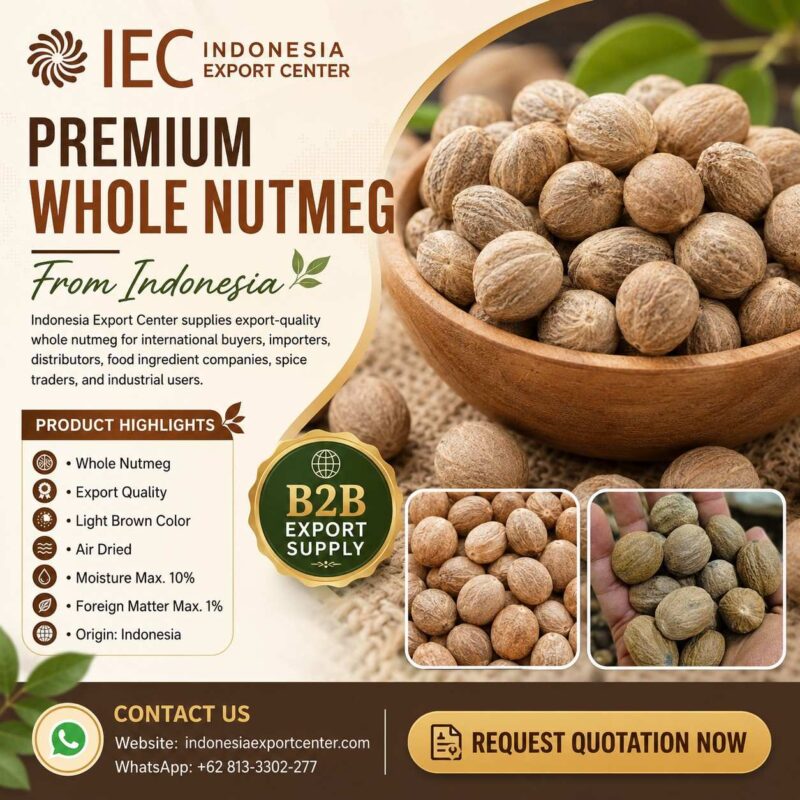
Indonesia Export Center’s referenced product offering includes premium whole nutmeg sourced from Indonesia.
Product Information
| Parameter | Referenced Specification |
|---|---|
| Product Name | Premium Whole Nutmeg |
| Botanical Name | Myristica fragrans Houtt. |
| Country of Origin | Indonesia |
| Product Form | Whole dried nutmeg |
| Drying Method | Air dried |
| Appearance | Light brown |
| Moisture Content | Maximum 10% |
| Foreign Matter | Maximum 1% |
| Commercial Grade | Premium, subject to agreed grading criteria |
| Packaging | Based on supplier availability and buyer requirements |
| Shipment Quantity | Subject to supplier confirmation |
| Quality Documentation | Request available lot-specific COA and test reports |
These are referenced supplier-offering specifications, not independently verified results for a particular shipment.
Important quality distinction: Codex CXS 352-2022 specifies a maximum of 0.5% foreign matter for whole shelled nutmeg, which is stricter than the referenced supplier’s 1% limit.
Importers requiring conformity with the relevant Codex parameter should request the tighter foreign matter limit and appropriate lot-specific verification.
Additional testing may be necessary depending on the destination market.
3. Step-by-Step Guide: How to Import Nutmeg from Indonesia
The following process provides a practical procurement workflow for first-time international nutmeg importers.
Step 1: Identify Your Nutmeg Requirements
Begin by defining exactly what you want to import.
Important requirements include:
- Whole, broken, or ground nutmeg.
- Shelled or in-shell product.
- Intended commercial application.
- Required quality grade.
- Moisture content.
- Foreign matter tolerance.
- Acceptable physical defects.
- Packaging specifications.
- Required laboratory testing.
- Estimated purchase quantity.
Clear specifications help potential suppliers prepare more accurate quotations.
Step 2: Find a Potential Indonesian Nutmeg Supplier
The next step is identifying potential suppliers capable of meeting your procurement requirements.
When evaluating a supplier, consider:
- Registered business identity.
- Role as producer, processor, trader, or exporter.
- Available product specifications.
- Ability to supply the required quantity.
- Quality management practices.
- Export transaction experience.
- Available documentation.
- Payment and delivery conditions.
Indonesia Export Center facilitates communication between international buyers and potential Indonesian suppliers.
Supplier information and commercial capability should be verified before entering into binding transactions.
Step 3: Submit a Request for Quotation (RFQ)
A Request for Quotation is a formal inquiry used to obtain supplier pricing and commercial terms.
Your RFQ should include enough information for suppliers to evaluate the proposed transaction.
Example RFQ for Indonesian Nutmeg
Product: Whole Nutmeg
Origin: Indonesia
Quality Grade: Buyer specification
Quantity: 10 Metric Tons (illustrative only)
Moisture: Maximum 10%
Foreign Matter: Maximum 0.5% if required under the selected Codex specification
Packaging: Food-grade packaging as agreed
Destination Port: Buyer-specified port
Incoterm: FOB or CIF, as appropriate
Required Documents: Commercial invoice, packing list, transport documents, and other applicable certificates
The quantity above is only an RFQ example and does not represent a confirmed IEC minimum order quantity or available stock.
A complete RFQ helps avoid misunderstandings about pricing, quality, logistics, and supplier obligations.
Step 4: Request a Nutmeg Sample
Before placing a commercial order, consider requesting a representative product sample.
A sample can help buyers evaluate the nutmeg’s appearance, aroma, physical quality, and suitability for the intended application.
Recommended Sample Evaluation
Visual Appearance
Inspect general color, cleanliness, visible defects, and consistency.
Physical Integrity
Assess the proportion of whole, broken, or damaged nutmeg.
Aroma
Evaluate whether the product has a characteristic nutmeg aroma and is free from unusual odors.
Moisture
Request analytical verification where required.
Foreign Matter
Check the presence of unwanted material against the agreed specification.
Laboratory Analysis
Request additional testing according to food safety and purchasing requirements.
Sample availability, charges, courier arrangements, and laboratory testing costs must be confirmed with the supplier.
A sample from one batch does not automatically guarantee that subsequent shipments will have identical characteristics.
Step 5: Verify Product Quality and Specifications
Quality verification should be completed according to the intended use and applicable destination requirements.
International nutmeg buyers may request testing for:
- Moisture content.
- Foreign matter.
- Physical defects.
- Visible mold.
- Insect infestation.
- Volatile oil content.
- Aflatoxins.
- Relevant pesticide residues.
- Additional contaminants or microbiological parameters.
The required testing scope may vary according to the importing country and the buyer’s food safety program.
Buyers should agree on the analytical methods, sampling procedures, laboratories, and acceptance criteria before shipment.
Step 6: Confirm Pricing and Payment Terms
Once the product specifications and quantity are agreed, the parties can discuss pricing and payment conditions.
Important commercial details include:
- Product unit price.
- Total contract value.
- Currency.
- Quantity tolerance.
- Packaging cost.
- Inspection and testing expenses.
- Incoterm and named location.
- Payment method.
- Shipment period.
- Quotation validity.
International payment methods may include bank transfers or documentary letters of credit, depending on agreement between the buyer and seller.
The appropriate payment mechanism should be selected after reviewing commercial risks and obtaining relevant banking advice.
Step 7: Arrange Export Packaging and Shipping
Packaging should protect nutmeg during storage, handling, and international transportation.
Buyers should confirm:
- Packaging type and material.
- Net weight per package.
- Moisture protection.
- Batch identification.
- Labeling requirements.
- Palletization, if applicable.
- Container loading arrangements.
- Intended shipping route.
Shipping may be arranged by the buyer or seller depending on the agreed contractual terms.
Step 8: Review Export and Import Documents
Before shipment, confirm which commercial, customs, plant health, and quality documents are required.
The specific requirements depend on the product, destination country, applicable regulations, and contract.
Step 9: Complete Customs Clearance
Customs clearance involves compliance with the relevant export and import procedures.
The Indonesian exporting party or its authorized representative generally manages the Indonesian export declaration and related clearance under commonly used export-cleared delivery terms.
The importer or its appointed customs representative typically manages destination-country import clearance, subject to the contractual arrangements and applicable rules.
The exact responsibilities should be confirmed in the sales contract.
Step 10: Receive and Inspect the Shipment
After the shipment reaches the destination, the importer should arrange appropriate cargo receipt and inspection.
Depending on the agreed procedure, this may include:
- Checking package quantities.
- Inspecting cargo condition.
- Reviewing shipping documents.
- Verifying seal numbers where relevant.
- Recording visible damage.
- Conducting agreed quality testing.
- Reporting discrepancies within contractual deadlines.
A clear inspection and claims procedure helps buyers manage potential disputes.
4. Nutmeg Import Documents: Essential Buyer Checklist
International nutmeg transactions require appropriate documentation to support shipping, customs, quality assurance, and traceability.
The following documents may be relevant.
| Document | Purpose |
|---|---|
| Commercial Invoice | Declares the goods, transaction value, and parties |
| Packing List | Identifies package details, weights, and quantities |
| Bill of Lading | Sea freight transport documentation |
| Air Waybill | Air cargo transport documentation, if applicable |
| Certificate of Origin | Supports origin declarations when applicable |
| Phytosanitary Certificate | Demonstrates compliance with specified plant health requirements when required |
| Certificate of Analysis | Records laboratory test results for identified product samples or lots |
| Inspection Certificate | Documents inspection findings when agreed |
| Insurance Certificate | Provides relevant insurance evidence when applicable |
| Export Declaration | Supports Indonesian export customs procedures |
| Import Permit or Registration | Required only where applicable in the destination market |
Not every document is mandatory for every shipment.
For example, a phytosanitary certificate is determined by the destination country’s applicable plant health requirements. Buyers should confirm requirements before arranging export certification.
An importer should also verify the appropriate tariff classification and any destination-specific food safety, labeling, or regulatory requirements.
5. Import Nutmeg from Indonesia: FOB vs CIF Shipping
International nutmeg purchases frequently involve negotiated shipping terms.
Understanding Incoterms helps buyers compare quotations and identify responsibilities.
FOB – Free On Board
Under FOB Incoterms 2020:
- The seller delivers goods on board the nominated vessel at the named shipment port.
- The seller handles export clearance.
- The buyer arranges and pays for the main international freight.
- Risk transfers when the goods are on board the vessel.
FOB is intended for sea and inland waterway shipments.
For containerized cargo delivered to a carrier at a terminal before vessel loading, FCA may be more suitable.
CIF – Cost, Insurance and Freight
Under CIF Incoterms 2020:
- The seller arranges and pays for freight to the named destination port.
- The seller obtains the insurance cover required under CIF.
- Risk generally transfers when the goods are on board the vessel at the port of shipment.
- The buyer typically manages destination import clearance.
CIF does not mean the seller bears every cost or risk until delivery at the buyer’s warehouse.
FOB vs CIF Comparison
| Item | FOB | CIF |
|---|---|---|
| Seller Handles Export Clearance | Yes | Yes |
| Seller Arranges Main Freight | No | Yes |
| Seller Provides Required Cargo Insurance | Not required by FOB | Yes |
| Risk Transfer | On board at origin port | On board at origin port |
| Buyer Handles Import Clearance | Generally yes | Generally yes |
The named ports and reference to Incoterms 2020 should be included clearly in the contract.
6. Nutmeg Quality Control Before Export
Quality control is particularly important when importing spices for food use.
Dried nutmeg may be subject to physical contamination, pest infestation, moisture-related quality problems, and certain food safety hazards.
Importers should consider a risk-based inspection program that addresses the relevant hazards for their market.
Pre-Shipment Quality Control Activities
1. Product Identification
Confirm the nutmeg type, lot identification, and supplier information.
2. Representative Sampling
Use an agreed sampling approach to assess the shipment lot.
3. Moisture Testing
Verify compliance with the contractual moisture limit.
4. Visual Inspection
Check physical condition, visible defects, insect activity, and foreign material.
5. Contamination Testing
Arrange relevant food safety testing where required, including mycotoxin or pesticide residue analysis.
6. Packaging Inspection
Confirm the packaging is suitable, correctly labeled, and appropriately sealed.
7. Documentation Review
Compare test reports and product identification against the commercial shipment documents.
8. Pre-Shipment Release
Apply the agreed acceptance procedure before releasing goods for shipment.
When appropriate, an independent inspection company or accredited laboratory may be appointed.
Testing requirements and costs should be established before the transaction.
7. Understanding Indonesian Nutmeg Import Regulations
Import requirements vary according to the destination country, product form, intended use, and prevailing regulations.
Before ordering nutmeg, first-time importers should verify the applicable rules with official government authorities or qualified customs and regulatory professionals.
Product Classification
Determine the correct HS tariff classification for the exact product.
For nutmeg, the international HS heading is generally within 0908, while the specific subheading and national tariff code depend on product characteristics and the importing country.
Food Safety Requirements
Confirm the relevant contaminant limits, pesticide residue requirements, hygiene rules, and food product controls.
Plant Health Requirements
Verify whether an import permit, phytosanitary certificate, treatment, or other plant health measure is required.
Importer Registration
Confirm whether your business requires an import license, food business registration, tax identification, or other approval.
Labeling and Traceability
Check product identification, country-of-origin marking, lot identification, language requirements, and any specific labeling regulations.
Customs and Duties
Verify the applicable import duties, taxes, customs valuation requirements, and potential preferential tariff arrangements.
Regulatory approval in one destination country does not automatically establish eligibility for another.
8. How Much Does It Cost to Import Nutmeg from Indonesia?
The total cost of importing Indonesian nutmeg depends on the supplier offer, shipment quantity, product quality requirements, and logistics arrangements.
Important cost components may include:
- Nutmeg purchase price.
- Processing and grading costs.
- Export packaging.
- Laboratory testing.
- Third-party inspection.
- Export documentation.
- Inland transportation.
- International freight.
- Cargo insurance.
- Import duties and taxes.
- Customs clearance.
- Destination terminal charges.
- Local delivery.
Calculate Your Estimated Landed Cost
For preliminary procurement planning, buyers can assess:
Estimated Landed Cost = Product Cost + Relevant Freight + Insurance + Import Duties and Taxes + Clearance and Destination Costs + Other Applicable Expenses
Avoid double-counting costs already included in the quoted Incoterm.
The final landed cost depends on the detailed contract, customs assessment, and actual charges.
Because commodity and freight prices can change, IEC recommends requesting a current quotation.
Request FOB or CIF Nutmeg Pricing
WhatsApp: https://wa.me/628133302277
9. How to Reduce Risks When Importing Nutmeg
First-time importers should adopt practical risk management procedures before committing funds.
Verify Supplier Identity
Check the legal business identity and transaction counterparties.
Confirm Specifications in Writing
Ensure moisture, foreign matter, grading, testing, and defect requirements are documented.
Request Samples and Inspection
Use sampling and independent inspection where commercially justified.
Agree on Payment Conditions
Use payment arrangements appropriate to the supplier relationship, transaction value, and commercial risk.
Verify Import Requirements Early
Do not assume that a nutmeg shipment accepted in one market will satisfy another country’s requirements.
Review Insurance and Shipping Arrangements
Confirm insurance coverage, transport responsibilities, and relevant exclusions.
Establish Dispute Procedures
Include written provisions covering nonconforming goods, claims, inspection findings, and dispute resolution.
These steps can help reduce commercial and operational risks, although they cannot eliminate them completely.
10. Why Work with Indonesia Export Center?
Indonesia Export Center helps connect international buyers with potential suppliers in Indonesia.
Our role is to facilitate sourcing communication and help buyers clarify their purchasing requirements.
Supplier Sourcing Assistance
We support international buyers seeking potential Indonesian nutmeg supply opportunities.
Product Specification Coordination
We help communicate grading, moisture, packaging, and other technical requirements.
RFQ Facilitation
We coordinate commercial inquiries based on buyer-specified quantities, destinations, and shipping terms.
Sample and Documentation Requests
We assist in requesting available supplier samples, quality documentation, and relevant commercial information.
Export Sourcing Communication
We facilitate discussions concerning shipping arrangements, documentary requirements, and transaction details.
IEC operates as a sourcing intermediary. The producer, seller, exporter, and other responsible parties are identified according to each transaction. Supplier availability, product quality, pricing, and export obligations require confirmation.
11. Frequently Asked Questions About Importing Nutmeg from Indonesia
How can I import nutmeg from Indonesia?
Start by defining your product specifications, verifying potential suppliers, requesting an RFQ, evaluating samples and quality documents, confirming destination import requirements, and arranging shipping and customs clearance.
Can I import Indonesian nutmeg in bulk?
Buyers can submit bulk purchasing inquiries. Available quantity, minimum order size, pricing, and shipment arrangements depend on the selected supplier.
What documents are required to import nutmeg?
Common documents include a commercial invoice, packing list, transport document, and applicable customs records. Depending on the market, additional origin, phytosanitary, testing, or import authorization documents may be required.
Do I need a phytosanitary certificate to import nutmeg?
The requirement depends on the importing country’s phytosanitary rules, product form, and relevant risk classification. Confirm the requirement with the destination country’s plant protection authority before shipment.
What moisture content should imported whole nutmeg have?
The referenced IEC offering states a maximum of 10% moisture for whole dried nutmeg. The Codex standard also specifies 10% maximum for whole shelled nutmeg. Actual lot compliance should be confirmed through appropriate testing.
Can I request nutmeg samples before placing an order?
Yes, buyers may request samples through the supplier sourcing process. Sample availability, costs, and delivery arrangements are subject to confirmation.
Can I get a Certificate of Analysis?
Buyers may request available lot-specific COAs or arrange additional testing. The availability of particular laboratory results must be confirmed for the relevant shipment.
Does Indonesia Export Center ship directly to international buyers?
IEC facilitates sourcing relationships and related commercial communication. The actual seller, exporter, and logistics responsibilities depend on the confirmed transaction structure.
Can I request FOB or CIF pricing?
Yes, buyers may request supplier quotations using FOB or CIF terms, where appropriate for the shipment. Include the named port and relevant delivery requirements.
What is the minimum order quantity?
There is no universal minimum order quantity for Indonesian nutmeg. MOQ depends on the supplier, product grade, packaging, and commercial arrangements.
How long does shipping take?
Shipping time varies by port of origin, destination, carrier schedule, transport method, customs procedures, and other operational conditions. Buyers should request a shipment-specific estimate.
Is Indonesian nutmeg suitable for food manufacturing?
Indonesian nutmeg can be sourced for food manufacturing, provided the selected product meets the buyer’s specifications and the applicable food safety and import requirements.
12. Request a Quotation to Import Nutmeg from Indonesia
Are you ready to explore Indonesian nutmeg sourcing opportunities?
Indonesia Export Center welcomes inquiries from international importers, spice distributors, food manufacturers, procurement companies, and commercial traders.
Indonesian Nutmeg RFQ Information
Please provide the following details:
- Company Name: Your registered business name.
- Country: Your import destination.
- Product: Whole, broken, or ground nutmeg.
- Quantity: Required kilograms or metric tons.
- Quality Specifications: Moisture, foreign matter, grading, and other requirements.
- Packaging: Preferred packaging type and weight.
- Destination Port: Your intended import port.
- Preferred Incoterm: FOB, CIF, FCA, or another agreed term.
- Required Documents: Quality, customs, origin, or phytosanitary documentation.
- Expected Shipment Schedule: Preferred delivery period.
Our team can help coordinate the inquiry with potential Indonesian suppliers.
Contact Indonesia Export Center
Website: https://indonesiaexportcenter.com/
WhatsApp: +62 813-3302-277
Request Indonesian Nutmeg Specifications, Samples and Export Quotations
Indonesia Export Center – Connecting Global Importers with Indonesian Supply Opportunities.
Disclaimer: Product availability, specifications, pricing, testing, export documentation, shipping schedules, and regulatory eligibility are subject to verification and agreement between the relevant parties. Importers remain responsible for confirming applicable destination requirements.
