

INDONESIA EXPORT CENTER
Authentic Indonesian Seafood | International Sourcing Assistance
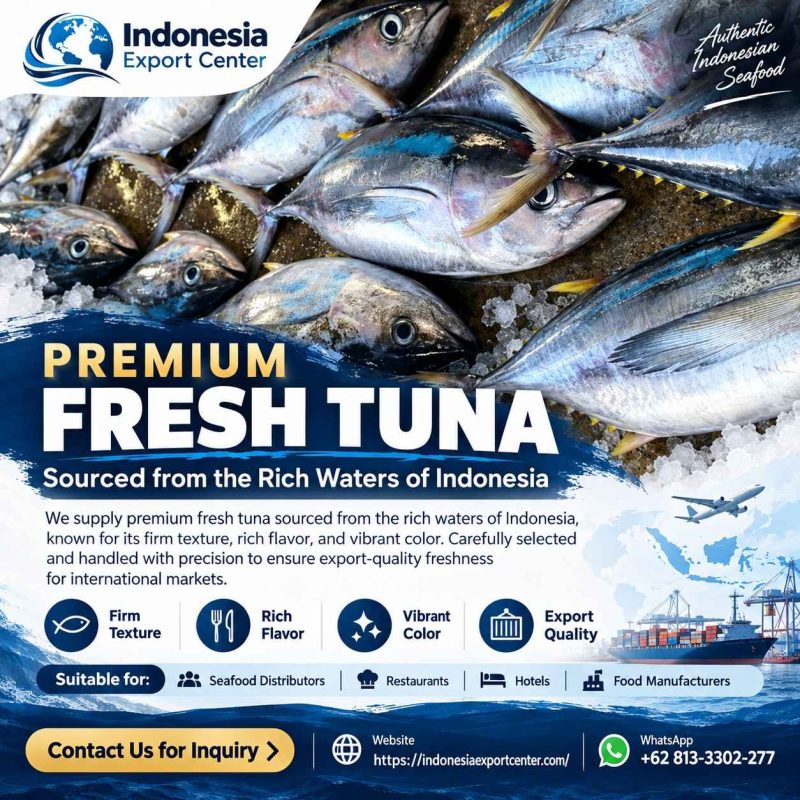
IMPORT FRESH TUNA FROM INDONESIA
A Practical Guide for First-Time Seafood Importers
How to Import Fresh Tuna from Indonesia
Importing fresh tuna from Indonesia requires careful coordination between the buyer, Indonesian supplier, contractual exporter, freight forwarder, customs broker, and relevant food safety authorities.
Unlike shelf-stable products, fresh tuna is highly perishable and requires suitable time-temperature controls throughout the supply chain.
Indonesia Export Center (IEC) helps international buyers communicate with potential Indonesian tuna suppliers and coordinate initial sourcing inquiries.
This guide explains the main steps involved in importing fresh yellowfin tuna, including supplier selection, import licensing, product specifications, documentation, air freight planning, and receiving procedures.
1. Understand the Fresh Tuna Products Available for Inquiry
| Specification | Description |
|---|---|
| Product | Fresh Yellowfin Tuna |
| Scientific Name | Thunnus albacares |
| Origin | Indonesia, subject to lot verification |
| Product Forms | Whole / Loin |
| Condition | Fresh / Chilled |
| Grade | Buyer-defined |
| Size | Buyer-specified |
| Packaging | Supplier-confirmed |
| Quantity | Subject to availability |
| Shipping | Validated chilled transport |
Actual product availability must be confirmed before ordering.
2. Check Import Licensing Requirements
Before purchasing fresh tuna, buyers should determine whether their country requires:
- Food importer registration
- Seafood import permits
- Veterinary or sanitary approvals
- Customs registration
- Food business licensing
- Product notifications
- Approved establishment registration
Requirements vary by destination country and intended use.
An importer should consult the competent authority or a qualified customs broker before placing an order.
3. Verify Product Import Eligibility
Fresh tuna import eligibility may depend on:
- Species
- Country of origin
- Processing establishment
- Exporting establishment
- Fishing documentation
- Intended use
- Applicable trade restrictions
A supplier’s ability to export to one country does not automatically establish eligibility for another.
4. Identify the Indonesian Supplier and Exporter
The supplier, processor, contractual seller, and exporter of record may be different businesses.
Buyers should verify:
- Legal company name
- Business registration
- Processing facility identity
- Applicable approvals
- Export capability
- Product traceability
- Commercial references where available
IEC can facilitate communication and document requests.
5. Define Your Product Specifications
A complete product specification should include:
- Species and scientific name
- Whole fish or loin
- Grade
- Size range
- Skin and trimming requirements
- Quantity
- Packaging
- Temperature requirements
- Quality acceptance criteria
Avoid relying solely on descriptions such as premium or export quality.
6. Request a Commercial Quotation
A seller-issued quotation should identify:
- Product description
- Quantity
- Unit price
- Currency
- Packaging
- Delivery term
- Named delivery point
- Payment terms
- Shipment window
- Quotation validity
For air freight, consider appropriate Incoterms such as FCA, CPT, CIP, or DAP.
FOB, CFR, and CIF are intended for sea and inland waterway transport, not air cargo.
7. Review Quality and Food Safety Documentation
Buyers may request:
- Product specification
- Traceability records
- Processing facility information
- Applicable health certificates
- HACCP-related documentation
- Temperature-control records
- Relevant laboratory results
Fresh tuna requires particular attention to histamine prevention.
8. Confirm Air Freight Arrangements
Important shipping details include:
- Departure airport
- Destination airport
- Flight routing
- Cargo cutoff time
- Packaging requirements
- Airline acceptance
- Temperature monitoring
- Customs clearance
- Final delivery
Flight schedules must be confirmed by the relevant logistics provider.
9. Prepare Import Documents
Depending on the destination, documents may include:
- Commercial invoice
- Packing list
- Air Waybill
- Health certificate
- Catch documentation
- Certificate of origin
- Customs declaration
- Import permit
The exact requirements must be verified for the destination market.
10. Understand the Import Timeline
A typical procurement process involves several stages.
| Stage | Main Activity |
|---|---|
| Buyer Preparation | Licensing and product specifications |
| Supplier Selection | Supplier and exporter verification |
| Commercial Negotiation | Price and contract agreement |
| Product Preparation | Processing and packing |
| Shipment | Cargo booking and transport |
| Import Clearance | Customs and sanitary checks |
| Receiving | Product inspection and acceptance |
There is no universal timeline. Duration depends on product availability, documentation, logistics
