

INDONESIA EXPORT CENTER
Indonesian Coal RFQ | Thermal Coal Procurement | Supplier Verification | International Bulk Trading
Requesting a Coal Quotation from Indonesia
A complete Request for Quotation (RFQ) is one of the most important steps in international coal procurement.
Buyers seeking Indonesian thermal coal should provide clear technical specifications, required quantity, destination details, delivery terms, shipment schedule, and proposed payment conditions.
Incomplete inquiries can create confusion about product suitability, pricing, freight responsibilities, and supplier capability.
Indonesia Export Center (IEC) facilitates preliminary sourcing inquiries between qualified international buyers and potential Indonesian coal suppliers.
IEC does not automatically act as the principal seller, coal producer, or exporter of record.
What Is a Coal RFQ?
A coal RFQ is a structured commercial inquiry requesting a potential supplier to provide information about a defined coal product and transaction.
A well-prepared RFQ helps suppliers understand the buyer’s requirements and determine whether they can offer a suitable product.
It also allows buyers to compare different proposals using consistent criteria.
Step 1: Identify the Required Coal Type
Before requesting a quotation, specify the intended application.
Examples include:
- Thermal coal for power generation.
- Industrial steam coal.
- Coal for cement production.
- Coal for blending.
- Coal for captive power plants.
- Other technically defined applications.
Coking coal, PCI coal, and thermal coal should not be treated as interchangeable.
Step 2: Specify the Calorific Value
State the required heating value and analytical basis.
For example:
Required GAR: [Buyer-Defined Value] kcal/kg
If the buyer requires NAR, state it explicitly.
Do not compare different heating-value bases as though they were equivalent.
Step 3: Define the Complete Quality Specification
| Parameter | RFQ Information |
|---|---|
| Coal Type | Required product |
| GAR | Required kcal/kg |
| NAR | If applicable |
| Total Moisture | Maximum percentage |
| Inherent Moisture | If required |
| Ash | Maximum percentage |
| Total Sulfur | Maximum percentage |
| Volatile Matter | Required range |
| HGI | If applicable |
| Particle Size | Required distribution |
| Ash Fusion | If applicable |
| Additional Tests | Buyer-defined |
The buyer should identify which parameters are mandatory and which allow negotiated tolerances.
Step 4: State the Quantity
Specify whether the inquiry concerns:
- Trial cargo.
- One-time shipment.
- Monthly supply.
- Quarterly procurement.
- Annual contract.
Include the required metric tonnage and any acceptable quantity tolerance.
Step 5: Identify the Loading and Destination Ports
Provide the destination port and, where relevant, the preferred Indonesian loading location.
If the loading port is flexible, indicate that the seller may propose a suitable location.
Port selection affects freight, vessel compatibility, and commercial feasibility.
Step 6: Select the Preferred Incoterm
Common requests include:
FOB
The buyer generally arranges the main ocean freight.
CFR
The seller arranges and pays for the main carriage to the named destination port.
CIF
The seller arranges the main carriage and required insurance.
Always specify the named port and applicable Incoterms edition.
Step 7: Provide the Shipment Schedule
Include the preferred shipment month, loading window, or recurring delivery requirements.
The supplier must confirm whether the requested schedule is feasible.
Step 8: Propose Payment Terms
The buyer may propose a letter of credit or another suitable payment arrangement.
The actual seller and financial institutions must review and accept the terms.
Payment proposals should identify relevant banking conditions and documentary requirements.
Step 9: Request Supplier Documentation
Before proceeding, request evidence of:
- Legal company identity.
- Authority to sell.
- Legitimate coal source.
- Export eligibility.
- Relevant COA.
- Cargo availability.
- Loading capability.
- Authorized commercial representative.
- Contracting bank details.
- Applicable supporting documents.
Step 10: Review the COA
A Certificate of Analysis should identify the laboratory, sample, testing methods, analytical basis, and results.
Check whether the COA corresponds to the actual proposed source or cargo.
An unrelated historical report is not sufficient evidence of current stock quality.
Step 11: Request a Seller-Issued Commercial Offer
Where the potential supplier can meet the inquiry, the actual seller or authorized representative may issue a commercial offer.
The offer should clearly identify:
- Seller identity.
- Coal specification.
- Quantity.
- Price basis.
- Named port.
- Shipment schedule.
- Payment conditions.
- Inspection terms.
- Offer validity.
- Applicable contractual conditions.
IEC does not guarantee that every RFQ will result in an offer.
Step 12: Compare Coal Quotations
Buyers should evaluate offers using consistent criteria.
| Evaluation Area | Questions to Ask |
|---|---|
| Product Quality | Does the COA meet the RFQ? |
| Supplier Identity | Is the seller verified? |
| Cargo Availability | Is current stock supported by evidence? |
| Price | Is the pricing basis clear? |
| Incoterm | Are responsibilities defined? |
| Shipment | Is the proposed schedule feasible? |
| Inspection | Are methods and surveyors agreed? |
| Payment | Are banking terms acceptable? |
| Documentation | Can the seller provide required records? |
Step 13: Conduct Commercial Due Diligence
Before making a payment or entering into a binding agreement, verify the contracting entity, beneficiary bank details, commercial authority, and applicable compliance requirements.
Independent legal, technical, financial, or inspection advice may be appropriate.
Step 14: Finalize the Sales Contract
A coal sales contract should define the product, quantity, quality tolerances, delivery terms, shipment period, payment arrangements, inspection procedures, and remedies for nonperformance.
The contract should also address applicable law and dispute resolution.
Complete Indonesian Coal RFQ Template
Subject: Formal RFQ – Indonesian Thermal Coal
Dear Indonesia Export Center Team,
We would like to submit a formal inquiry for Indonesian thermal coal sourcing.
BUYER INFORMATION
Company Name: [Company] Country: [Country] Business Activity: [Utility / Industrial / Trader] Contact Person: [Name] Email: [Email] WhatsApp: [Number]
PRODUCT REQUIREMENTS
Coal Type: [Thermal / Industrial]
Intended Application: [Application]
GAR: [Value] kcal/kg
NAR: [If Required]
Total Moisture Maximum: [Value]%
Inherent Moisture: [Value]%
Ash Maximum: [Value]%
Total Sulfur Maximum: [Value]%
Volatile Matter: [Range]%
HGI: [Range]
Particle Size: [Requirement]
Additional Parameters: [Details]
COMMERCIAL REQUIREMENTS
Trial Quantity: [MT] Monthly Quantity: [MT] Annual Quantity: [MT] Preferred Origin: [Region / Flexible] Preferred Loading Port: [Port / Flexible] Destination Port: [Port] Incoterm: [FOB / CFR / CIF] Expected Shipment: [Period] Payment Proposal: [Method] Inspection Requirements: [Details]
DOCUMENTATION REQUEST
Please advise whether potential suppliers can provide:
- Verified company information.
- Legitimate coal source documentation.
- Relevant COA.
- Export eligibility evidence.
- Cargo availability confirmation.
- Loading and shipment information.
- Seller-issued commercial offer.
We look forward to receiving information on potential sourcing options.
Best regards,
[Name] [Company]What Happens After an RFQ Is Submitted?
The preliminary process may involve:
- Review of buyer requirements.
- Clarification of technical specifications.
- Potential supplier identification.
- Supplier documentation requests.
- Availability checks.
- Commercial feasibility review.
- Introduction to an appropriate contracting party.
- Further negotiations between the responsible parties.
The actual process depends on supplier availability, buyer eligibility, and commercial circumstances.
Frequently Asked Questions
Can buyers request a quotation without an LOI?
A preliminary inquiry can be submitted, although individual suppliers may require additional documentation.
Does IEC guarantee an FCO?
No. Any formal offer depends on the actual seller.
Can buyers request FOB and CIF pricing together?
Yes, subject to supplier and shipping capability.
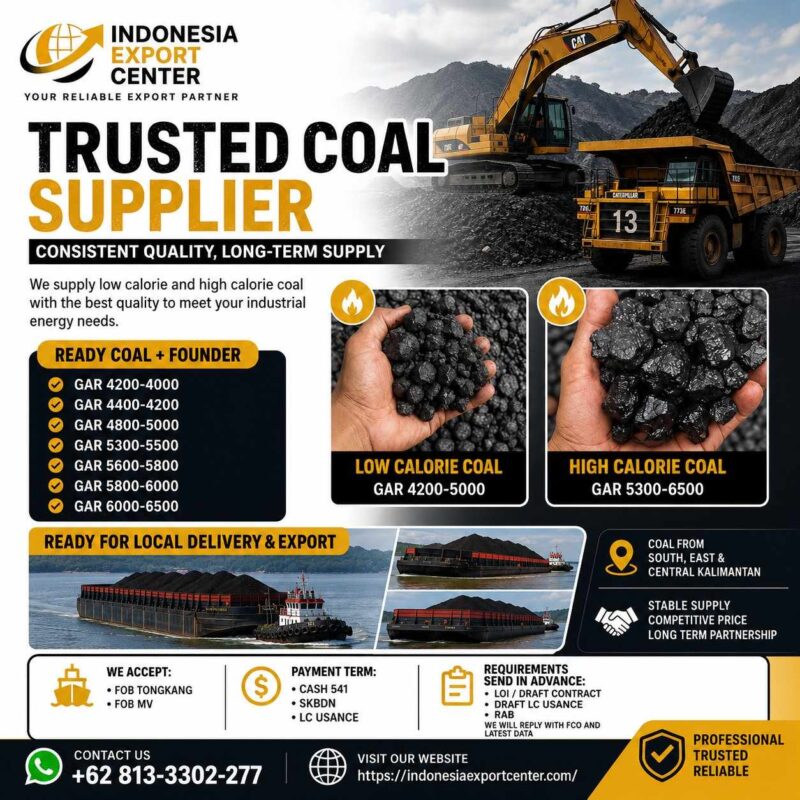
Does IEC guarantee the advertised GAR ranges?
No. Each grade requires relevant laboratory verification.
Can buyers request monthly coal contracts?
Yes, subject to confirmed supplier capacity and commercial agreement.
Can buyers request SKBDN or LC usance?
They may propose suitable payment instruments, subject to the transaction structure, seller acceptance, and banking requirements.
Does IEC charge sourcing fees?
Any applicable fees, responsibilities, and payment arrangements should be disclosed and agreed in writing before a sourcing engagement.
Is submitting an RFQ a purchase commitment?
A preliminary RFQ is generally an inquiry rather than a completed purchase contract, but buyers should review the wording of any document they sign.
Send Your Formal Indonesian Coal RFQ
Provide your technical requirements, destination, volume, shipment schedule, and proposed commercial terms.
SUBMIT INDONESIAN COAL RFQ VIA WHATSAPP
INDONESIA EXPORT CENTER
Connecting Indonesian Products to Global Markets
Website: https://indonesiaexportcenter.com/
WhatsApp: +62 813-3302-277
Related Resources
Indonesian Coal Supplier Verification
