

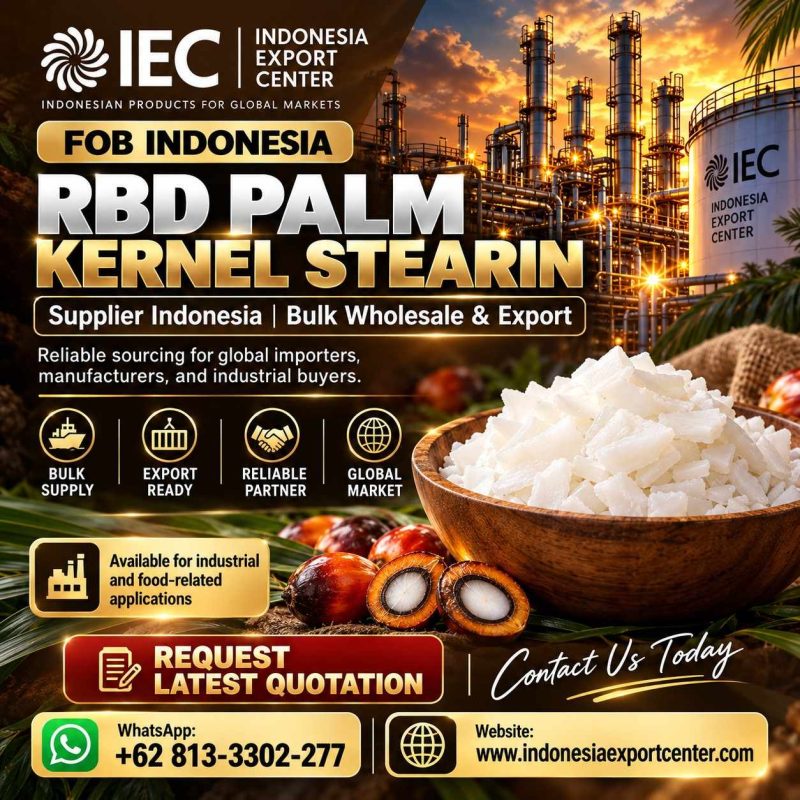
Importing Indonesian RBD Palm Kernel Stearin for Industrial Manufacturing
Indonesia offers sourcing opportunities for international buyers of palm kernel-derived oils and fats, including RBD Palm Kernel Stearin.
However, importing an industrial fat requires more than identifying a potential supplier.
Buyers must verify product identity, technical specifications, supplier credentials, shipping arrangements, customs classification, and destination-country requirements.
Indonesia Export Center (IEC) supports international buyers seeking RBD Palm Kernel Stearin import sourcing assistance from Indonesia.
This guide explains the main stages of an international purchasing transaction and provides practical checklists for first-time importers.
Step 1: Understand the Product
RBD Palm Kernel Stearin is the higher-melting fraction of refined palm kernel oil.
It differs from conventional palm stearin and from whole palm kernel oil.
Potential applications include selected specialty fat manufacturing, confectionery fat systems, and industrial processing.
The buyer should establish the exact product required before contacting suppliers.
Step 2: Define the Intended Application
The intended application influences technical requirements.
A manufacturer producing specialty fats may need detailed melting and crystallization data.
A soap manufacturer may focus on fatty acid composition and process suitability.
A food ingredient distributor may need additional food safety and regulatory documentation.
The RFQ should identify the intended use clearly.
Step 3: Prepare a Technical Specification
A suitable purchasing specification may include FFA, iodine value, slip melting point, fatty acid composition, moisture and impurities, color, and solid fat content.
The required numerical limits should be determined by the buyer’s technical team.
If the buyer does not have a specification, request the supplier’s available TDS for evaluation.
Step 4: Verify the Supplier
Supplier due diligence is essential.
Buyers should confirm the supplier’s legal identity, commercial role, product capability, and relevant documentation.
Determine whether the company is a manufacturer, distributor, trader, or exporter.
The entity receiving payment should be identified and verified independently.
Step 5: Request a Commercial Quotation
A complete quotation should state the product grade, quantity, price, currency, packaging, delivery terms, payment conditions, and offer validity.
Buyers should avoid accepting vague offers that do not identify the actual product or delivery basis.
Step 6: Confirm MOQ and Lead Time
Minimum order quantity and production or dispatch lead time vary by supplier.
Buyers should ask whether the product is available from inventory or requires production scheduling.
The quoted lead time should distinguish product readiness from shipping transit.
Step 7: Review Packaging and Handling
Palm kernel stearin is a higher-melting fat fraction.
Packaging and transport should be compatible with its physical properties.
Discuss drums, cartons, or other industrial packaging only as supplier-confirmed options.
Where temperature management is required, obtain suitable handling instructions.
Step 8: Select the Delivery Terms
Common maritime trade discussions may involve FOB or CIF.
Under FOB, the buyer generally arranges the main ocean carriage.
Under CIF, the seller arranges and pays for carriage and the required insurance to the named destination port, while risk transfers at shipment under the rule.
The actual Incoterms version and named port should appear in the contract.
For some containerized or multimodal arrangements, other rules may be more appropriate.
Step 9: Verify Import Regulations
The importing company is responsible for understanding destination-country requirements.
These may include customs classification, duties, taxes, permits, food safety rules, labeling, and product-specific restrictions.
Requirements vary by country and may change.
Buyers should consult their customs broker or relevant authorities before committing to shipment.
Step 10: Review Export Documents
| Document | Main Purpose |
|---|---|
| Commercial Invoice | Commercial transaction |
| Packing List | Cargo packaging and quantities |
| Bill of Lading | Ocean transport documentation |
| Certificate of Origin | Origin documentation where applicable |
| Certificate of Analysis | Analytical quality results |
| Inspection Certificate | Agreed inspection findings |
| Insurance Document | Relevant insurance arrangements |
| Other Regulatory Documents | Destination-specific requirements |
Not every document is mandatory in every transaction.
Step 11: Arrange Quality Inspection
Buyers may request pre-shipment inspection or independent laboratory testing.
The contract should define the sampling method, analytical procedures, inspection costs, and treatment of non-conforming cargo.
Retained samples may support later quality investigations.
Step 12: Finalize the Purchase Contract
The contract should identify:
- Correct product name and grade.
- Quantity and tolerance.
- Price and currency.
- Delivery terms.
- Shipment schedule.
- Packaging.
- Quality requirements.
- Inspection arrangements.
- Payment terms.
- Required documents.
- Claims and dispute procedures.
Qualified legal and trade advisers should review important transactions.
Step 13: Coordinate Shipment
The seller, buyer, freight provider, and other relevant parties coordinate their responsibilities according to the contract.
Buyers should monitor product readiness, documentation, freight booking, and expected arrival.
Estimated dates are not automatically guaranteed.
Step 14: Complete Import Clearance
The importer or appointed customs representative handles the destination-country clearance process.
Documentation must match the actual cargo and applicable customs requirements.
Incorrect product classification or inconsistent documents may create delays.
Step 15: Inspect the Cargo on Arrival
The buyer should verify quantity, packaging condition, and relevant quality requirements according to the contract.
Any discrepancies should be documented promptly.
Claims must follow the agreed procedures and deadlines.
Import Cost Planning
A complete import budget may include product value, freight, insurance, destination port charges, customs duties, taxes, inland transport, storage, inspection, and banking expenses.
The importer should calculate the total landed cost rather than relying solely on the FOB price.
Common Importing Mistakes
Common problems include confusing palm kernel stearin with palm stearin, failing to verify the supplier, overlooking packaging requirements, relying on outdated prices, and neglecting destination-country regulations.
A structured procurement process can reduce these risks.
Frequently Asked Questions
Can international buyers import RBD Palm Kernel Stearin from Indonesia?
Potentially, subject to supplier availability and applicable export and import requirements.
What is the minimum order quantity?
MOQ depends on the supplier and transaction.
Is FOB Indonesia available?
FOB quotations can be requested, subject to confirmation.
What documents are required?
Requirements vary by destination and contract.
Can I request independent inspection?
Yes. Inspection arrangements can be negotiated.
Does IEC handle customs clearance in my country?
IEC acts as a sourcing intermediary. Destination clearance arrangements must be confirmed separately.
Can I request recurring shipments?
Yes. Include your expected monthly or quarterly volume in the RFQ.
Start Your Indonesian Palm Kernel Stearin Import Inquiry
Company Name:
Destination Country:
Product Grade:
Intended Application:
Technical Specifications:
Initial Quantity (MT):
Monthly Requirement (MT):
Packaging:
Destination Port:
Preferred Incoterms:
Target Shipment Date:
Required Documents:
Indonesia Export Center (IEC)
Website: https://indonesiaexportcenter.com/
WhatsApp: +62 813-3302-277
Contact IEC to begin sourcing RBD Palm Kernel Stearin from Indonesia and request supplier-confirmed commercial information.
Import rules, customs classification, permits, taxes, and documentation requirements must be verified for the buyer’s destination country.
