

IEC | INDONESIA EXPORT CENTER
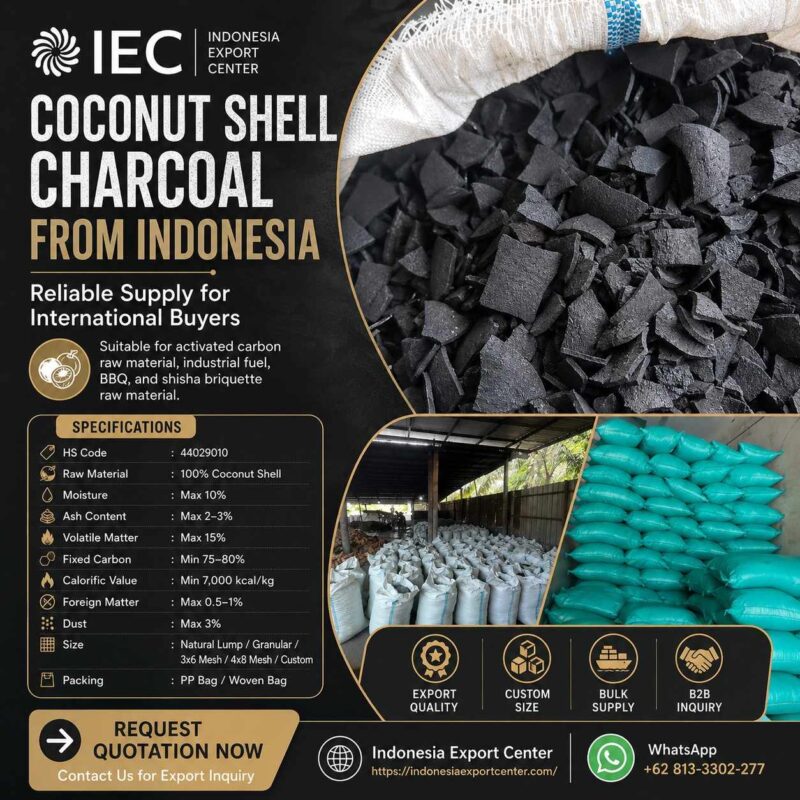
COCONUT SHELL CHARCOAL FROM INDONESIA
Reliable Supply for International Buyers
Looking for high fixed carbon coconut shell charcoal from Indonesia for activated carbon manufacturing, industrial processing, or bulk raw material procurement?
Indonesia Export Center (IEC) facilitates B2B sourcing and export inquiries for Indonesian coconut shell charcoal, including raw charcoal grades that may be evaluated for industrial carbon processing.
For activated carbon manufacturers, fixed carbon is an important technical purchasing parameter. However, a supplier’s fixed carbon claim should be supported by an agreed analytical method, clearly identified sample, defined reporting basis, and relevant laboratory results.
IEC’s supplied raw coconut shell charcoal specifications include a grade-dependent minimum fixed carbon range of 75–80%.
This does not mean that every available lot has been tested at 80% fixed carbon or that a higher fixed carbon grade is automatically available.
Exact fixed carbon requirements, product availability, batch-specific laboratory results, and commercial terms must be confirmed before purchase.
IEC welcomes inquiries from activated carbon factories, industrial carbon processors, commodity traders, and bulk importers in China, India, and other international markets.
Request High Fixed Carbon Coconut Shell Charcoal Quotation:
https://wa.me/628133302277
High Fixed Carbon Coconut Shell Charcoal from Indonesia
Raw coconut shell charcoal is produced by carbonizing coconut shells under controlled conditions.
It may be used as feedstock for further processing, including activated carbon manufacturing, subject to suitability testing.
Industrial Buyer Priorities
- Fixed carbon
- Moisture
- Ash
- Volatile matter
- Particle size
- Foreign matter
- Dust
- Product consistency
- Sampling
- Laboratory documentation
Why Technical Verification Matters
A specification sheet provides a reference for commercial discussions, but buyers should verify whether the offered lot meets their actual acceptance criteria.
What Is Fixed Carbon in Coconut Shell Charcoal?
Fixed carbon is a proximate-analysis parameter representing the combustible solid residue calculated after accounting for moisture, volatile matter, and ash according to the applicable analytical method.
It is not necessarily the same as total elemental carbon.
General Proximate Analysis Relationship
Fixed Carbon (%) = 100 − Moisture (%) − Ash (%) − Volatile Matter (%)
This relationship applies when all components are expressed on a consistent analytical basis.
Important Clarification
Fixed carbon is commonly calculated from proximate analysis rather than measured directly as elemental carbon.
Buyers should request the complete analytical results, not just a standalone fixed carbon number.
Understanding IEC’s Fixed Carbon Specification
IEC’s supplied raw coconut shell charcoal specification states:
Fixed Carbon: Minimum 75–80%
This is a grade-dependent range of minimum limits.
How to Interpret the Range
A grade may have a minimum fixed carbon requirement of 75%.
Another grade may be specified with a minimum of 80%.
The exact minimum must be confirmed for the offered grade and shipment.
What the Range Does Not Mean
It does not automatically establish that:
- Every lot contains at least 80% fixed carbon.
- All grades are interchangeable.
- Laboratory results are available for every batch.
- Higher fixed carbon values are guaranteed.
- The charcoal will produce a specific activated carbon yield.
Why Fixed Carbon Matters for Activated Carbon Manufacturers
Activated carbon producers evaluate raw charcoal as a potential feedstock for further thermal or chemical processing.
Feedstock Characterization
Fixed carbon is one parameter used to describe raw charcoal composition.
Process Evaluation
Proximate analysis can help manufacturers compare potential feedstock grades.
Quality Consistency
Batch-to-batch variation may affect manufacturing decisions.
Purchasing Specifications
A fixed carbon acceptance limit helps define measurable contract requirements.
Important Limitation
Fixed carbon alone does not determine activation yield, pore structure, iodine number, BET surface area, hardness, or finished activated carbon performance.
These require separate processing trials and testing.
High Fixed Carbon vs. Total Carbon
Fixed carbon and total carbon are not interchangeable.
Fixed Carbon
A proximate-analysis value calculated using moisture, ash, and volatile matter.
Total Carbon
An elemental-analysis result measuring carbon content according to a different analytical approach.
Buyer Recommendation
If your process requires both values, specify separate analytical tests and reporting requirements.
Do not compare elemental carbon and fixed carbon percentages as if they were identical.
Fixed Carbon Testing and Proximate Analysis
Proximate analysis typically includes:
- Moisture
- Ash
- Volatile matter
- Fixed carbon calculation
Why Complete Results Matter
A fixed carbon value depends on the other proximate-analysis components and their reporting basis.
Laboratory Report Requirements
Buyers should request:
- Sample identification
- Batch or lot number
- Sampling date
- Test date
- Laboratory identity
- Test methods
- Reporting basis
- Moisture result
- Ash result
- Volatile matter result
- Fixed carbon result
Fixed Carbon Calculation Example
Consider a hypothetical sample with the following values, all expressed on the same as-received basis:
| Parameter | Illustrative Result |
|---|---|
| Moisture | 8% |
| Ash | 2% |
| Volatile Matter | 12% |
| Fixed Carbon | 78% |
Calculation
100 − 8 − 2 − 12 = 78%
This is an illustrative calculation, not a verified IEC laboratory result.
Important Note
The result changes if the analytical basis changes.
Buyers should not compare fixed carbon percentages without checking how they were calculated.
Fixed Carbon Reporting Basis
Laboratories may report charcoal analysis using different bases.
As-Received Basis
Reflects the sample’s condition as received, including its moisture content.
Dry Basis
Excludes moisture from the reporting basis.
Other Analytical Bases
Some reports may use additional conventions depending on the selected method.
Why Basis Matters
The same charcoal can have different reported fixed carbon percentages on different bases.
Buyer Recommendation
Specify the required basis in the purchase agreement and request consistent reporting across suppliers.
Dry-Basis Fixed Carbon Calculation
When moisture and fixed carbon are reported on an as-received basis, a dry-basis conversion may be calculated using compatible values.
General Relationship
Fixed Carbon (Dry Basis) = Fixed Carbon (As Received) ÷ (100 − Moisture %) × 100
Illustrative Example
Suppose:
- Fixed carbon, as received: 78%
- Moisture, as received: 8%
Then:
78 ÷ 92 × 100 = approximately 84.78%
This is a mathematical example only.
It does not represent an IEC product test result.
Important Clarification
The conversion is valid only when the input values and analytical definitions are compatible.
Fixed Carbon vs. Ash Content
Ash is the inorganic residue remaining after a defined laboratory procedure.
Why Ash Matters
Ash may be relevant to feedstock evaluation and downstream processing.
Relationship With Fixed Carbon
Both are components of proximate analysis.
However, lower ash does not independently guarantee higher fixed carbon because moisture and volatile matter also affect the calculation.
Buyer Recommendation
Evaluate the complete proximate analysis rather than relying on a single parameter.
Fixed Carbon vs. Volatile Matter
Volatile matter represents material released under specified test conditions.
Why Volatile Matter Matters
It is an important component of raw charcoal characterization.
Relationship With Fixed Carbon
For a consistent analytical basis, a higher volatile matter result generally leaves less of the total percentage available for fixed carbon when the other components are held constant.
Important Clarification
Volatile matter results depend on the analytical procedure.
Buyers should specify an appropriate method.
Fixed Carbon vs. Moisture
Moisture affects raw charcoal handling, shipping weight, and analytical reporting.
Why Moisture Matters
- Influences as-received composition
- Affects dry-basis calculations
- Contributes to shipping weight
- May affect handling and processing
Buyer Recommendation
Specify both moisture and fixed carbon limits.
Do not rely on fixed carbon alone.
Coconut Shell Charcoal Raw Material Specifications
IEC’s supplied technical specifications for raw coconut shell charcoal are:
| Parameter | Specification |
|---|---|
| HS Code | 44029010 |
| Raw Material | 100% Coconut Shell |
| Moisture | Max 10% |
| Ash Content | Max 2–3% |
| Volatile Matter | Max 15% |
| Fixed Carbon | Min 75–80% |
| Calorific Value | Min 7,000 kcal/kg |
| Foreign Matter | Max 0.5–1% |
| Dust | Max 3% |
| Size | Natural Lump / Granular / 3×6 Mesh / 4×8 Mesh / Custom |
| Packing | PP Bag / Woven Bag |
Specification note: Ash, fixed carbon, and foreign matter values are grade-dependent ranges of limits.
The exact applicable limits must be confirmed for the selected grade.
The supplied HS code should be checked against the relevant customs classification requirements before shipment.
Natural Lump and Granular Charcoal Options
IEC’s supplied raw charcoal size categories include:
- Natural Lump
- Granular
- 3×6 Mesh
- 4×8 Mesh
- Custom Size
Natural Lump Charcoal
May be evaluated by buyers requiring larger raw charcoal pieces.
Granular Charcoal
May be relevant to buyers with defined particle-size requirements.
Screened Mesh Grades
May be requested where particle-size distribution matters.
Important Clarification
Mesh conventions, screening tolerances, and size availability must be confirmed.
Particle Size for Activated Carbon Feedstock
Particle size is important for industrial processing.
Buyer Considerations
- Particle-size distribution
- Oversize fraction
- Undersize fraction
- Dust
- Screening method
- Product handling
Size Acceptance
Buyers should define:
- Required size range
- Maximum oversize
- Maximum undersize
- Maximum dust
- Sampling method
No verified particle-size distribution report has been supplied.
Foreign Matter and Feedstock Cleanliness
Foreign matter is a separate quality parameter from ash.
IEC’s supplied raw charcoal specification states:
Foreign Matter: Maximum 0.5–1%
This represents grade-dependent limits.
Buyer Considerations
- Visible contamination
- Non-charcoal material
- Sampling
- Inspection
- Acceptance criteria
Important Clarification
Foreign matter results and ash results should not be treated as interchangeable.
Dust Content and Handling
IEC’s supplied raw charcoal specification includes:
Dust: Maximum 3%
Why Dust Matters
Dust may affect:
- Handling
- Screening
- Storage
- Packaging
- Material transfer
Buyer Recommendation
Define the dust measurement method and acceptance limit.
Dust generation may change during transportation and handling.
Calorific Value and Fixed Carbon
IEC’s supplied raw charcoal specification includes:
Calorific Value: Minimum 7,000 kcal/kg
Why Calorific Value Matters
Calorific value describes energy content under a specified test procedure and reporting basis.
Relationship With Fixed Carbon
Fixed carbon and calorific value are related to charcoal composition but are not identical measurements.
Buyer Recommendation
Request separate calorific value and proximate analysis results when both are relevant.
Laboratory Testing for High Fixed Carbon Charcoal
Laboratory testing helps establish whether a raw charcoal sample meets the buyer’s specification.
Testing Parameters
- Moisture
- Ash
- Volatile matter
- Fixed carbon
- Calorific value
- Particle size
- Dust
- Foreign matter
Laboratory Selection
Buyers should confirm:
- Laboratory competence
- Applicable methods
- Sample traceability
- Reporting basis
- Testing scope
No verified batch-specific laboratory report has been supplied.
Certificate of Analysis for Raw Coconut Shell Charcoal
A Certificate of Analysis (COA) may document test results for an identified sample or batch.
COA Checklist
- Product name
- Grade
- Sample ID
- Batch or lot number
- Sampling date
- Test date
- Laboratory name
- Test methods
- Reporting basis
- Analytical results
Important Clarification
A COA for one sample should not be assumed to represent all future shipments.
Buyers should establish appropriate batch testing and acceptance procedures.
Representative Sampling for Fixed Carbon Testing
Representative sampling is essential for meaningful laboratory results.
Suggested Sampling Workflow
- Define the shipment or production lot.
- Establish the sampling plan.
- Select sampling locations or packaging units.
- Collect samples using an agreed method.
- Prepare the composite or individual samples.
- Preserve sample identification.
- Submit samples for laboratory testing.
- Review results against acceptance criteria.
Sampling Frequency
Sampling may be requested per batch, per lot, or per shipment.
The frequency should be agreed upon commercially.
Batch Consistency for Industrial Procurement
Activated carbon manufacturers may require consistent raw material properties.
Batch Control Considerations
- Fixed carbon
- Moisture
- Ash
- Volatile matter
- Particle size
- Dust
- Foreign matter
Traceability
Buyers may request:
- Production batch identification
- Packaging date
- Test report references
- Shipment identification
No verified batch traceability program has been supplied.
Activated Carbon Feedstock Suitability
Raw coconut shell charcoal may be evaluated as feedstock for activated carbon production.
Technical Evaluation Areas
- Proximate analysis
- Particle size
- Ash
- Fixed carbon
- Mechanical characteristics
- Process compatibility
- Activation trial results
Important Clarification
High fixed carbon does not independently guarantee:
- A particular activation yield
- Iodine adsorption value
- BET surface area
- Pore-size distribution
- Hardness
- Finished activated carbon grade
These require separate activation trials and finished-product testing.
Why Activation Trials Matter
Activated carbon manufacturers may need to test the raw charcoal under their own process conditions.
Trial Objectives
- Evaluate feedstock compatibility
- Assess processing behavior
- Measure activation yield
- Test finished activated carbon properties
- Compare raw material grades
Buyer Recommendation
Request representative samples and conduct process-specific trials before committing to large commercial volumes.
Comparing High Fixed Carbon Charcoal Suppliers
Procurement teams should use comparable technical data.
Supplier Comparison Matrix
| Parameter | Supplier A | Supplier B | Supplier C |
|---|---|---|---|
| Fixed Carbon | [Result] | [Result] | [Result] |
| Reporting Basis | [Basis] | [Basis] | [Basis] |
| Moisture | [Result] | [Result] | [Result] |
| Ash | [Result] | [Result] | [Result] |
| Volatile Matter | [Result] | [Result] | [Result] |
| Calorific Value | [Result] | [Result] | [Result] |
| Particle Size | [Result] | [Result] | [Result] |
| Dust | [Result] | [Result] | [Result] |
| Test Method | [Method] | [Method] | [Method] |
| Sample Date | [Date] | [Date] | [Date] |
This is an evaluation template, not a list of confirmed IEC suppliers.
Fixed Carbon Acceptance Criteria for Purchase Orders
Buyers should define measurable acceptance criteria.
Important Contract Elements
- Minimum fixed carbon
- Reporting basis
- Test method
- Sampling plan
- Lot definition
- Laboratory responsibility
- Retesting procedure
- Acceptance or rejection rules
Example Buyer Requirement
Minimum Fixed Carbon: [Agreed %]
Reporting Basis: [Dry / As Received]
Test Method: [Agreed Method]
Sampling Plan: [Agreed Procedure]
Acceptance Rule: [Agreed Criteria]
No universal fixed carbon acceptance value is claimed.
High Fixed Carbon Coconut Shell Charcoal for China
IEC welcomes inquiries from activated carbon manufacturers and industrial raw material buyers in China.
China Buyer Considerations
- Fixed carbon requirements
- Proximate analysis
- Particle size
- Laboratory documentation
- Batch consistency
- Import classification
- Customs documentation
- Transport arrangements
Buyers should verify current import and product requirements for the actual shipment.
High Fixed Carbon Coconut Shell Charcoal for India
IEC also welcomes inquiries from activated carbon factories and industrial charcoal importers in India.
India Buyer Considerations
- Fixed carbon specification
- Ash and moisture
- Particle-size distribution
- Sample testing
- Activation trials
- Import documentation
- Shipping terms
- Commercial quantity
Destination-specific requirements must be confirmed.
Bulk Packaging for Industrial Charcoal
IEC’s supplied raw charcoal packaging options include:
- PP Bags
- Woven Bags
Packaging Questions
- Net weight per bag
- Gross weight per bag
- Bag material
- Bag dimensions
- Labeling
- Palletization
- Loading arrangement
Exact bag weights and packaging configurations have not been supplied.
MOQ and Bulk Pricing
IEC has not supplied a fixed MOQ or live wholesale price.
Pricing Factors
- Fixed carbon grade
- Ash specification
- Moisture
- Particle size
- Dust tolerance
- Packaging
- Order quantity
- Laboratory testing
- Shipping terms
Commercial Information to Request
- Available grade
- MOQ
- Unit price
- Currency
- Test reports
- Packaging
- Lead time
- Incoterm
- Payment terms
Export Shipping and Transport Safety
Bulk raw charcoal shipments require appropriate logistics arrangements.
Container Planning
Buyers should confirm:
- Packaging dimensions
- Net weight
- Gross weight
- Container type
- Payload limits
- Loading configuration
- Cargo securing
No verified container loading quantity has been supplied.
Maritime Transport Safety
Charcoal may present self-heating and fire hazards.
The applicable transport classification, testing, packaging, documentation, and carrier requirements must be verified under the current International Maritime Dangerous Goods (IMDG) Code.
Charcoal should not automatically be treated as unrestricted general cargo.
IEC’s Role in High Fixed Carbon Charcoal Sourcing
Indonesia Export Center operates as a sourcing and export facilitation intermediary.
IEC receives international buyer requirements and facilitates inquiries about potential raw coconut shell charcoal supply arrangements.
IEC is not represented as a confirmed charcoal manufacturer or independent laboratory.
Available grades, fixed carbon test results, batch consistency, MOQ, packaging, production capacity, and commercial terms must be confirmed with the relevant supplier.
How to Request High Fixed Carbon Coconut Shell Charcoal
Step 1 – Define the Application
Specify activated carbon production or another industrial use.
Step 2 – Set the Fixed Carbon Requirement
State the required minimum fixed carbon percentage.
Step 3 – Define the Reporting Basis
Specify dry basis or as-received basis.
Step 4 – Set Other Quality Parameters
Include ash, moisture, volatile matter, size, dust, and foreign matter.
Step 5 – Request Laboratory Documentation
Specify the required test methods and COA information.
Step 6 – Define Sampling and Acceptance
State batch testing and acceptance requirements.
Step 7 – Provide Quantity and Destination
Include purchasing volume, destination country, and port.
Step 8 – Request Quotation
Contact IEC with your complete technical requirements.
High Fixed Carbon Coconut Shell Charcoal RFQ Template
Subject: RFQ – High Fixed Carbon Coconut Shell Charcoal
Dear Indonesia Export Center Team,
We are interested in sourcing high fixed carbon raw coconut shell charcoal from Indonesia for industrial processing.
Please advise whether the following requirements can be supported.
Company Name: [Company Name]
Destination Country: [China / India / Other]
Destination Port: [Port]
Intended Application: [Activated Carbon Manufacturing / Other]
Product: Raw Coconut Shell Charcoal
Required Minimum Fixed Carbon: [Percentage]
Fixed Carbon Reporting Basis: [Dry / As Received]
Required Test Method: [Method]
Maximum Moisture: [Percentage]
Maximum Ash: [Percentage]
Maximum Volatile Matter: [Percentage]
Minimum Calorific Value: [kcal/kg]
Required Particle Size: [Natural Lump / Granular / Mesh]
Maximum Dust: [Percentage]
Maximum Foreign Matter: [Percentage]
Sampling Requirements: [Details]
Batch Acceptance Criteria: [Details]
Required Quantity: [Metric Tons]
Packaging: [PP Bag / Woven Bag / Other Request]
Preferred Incoterm: [Specify]
Expected Shipment Date: [Date]
Please provide:
- Available raw charcoal grades
- Applicable fixed carbon specification
- Fixed carbon reporting basis
- Available laboratory test reports
- Full proximate analysis
- Sample availability
- Sampling and batch testing arrangements
- Particle-size information
- MOQ
- Wholesale price
- Packaging options
- Production or supply lead time
- Pre-shipment inspection options
- Export and shipping arrangements
We look forward to receiving your quotation.
Best regards,
[Your Name]
[Company Name]
[Contact Information]
Send Your High Fixed Carbon Charcoal RFQ via WhatsApp:
https://wa.me/628133302277
Frequently Asked Questions About High Fixed Carbon Coconut Shell Charcoal
What is high fixed carbon coconut shell charcoal?
It refers to raw coconut shell charcoal specified with a relatively high fixed carbon content under a defined analytical method and reporting basis.
What is IEC’s fixed carbon specification?
IEC’s supplied raw charcoal specification is a grade-dependent minimum of 75–80%.
Does every IEC-sourced charcoal lot contain at least 80% fixed carbon?
No. The exact minimum and actual results must be confirmed for the offered grade and lot.
Is fixed carbon the same as total carbon?
No. Fixed carbon is a proximate-analysis parameter, while total carbon is determined through elemental analysis.
How is fixed carbon calculated?
It is commonly calculated from moisture, ash, and volatile matter results on a consistent analytical basis.
Why does the reporting basis matter?
Dry-basis and as-received values can differ, so the basis must be stated for valid comparisons.
Can high fixed carbon charcoal be used for activated carbon production?
It may be evaluated as feedstock, subject to process-specific suitability testing.
Does high fixed carbon guarantee high activation yield?
No. Activation yield depends on additional material properties and process conditions.
Does high fixed carbon guarantee a high iodine number?
No. Iodine number is a finished activated carbon property requiring separate testing.
Can I request laboratory test reports?
Buyers may request available laboratory documentation for the offered grade.
Can I request independent testing?
Buyers may specify independent testing requirements, subject to commercial arrangements.
What sizes are available?
IEC’s supplied raw charcoal size categories include natural lump, granular, 3×6 mesh, 4×8 mesh, and custom sizes, subject to availability.
What packaging is listed?
PP bags and woven bags are listed for raw charcoal.
What is the MOQ?
No fixed MOQ has been supplied.
Can Chinese activated carbon manufacturers request quotations?
Yes. IEC welcomes inquiries from China.
Can Indian activated carbon manufacturers request quotations?
Yes. IEC welcomes inquiries from India.
Does IEC manufacture coconut shell charcoal?
IEC is presented as a sourcing and export facilitation intermediary, not a confirmed manufacturer.
How do I request a quotation?
Contact IEC through WhatsApp at +62 813-3302-277 with your fixed carbon requirement, reporting basis, test methods, particle size, quantity, packaging, and destination.
Request High Fixed Carbon Coconut Shell Charcoal Quotation
Looking for high fixed carbon coconut shell charcoal with clearly defined technical specifications and laboratory verification requirements?
Indonesia Export Center (IEC) welcomes B2B sourcing inquiries from activated carbon manufacturers, industrial carbon processors, raw material traders, and bulk importers in China, India, and other international markets.
Sourcing Focus: Raw Coconut Shell Charcoal for Industrial Processing
Raw Material: 100% Coconut Shell
Fixed Carbon Reference: Minimum 75–80%, Depending on Grade
Quality Focus: Proximate Analysis • Test Methods • Reporting Basis • Sampling • Batch Consistency
Size Inquiries: Natural Lump • Granular • 3×6 Mesh • 4×8 Mesh • Custom
Packaging Reference: PP Bag • Woven Bag
Origin: Indonesia
Contact IEC to discuss available grades, fixed carbon specifications, laboratory documentation, sampling, MOQ, packaging, and export quotations.
Indonesia Export Center (IEC)
Website: https://indonesiaexportcenter.com/
WhatsApp: +62 813-3302-277
Request Quotation via WhatsApp:
https://wa.me/628133302277
Please include your company name, destination country, intended industrial application, required minimum fixed carbon, reporting basis, test method, particle size, packaging, purchasing quantity, and expected shipment date.
