

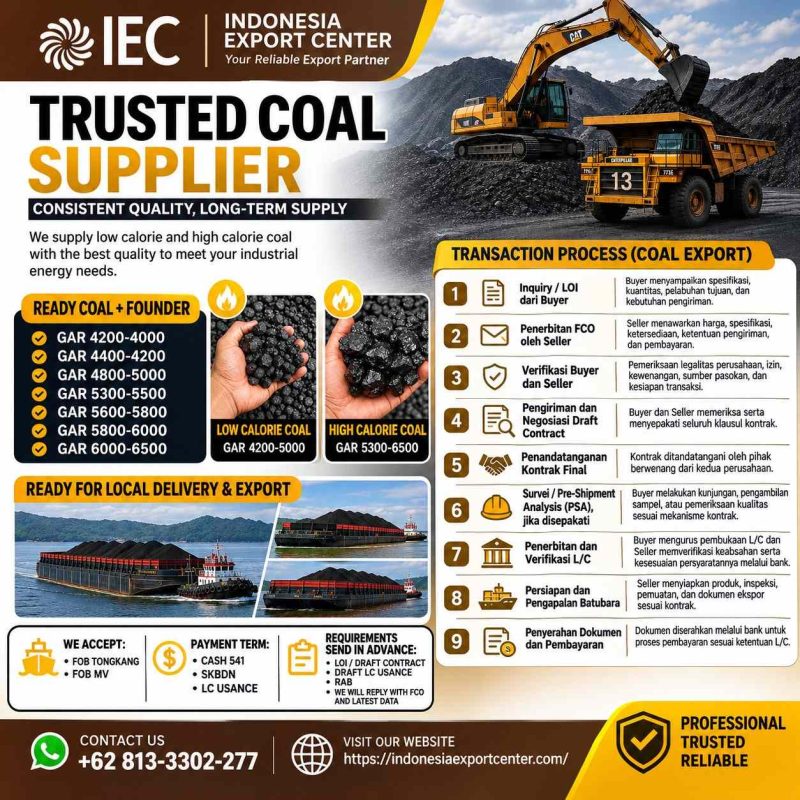
Indonesian High Calorie Thermal Coal for International Industrial Buyers
Are you looking for high calorific value coal from Indonesia, including GAR 6000, GAR 6200, or GAR 6500 thermal coal?
Indonesia Export Center (IEC) welcomes international procurement inquiries for higher-calorific-value Indonesian steam coal, subject to verified source availability and commercial feasibility.
Our sourcing coordination focuses on potential coal supply networks in South Kalimantan, East Kalimantan, and Central Kalimantan, Indonesia.
We help industrial buyers and qualified coal trading companies discuss technical requirements, supply verification, shipping arrangements, commercial documentation, and transaction procedures.
High calorific value coal may be relevant to buyers seeking greater gross heat energy per unit of fuel mass.
However, a successful coal procurement decision requires careful evaluation of product specifications, delivered costs, supplier capabilities, and the intended industrial application.
IEC encourages buyers to establish clear technical and commercial requirements before negotiating a bulk purchase agreement.
Contact Indonesia Export Center
WhatsApp: +62 813-3302-277
Website: https://indonesiaexportcenter.com/
1. Understanding High Calorific Value Coal
Calorific value represents the heat released during combustion under specified testing conditions.
In the international thermal coal market, Gross Calorific Value on an As-Received basis is commonly expressed as GAR kcal/kg.
Higher GAR values indicate greater gross heat energy per kilogram.
For example, GAR 6000 coal has a greater stated gross calorific value than GAR 5000 coal.
However, the difference in energy content does not automatically determine which coal is more commercially attractive.
Buyers must consider delivered price, total moisture, ash, sulfur, equipment efficiency, fuel handling, and environmental compliance requirements.
High calorific value coal may be described commercially as high calorie steam coal or high energy thermal coal.
These expressions are broad commercial descriptions and should not replace detailed contractual specifications.
IEC welcomes sourcing inquiries where buyers provide both the desired GAR value and complete quality parameters.
2. Indonesian GAR 6000–6500 Coal Categories
IEC coordinates inquiries involving different higher-calorific-value coal categories.
| Requested Coal Grade | Target Calorific Value |
|---|---|
| Indonesian GAR 6000 Coal | Approximately 6000 kcal/kg |
| Indonesian GAR 6200 Coal | Approximately 6200 kcal/kg |
| Indonesian GAR 6300 Coal | Approximately 6300 kcal/kg |
| Indonesian GAR 6500 Coal | Approximately 6500 kcal/kg |
These figures identify potential sourcing requirements, not verified stock availability.
Actual products may differ in moisture, ash, sulfur, volatile matter, and other quality characteristics.
The buyer should specify minimum acceptable calorific value and appropriate rejection limits.
The supplier must confirm whether the requested grade is available and whether the source can provide the required quantity.
Where appropriate, the parties may agree to independent laboratory analysis.
IEC does not guarantee continuous availability of GAR 6000–6500 coal.
3. Technical Specifications for High Calorie Coal
A high GAR value is only one part of a comprehensive coal specification.
For international procurement, buyers should evaluate the following parameters.
Gross Calorific Value: The amount of gross heat energy measured under the relevant analytical conditions.
Total Moisture: Moisture present in the coal as received, which affects the energy content and cargo characteristics.
Inherent Moisture: Moisture associated with the coal under the applicable laboratory definition.
Ash Content: Non-combustible residue that affects ash handling requirements and may influence industrial operation.
Total Sulfur: An important parameter for combustion performance and emissions management.
Volatile Matter: Relevant to assessing combustion behavior under specified conditions.
Fixed Carbon: A calculated component of proximate analysis that helps describe coal characteristics.
Coal Size Distribution: Important for storage, transportation, handling, and fuel preparation.
Hardgrove Grindability Index: Relevant to coal pulverization processes where required by the end user.
Ash Fusion Characteristics: May be relevant to the evaluation of slagging and combustion-related operating conditions.
Final product requirements should be established through the buyer’s technical specifications and the contractual agreement.
4. Why Buyers Evaluate GAR 6000–6500 Coal
High calorific value thermal coal can be commercially relevant for buyers seeking greater gross energy content per metric ton.
Energy Density
Higher GAR values indicate greater stated gross energy per kilogram of coal.
This may influence cargo planning and fuel procurement comparisons.
Transportation Economics
Where freight is calculated on a mass basis, higher gross energy content can affect the amount of heat energy transported per unit of cargo weight.
However, the resulting financial advantage depends on actual coal prices and shipping costs.
Industrial Operating Requirements
Some industrial facilities may evaluate higher-calorific-value coal to meet their energy procurement needs.
The suitability of a product must be confirmed through engineering and technical assessment.
Procurement Portfolio Management
Large industrial buyers may evaluate several coal grades when developing procurement strategies.
Comparing GAR 6000, GAR 6200, and GAR 6500 products may be useful, provided all offers use consistent analytical and delivery assumptions.
IEC encourages buyers to request complete quotations rather than compare prices without considering quality differences.
5. Indonesian GAR 6000 Coal Sourcing
GAR 6000 coal is a specific procurement category for buyers seeking higher gross heat energy.
An inquiry for GAR 6000 coal should include complete technical specifications, desired cargo quantity, and shipment destination.
The proposed supplier should establish the source of the coal and provide appropriate supporting information.
Buyers should assess whether the quoted calorific value is guaranteed, typical, or associated with a specific analysis report.
For transactions involving substantial volumes, stockpile verification and independent inspection may be appropriate.
IEC welcomes GAR 6000 inquiries and can coordinate sourcing discussions where a potentially suitable supplier is identified.
The commercial feasibility of each inquiry depends on actual product availability and contractual conditions.
6. Indonesian GAR 6200 and GAR 6300 Coal
Some international buyers may search for GAR 6200 or GAR 6300 coal instead of broader GAR 6000–6500 categories.
Such buyers often have specific fuel requirements or established procurement specifications.
IEC encourages buyers to provide the precise calorific value requirements together with acceptable technical tolerances.
It is important to distinguish a requested commercial grade from the actual laboratory results of a proposed cargo.
A seller should not claim that a particular product meets GAR 6200 or GAR 6300 specifications without appropriate evidence.
The buyer and seller should agree on sampling, testing, and contractual acceptance procedures.
A well-documented quality assessment can reduce the possibility of disputes during shipment and payment.
7. Indonesian GAR 6500 Coal Inquiry
GAR 6500 represents a relatively high gross calorific value within the thermal coal categories discussed on this page.
A request for GAR 6500 coal requires careful supplier evaluation.
Buyers should not assume that every Indonesian coal mine or trader can provide this grade.
The proposed seller must confirm actual product access, coal quality, available quantity, legal authorization, and loading arrangements.
Where required, independent testing may provide additional confidence in the stated product characteristics.
For long-term supply requests, the buyer should evaluate whether the source can maintain the required specification across successive shipments.
IEC welcomes qualified GAR 6500 sourcing inquiries but does not represent unverified product availability as guaranteed inventory.
8. Kalimantan High Calorie Coal Sources
Kalimantan is a major Indonesian coal-producing region.
IEC focuses on potential sourcing relationships associated with South Kalimantan, East Kalimantan, and Central Kalimantan.
Each region includes coal production and transportation activities, but individual coal deposits may have substantially different quality characteristics.
The actual origin and suitability of proposed coal must be verified.
For high-calorific-value inquiries, source-specific verification is particularly important.
Buyers should request supporting information concerning the proposed coal source, legal status, production capability, and relevant loading facilities.
The commercial structure may involve a licensed mine operator, authorized trader, or other eligible supplier.
IEC encourages buyers to verify the role and authority of the entity issuing the commercial offer.
9. Bulk Coal Export and Shipping Arrangements
International buyers may request different shipping terms depending on their cargo requirements.
FOB Barge
Under a specifically negotiated FOB barge arrangement, coal may be delivered onto an agreed barge.
The contract should clearly identify delivery responsibilities and the point at which risk transfers.
FOB Mother Vessel
Buyers may request coal loaded onto a nominated ocean-going vessel at an agreed location.
The transaction should specify loading obligations, vessel requirements, inspection responsibilities, and shipment documents.
Other Delivery Terms
Alternative delivery arrangements may be discussed according to supplier capabilities and mutual agreement.
Any commercial term must clearly define transportation costs, insurance responsibilities, risk transfer, and required documentation.
IEC does not guarantee the availability of every shipping arrangement for every coal source.
10. International Coal Transaction Procedure
IEC recommends the following nine-stage commercial framework.
1. Buyer Inquiry: The buyer submits a Letter of Intent with the required coal grade, specifications, quantity, destination, and shipment schedule.
2. Seller FCO: The seller issues a commercial offer containing verified supply information and proposed contractual terms.
3. Buyer and Seller Verification: Both parties perform due diligence concerning identity, legal authority, relevant licenses, and transaction capability.
4. Draft Contract: The parties negotiate the proposed Sales and Purchase Agreement, including quality, quantity, payment, delivery, and inspection provisions.
5. Final Contract Signing: Authorized representatives execute the mutually agreed agreement.
6. Survey or Pre-Shipment Analysis: Where agreed, inspection, sampling, and quality verification may take place.
7. Letter of Credit Issuance: If L/C payment is agreed, the buyer arranges issuance and the seller verifies the credit through banking channels.
8. Coal Preparation and Shipment: The seller coordinates cargo preparation, required inspection, loading, and documentation.
9. Payment and Documents: The seller presents the required documents and payment is processed according to the agreed instrument.
This process may be modified through written agreement while preserving essential legal, verification, and payment safeguards.
11. Quality Assurance and Independent Inspection
Quality verification is particularly important for high-calorific-value coal because contract values may be sensitive to relatively small differences in reported specifications.
The buyer and seller should agree on the sampling location and testing procedure.
Independent laboratories may be appointed where suitable and contractually required.
A certificate of analysis should identify the tested material and relevant laboratory findings.
Buyers should examine whether the results relate to the actual cargo being purchased.
The contract should identify how analytical discrepancies will be resolved.
Commercial provisions may include price adjustments, contractual rejection thresholds, or other remedies.
IEC encourages documentation that enables both parties to understand their obligations before shipment.
12. Letters of Credit and Transaction Security
International bulk coal transactions may use documentary Letters of Credit where accepted by the seller.
A Letter of Credit provides a documented payment mechanism under which banks examine the documents required by the credit.
The buyer should arrange issuance through an appropriate bank.
The seller should review the credit and request amendments if necessary before shipment.
Usance L/C arrangements may also be discussed, subject to the financial and commercial conditions of the transaction.
Other payment structures require approval from the relevant contracting parties.
A buyer should not assume that an L/C eliminates all commercial or documentary risks.
Proper contract drafting and banking review remain important.
13. Frequently Asked Questions
Is Indonesian GAR 6000 coal available?
IEC welcomes inquiries for GAR 6000 coal, but specific availability requires confirmation from the proposed supplier.
Can I purchase GAR 6500 coal from Kalimantan?
Potential sourcing inquiries can be evaluated, although no particular source or stockpile is guaranteed to meet the requested specification.
What is the difference between GAR 6000 and GAR 6500?
The values represent different gross calorific values on an as-received basis. GAR 6500 indicates greater gross heat energy per kilogram.
Can the buyer conduct a pre-shipment inspection?
Inspection may be arranged where agreed by the buyer and seller.
What is the minimum order quantity?
The minimum quantity depends on the source, stockpile availability, loading arrangements, and commercial conditions.
Can I request FOB mother vessel delivery?
Such inquiries are welcome, subject to logistics feasibility and supplier confirmation.
Do you accept Letter of Credit payment?
Documentary L/C arrangements may be considered subject to seller approval and banking verification.
Are long-term high calorie coal contracts possible?
Long-term supply proposals may be discussed once product availability, supplier capacity, legal eligibility, and logistics have been verified.
14. Contact IEC for GAR 6000–6500 Coal
Indonesia Export Center welcomes formal inquiries from qualified buyers seeking high calorific value thermal coal.
Please provide your company information, required coal grade, complete technical specifications, cargo quantity, destination port, preferred payment method, delivery terms, and expected shipment schedule.
Where available, attach a formal Letter of Intent.
Our team will review the procurement requirements and coordinate a commercial response based on verified sourcing opportunities.
INDONESIA EXPORT CENTER (IEC)
Your Reliable Export Partner
WhatsApp: +62 813-3302-277
Website: https://indonesiaexportcenter.com/
Indonesian High Calorific Value Coal | GAR 6000 Coal | GAR 6200 Coal | GAR 6500 Coal | Kalimantan Coal Sourcing
Reliable Sourcing • Professional Communication • Long-Term Partnership
Disclaimer: All coal grades, quantities, prices, loading locations, shipment schedules, payment terms, and export arrangements require independent verification and contractual agreement. IEC does not guarantee the availability of any specific high-calorific-value coal cargo. All export transactions must comply with applicable Indonesian regulations.
