

IEC | INDONESIA EXPORT CENTER
Your Global Sourcing Partner
Plan International Shipping for Indonesian Gum Copal
International Gum Copal procurement requires more than finding a potential supplier and agreeing on a price.
Buyers must also evaluate packaging, freight arrangements, customs classification, export documentation, destination requirements, insurance, and receiving logistics.
For natural resin shipments, clear coordination between the seller, buyer, freight forwarder, and customs representatives can help reduce avoidable delays and commercial misunderstandings.
Indonesia Export Center (IEC) facilitates sourcing inquiries involving potential Indonesian Gum Copal suppliers.
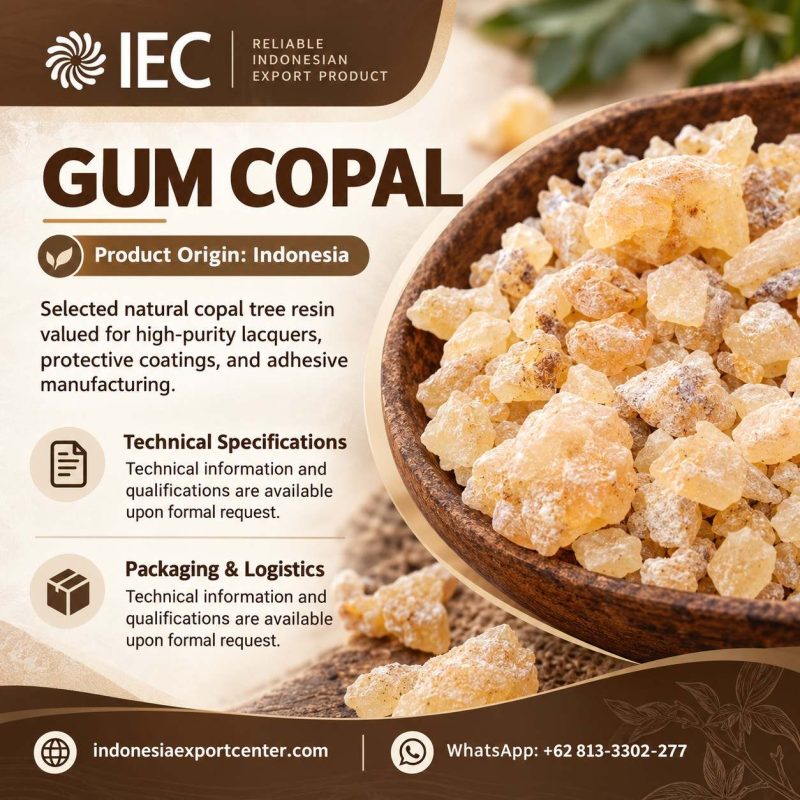
The IEC product brochure identifies Indonesia as the origin of the Gum Copal product. Specific packaging, loading locations, shipment availability, and logistics arrangements require confirmation.
Understanding the Gum Copal Export Supply Chain
An international transaction may involve:
- Product supplier.
- Processor or trading company.
- Contracting seller.
- Exporter of record.
- Inland transport provider.
- Freight forwarder.
- Customs representative.
- Ocean or air carrier.
- Destination importer.
- Receiving warehouse.
The actual responsibilities depend on the transaction structure.
Step 1 – Confirm the Product
Before arranging freight, establish:
- Exact resin identity.
- Commercial grade.
- Physical form.
- Quantity.
- Packaging.
- Relevant handling characteristics.
The commercial name alone may not provide sufficient information for customs and transport planning.
Step 2 – Verify Customs Classification
International trade documentation generally requires an appropriate customs classification.
The applicable HS classification must be determined using the actual product identity, composition, processing status, and relevant customs rules.
IEC does not assign or guarantee a particular HS code for Gum Copal in this guide.
Buyers and exporters should consult qualified customs professionals or the relevant customs authority.
Step 3 – Determine Shipment Quantity
The proposed quantity influences:
- Packaging.
- Freight mode.
- Handling.
- Container planning.
- Storage.
- Insurance.
- Cost per unit.
A supplier must confirm the actual available quantity.
Step 4 – Select an Appropriate Transport Mode
Depending on the shipment, possible arrangements may include:
Ocean Freight
May be considered for suitable commercial cargo quantities.
Air Freight
May be evaluated for smaller or time-sensitive shipments, subject to cost and carrier acceptance.
Multimodal Transport
May involve a combination of inland and international transport.
The appropriate mode depends on the actual route, cargo, and commercial requirements.
Step 5 – Confirm Packaging
Packaging should be suitable for:
- Cargo handling.
- Transport.
- Storage.
- Protection from contamination.
- Traceability.
- Destination receiving.
No specific IEC packaging format is guaranteed.
Step 6 – Choose an Incoterm
Incoterms clarify specified responsibilities between buyer and seller.
Relevant options may include:
- EXW.
- FCA.
- FOB.
- CFR.
- CIF.
- CPT.
- CIP.
- DAP.
The appropriate rule depends on the shipment structure.
For containerized cargo handed to a carrier before loading on a vessel, FCA may be more appropriate than FOB in some circumstances.
The contract should identify the selected Incoterms edition and named place or port.
Step 7 – Prepare Export Documentation
Depending on the transaction, documents may include:
| Document | Purpose |
|---|---|
| Commercial Invoice | Transaction information |
| Packing List | Packaging and quantity |
| Transport Document | Evidence relevant to carriage |
| Certificate of Origin | Origin documentation where applicable |
| Product Specification | Quality requirements |
| Inspection Report | Agreed inspection evidence |
| Export Declaration | Customs procedure |
| Other Permits | Where legally required |
Requirements must be verified for the actual product and destination.
Step 8 – Check Import Requirements
The destination importer should verify:
- Customs classification.
- Import permissions.
- Applicable duties.
- Taxes.
- Product restrictions.
- Required documentation.
- Labelling requirements.
- Customs clearance procedures.
These obligations vary by jurisdiction and product.
Step 9 – Review Freight Quotations
A freight quotation should clarify:
- Origin.
- Destination.
- Cargo description.
- Weight.
- Volume.
- Packaging.
- Transport mode.
- Freight charges.
- Additional charges.
- Validity.
- Exclusions.
Step 10 – Review Insurance
Cargo insurance should be evaluated based on the shipment’s risks and the agreed Incoterm.
The buyer should not assume that every quotation includes insurance.
Step 11 – Coordinate Loading
Relevant preparations may include:
- Cargo readiness.
- Packaging inspection.
- Transport booking.
- Weight verification.
- Loading instructions.
- Shipment documentation.
- Cargo securing.
Step 12 – Prepare Destination Receiving
Before shipment, confirm:
- Customs broker.
- Receiving address.
- Warehouse capacity.
- Unloading arrangements.
- Product inspection procedure.
- Documentation requirements.
Gum Copal Logistics Checklist
| Area | Verification |
|---|---|
| Product Identity | Confirmed |
| Grade | Defined |
| Quantity | Confirmed |
| Packaging | Approved |
| Loading Location | Verified |
| HS Classification | Reviewed by qualified party |
| Export Documents | Confirmed |
| Import Requirements | Checked |
| Incoterm | Agreed |
| Freight | Quoted |
| Insurance | Reviewed |
| Inspection | Arranged if required |
| Delivery Schedule | Confirmed |
| Receiving Facility | Prepared |
Gum Copal Shipping RFQ Template
Subject: Indonesian Gum Copal International Shipping Inquiry
Company: [Name]
Country: [Country]
Product: Natural Gum Copal
Grade: [Details]
Quantity: [KG / MT]
Physical Form: [Details]
Packaging: [Details]
Origin Location: [If Known]
Destination Port: [Port, Country]
Preferred Transport Mode: [Details]
Preferred Incoterm: [Term]
Required Delivery Period: [Dates]
Required Documents: [Details]
Please clarify potential supplier arrangements, packaging, freight responsibilities, and relevant export documentation.
Frequently Asked Questions
Can Gum Copal be shipped internationally from Indonesia?
A proposed shipment must be evaluated for supplier availability, legal requirements, carrier acceptance, and logistics feasibility.
Does IEC guarantee a shipping route?
No.
What HS code applies to Gum Copal?
Classification requires product-specific customs verification.
Can buyers request CIF quotations?
Yes, subject to supplier and freight arrangements.
Are export permits always required?
Requirements depend on the product classification and applicable regulations.
Can IEC guarantee customs clearance?
No.
Does freight include destination taxes?
Not unless specifically provided for under the contractual arrangement.
Request Gum Copal Shipping and Logistics Information
Planning to import Gum Copal from Indonesia for manufacturing or wholesale distribution?
Send IEC your product requirements, quantity, destination, and preferred delivery basis.
REQUEST GUM COPAL SHIPPING INFORMATION
IEC | INDONESIA EXPORT CENTER
Website: https://indonesiaexportcenter.com/
WhatsApp: +62 813-3302-277
Related Resources
Gum Copal Packaging for Export
Gum Copal FOB Indonesia Buying Guide
