

IEC | INDONESIA EXPORT CENTER
Your Global Sourcing Partner
Source Indonesian Gum Copal for International Trade
International sourcing of natural resins requires coordination between product suppliers, buyers, freight providers, customs representatives, and other commercial parties.
For Gum Copal, buyers should pay particular attention to resin identity, grading, quality verification, export documentation, and supplier credibility.
Indonesia Export Center (IEC) facilitates B2B inquiries involving potential Indonesian Gum Copal suppliers.
IEC serves as a sourcing contact and intermediary. It should not be assumed to be the manufacturer, physical inventory owner, contracting exporter, or exporter of record for every transaction.
Indonesian Gum Copal Product Overview
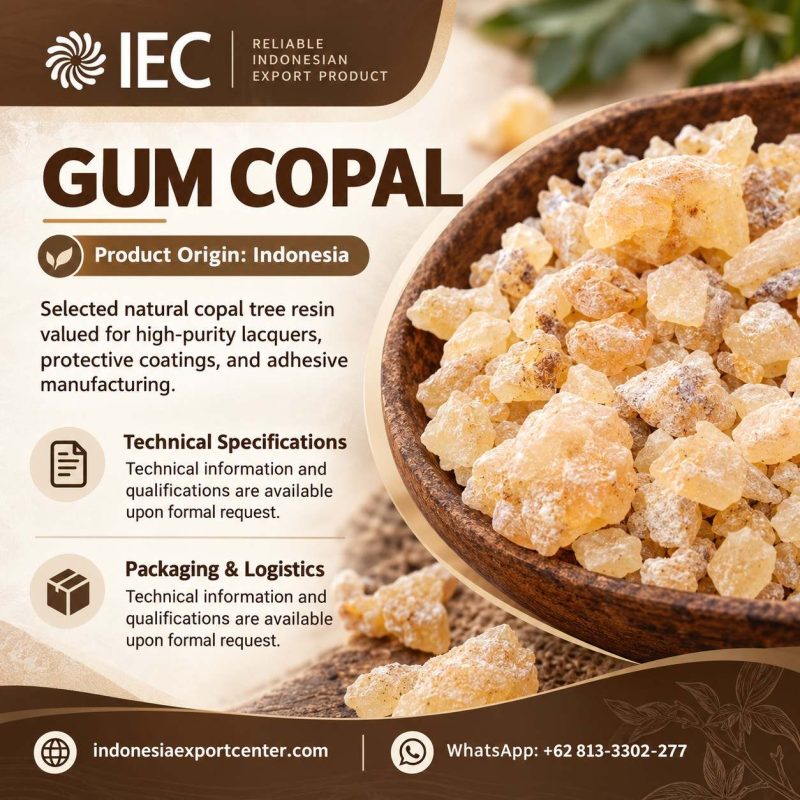
Gum Copal is a natural tree resin associated with applications in:
- Varnish manufacturing.
- Protective coatings.
- Industrial lacquer.
- Selected adhesive formulations.
The IEC product brochure identifies Indonesia as the product origin.
Technical specifications, packaging arrangements, and logistics details are available upon formal request, subject to verification.
What Does Export Sourcing Involve?
Export sourcing includes more than finding a product.
It may involve:
- Identifying potential suppliers.
- Verifying the legal seller.
- Establishing product specifications.
- Evaluating samples.
- Confirming commercial quantities.
- Checking export readiness.
- Negotiating contract terms.
- Preparing documentation.
- Coordinating logistics.
- Managing quality acceptance.
Each stage should be supported by appropriate evidence.
Understanding the Parties in an Export Transaction
| Party | Possible Responsibility |
|---|---|
| Product Collector or Producer | Material supply |
| Processor | Sorting or preparation |
| Trader | Commercial purchase and resale |
| Exporter of Record | Export declarations and legal export obligations |
| Sourcing Intermediary | Facilitating buyer-supplier communication |
| Freight Forwarder | Transport arrangements |
| Customs Representative | Customs procedures |
| Importer | Destination-country obligations |
The same company may perform multiple roles, but those roles must be verified.
Step 1 – Establish Product Requirements
The buyer should identify:
- Product name.
- Resin grade.
- Intended use.
- Physical form.
- Required quantity.
- Quality requirements.
- Packaging.
- Destination.
- Delivery timeline.
A clear product description helps prevent misunderstandings.
Step 2 – Verify the Supplier
Supplier due diligence should include:
- Legal company name.
- Registration information.
- Business address.
- Role in the supply chain.
- Selling authority.
- Product source.
- Export arrangements.
- Payment beneficiary.
Supplier verification should be completed before making substantial financial commitments.
Step 3 – Request Technical Documentation
The buyer may request:
- Product specification.
- Available test results.
- Product photographs.
- Representative samples.
- Grade description.
- Origin information.
- Packaging details.
IEC’s brochure does not provide numerical quality specifications, so these must be confirmed separately.
Step 4 – Qualify Samples
A buyer should determine whether the sample matches the intended application.
For industrial use, sample qualification may include:
- Visual examination.
- Foreign matter testing.
- Moisture analysis.
- Solubility testing.
- Thermal evaluation.
- Formulation trials.
The scope depends on the product and intended application.
Step 5 – Confirm Export Readiness
Before accepting a quotation, establish whether the contracting seller can lawfully and practically arrange the proposed export.
Important questions include:
- Who will act as exporter of record?
- Which export documents are required?
- Is the product correctly classified?
- Are permits required?
- Where will the goods be loaded?
- What is the proposed shipment schedule?
The requirements must be verified under current applicable law.
Step 6 – Prepare Trade Documentation
Documents may include:
Commercial Invoice
Identifies the commercial transaction and invoiced goods.
Packing List
Describes the packaging and shipment quantities.
Bill of Lading or Other Transport Document
Provides evidence relevant to the shipment under the applicable transport arrangement.
Certificate of Origin
May be required for customs or trade purposes.
Product Specification
Describes the agreed quality requirements.
Inspection Certificate
May be required by contract or buyer policy.
Other Documents
Permits, declarations, or certificates may be necessary depending on the product classification and destination.
No universal document list applies to every transaction.
Step 7 – Agree on Incoterms
International buyers should select appropriate Incoterms and name the relevant place or port.
For example:
FOB: May be suitable for certain seaborne shipments where the contractual and operational requirements are met.
CFR: Addresses cost and freight allocation under the applicable Incoterms rules.
CIF: Includes specified insurance obligations in addition to cost and freight responsibilities.
The parties should identify the Incoterms edition and understand the transfer of risk.
Step 8 – Review Payment Risk
Before transferring funds:
- Verify the contracting company.
- Independently confirm bank details.
- Review the purchase contract.
- Confirm the payment schedule.
- Consider appropriate trade finance arrangements.
- Verify documents and conditions.
No payment method eliminates all transaction risks.
Step 9 – Arrange Inspection
Depending on the purchase, inspection may cover:
- Product identity.
- Grade.
- Quantity.
- Packaging.
- Container condition.
- Loading.
- Documentation.
The scope should be agreed before shipment.
Step 10 – Prepare Destination Import Clearance
The importer should verify:
- Customs classification.
- Import permissions.
- Applicable duties and taxes.
- Product-specific restrictions.
- Required documents.
- Customs representation.
- Receiving arrangements.
Export Sourcing Verification Checklist
| Area | Verification |
|---|---|
| Seller | Legal identity |
| Product | Gum Copal identity |
| Origin | Supporting information |
| Grade | Agreed description |
| Quality | Sample and test results |
| Quantity | Confirmed |
| Packaging | Approved |
| Exporter | Identified |
| Documentation | Confirmed |
| Incoterm | Agreed |
| Freight | Feasible |
| Payment | Verified |
| Inspection | Defined |
| Claims | Contractually addressed |
Export Gum Copal RFQ Template
Subject: Indonesian Gum Copal Export Sourcing Inquiry
Company: [Name]
Country: [Country]
Product: Gum Copal
Application: [Details]
Grade: [Details]
Quantity: [KG / MT]
Required Packaging: [Details]
Destination Port: [Port, Country]
Preferred Incoterm: [Term]
Required Documents: [Details]
Inspection Requirements: [Details]
Desired Shipment Period: [Dates]
Please provide potential supplier information, product details, and clarification of the proposed exporter and shipping arrangements.
Frequently Asked Questions
Does IEC directly export every Gum Copal order?
No. The actual exporter and contracting seller must be identified.
Can buyers request FOB quotations?
Yes, subject to supplier and shipment feasibility.
Are export documents available?
The necessary documents must be confirmed for each transaction.
Can IEC guarantee customs clearance?
No. Customs requirements and responsibilities must be independently verified.
Can buyers request independent inspection?
Yes, subject to agreement with the relevant parties.
Does IEC guarantee export-ready stock?
No. Product availability and readiness require confirmation.
Request Gum Copal Export Sourcing Information
Looking for Indonesian Gum Copal for international industrial procurement?
Send IEC your required grade, quantity, destination, and commercial requirements.
REQUEST GUM COPAL EXPORT SOURCING INFORMATION
IEC | INDONESIA EXPORT CENTER
Website: https://indonesiaexportcenter.com/
WhatsApp: +62 813-3302-277
Related Resources
Bulk Gum Copal Sourcing from Indonesia
