

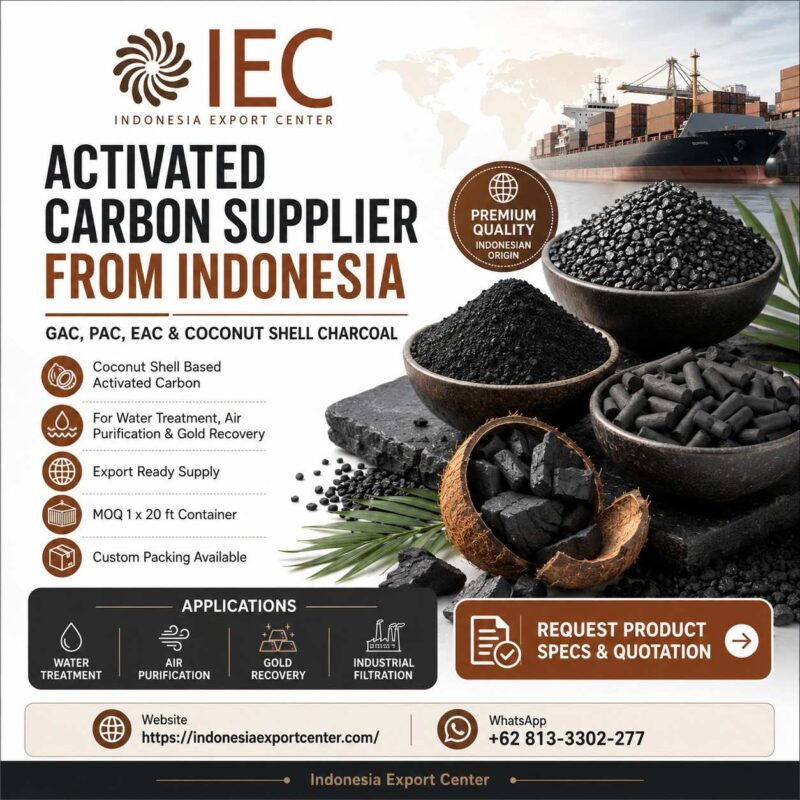
IEC | INDONESIA EXPORT CENTER
GRANULAR COCONUT SHELL ACTIVATED CARBON FROM INDONESIA
Wholesale GAC Sourcing | Industrial Filtration Media | Technical Procurement | International Bulk Supply Inquiries
Source Granular Coconut Shell Activated Carbon from Indonesia
Are you searching for granular coconut shell activated carbon wholesale opportunities in Indonesia?
Indonesia Export Center (IEC) facilitates international sourcing inquiries for buyers seeking coconut shell-based granular activated carbon (GAC) for water treatment, industrial filtration, purification systems, and other technically qualified adsorption applications.
Our sourcing support is designed for international importers, GAC distributors, filtration-system manufacturers, treatment contractors, industrial procurement teams, and wholesale trading companies.
Granular activated carbon is not a single standardized product. Different grades can vary in adsorption characteristics, particle-size distribution, hardness, ash content, moisture, density, and application performance.
For this reason, professional wholesale procurement begins with a clear technical specification and reliable supplier documentation.
IEC helps buyers communicate those requirements to potential Indonesian suppliers. Product availability, manufacturing capability, minimum order quantities, and commercial terms remain subject to supplier verification.
What Is Granular Coconut Shell Activated Carbon?
Granular coconut shell activated carbon is an adsorbent produced from coconut-shell-derived carbon material through controlled carbonization and activation.
The activation process develops a porous structure that can adsorb selected substances from liquids or gases.
The resulting material is processed into granular particles suitable for specific industrial systems.
Unlike ordinary coconut shell charcoal, activated carbon is manufactured and characterized for adsorption applications.
The two products should not be treated as technically interchangeable.
Why Consider Indonesian Coconut Shell GAC?
Indonesia has a coconut-processing industry that can support the sourcing of coconut-shell-derived carbon materials.
For international buyers, Indonesia may offer opportunities to identify manufacturers and exporters supplying activated carbon grades for different industrial markets.
Potential sourcing considerations include:
- Coconut-shell-based raw-material sourcing.
- Granular activated carbon production.
- Different mesh-size requirements.
- Industrial wholesale quantities.
- Technical documentation and testing.
- Export packaging.
- Repeat-order procurement.
- Supplier-specific customization.
Each supplier’s actual capability must be confirmed before a commercial claim is made.
Applications of Granular Activated Carbon
Industrial Water Treatment
GAC may be evaluated for adsorption of selected organic contaminants, taste- and odor-causing compounds, and other substances in water-treatment processes.
Drinking-Water Filtration
Certain activated carbon grades may be used in drinking-water treatment systems when they meet applicable technical and regulatory requirements.
Wastewater Polishing
GAC may be incorporated into treatment processes designed to reduce selected residual contaminants.
Industrial Liquid Purification
Manufacturers may evaluate GAC for specific liquid-processing applications.
Air and Gas Purification
Certain activated carbon grades can be evaluated for gas-phase adsorption, subject to appropriate product selection and testing.
OEM Filtration Media
Filter manufacturers may source GAC for cartridges, treatment vessels, and other engineered systems.
No application suitability is guaranteed without appropriate qualification.
GAC Technical Specifications
International buyers should request a product-specific Technical Data Sheet (TDS) and Certificate of Analysis (COA).
| Technical Parameter | Information to Confirm |
|---|---|
| Product | Granular Activated Carbon |
| Raw Material | Coconut shell |
| Iodine Number | Tested mg/g |
| Particle Size | Specified mesh distribution |
| Moisture Content | Tested percentage |
| Ash Content | Tested percentage |
| Apparent Density | Tested value |
| Hardness / Abrasion | Test method and result |
| pH | Tested value |
| Surface Area | If required |
| Fines Content | Maximum acceptable level |
| Water-Soluble Matter | If required |
| Application Performance | Relevant adsorption test |
| Origin | Verified manufacturing location |
These are specification fields, not guaranteed product values.
Understanding GAC Mesh Sizes
Mesh size describes particle-size classification using an identified sieve standard.
Potential sourcing inquiries may reference:
- 4×8 mesh.
- 6×12 mesh.
- 8×16 mesh.
- 8×30 mesh.
- 12×40 mesh.
- Buyer-defined particle distributions.
These examples do not establish current inventory.
The buyer should specify the applicable sieve standard, permitted oversize and undersize fractions, and required uniformity.
Particle Uniformity and Filtration Performance
Particle-size consistency is important because irregular distribution may affect pressure drop, flow distribution, backwashing, and adsorption behavior.
For filtration systems, buyers should evaluate:
- Particle-size distribution.
- Uniformity.
- Hydraulic resistance.
- Contact time.
- Fines generation.
- Media retention.
- Backwash requirements.
- Operating conditions.
The appropriate specification depends on equipment design.
Hardness and Abrasion Resistance
Granular activated carbon may experience mechanical stress during packaging, transportation, loading, and operation.
Hardness or abrasion testing helps buyers evaluate resistance to particle breakdown.
The test method must be identified because results from different procedures may not be directly comparable.
Iodine Number and Adsorption
Iodine number is commonly used to characterize certain adsorption properties of activated carbon.
However, it does not establish performance against every contaminant.
For demanding applications, buyers may need adsorption isotherms, breakthrough testing, or other application-specific assessments.
Wholesale Packaging
Potential packaging arrangements may include industrial bags, moisture-resistant liners, palletized shipments, or customized labeling.
Packaging requirements should specify:
- Net weight per bag.
- Bag material.
- Inner liner.
- Labeling.
- Batch identification.
- Palletization.
- Moisture protection.
- Container-loading method.
Custom packaging is subject to supplier capability.
Bulk MOQ and Container Shipments
Buyers may inquire about full-container procurement, including a 20-foot container.
However, MOQ 1 × 20 ft container is not a verified universal requirement or confirmed supplier offer.
The actual MOQ, container payload, bag configuration, and shipment feasibility must be confirmed by the seller and logistics provider.
Quality Assurance and Sample Testing
Before approving a commercial order, buyers should request representative samples and evaluate them against the intended application.
Testing may include particle distribution, iodine number, moisture, ash, hardness, density, and application-specific performance.
The buyer and seller should agree on commercial batch acceptance criteria.
Supplier Verification
A professional sourcing review should consider:
- Supplier legal identity.
- Manufacturing or trading status.
- Actual product origin.
- Production capability.
- Quality-control procedures.
- COA and TDS authenticity.
- Sample traceability.
- Export eligibility.
- Shipment capability.
- Contract and payment details.
IEC Wholesale Sourcing Process
Step 1: Buyer submits technical specifications.
Step 2: IEC reviews the sourcing requirements.
Step 3: Potential Indonesian suppliers are identified.
Step 4: Product documentation and supplier information are requested.
Step 5: Sample testing and qualification are discussed.
Step 6: The responsible supplier confirms MOQ, price, and delivery feasibility.
Step 7: The contracting parties negotiate the purchase agreement.
Step 8: Shipment proceeds under the agreed commercial responsibilities.
IEC acts as a sourcing facilitator unless otherwise agreed in writing.
Granular Activated Carbon Wholesale RFQ
Subject: Indonesian Granular Coconut Shell Activated Carbon Wholesale RFQ
Dear Indonesia Export Center Team,
We are looking for potential Indonesian suppliers of granular coconut shell activated carbon.
Buyer Company: [Company Name] Destination Country: [Country] Application: [Water Treatment / Industrial Filtration / Other] Required Iodine Number: [mg/g] Mesh Size: [Requirement] Particle Distribution: [Requirement] Moisture Maximum: [%] Ash Maximum: [%] Hardness Requirement: [Value / Method] Apparent Density: [Value] Trial Quantity: [Quantity] Bulk Quantity: [MT] Monthly Requirement: [MT] Packaging: [Requirement] Destination Port: [Port] Preferred Incoterm: [FOB / CFR / CIF] Required Documents: [COA / TDS / Other]
Please advise whether potential suppliers can provide verified technical specifications, samples, MOQ, and a commercial quotation.
Best regards,
[Name]
Frequently Asked Questions
What is granular coconut shell activated carbon?
It is an activated carbon adsorbent produced from coconut-shell-derived material and supplied in granular form.
What mesh sizes are available?
Available mesh sizes must be confirmed with the supplier.
Does a higher iodine number guarantee better filtration?
No. Performance depends on the application and other material characteristics.
Can buyers request samples?
Yes, subject to supplier policy.
Is 1 × 20 ft container the minimum order?
That requirement must be verified with the actual supplier.
Can buyers request custom packaging?
Potentially, subject to supplier capability.
Can IEC guarantee product performance?
No. The buyer should qualify the product through appropriate testing.
Request Wholesale Granular Activated Carbon
REQUEST GAC WHOLESALE QUOTATION
INDONESIA EXPORT CENTER
Connecting Indonesian Products to Global Markets
Website: https://indonesiaexportcenter.com/
WhatsApp: +62 813-3302-277
Related Resources
Coconut Shell Activated Carbon Supplier in Indonesia
Buy Coconut Shell Activated Carbon in Bulk
Coconut Shell Activated Carbon Samples and COA
