

IEC | INDONESIA EXPORT CENTER
Indonesian Coffee for a Brighter Tomorrow
GAYO ARABICA COFFEE SUPPLIER DUE DILIGENCE
Business Verification | Quality Evidence | Export Readiness | Secure Payments | Supplier Selection
Verify Your Gayo Arabica Coffee Supplier Before Purchasing
Choosing an international coffee supplier requires more than comparing prices and reviewing product photographs.
Importers, roasters, and trading companies should establish whether a potential supplier is legally identifiable, commercially capable, able to support its product claims, and prepared to meet the agreed shipment requirements.
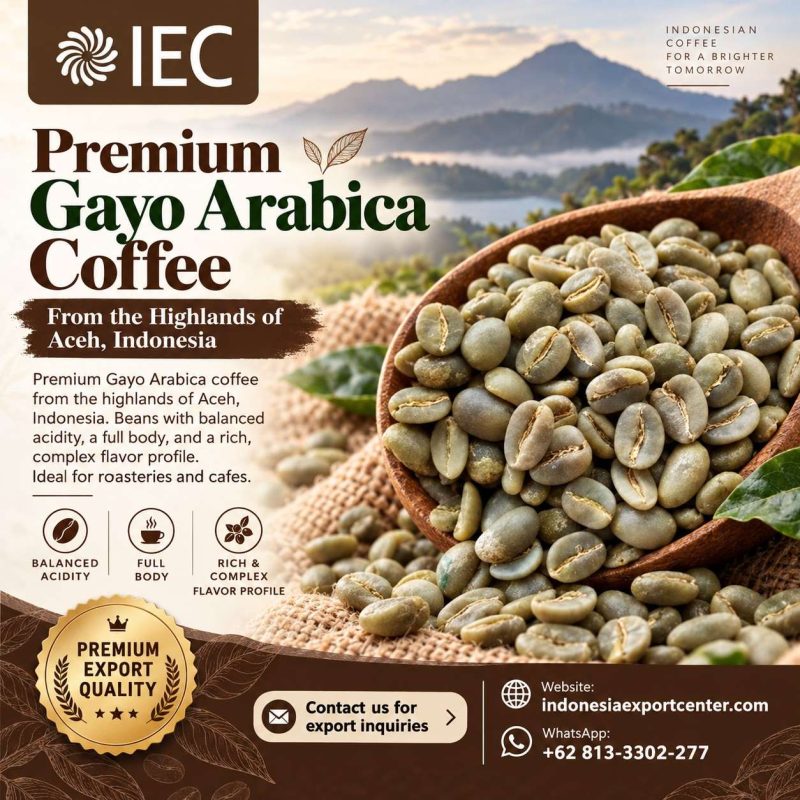
For buyers interested in Gayo Arabica coffee from Aceh, Indonesia, supplier verification is an essential part of responsible procurement.
Indonesia Export Center (IEC) facilitates inquiries with potential Indonesian coffee suppliers and helps buyers communicate their due diligence requirements.
IEC acts as a sourcing intermediary. Buyers should independently verify material information and identify the actual contracting seller and exporter before payment.
Why Supplier Verification Matters
Supplier verification can help reduce risks involving:
- Misrepresented product quality.
- Incorrect origin claims.
- Unavailable stock.
- Unsupported certifications.
- Inconsistent documentation.
- Payment fraud.
- Unclear contractual responsibilities.
- Shipment delays.
- Quality disputes.
- Inadequate traceability.
No checklist eliminates every commercial risk, but a structured process supports more informed purchasing decisions.
Step 1: Verify the Supplier’s Legal Identity
Request:
- Registered company name.
- Business registration information.
- Registered address.
- Operating address, if different.
- Authorized contact person.
- Official communication channels.
- Relevant tax or business identifiers where appropriate.
- Company website or business profile.
Information should be checked against reliable records where possible.
Step 2: Identify the Supplier’s Actual Role
A company offering coffee may be a farmer organization, processor, dry mill, trader, exporter, or intermediary.
These roles are not interchangeable.
| Supplier Role | Questions to Ask |
|---|---|
| Producer | What coffee does the organization produce? |
| Cooperative | Which producers and lots are represented? |
| Processor | Which processing activities are performed? |
| Dry Mill | What grading and preparation capabilities exist? |
| Trader | Where is the coffee sourced? |
| Exporter | Can the business legally complete the export? |
| Intermediary | Who is the actual seller and exporter? |
The buyer should know which entity will issue the invoice and receive payment.
Step 3: Verify Coffee Origin
A supplier should be able to explain the basis for describing a product as Gayo Arabica.
Depending on the offer, supporting evidence may include:
- Regional sourcing records.
- Producer or cooperative information.
- Purchase documentation.
- Processing records.
- Lot identification.
- Relevant origin declarations.
The degree of available traceability varies by supplier.
Step 4: Request Product Specifications
| Specification | Verification Requirement |
|---|---|
| Product | Gayo Arabica Green Coffee |
| Origin | Aceh Gayo, Indonesia |
| Species | Arabica |
| Processing | Verified method |
| Grade | Defined grading basis |
| Moisture | Actual measurement |
| Water Activity | If required |
| Defect Count | Method and result |
| Screen Size | Actual or agreed distribution |
| Cupping | Lot-specific report if claimed |
| Harvest Period | Available record |
| Lot Code | Required |
| Quantity | Supplier-confirmed |
| Packaging | Agreed specification |
Step 5: Verify Sample Authenticity
Buyers should establish whether the sample represents the actual commercial lot.
Questions include:
- What is the lot code?
- When was the sample collected?
- Who collected it?
- Is the commercial lot still available?
- Does the sample represent the offered grade?
- Can the lot be independently inspected?
- What happens if shipment quality differs?
A sample without a reliable link to the commercial lot offers limited assurance.
Step 6: Assess Physical and Sensory Quality
A quality review may include:
- Visual inspection.
- Moisture testing.
- Water activity testing.
- Defect analysis.
- Screen distribution.
- Sample roasting.
- Cupping.
- Comparison with specifications.
- Review of storage conditions.
- Final approval.
Buyers should define the applicable testing methods and acceptance limits.
Step 7: Verify Certifications and Claims
A supplier may claim that its coffee is organic, specialty grade, traceable, or produced under a particular sustainability program.
Each claim requires appropriate evidence.
For certification claims, request:
- Certificate name.
- Issuing organization.
- Certificate number.
- Validity dates.
- Certified operator.
- Product scope.
- Relevant lot status.
- Chain-of-custody evidence where applicable.
A certificate issued to one organization does not automatically cover every product sold by another organization.
Step 8: Assess Export Readiness
Ask whether the actual seller or exporter can provide the documentation required for the transaction.
Potential documents include:
- Commercial invoice.
- Packing list.
- Transport document.
- Certificate of origin, where applicable.
- Phytosanitary certificate, where required.
- Quality reports.
- Other destination-specific documents.
The buyer should verify the exporter’s legal and operational role.
Step 9: Confirm Stock and Capacity
A supplier’s advertised capacity is not necessarily the quantity available for immediate shipment.
Buyers should request confirmation of:
- Current lot availability.
- Quantity.
- Location.
- Preparation status.
- Packaging capability.
- Lead time.
- Shipment schedule.
- Quality documentation.
For larger transactions, independent inspection may be appropriate.
Step 10: Verify Payment Instructions
Payment security is an important part of international procurement.
Buyers should:
- Confirm the contracting seller.
- Verify beneficiary details independently.
- Compare bank account information with the contract.
- Confirm changes to payment instructions through a trusted channel.
- Understand the agreed payment schedule.
- Avoid relying solely on informal messages.
- Maintain records of commercial communications.
A last-minute change to beneficiary details should trigger additional verification.
Step 11: Review the Purchase Contract
A commercial contract should address:
- Legal buyer and seller.
- Product description.
- Quantity.
- Grade and processing.
- Quality specifications.
- Price and currency.
- Incoterm and named place.
- Payment terms.
- Shipment period.
- Packaging.
- Inspection rights.
- Quality claims procedure.
- Applicable law and dispute resolution.
- Required documents.
- Responsibilities for delays or nonconformity.
Contract terms should be reviewed by qualified advisers where appropriate.
Step 12: Evaluate Logistics Arrangements
The buyer should confirm:
- Loading location.
- Destination port.
- Freight provider.
- Container or shipment type.
- Packaging.
- Cargo insurance.
- Export clearance responsibilities.
- Import clearance responsibilities.
- Delivery conditions.
Freight and insurance arrangements should match the agreed commercial terms.
Step 13: Consider Independent Inspection
Independent inspection may help buyers verify selected aspects of product condition, quantity, packing, or shipment preparation.
The inspection scope should be defined in writing.
An inspection certificate is only evidence of the matters actually examined and does not guarantee every aspect of the transaction.
Step 14: Assess Supplier Communication
Professional procurement also involves evaluating how the supplier responds to technical and commercial questions.
Positive indicators may include:
- Clear identification of the business.
- Consistent product descriptions.
- Timely responses.
- Willingness to clarify limitations.
- Accurate documentation.
- Transparent commercial terms.
- Cooperation with reasonable verification requests.
However, good communication alone does not prove product availability or supplier legitimacy.
Step 15: Final Supplier Approval Checklist
| Verification Item | Status |
|---|---|
| Legal company identity checked | Pending |
| Authorized contact verified | Pending |
| Seller and exporter identified | Pending |
| Coffee origin reviewed | Pending |
| Product specification agreed | Pending |
| Lot identity established | Pending |
| Representative sample evaluated | Pending |
| Quality reports reviewed | Pending |
| Certification claims checked | Pending |
| Quantity and stock confirmed | Pending |
| Packaging confirmed | Pending |
| Export documentation reviewed | Pending |
| Payment beneficiary verified | Pending |
| Contract terms reviewed | Pending |
| Freight arrangements confirmed | Pending |
| Destination import requirements checked | Pending |
This checklist is intended for buyers to complete. It does not represent completed verification of any supplier.
Warning Signs Requiring Additional Investigation
Buyers should investigate situations involving:
- Unclear legal company identity.
- Inconsistent business addresses.
- Refusal to identify the contracting seller.
- Unsupported certification claims.
- Samples without lot identification.
- Inconsistent invoice and payment details.
- Unexplained changes to bank accounts.
- Pressure to pay before basic verification.
- Unverifiable stock claims.
- Conflicting shipment documents.
A warning sign does not necessarily establish wrongdoing, but it warrants additional checks.
How IEC Supports Supplier Inquiries
IEC facilitates communication between buyers and potential Indonesian suppliers.
Its role may include:
- Collecting buyer requirements.
- Identifying potential supplier options.
- Requesting company information.
- Coordinating sample inquiries.
- Communicating quality specifications.
- Requesting available documents.
- Facilitating quotation discussions.
IEC does not automatically certify, audit, insure, or guarantee the performance of any supplier.
Supplier Verification RFQ Template
Subject: Gayo Arabica Coffee Supplier Verification and Sourcing Inquiry
Dear Indonesia Export Center Team,
We are interested in sourcing Gayo Arabica green coffee from Indonesia and would like to review potential supplier qualifications before proceeding.
Buyer Information
Company: [Name]
Country: [Country]
Website: [Website]
Contact Person: [Name]
Product Requirements
Product: Gayo Arabica Green Coffee
Processing: [Details]
Grade: [Requirement]
Moisture Range: [Requirement]
Defect Limit: [Requirement]
Cupping Requirement: [Details]
Quantity: [kg / MT]
Packaging: [Details]
Destination Port: [Port]
Preferred Incoterm: [Term]
Target Shipment Date: [Date]
Supplier Verification Requirements
Legal Company Information: Required
Actual Seller Identity: Required
Exporter of Record: Required
Origin Documentation: [Details]
Lot Identification: Required
Quality Reports: [Details]
Certification Documents: [If Applicable]
Sample Request: [Details]
Inspection Requirements: [Details]
Please advise on potential suppliers and which verification documents are available for review.
Best regards,
[Name]Frequently Asked Questions
Why should buyers verify a Gayo Arabica supplier?
Verification helps buyers assess commercial legitimacy, product quality, documentation, and transaction risks.
Is a company website enough to verify a supplier?
No. Buyers should review additional legal and commercial evidence.
Does a coffee sample prove stock availability?
No. Stock must be confirmed separately.
Can a supplier claim specialty quality without a cupping report?
Buyers should request appropriate quality evidence and evaluate the actual lot.
Does organic certification cover every coffee lot?
Not necessarily. Certification scope and lot eligibility must be verified.
Can IEC guarantee supplier legitimacy?
No. IEC facilitates sourcing inquiries, while buyers should conduct appropriate due diligence.
Should buyers use independent inspections?
They may be appropriate depending on transaction value, risk, and buyer requirements.
What should buyers verify before payment?
At minimum, the contracting seller, payment beneficiary, commercial terms, and relevant transaction documentation.
Request Gayo Arabica Supplier Verification Information
Build a more reliable Indonesian coffee sourcing process with supplier due diligence, representative samples, and clearly documented commercial responsibilities.
REQUEST GAYO ARABICA SUPPLIER INFORMATION
IEC | INDONESIA EXPORT CENTER
Indonesian Coffee for a Brighter Tomorrow
Website: https://indonesiaexportcenter.com/
WhatsApp: +62 813-3302-277
Related Resources
Gayo Arabica Coffee Export Sourcing Indonesia
Gayo Arabica Coffee Samples and Quality Approval
Gayo Arabica Coffee Export Documents Guide
