

Technical Quality Information, Green Coffee Grading, Moisture Content, Defect Analysis, Screen Size, Crop Year, COA and Cupping Evaluation for International Coffee Buyers
Are you searching for reliable Gayo Arabica coffee specifications before purchasing Indonesian green coffee beans?
Indonesia Export Center (IEC) helps international coffee importers, quality assurance teams, specialty coffee roasters, and procurement professionals request technical information for Gayo Arabica coffee originating from the highlands of Aceh, Indonesia.
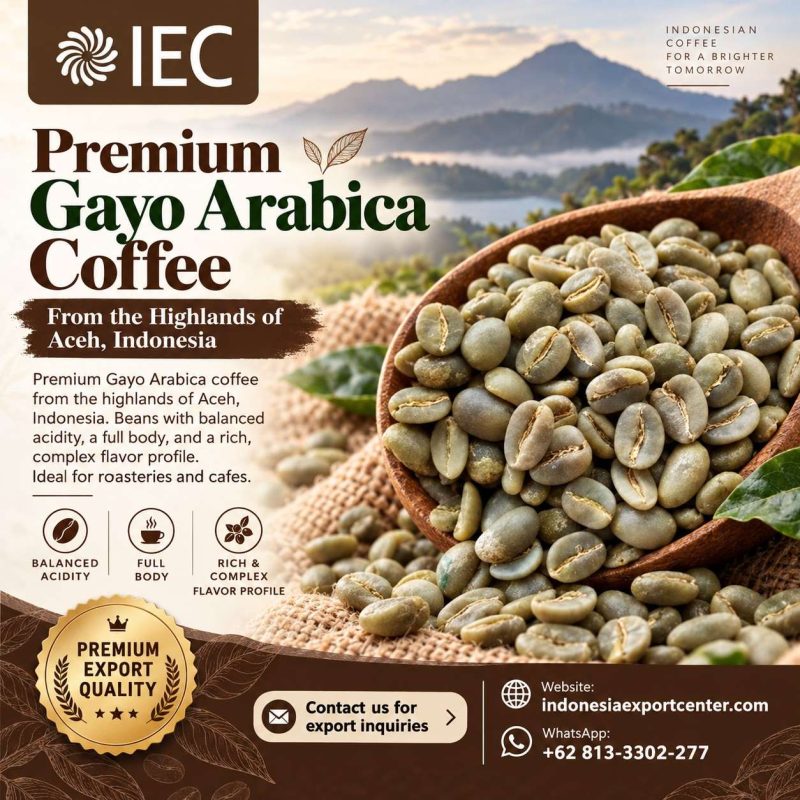
Gayo Arabica coffee is recognized for its Indonesian highland origin, balanced acidity, full body, and potentially complex flavor profile.
However, professional coffee procurement requires more than a general description of the origin. International buyers need reliable, lot-specific quality data to evaluate green coffee suitability, compare supplier offers, establish contractual requirements, and reduce quality-related risks.
Important technical parameters include:
- Moisture content
- Water activity, where tested
- Physical defect count
- Bean screen size distribution
- Coffee grade and grading methodology
- Crop year and harvest period
- Processing method
- Lot identification and traceability
- Cupping score and sensory evaluation, where tested
- Certificate of Analysis (COA) or quality inspection reports, where available
Through our sourcing and trade facilitation services, IEC can coordinate inquiries for available product specifications and relevant supplier documentation.
Request Lot-Specific Gayo Arabica Coffee Specifications and Quality Documentation
Website: https://indonesiaexportcenter.com/
WhatsApp: https://wa.me/628133302277
1. Understanding Gayo Arabica Coffee Quality Specifications
Gayo Arabica coffee is cultivated in the Gayo Highlands of Aceh Province, Indonesia, particularly in the coffee-producing areas of Central Aceh and Bener Meriah.
The region is associated with established Arabica coffee cultivation and different post-harvest processing traditions.
Coffee quality can vary between farms, harvest periods, processing facilities, storage conditions, and individual commercial lots.
Therefore, international buyers should distinguish between general origin characteristics and the actual specifications of a particular shipment.
Why Coffee Specifications Matter
Quality Consistency
Documented specifications help buyers evaluate whether a coffee lot meets their required physical and sensory standards.
Roasting Performance
Bean size distribution, moisture content, and physical defects can influence roasting consistency and production efficiency.
Commercial Transparency
Clearly defined product specifications help buyers compare offers and establish appropriate quality acceptance criteria.
International Procurement
Technical documentation may support supplier approval, internal quality assurance, and contractual quality verification.
Risk Management
Representative sampling, inspection, and agreed specifications can reduce the risk of receiving coffee that differs from the approved sample.
2. Gayo Arabica Green Coffee Technical Specifications
The following table provides an overview of the technical parameters commonly evaluated by international green coffee buyers.
These are parameters for verification, not a certified COA for any particular coffee lot.
| Quality Parameter | Product Information / Verification Requirement |
|---|---|
| Product Name | Gayo Arabica Green Coffee Beans |
| Botanical Species | Coffea arabica |
| Country of Origin | Indonesia |
| Origin Region | Gayo Highlands, Aceh |
| Main Producing Areas | Central Aceh and Bener Meriah |
| Product Form | Unroasted Green Coffee Beans |
| Coffee Grade | Lot-specific grading required |
| Processing Method | Confirm actual method for each lot |
| Moisture Content | Measured value required |
| Water Activity | Measured value, if tested |
| Defect Count | Actual grading report required |
| Screen Size | Actual size distribution required |
| Foreign Matter | Inspection result required |
| Bean Appearance | Visual assessment of representative sample |
| Crop Year | Confirm with supplier |
| Harvest Period | Confirm with supplier |
| Cupping Score | Report if evaluated using a stated protocol |
| Cupping Notes | Actual sensory assessment, if available |
| Lot Identification | Supplier’s lot or batch reference |
| Traceability | Origin and supply-chain information, where available |
| Packaging | Actual packing configuration |
| Available Quantity | Confirmed lot inventory |
| COA Availability | Subject to supplier or laboratory documentation |
Important: Specifications should be supported by actual testing, supplier records, and representative samples before they are used as contractual quality guarantees.
3. Gayo Arabica Coffee Moisture Content
Moisture content is one of the most important physical quality parameters in green coffee trading.
It measures the amount of water present in green coffee beans and is typically expressed as a percentage of the sample’s mass.
Moisture content can influence coffee stability, storage conditions, shipment management, and quality preservation.
Why Moisture Testing Is Important
Excessive moisture can contribute to quality deterioration and increase the risk of microbial growth under unfavorable storage conditions.
Conversely, excessive drying may affect coffee weight, physical characteristics, and quality.
Buyers should establish appropriate moisture acceptance criteria based on relevant standards, the product’s intended use, and agreed contractual requirements.
Moisture Verification Requirements
International buyers may request:
- Actual measured moisture percentage
- Testing method or instrument
- Sampling date
- Testing date
- Lot or batch identification
- Laboratory or inspection provider
- Applicable acceptance criteria
Example Moisture Reporting Format
| Parameter | Information |
|---|---|
| Test Parameter | Green Coffee Moisture Content |
| Unit | % |
| Actual Result | Pending lot-specific testing |
| Test Method | To be identified |
| Testing Date | To be confirmed |
| Acceptance Limit | Buyer and seller agreement |
| Compliance Status | Cannot be determined without results |
Indonesia Export Center can help coordinate requests for moisture information from prospective suppliers.
4. Water Activity in Green Coffee Beans
In addition to moisture content, some coffee buyers evaluate water activity, commonly abbreviated as aw.
Water activity describes the availability of water within a product and is relevant to microbial stability and storage considerations.
Moisture content and water activity are related but are not interchangeable measurements.
Why Buyers May Request Water Activity
Water activity testing can provide additional information about:
- Storage stability
- Moisture-related quality risks
- Suitability of packaging and storage conditions
- Lot comparison
- Quality assurance requirements
Water activity results should be reported using actual measurements and the relevant testing methodology.
No water activity value should be assumed solely from coffee origin or general moisture information.
5. Gayo Arabica Coffee Defect Count and Grading
Defect count is an important criterion for evaluating the physical quality of green coffee beans.
Physical defects may develop during cultivation, harvesting, processing, drying, sorting, transportation, or storage.
Coffee grading procedures identify and classify defects according to a recognized grading method.
Common Green Coffee Defect Categories
Defects may include:
Black Beans
Beans with substantial black discoloration that may indicate serious quality deterioration.
Sour Beans
Beans associated with undesirable fermentation or other deterioration, depending on the grading definition.
Broken or Chipped Beans
Beans physically damaged during processing or handling.
Insect-Damaged Beans
Beans showing damage associated with insect activity.
Foreign Matter
Unwanted materials such as stones, sticks, or other non-coffee substances.
Other Physical Defects
Additional defects defined under the applicable grading standard.
Indonesian Coffee Grading Standards
Indonesian coffee may be graded with reference to applicable Indonesian National Standards (SNI), including relevant green coffee grading provisions.
International buyers should request confirmation of the standard, edition, sample weight, defect classification, and grading method used.
Different grading systems may use different defect definitions or calculation procedures. Their results should not be treated as directly equivalent without reviewing the methodology.
Defect Inspection Information
| Inspection Item | Required Information |
|---|---|
| Grading Standard | Identified standard and edition |
| Sample Weight | Actual inspected sample weight |
| Defect Categories | Based on selected grading method |
| Defect Results | Actual observed or calculated defects |
| Assigned Grade | Supported by grading results |
| Inspection Date | Date of assessment |
| Inspector | Supplier QC or independent inspector |
| Acceptance Criteria | Contractually agreed requirements |
Quality Assurance Recommendation: Request the actual physical grading report rather than accepting an unsupported Grade 1 or premium-quality designation.
6. Gayo Arabica Green Coffee Screen Size
Screen size describes the physical dimensions of green coffee beans determined through sieve analysis.
Coffee beans may be sorted according to their ability to pass through or remain on sieves with defined openings.
Screen size is commonly used in the international coffee trade to communicate bean-size requirements.
Why Screen Size Matters
Roasting Uniformity
A more consistent bean-size distribution may assist roasting operations, although bean density, moisture, and other factors also affect roast behavior.
Sorting and Processing
Screen analysis supports classification of green coffee lots for processing and commercial requirements.
Commercial Specifications
Importers may establish particular screen-size requirements for their customers or roasting facilities.
Common Green Coffee Screen Categories
International buyers may encounter screen designations such as:
| Screen Designation | Nominal Round Opening |
|---|---|
| Screen 14 | 14/64 inch |
| Screen 15 | 15/64 inch |
| Screen 16 | 16/64 inch |
| Screen 17 | 17/64 inch |
| Screen 18 | 18/64 inch |
These designations explain common screen terminology. They do not indicate the screen sizes currently available from IEC’s prospective suppliers.
Requesting Screen Analysis
Buyers should request the actual percentage distribution of beans across the relevant sieves, including the testing method and sample weight.
A statement such as “Screen 16” may not sufficiently describe an entire coffee lot without an agreed tolerance or distribution.
7. Gayo Arabica Coffee Crop Year and Harvest Information
Crop year and harvest timing are important considerations for international green coffee procurement.
Coffee quality can vary between crop periods because of weather conditions, harvesting practices, post-harvest processing, and storage duration.
Information Buyers Should Request
- Crop or harvest year
- Harvest period
- Date or period of processing
- Drying and preparation information, where available
- Warehouse intake or storage date
- Lot identification
- Current inventory status
Why Crop Year Matters
Inventory Evaluation
Harvest information helps buyers understand the age and history of a coffee lot.
Product Traceability
Crop records contribute to identifying the origin and production history of the coffee.
Quality Comparison
Different harvests may exhibit variations in physical and sensory characteristics.
Repeat Purchasing
Buyers arranging recurring procurement should recognize that subsequent shipments may originate from different harvest periods.
A crop-year declaration should be supported by supplier records rather than inferred from the shipment date.
8. Processing Methods and Their Influence on Coffee Quality
Gayo Arabica coffee may be processed using different post-harvest methods.
These methods can influence moisture management, physical appearance, flavor development, and other product characteristics.
Wet-Hulled Gayo Arabica
Wet-hulling, known locally as Giling Basah, is closely associated with Indonesian coffee processing.
Parchment is removed while the coffee retains relatively high moisture, followed by further drying.
Fully Washed Gayo Arabica
Washed processing involves removing fruit material through controlled post-harvest steps and drying the coffee to an appropriate condition.
Natural Gayo Arabica
Natural processing involves drying whole coffee cherries before removing the dried fruit layers.
Honey-Processed Gayo Arabica
Honey processing involves drying depulped coffee while some mucilage remains attached to the beans.
Quality Verification Across Processing Methods
Regardless of the processing method, buyers should verify:
- Actual processing identification
- Moisture content
- Defect classification
- Physical cleanliness
- Lot consistency
- Sensory quality
- Packaging and storage conditions
Processing method alone does not guarantee a particular grade or cup score.
9. Gayo Arabica Coffee Cupping Score and Sensory Quality
Cupping is a structured sensory evaluation used to assess coffee quality.
Professional evaluation may examine fragrance, aroma, flavor, aftertaste, acidity, body, sweetness, and other sensory characteristics according to the selected assessment protocol.
Typical Gayo Arabica Flavor Potential
Depending on origin, processing, harvest, and roasting, Gayo Arabica may exhibit characteristics such as:
- Balanced acidity
- Full body
- Chocolate-like notes
- Herbal notes
- Earthy characteristics
- Sweetness
- Fruit-related flavor characteristics
These are possible origin-related sensory descriptions, not guaranteed tasting notes for every commercial lot.
Understanding Cupping Scores
Coffee evaluation methods have evolved, and different protocols may produce different forms of scoring and sensory reports.
Where a numerical cup score is supplied, buyers should identify the assessment methodology, evaluator, sample preparation, and testing date.
A numerical score should not be claimed without documented evaluation.
Recommended Cupping Report Information
| Evaluation Parameter | Reporting Requirement |
|---|---|
| Coffee Lot | Lot identification |
| Crop Year | Verified harvest information |
| Processing Method | Supplier-confirmed |
| Evaluation Protocol | Identified method and version |
| Sample Roast | Relevant preparation details |
| Sensory Attributes | Actual recorded observations |
| Cup Score | Actual score if the protocol provides one |
| Evaluator | Qualified evaluator or testing organization |
| Evaluation Date | Date of cupping |
Important: The Gayo Arabica coffee presented by IEC should not be described as having a guaranteed 80+, 85+, or 90+ cup score without documented lot-specific evaluation using an identified scoring protocol.
10. Certificate of Analysis (COA) for Gayo Arabica Coffee
A Certificate of Analysis (COA) is a document reporting specified test results for an identified product sample or lot.
For international green coffee procurement, a COA or equivalent laboratory/inspection documentation may help buyers assess whether an offered lot meets agreed quality requirements.
The exact contents depend on the laboratory, inspection arrangement, and tests performed.
Information Commonly Requested in a Coffee COA
| COA Field | Description |
|---|---|
| Product Name | Gayo Arabica Green Coffee Beans |
| Sample / Lot ID | Identified sample or coffee lot |
| Origin | Verified origin information |
| Crop Year | Supplier-provided harvest information |
| Test Date | Actual testing date |
| Moisture Content | Measured result |
| Water Activity | Measured result, if tested |
| Defect Count | Actual inspection result, where included |
| Screen Size | Actual analysis, where included |
| Other Tests | As requested and performed |
| Test Methods | Identified methods |
| Laboratory | Name of testing organization |
| Authorization | Appropriate report authorization |
A COA may contain only laboratory test results. Physical grading, cupping, traceability, and packaging information may be documented separately.
COA Verification
Before accepting a COA, buyers should verify that:
- The document refers to the correct product and lot.
- The results are relevant to the agreed specification.
- Sample collection and testing dates are appropriate.
- Test methods are identified.
- The issuing organization can be verified.
- The sample tested appropriately represents the coffee being purchased.
IEC can assist with inquiries for existing COAs or requests for additional testing, subject to supplier cooperation and commercial arrangements.
No existing COA, laboratory accreditation, or certified result is claimed on this page without supporting documentation.
11. Green Coffee Sampling and Quality Inspection
Representative sampling is essential when evaluating coffee quality.
A laboratory result or sensory assessment is meaningful only when the tested sample is appropriately linked to the lot being offered.
Pre-Purchase Sampling
Buyers may request a sample before confirming a purchase to evaluate physical and sensory characteristics.
Sample Identification
Each sample should be identified using the relevant supplier reference, lot number, or other traceability information.
Quality Testing
Depending on the agreed requirements, samples may undergo:
- Moisture testing
- Screen size analysis
- Physical defect inspection
- Sensory evaluation
- Additional laboratory testing
Pre-Shipment Inspection
Where agreed, an inspection may verify that the prepared shipment corresponds to the contractual specifications and approved reference sample.
Independent Verification
Buyers may choose an independent inspection or laboratory service to support their procurement decisions.
Inspection procedures, applicable tolerances, testing costs, and acceptance responsibilities should be agreed upon before shipment.
12. Coffee Traceability and Lot Identification
Traceability enables buyers to obtain information about the production and movement of a coffee lot.
For Gayo Arabica coffee, relevant records may include the producing area, farmer organization, processor, harvest period, and warehouse identification.
Traceability Information
| Information | Buyer Verification |
|---|---|
| Country of Origin | Indonesia |
| Geographic Origin | Gayo Highlands, Aceh |
| Producing Area | Supplier-confirmed location |
| Producer / Farmer Group | Where documented |
| Processing Facility | Where documented |
| Crop Year | Confirmed harvest record |
| Lot Number | Unique supplier reference |
| Warehouse Location | Where relevant |
| Exporter Identity | Confirmed contractual/export entity |
| Shipment Reference | Actual shipment documents |
Buyers requiring specific traceability standards or destination-market due diligence should identify those requirements before the commercial quotation stage.
Traceability information must be supported by appropriate records. General statements about Gayo origin should not be treated as evidence of farm-level traceability.
13. Packaging, Storage and Quality Preservation
Coffee quality management continues after processing and sorting.
Packaging and storage conditions may influence the condition of green coffee during international shipment.
Export Packaging
Potential packaging arrangements may include:
- Jute bags
- Export bags with protective liners
- Buyer-specified bag weights
- Lot-identification labels
- Other mutually agreed packaging formats
Storage Requirements
Appropriate storage practices should seek to minimize:
- Excessive humidity exposure
- Water contamination
- Pest activity
- Foreign odors
- Excessive temperature fluctuations
- Physical damage to packaging
Shipment Quality Management
Buyers may request information about warehouse conditions, cargo preparation, loading practices, and measures intended to protect the product during transport.
Actual storage and packaging arrangements must be confirmed with the supplier or exporter.
14. Recommended Gayo Arabica Coffee Quality Documentation
For technical procurement evaluation, buyers may request the following documents.
| Document | Purpose |
|---|---|
| Product Specification Sheet | Describes the offered product and agreed requirements |
| COA or Laboratory Report | Provides measured analytical results |
| Physical Grading Report | Documents defect inspection and grade |
| Screen Analysis Report | Documents bean-size distribution |
| Cupping Report | Records sensory assessment, where performed |
| Crop / Harvest Information | Identifies production period |
| Lot Traceability Records | Supports origin and supply-chain identification |
| Packing List | Describes shipment packaging |
| Independent Inspection Report | Provides third-party findings where commissioned |
These documents serve different purposes and should not be treated as interchangeable.
Documentation availability depends on the supplier, testing arrangements, and specific transaction.
15. How IEC Supports Technical Quality Inquiries
Indonesia Export Center acts as a sourcing intermediary and trade facilitation partner connecting international buyers with Indonesian suppliers and exporters.
Our role includes coordinating technical inquiries and communicating buyer requirements to potential suppliers.
Step 1 — Submit Quality Requirements
Provide your required coffee grade, moisture tolerance, defect specification, screen size, processing method, and target quantity.
Step 2 — Request Available Coffee Lots
IEC coordinates sourcing inquiries based on your procurement requirements.
Step 3 — Obtain Supplier Technical Information
Where available, relevant product specifications, quality reports, and lot information are requested.
Step 4 — Arrange Sample Evaluation
Buyers may request samples or discuss independent inspection arrangements.
Step 5 — Review Compliance with Specifications
The buyer compares verified results against the agreed acceptance criteria.
Step 6 — Finalize Commercial Requirements
The relevant parties document product specifications, inspection conditions, price, packaging, and delivery terms in their commercial agreement.
Step 7 — Coordinate Export Preparation
Once contractual arrangements are established, the responsible supplier or exporter prepares the goods according to the agreed transaction requirements.
IEC does not guarantee specific test outcomes, product grades, or supplier performance unless those obligations are expressly established through the relevant contractual arrangements.
16. Frequently Asked Questions About Gayo Arabica Coffee Specifications
What are the specifications of Gayo Arabica coffee?
Important specifications include moisture content, defect count, screen size, processing method, crop year, physical grade, and sensory quality. Actual values vary by coffee lot.
What is the moisture content of Gayo Arabica green coffee beans?
Moisture content varies according to drying, storage, and individual lot conditions. Buyers should request actual moisture test results.
What screen sizes are available for Gayo Arabica coffee?
Available screen sizes depend on the supplier’s inventory and sorting practices. Buyers should request an actual screen distribution report.
What is the defect count of Grade 1 Gayo Arabica coffee?
Grade 1 requirements depend on the applicable grading standard and methodology. The specific lot must be assessed under the stated standard to establish compliance.
Does Gayo Arabica coffee have a Certificate of Analysis?
A COA may be available for particular lots or may require additional testing. Availability should be confirmed with the supplier.
What is the typical cup score of Gayo Arabica coffee?
Gayo Arabica coffee does not have one universal cup score. Scores depend on the particular coffee lot and the evaluation protocol used.
Is Gayo Arabica coffee considered specialty coffee?
Selected Gayo Arabica lots may qualify for specialty coffee programs following suitable quality and sensory evaluation. Origin alone does not establish specialty status.
Can international buyers request moisture and defect reports?
Yes. Buyers may submit requests for lot-specific quality information, subject to the documentation available from the supplier or inspection provider.
Can I request third-party quality inspection?
Third-party inspection may be arranged by agreement between the relevant parties, subject to inspection availability, scope, and payment arrangements.
Can I request Gayo Arabica coffee samples?
Sample requests may be coordinated with prospective suppliers, subject to stock availability and supplier policies.
Are all Gayo Arabica coffee lots the same quality?
No. Quality may differ according to growing conditions, processing, harvest period, storage, sorting, and individual lot characteristics.
How can I request technical specifications before importing?
Contact Indonesia Export Center with your quality parameters, required quantity, and destination country so that a relevant sourcing and documentation inquiry can be coordinated.
17. Request Gayo Arabica Coffee COA, Specifications and Quality Reports
Looking for verified Gayo Arabica coffee specifications for international procurement?
Indonesia Export Center welcomes technical and commercial inquiries from quality assurance teams, international coffee importers, green coffee traders, wholesale distributors, and specialty coffee roasters.
To help coordinate relevant technical information, please provide:
- Company name and importing country
- Required coffee quantity
- Preferred coffee grade
- Processing method
- Maximum acceptable moisture content
- Required defect count or grading standard
- Preferred screen size distribution
- Crop year or harvest preference
- Cupping score requirements, if applicable
- Required laboratory tests or documents
- Packaging requirements
- Destination port and target shipment schedule
IEC can help communicate these requirements to prospective suppliers and request available technical documentation.
Contact Indonesia Export Center
Website: https://indonesiaexportcenter.com/
WhatsApp: https://wa.me/628133302277
Technical Specifications Page: https://indonesiaexportcenter.com/gayo-arabica-coffee-specifications/
Request Gayo Arabica Coffee Technical Specifications and a Commercial Quotation Today.
Indonesia Export Center — Connecting Indonesian Products with Global Markets.
18. Explore Related Gayo Arabica Coffee Sourcing Pages
Premium Gayo Arabica Coffee Supplier & Exporter Indonesia
Explore our main coffee sourcing page covering product origin, processing methods, supplier inquiries, and international procurement.
https://indonesiaexportcenter.com/gayo-arabica-coffee-supplier-indonesia/
Gayo Arabica Green Coffee Beans Exporter
Learn about green coffee bean physical characteristics, screening, defect evaluation, and lot-based purchasing.
https://indonesiaexportcenter.com/gayo-arabica-green-coffee-beans-exporter/
Wholesale Gayo Arabica Coffee Beans from Indonesia
Explore wholesale purchasing requirements, MOQ inquiries, packaging, and commercial coffee sourcing.
https://indonesiaexportcenter.com/wholesale-gayo-arabica-coffee-beans/
Aceh Gayo Coffee Exporter Indonesia
Learn about supplier verification, export procurement, documentation, commercial terms, and shipment coordination.
https://indonesiaexportcenter.com/aceh-gayo-coffee-exporter/
For product-specific quality verification, please contact IEC and request documentation corresponding to the actual coffee lot being offered.
