

IEC | INDONESIA EXPORT CENTER
Indonesian Coffee for a Brighter Tomorrow
GAYO ARABICA COFFEE FOR RESPONSIBLE SOURCING
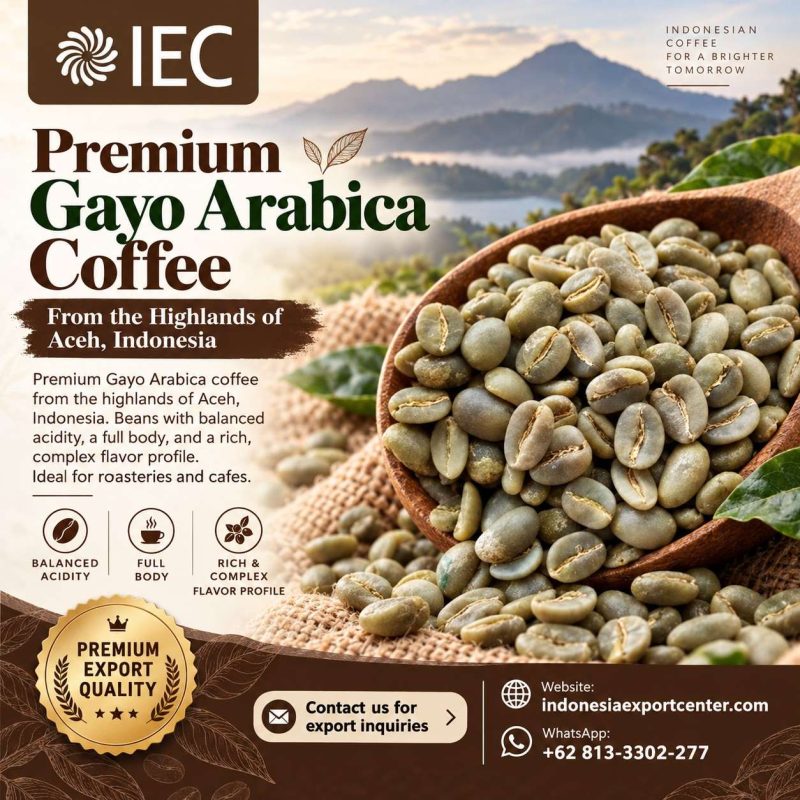
From the Highlands of Aceh, Indonesia
Supply Chain Traceability | Supplier Due Diligence | Responsible Procurement | ESG Documentation
Explore Gayo Arabica Coffee Through Responsible Sourcing
International coffee procurement increasingly involves questions beyond product quality and price.
Buyers may need to understand the origin of their coffee, the organizations involved in its supply chain, the availability of producer records, and whether environmental or social claims can be supported by evidence.
For sustainability sourcing managers, these considerations are important when evaluating potential coffee suppliers.
Gayo Arabica coffee from Aceh, Indonesia, may be considered for responsible sourcing programs where appropriate supplier and lot documentation is available.
Indonesia Export Center (IEC) facilitates inquiries for Gayo Arabica green coffee and helps buyers communicate their traceability, documentation, and supplier due diligence requirements.
IEC does not automatically certify coffee, audit farms, or guarantee compliance with sustainability standards.
What Responsible Coffee Sourcing Means
Responsible sourcing involves assessing relevant risks and obtaining suitable evidence about how products are produced, purchased, processed, and traded.
The exact requirements depend on the buyer’s policies, destination market, and applicable laws.
A responsible coffee procurement program may consider:
- Geographic origin.
- Producer identification.
- Supply chain traceability.
- Labor-related risks.
- Environmental practices.
- Agricultural production information.
- Supplier legal status.
- Product quality.
- Certification claims.
- Documentation integrity.
- Corrective action procedures.
Why Sustainability Buyers Evaluate Gayo Arabica
Origin Transparency
Buyers may request evidence supporting the stated Aceh Gayo origin.
Supplier Due Diligence
Procurement teams can assess potential commercial partners before contracting.
Traceability Development
Lot-level documentation can support a better understanding of the supply chain.
Quality and Risk Management
Quality testing and traceability can help identify and investigate product issues.
Customer Reporting
Documented information may support accurate communication with downstream customers.
Regulatory Preparation
Some import markets impose requirements concerning agricultural supply chains and due diligence.
Levels of Coffee Traceability
| Traceability Level | Potential Evidence |
|---|---|
| Country | Indonesian origin documentation |
| Region | Aceh Gayo origin records |
| Cooperative | Cooperative identity and purchase records |
| Producer Group | Producer group documentation |
| Farm | Farm-level records where available |
| Processing Lot | Processing and lot records |
| Export Lot | Shipment-linked identification |
Not every coffee lot offers the same level of traceability.
Mapping the Coffee Supply Chain
A potential supply chain may involve:
Coffee Farmer → Producer Group → Collector → Processor → Dry Mill → Trader → Exporter → Importer → Roaster
The actual structure should be verified.
Some suppliers may combine multiple roles, while other transactions may involve additional intermediaries.
Supplier Verification
A responsible sourcing assessment should begin with the supplier’s identity.
Buyers may request:
- Legal company name.
- Business registration details.
- Commercial address.
- Relevant operating facilities.
- Role in the supply chain.
- Product sourcing information.
- Export readiness.
- Quality management procedures.
- Available policies and certifications.
- Supporting records.
These documents should be evaluated for authenticity and relevance.
Farm and Producer Documentation
Depending on the sourcing program, buyers may request:
- Producer identification.
- Cooperative membership.
- Farm location records.
- Harvest information.
- Coffee purchase records.
- Processing records.
- Lot mapping.
- Applicable agricultural practice information.
Availability varies by supplier.
Personal data should be collected and handled in accordance with applicable privacy and data-protection requirements.
Ethical Sourcing Claims
Statements such as ethically sourced, fairly traded, or responsibly produced should not be used without sufficient evidence.
A buyer should define what each claim means and identify the supporting documentation.
Participation in a supply chain does not automatically establish compliance with a particular ethical standard.
Environmental Claims and Verification
Potential claims requiring substantiation include:
- Organic production.
- Deforestation-free sourcing.
- Reduced environmental impact.
- Sustainable agricultural practices.
- Certified production.
- Carbon-related performance.
These claims require appropriate evidence.
A general description of coffee as natural does not establish environmental certification or sustainability performance.
Certification Verification
Buyers may request certification information where relevant.
| Verification Item | Buyer Review |
|---|---|
| Certification Name | Identify the standard |
| Issuing Organization | Verify authority |
| Certificate Number | Record |
| Validity Period | Confirm current status |
| Product Scope | Confirm coffee coverage |
| Operator Scope | Confirm relevant entities |
| Lot Eligibility | Verify |
| Chain of Custody | Review |
| Destination Recognition | Check applicability |
No specific certification has been established for the Gayo Arabica coffee described on this page.
Destination-Market Compliance
Sustainability sourcing teams should assess applicable import regulations and due diligence obligations.
For European Union buyers, this may include evaluating whether the EU Deforestation Regulation applies to the relevant coffee products and transactions, and determining the current implementation requirements.
Other markets may have different food safety, labeling, customs, and supply-chain requirements.
Compliance must be evaluated for the actual shipment and current legal framework.
Coffee Quality Remains Essential
Responsible sourcing does not replace product quality control.
Buyers should also request:
- Processing method.
- Grade.
- Moisture.
- Defect count.
- Screen distribution.
- Cupping information.
- Lot identification.
- Packaging.
- Storage conditions.
The final purchasing decision should account for both commercial quality and the buyer’s responsible sourcing requirements.
Supplier Audit and Assessment
Some procurement programs require supplier questionnaires, remote assessments, document reviews, or independent audits.
A possible assessment process includes:
- Defining the required standard.
- Identifying the supplier.
- Reviewing legal documents.
- Mapping the supply chain.
- Evaluating traceability records.
- Reviewing relevant policies.
- Checking certifications.
- Assessing identified risks.
- Requesting corrective actions where needed.
- Approving or rejecting the supplier.
Any independent audit must be arranged with a qualified party under an agreed scope.
IEC does not claim to operate an accredited certification or audit service.
Traceability and Lot Segregation
When coffee from multiple sources is combined, buyers should understand how the supplier maintains product identity.
The purchasing specification should identify whether the product is a farm lot, cooperative lot, regional lot, or consolidated commercial lot.
The traceability claim must match the actual sourcing arrangement.
Responsible Sourcing Data Request
| Data Category | Requested Information |
|---|---|
| Supplier Identity | Legal details |
| Origin | Country and region |
| Producer Information | Available records |
| Cooperative | If applicable |
| Farm Data | Where required and available |
| Lot Code | Required |
| Processing | Documented |
| Quality Reports | Available test results |
| Certification | Valid documents if claimed |
| Supply Chain | Relevant participants |
| Environmental Evidence | Defined by buyer |
| Social Due Diligence | Defined by buyer |
| Export Documents | Shipment-specific |
Commercial Procurement Considerations
Sustainability requirements may affect sourcing complexity, documentation costs, supplier selection, and lead time.
Buyers should specify requirements early in the procurement process.
A supplier should not be considered compliant merely because it agrees verbally to a sustainability policy.
IEC Responsible Coffee Sourcing Process
IEC facilitates the following workflow:
Buyer Requirements → Potential Supplier Identification → Document Request → Origin and Traceability Review → Sample Evaluation → Commercial Discussion → Contracting with Actual Seller → Shipment Documentation
IEC’s role is to support communication and sourcing coordination.
The actual supplier remains responsible for its representations, and the buyer remains responsible for its own applicable due diligence obligations.
Sustainable Gayo Arabica Coffee RFQ
Subject: Responsible and Traceable Gayo Arabica Green Coffee Sourcing Inquiry
Dear Indonesia Export Center Team,
We are interested in sourcing Gayo Arabica green coffee with documented origin and responsible sourcing information.
Buyer Information
Company: [Name]
Country: [Country]
Website: [Website]
Contact Person: [Name]
Coffee Requirements
Product: Gayo Arabica Green Coffee
Origin: Aceh Gayo, Indonesia
Preferred Processing: [Details]
Grade: [Requirement]
Moisture Range: [Requirement]
Defect Limit: [Requirement]
Cupping Requirement: [Details]
Quantity: [kg / MT]
Traceability Requirements
Required Traceability Level: [Regional / Cooperative / Farm]
Required Origin Records: [Details]
Supply Chain Mapping: [Details]
Certification Requirements: [If Applicable]
Environmental Data Requirements: [Details]
Social Due Diligence Requirements: [Details]
Audit Requirements: [If Applicable]
Shipping Requirements
Packaging: [Details]
Destination Port: [Port]
Preferred Incoterm: [Term]
Target Shipment Date: [Date]
Please advise on potential supplier options, available traceability evidence, certification documents where applicable, quality specifications, samples, and export quotation.
Best regards,
[Name]Frequently Asked Questions
Is Gayo Arabica automatically sustainably sourced?
No. Sustainability claims require evidence relevant to the specific sourcing arrangement.
Can buyers request farm-level traceability?
Yes, where suitable records exist.
Does IEC guarantee deforestation-free coffee?
No. Any such claim requires appropriate verification against the relevant requirements.
Are organic and responsible sourcing the same?
No. Organic certification addresses a defined standard, while responsible sourcing may involve a broader set of requirements.
Can buyers request supplier audits?
They may be arranged with qualified parties, subject to agreement.
Does traceability guarantee coffee quality?
No. Physical and sensory quality must be evaluated separately.
Can IEC provide certification documents?
IEC can facilitate requests for documents available from potential suppliers.
Can sustainability buyers request recurring supply?
Yes, subject to supplier capacity, documentation continuity, and commercial agreement.
Request Responsible Gayo Arabica Coffee Sourcing
Explore Indonesian Gayo Arabica with clear origin requirements, documented supplier information, and evidence-based procurement practices.
REQUEST TRACEABLE GAYO ARABICA SOURCING QUOTATION
IEC | INDONESIA EXPORT CENTER
Indonesian Coffee for a Brighter Tomorrow
Website: https://indonesiaexportcenter.com/
WhatsApp: +62 813-3302-277
Related Resources
Traceable Gayo Arabica Coffee Supply
Certified Organic Gayo Arabica Coffee
Gayo Coffee Moisture and Defect Specifications
