

IEC | INDONESIA EXPORT CENTER
Natural Goodness from Indonesia to the World
Requesting Indonesian Edible Bird’s Nest Samples for International Evaluation
A product sample can help importers assess edible swiftlet bird’s nest before committing to a commercial purchase.
Samples may support visual inspection, product testing, packaging evaluation, and preliminary supplier qualification.
Indonesia Export Center (IEC) facilitates sourcing inquiries involving potential Indonesian edible bird’s nest suppliers.
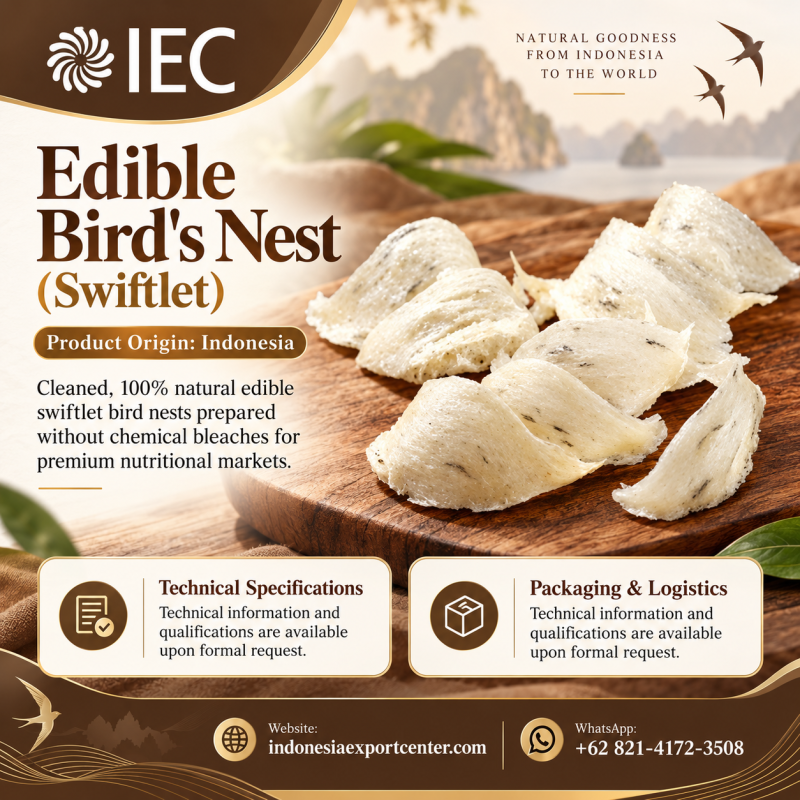
The IEC brochure describes cleaned, natural Indonesian edible swiftlet nests prepared without chemical bleaches.
Sample availability, sample quantity, cost, laboratory documentation, and international shipment feasibility must be confirmed.
Why Buyers Request Samples
Samples may help evaluate:
- Product appearance.
- Shape.
- Completeness.
- Colour.
- Visible foreign matter.
- Processing suitability.
- Packaging.
- Moisture.
- Relevant contaminants.
- Laboratory test results.
A sample should be evaluated against an established specification.
Step 1 – Define the Sample Purpose
Different buyers may need samples for different reasons.
Importer Qualification
Evaluate supplier documentation and product identity.
Wholesale Distribution
Assess appearance, grading, and presentation.
Food Manufacturing
Evaluate ingredient suitability for a proposed process.
Laboratory Verification
Conduct defined analytical testing.
Packaging Evaluation
Review product protection and handling.
Step 2 – Define the Product Form
Specify whether the sample should represent:
- Whole nests.
- Broken pieces.
- Strips.
- Fragments.
- Another defined form.
These forms may have different evaluation requirements.
Step 3 – Confirm Sample Import Eligibility
Before requesting dispatch, determine whether the destination country permits the sample.
Food samples may still require:
- Import authorization.
- Official certificates.
- Product documentation.
- Inspection.
- Customs declaration.
- Other regulatory procedures.
A small quantity or a declaration of “sample only” does not automatically exempt the shipment.
Step 4 – Request Sample Identification
A sample label should ideally identify:
- Supplier.
- Product.
- Product form.
- Grade.
- Lot number.
- Sample date.
- Net weight.
- Relevant storage instructions.
Step 5 – Confirm Sample Fees
Clarify:
- Product sample cost.
- Packaging cost.
- Testing charges.
- Freight.
- Insurance.
- Customs charges.
- Import duties or taxes.
- Other handling fees.
IEC does not advertise a guaranteed free-sample program.
Step 6 – Request Supporting Documents
Depending on the purpose, request:
- Product specification.
- Supplier declaration.
- Lot information.
- COA.
- Laboratory reports.
- Packaging details.
- Regulatory documentation.
Step 7 – Evaluate the Sample
A structured sample assessment may cover:
| Attribute | Evaluation |
|---|---|
| Product Identity | Confirm |
| Shape | Inspect |
| Appearance | Inspect |
| Cleaning Status | Review |
| Foreign Matter | Assess |
| Moisture | Test if required |
| Nitrite | Test if required |
| Microbiology | Test if required |
| Heavy Metals | Test if required |
| Packaging | Inspect |
| Traceability | Verify |
Step 8 – Record the Approval Decision
Buyers may classify the result as:
- Approved for further commercial discussion.
- Conditionally approved.
- Additional information required.
- Rejected.
Approval should be based on defined criteria.
Step 9 – Link Samples to Commercial Lots
An approved sample is most useful when it can be compared with the subsequent commercial material.
Buyers should define whether the sample represents:
- A particular production lot.
- A proposed commercial grade.
- A general product form.
- A reference specification.
A sample from one lot does not guarantee every later lot will be identical.
Step 10 – Prepare for Commercial Procurement
After successful evaluation, buyers may request:
- Final specification.
- MOQ.
- Commercial price.
- Packaging.
- Lead time.
- Laboratory requirements.
- Export documentation.
- Incoterms.
- Payment terms.
- Shipment schedule.
Sample Request Template
Subject: Indonesian Edible Bird’s Nest Sample Request
Company: [Name]
Country: [Country]
Product Form: [Details]
Required Grade: [Details]
Sample Quantity: [KG]
Sample Purpose: [Visual / Laboratory / Manufacturing]
Required Tests: [Details]
Required Documents: [Details]
Shipping Destination: [Country / City]
Import Authorization Status: [Details]
Expected Commercial Quantity: [KG]
Please advise sample availability, identification details, legal shipping requirements, estimated charges, and commercial sourcing feasibility.
Frequently Asked Questions
Does IEC guarantee samples?
No.
Are samples free?
No sample pricing policy is confirmed.
Can samples be shipped to every country?
No automatic eligibility should be assumed.
Can a sample be tested independently?
Yes, subject to legal and practical arrangements.
Does sample approval guarantee future lot quality?
No.
Can buyers request sample photographs first?
Yes, subject to supplier availability.
Request Indonesian Bird’s Nest Samples
Interested in evaluating Indonesian edible swiftlet bird’s nest before a commercial order?
Contact IEC with your sample purpose, product requirements, destination, and anticipated purchasing quantity.
REQUEST BIRD’S NEST SAMPLE INFORMATION
IEC | INDONESIA EXPORT CENTER
Website: https://indonesiaexportcenter.com/
WhatsApp: +62 821-4172-3508
Related Resources
Edible Bird’s Nest Quality Specifications
How to Inspect Cleaned Bird’s Nest
Selecting an Indonesian Bird’s Nest Supplier
