

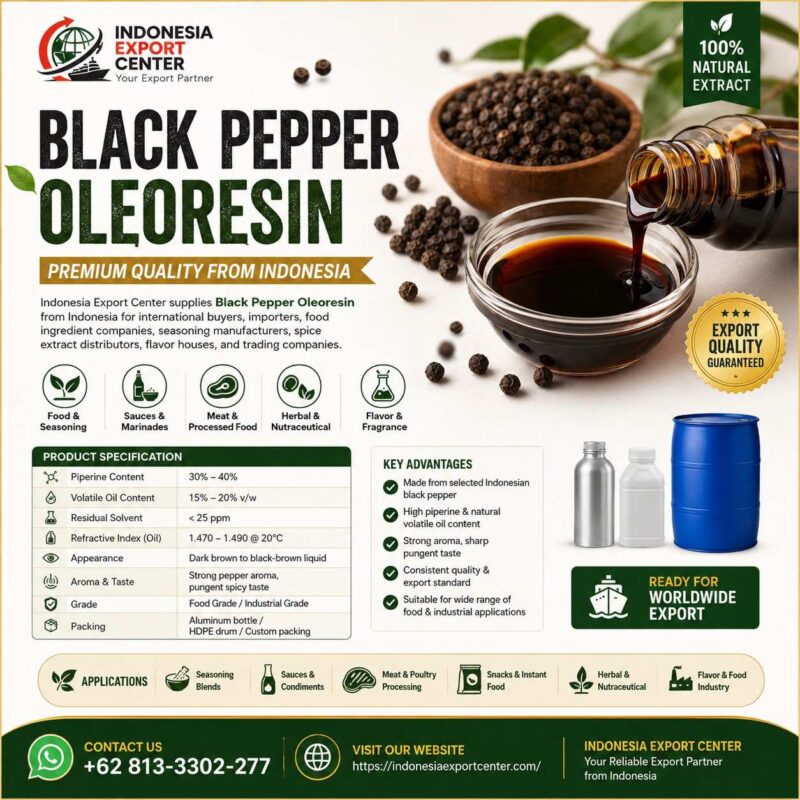
Understanding the Documents Required for Importing Black Pepper Oleoresin
When importing Black Pepper Oleoresin from Indonesia, buyers need to review both commercial shipping documents and product-related technical documents.
Proper documentation helps importers verify the product, prepare customs clearance, conduct quality checks, and meet applicable regulatory requirements.
However, the exact document list depends on the product’s classification, intended application, destination country, shipment method, and buyer requirements.
Indonesia Export Center facilitates sourcing inquiries for international buyers interested in Indonesian Black Pepper Oleoresin.
This guide explains the common documents buyers may need to request before confirming an order and arranging international shipment.
Why Export Documentation Matters
Export and import documents serve different purposes.
Some documents support the commercial transaction, while others provide technical, safety, origin, or regulatory information.
A complete document review helps buyers:
- Confirm the identity of the goods.
- Verify product specifications.
- Check batch analytical results.
- Prepare customs declarations.
- Review country-of-origin information.
- Support internal quality approval.
- Coordinate shipment and delivery.
- Assess regulatory requirements.
Buyers should establish the required documents before shipment rather than waiting until the goods arrive.
1. Commercial Invoice
A Commercial Invoice is a key document in an international trade transaction.
It generally contains information such as:
- Seller’s legal name and address.
- Buyer’s legal name and address.
- Invoice number.
- Invoice date.
- Product description.
- Quantity.
- Unit price.
- Total value.
- Currency.
- Country of origin, where stated.
- Delivery and trade-term information.
- Other transaction details.
What Black Pepper Oleoresin Buyers Should Check
Confirm that the product description is accurate.
For example, the invoice should identify the goods as Black Pepper Oleoresin rather than using an unclear description such as “spice material.”
Check that quantity, packaging, price, and buyer information match the purchase agreement.
2. Packing List
A Packing List describes how the goods are packed for shipment.
It may include:
- Product description.
- Number of packages.
- Net weight.
- Gross weight.
- Packaging type.
- Dimensions.
- Container or package identification.
- Shipment details.
What Buyers Should Check
Confirm that the packing list matches:
- The commercial invoice.
- The purchase order.
- The agreed packaging configuration.
- The actual shipment.
Accurate package and weight information helps logistics providers and customs brokers handle the shipment.
3. Bill of Lading or Air Waybill
A Bill of Lading (B/L) is commonly used for sea freight, while an Air Waybill (AWB) is used for air freight.
These documents provide important transportation and shipment information.
They may identify:
- Shipper.
- Consignee.
- Notify party.
- Port or airport of loading.
- Port or airport of destination.
- Description of goods.
- Package count.
- Gross weight.
- Transport details.
What Buyers Should Check
Review the shipment details and confirm that the consignee, destination, and goods information are correct.
The type of transport document and its issuance depend on the selected logistics arrangement.
4. Certificate of Analysis (COA)
The COA is an important technical document for Black Pepper Oleoresin buyers.
It provides analytical results for a particular product batch or sample.
Relevant information may include:
- Product name.
- Batch number.
- Test date.
- Analytical parameters.
- Test results.
- Measurement units.
- Test methods.
- Laboratory or responsible issuer.
- Authorization or approval details.
Parameters Buyers May Review
| Parameter | Why It Matters |
|---|---|
| Piperine Content | Indicates the reported piperine concentration |
| Volatile Oil Content | Provides information about volatile oil level |
| Residual Solvent | Relevant to extraction process and intended use |
| Appearance | Supports physical product assessment |
| Other Test Results | Depends on product specification and buyer requirements |
Buyers should verify that the COA corresponds to the actual batch being purchased.
A generic specification sheet is not the same as a batch-specific COA.
5. Technical Data Sheet (TDS)
A Technical Data Sheet provides product-related technical information.
For Black Pepper Oleoresin, a TDS may include:
- Product description.
- Botanical source.
- Product composition or characteristics.
- Piperine specification.
- Volatile oil information.
- Appearance.
- Aroma and taste.
- Physical properties.
- Packaging information.
- Storage instructions.
- Shelf-life information, where established.
- Intended application information.
What Buyers Should Check
Make sure the TDS matches the product being quoted.
If the supplier offers different grades or specifications, request the relevant document for each product.
6. Safety Data Sheet (SDS)
An SDS provides safety-related information for handling, storage, transportation, and emergency response where applicable.
Depending on the product classification and applicable rules, it may contain:
- Product identification.
- Hazard identification.
- Composition information.
- First-aid measures.
- Firefighting measures.
- Accidental release measures.
- Handling and storage.
- Exposure controls and personal protection.
- Physical and chemical properties.
- Stability and reactivity.
- Toxicological information.
- Transport information.
- Regulatory information.
Buyers should review the SDS and ensure that warehouse and handling teams follow the applicable safety instructions.
7. Certificate of Origin (COO)
A Certificate of Origin provides information about the origin of goods according to the applicable origin rules and issuing procedures.
For Indonesian Black Pepper Oleoresin, buyers may request origin documentation when it is required by customs, trade agreements, or internal procurement procedures.
What Buyers Should Check
Confirm:
- Exporter details.
- Product description.
- Origin declaration.
- Shipment information.
- Issuing authority or authorized organization.
- Applicable preferential origin requirements, if relevant.
A product’s raw material origin and its manufacturing origin may differ. Buyers should verify which origin is being declared and under which rules.
8. Ingredient and Composition Declaration
An ingredient or composition declaration may be important for food ingredient buyers.
It can help identify:
- Product identity.
- Main constituents.
- Added carriers or diluents, if any.
- Processing-related information, where disclosed.
- Other relevant formulation details.
The exact document format depends on the manufacturer and buyer requirements.
For food applications, buyers should review the declaration against the intended use and applicable destination-market rules.
9. Residual Solvent Test Results
Where the extraction process involves solvents, buyers may request residual solvent test information.
The document should identify:
- Relevant solvent.
- Test result.
- Unit of measurement.
- Analytical method.
- Sample or batch identification.
- Laboratory information.
Do not treat a general claim such as “low solvent” as a substitute for an actual test result.
The applicable requirements depend on the extraction process, intended use, and destination market.
10. Additional Quality and Compliance Documents
Depending on the buyer’s industry and destination country, other documents may be requested.
Examples include:
- Microbiological test results.
- Heavy metal analysis.
- Contaminant test reports.
- Pesticide residue information, where relevant.
- Allergen or cross-contact statement, where applicable.
- Manufacturing process information.
- Batch traceability records.
- Food safety management certificates, if available and relevant.
- Product-specific declarations required by the destination market.
Do not assume that every supplier has all these documents. Confirm availability, validity, scope, and relevance.
Export and Import Document Checklist
| Document | Main Purpose | Buyer Review |
|---|---|---|
| Commercial Invoice | Commercial transaction details | Product, quantity, price, parties |
| Packing List | Package and weight information | Net/gross weight and packaging |
| Bill of Lading | Sea freight transport document | Shipper, consignee, destination |
| Air Waybill | Air freight transport document | Shipment and consignee details |
| COA | Batch analytical results | Specification and batch identity |
| TDS | Technical product information | Product parameters and storage |
| SDS | Safety and handling information | Hazard and handling requirements |
| Certificate of Origin | Origin declaration | Origin and issuing authority |
| Ingredient Declaration | Product composition | Ingredients and intended use |
| Residual Solvent Report | Solvent test results | Test method and actual result |
| Other Test Reports | Additional quality verification | Buyer and regulatory requirements |
Which Documents Are Required for Every Shipment?
Not every document is mandatory for every Black Pepper Oleoresin shipment.
The requirements depend on:
- Product classification.
- Intended application.
- Destination country.
- Importer obligations.
- Customs procedures.
- Shipping method.
- Contractual requirements.
- Applicable food safety rules.
A buyer should prepare a document checklist with the customs broker and relevant regulatory professionals before shipment.
How to Review Documents Before Shipment
Before approving the shipment, follow these steps:
Step 1: Match Product Identity
Confirm that all documents refer to the correct product.
Step 2: Compare Quantities
Check that invoice, packing list, and shipment details agree.
Step 3: Review Batch Identification
Ensure that the COA and relevant technical documents correspond to the supplied product or batch.
Step 4: Check Company Details
Confirm that seller, buyer, exporter, and consignee information is consistent.
Step 5: Review Origin Information
Check that the origin declaration is appropriate for the transaction and destination.
Step 6: Confirm Regulatory Requirements
Make sure the documents satisfy the requirements identified by the destination-country importer and customs broker.
Step 7: Retain Document Copies
Keep relevant records for procurement, quality, customs, and traceability purposes.
Common Documentation Mistakes
1. Treating a product brochure as a COA
A brochure does not establish batch-specific analytical results.
2. Using an outdated TDS
Always request the current specification for the product being offered.
3. Inconsistent product descriptions
The invoice, packing list, and supporting documents should identify the product clearly and consistently.
4. Missing batch information
Batch identification is important for traceability and quality control.
5. Assuming certificates are automatically available
Ask which documents actually exist and request copies for review.
6. Ignoring destination-country requirements
A document set accepted for one market may not be sufficient for another.
How Indonesia Export Center Can Assist
Indonesia Export Center facilitates sourcing inquiries for international buyers interested in Black Pepper Oleoresin from Indonesia.
Our role may include:
- Coordinating requests for available COA and TDS documents.
- Requesting SDS and product information.
- Discussing origin documentation.
- Following up on available quality test reports.
- Coordinating buyer-specific documentation requests.
- Facilitating supplier communication.
- Supporting initial export sourcing discussions.
The availability and validity of documents depend on the selected supplier and transaction. Indonesia Export Center does not claim that a particular certification or document is available until it has been confirmed.
Frequently Asked Questions
1. What documents should I request before importing Black Pepper Oleoresin?
Start with the COA, TDS, SDS, commercial invoice, packing list, and relevant origin and transport documents. Additional requirements depend on the destination and intended use.
2. Is a COA mandatory?
It may be required by the buyer, contract, or applicable regulations. It is also an important document for technical and quality evaluation.
3. What is the difference between COA and TDS?
A COA reports analytical results for a batch or sample. A TDS describes the product’s technical characteristics and specifications.
4. Do I need a Certificate of Origin?
It may be required for customs, trade agreement, or buyer purposes. Confirm the requirement for your destination and transaction.
5. Is an SDS required for Black Pepper Oleoresin?
An SDS may be needed for safety communication, handling, transport, or compliance depending on the product classification and applicable rules.
6. Are food safety certificates always available?
No. Their availability depends on the supplier, manufacturing facility, product, and certification scope. Ask for valid supporting documents.
7. Can Indonesia Export Center help request these documents?
Yes. We can coordinate document requests with potential suppliers, subject to their availability.
Request Black Pepper Oleoresin and Export Documentation
Are you an importer, procurement manager, food manufacturer, or international ingredient distributor looking for Black Pepper Oleoresin from Indonesia?
Contact Indonesia Export Center to discuss product specifications, available documents, and sourcing requirements.
INDONESIA EXPORT CENTER
Your Reliable Export Partner from Indonesia
WhatsApp: +62 813-3302-277
Website: https://indonesiaexportcenter.com/
Request Product Documents and a Quotation
Please include:
- Required product specification.
- Piperine content target.
- Volatile oil requirement.
- Required quantity.
- Intended application.
- Destination country.
- Packaging preference.
- Required export and quality documents.
We welcome inquiries from international buyers seeking Indonesian Black Pepper Oleoresin.
