

IEC | INDONESIA EXPORT CENTER
DAMAR BATU VS GUM DAMAR
Natural Resin Identification | Material Differences | Application Testing | Indonesian Sourcing
Product / Buyer Need
Understanding the Difference Between Damar Batu and Gum Damar
International buyers may encounter the names damar batu, damar stone, gum damar, and damar gum when sourcing natural resins.
These terms can refer to materials with different botanical origins, physical characteristics, processing histories, and commercial uses.
They should not automatically be treated as interchangeable.
Indonesia Export Center (IEC) facilitates sourcing inquiries for industrial resin importers, formulation laboratories, and raw-material distributors seeking Indonesian natural resins.
For technical procurement, identifying the actual resin is more important than relying only on a trade name.
What Is Damar Batu?
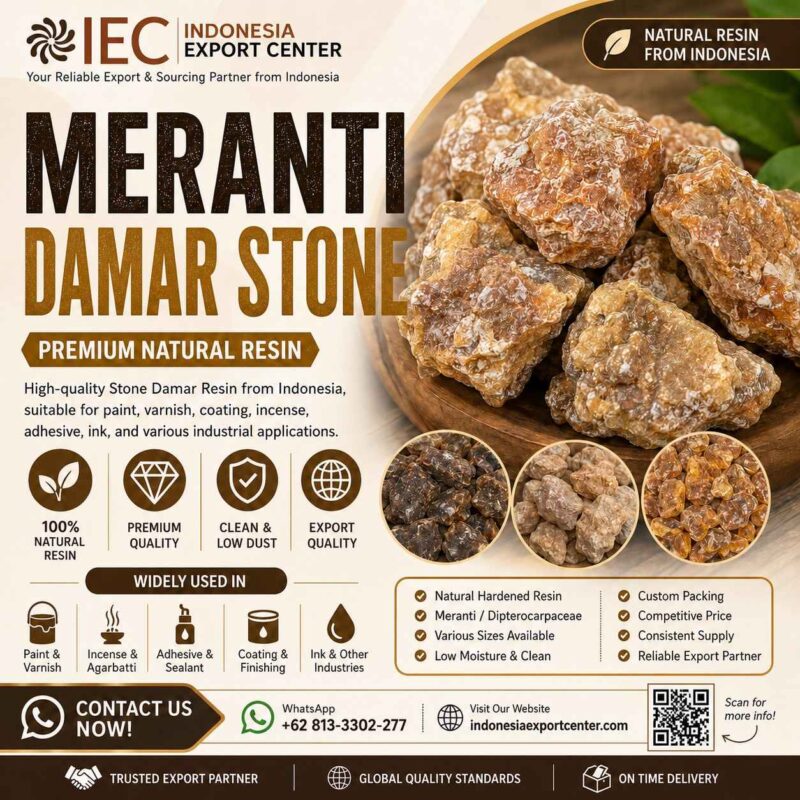
Damar batu is a commercial term associated with natural hardened resin.
Its exact source and composition should be established for the specific material offered.
Commercial descriptions may refer to stone-like resin lumps, but physical appearance alone does not confirm identity.
What Is Gum Damar?
Gum damar is a commercial term commonly associated with natural damar resins used in various traditional and industrial applications.
Depending on the trade context, gum damar may refer to resin from particular tree sources, including certain Dipterocarpaceae species.
However, suppliers may use overlapping or inconsistent naming conventions.
The buyer should request botanical or analytical identification when the distinction is technically important.
Material Comparison
| Parameter | Damar Batu | Gum Damar |
|---|---|---|
| Commercial Identity | Supplier-defined natural hardened resin | Supplier-defined natural damar resin |
| Botanical Origin | Requires verification | Requires verification |
| Physical Appearance | Lot-dependent | Lot-dependent |
| Lump Size | Supplier-specific | Supplier-specific |
| Color | Variable | Variable |
| Solubility | Must be tested | Must be tested |
| Impurities | Lot-dependent | Lot-dependent |
| Industrial Suitability | Application testing | Application testing |
| Interchangeability | Not assumed | Not assumed |
Different Origin and Appearance
The botanical origin of a natural resin can influence its composition and properties.
Even materials sold under similar names may behave differently during processing.
Buyers should investigate:
- Botanical source.
- Collection and processing method.
- Physical appearance.
- Color.
- Moisture.
- Impurities.
- Solubility.
- Relevant analytical characteristics.
Distinct Industrial Use Cases
Potential evaluation areas for natural resins may include:
- Varnish formulations.
- Paint research.
- Surface finishing.
- Specialty coatings.
- Incense production.
- Adhesive trials.
- Other resin-based industrial processes.
However, an application associated with one resin should not automatically be assigned to another.
Solubility and Compatibility
For formulation buyers, solubility may be a critical difference.
Testing should use the intended processing conditions and relevant formulation components.
The technical team may assess:
- Solubility or dispersibility.
- Dissolution time.
- Residue formation.
- Solution color.
- Viscosity.
- Formulation stability.
- Finished-product performance.
Test-Based Substitute Decisions
Step 1: Identify the Original Material
Determine the actual resin used in the existing formulation.
Step 2: Obtain Candidate Samples
Request representative samples of the proposed substitute.
Step 3: Compare Technical Characteristics
Evaluate identity, moisture, impurities, appearance, and application-specific properties.
Step 4: Conduct Laboratory Trials
Test the substitute in the actual formulation.
Step 5: Evaluate Finished Products
Compare performance against the established specification.
Step 6: Approve or Reject Substitution
Make the decision based on test evidence rather than commercial naming.
Why Trade Names Are Not Enough
A product labeled “damar” may not match the chemical and physical properties expected by a manufacturer.
For regulated or performance-critical applications, additional documentation and testing may be necessary.
Sampling & Terms
IEC can facilitate inquiries for available natural resin samples and supplier documentation.
Product identity, quantities, pricing, and export arrangements require supplier confirmation.
Request for Quotation
Subject: Damar Batu vs Gum Damar – Material Comparison Inquiry
Dear Indonesia Export Center Team,
We are comparing Indonesian natural resin materials for industrial use.
Company: [Name] Country: [Country] Application: [Description] Current Resin: [Name / Specification] Candidate Resin: [Damar Batu / Gum Damar] Required Botanical Identity: [Details] Physical Form: [Requirement] Solubility Requirements: [Details] Moisture Limit: [%] Impurity Limit: [%] Required Tests: [List] Sample Quantity: [Amount] Potential Order: [MT] Packaging: [Requirement] Destination Port: [Port] Incoterm: [Term]
Please advise on supplier identification, sample availability, and technical information.
Best regards,
[Name]
Frequently Asked Questions
Are damar batu and gum damar the same product?
Not necessarily. Their exact identities must be confirmed.
Can gum damar replace damar batu?
Only after technical qualification.
Can both materials be used in varnish?
Potential applications depend on the specific resin and formulation.
Does appearance establish resin identity?
No.
Can IEC help request samples of both materials?
IEC can facilitate supplier inquiries, subject to availability.
Request a Sourcing Quote
Compare Indonesian natural resin options through supplier verification and application testing.
REQUEST DAMAR RESIN MATERIAL COMPARISON
INDONESIA EXPORT CENTER
Your Reliable Export & Sourcing Partner from Indonesia
Website: https://indonesiaexportcenter.com/
WhatsApp: +62 813-3302-277
Related Resources
Meranti Damar Stone Supplier in Indonesia
Damar Stone for Varnish Manufacturers
Damar Stone Sample Request for Industrial Testing
