

IEC | INDONESIA EXPORT CENTER
DAMAR BATU IMPURITIES AND DUST SPECIFICATION
Natural Resin Quality Assurance | Foreign Matter Testing | Dust Percentage | International Procurement
Product / Buyer Need
Understanding Impurities and Dust in Indonesian Damar Batu
International buyers of damar batu require more than a general description of natural resin quality. For industrial processing, wholesale distribution, and manufacturing, the amount of foreign matter, dust, and smaller resin fragments can influence usable material yield, processing efficiency, and purchasing decisions.
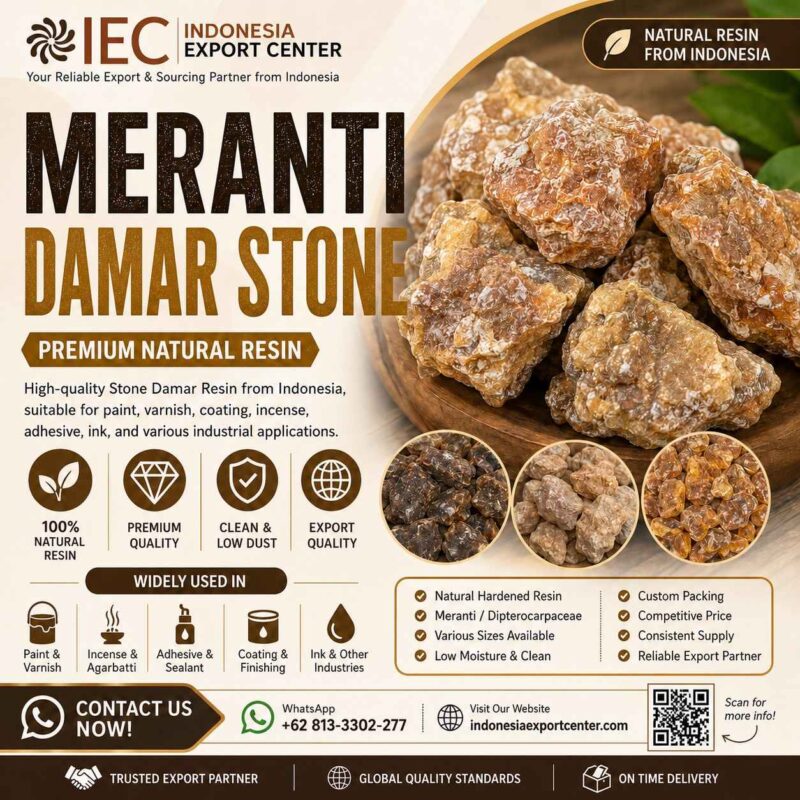
Damar batu, also commercially described as Meranti damar stone, is a natural hardened resin traded in Indonesia. Its physical characteristics may vary according to the source, collection process, sorting, handling, and storage.
For this reason, buyers should establish measurable acceptance criteria rather than relying only on commercial descriptions such as “clean,” “low dust,” “premium,” or “export quality.”
Indonesia Export Center (IEC) facilitates sourcing inquiries for international quality assurance managers, industrial resin importers, manufacturers, and distributors seeking Indonesian damar batu with buyer-defined quality specifications.
IEC can help coordinate requests for supplier information, representative lot photographs, samples, available test reports, and commercial quotations.
Actual quality characteristics and supply availability must be verified with the relevant supplier.
Product Specification Overview
| Parameter | Buyer Requirement |
|---|---|
| Product | Damar Batu / Meranti Damar Stone |
| Material | Natural hardened resin |
| Country of Origin | Indonesia, subject to verification |
| Resin Identity | Supplier evidence or testing |
| Physical Form | Lumps, selected pieces, or other confirmed forms |
| Lump Size | Buyer-defined |
| Foreign Matter | Buyer-defined maximum |
| Dust and Fines | Buyer-defined maximum |
| Moisture | Buyer-defined maximum |
| Color | Agreed reference |
| Sampling Procedure | Buyer-supplier agreement |
| Test Methods | Agreed and documented |
| COA | Subject to supplier or laboratory capability |
| Commercial Availability | Supplier confirmation |
What Counts as Foreign Matter?
Foreign matter refers to material that does not belong to the agreed resin product.
Depending on the lot, potential examples may include:
- Soil and sand.
- Stones or mineral fragments.
- Bark.
- Wood fragments.
- Leaves or other plant debris.
- Packaging residues.
- Unrelated resin materials.
- Other visible contaminants.
The buyer and seller should agree on the exact definition.
For example, a naturally occurring inclusion may be treated differently from an external contaminant depending on the product specification.
A clear definition helps prevent disputes during inspection.
Foreign Matter Method
Step 1: Identify the Commercial Lot
The lot should have a traceable reference connecting the sample to the material offered for sale.
Step 2: Collect Representative Samples
Sampling should cover different locations within the lot.
A sample taken only from the cleanest visible pieces may not represent the shipment.
Step 3: Define the Separation Method
The buyer and supplier should agree on how foreign matter will be identified and separated.
Step 4: Weigh the Material
The test procedure should specify whether measurements use as-received material or another defined basis.
Step 5: Calculate Foreign Matter Percentage
A simplified mass-based calculation is:
Foreign Matter (%) = Mass of Identified Foreign Matter ÷ Total Sample Mass × 100
The method should state whether any material is excluded from the calculation.
Step 6: Record the Result
The report should identify the sample, test method, measured result, and applicable acceptance limit.
Dust Percentage and Resin Fines
Why Dust Content Matters
Natural resin can fracture during handling and transportation.
This may generate small resin fragments or fine particles.
Dust and fines can affect:
- Material handling.
- Processing equipment.
- Warehouse cleanliness.
- Packaging losses.
- Grinding operations.
- Usable yield.
- Buyer acceptance.
However, fine resin particles are not automatically foreign matter.
They may remain chemically related to the intended resin but fall outside the required particle-size specification.
Defining Dust and Fines
The buyer should specify the size threshold used to classify fines.
For example:
Dust/Fines Definition: Material passing the agreed sieve size.
The actual sieve opening must be selected by the contracting parties.
Dust Percentage Calculation
Dust/Fines (%) = Mass of Material Below the Agreed Size Cut-Off ÷ Total Sample Mass × 100
The sampling and measurement method should be documented.
Foreign Matter vs Dust: Key Differences
| Characteristic | Foreign Matter | Resin Dust/Fines |
|---|---|---|
| Definition | Material outside the agreed resin product | Small particles of the resin |
| Typical Concern | Contamination | Size distribution and handling |
| Measurement | Sorting and weighing, or agreed method | Sieving or agreed particle-size method |
| Acceptance Limit | Buyer-defined | Buyer-defined |
| Processing Impact | May require removal | Depends on application |
| Commercial Value | Usually assessed as contamination | May be usable in selected processes |
Acceptance Criteria
Buyers should establish a written specification before ordering.
Example Buyer Specification
| Quality Parameter | Acceptance Requirement |
|---|---|
| Product Identity | Approved reference |
| Foreign Matter | Maximum [X]% |
| Dust/Fines | Maximum [X]% |
| Moisture | Maximum [X]% |
| Target Lump Size | [Range] |
| Undersized Material | Maximum [X]% |
| Color | Approved reference |
| Sampling Method | [Method] |
| Test Method | [Method] |
The placeholders must be completed using the buyer’s requirements and supplier-confirmed capability.
Why Sample Representativeness Matters
A small sample may not reflect the full composition of a bulk lot.
Differences may occur between the top, middle, and bottom of packed material.
For larger transactions, buyers may establish a formal sampling plan or arrange independent inspection.
Claims Verification
What Does “Clean Damar Batu” Mean?
The word “clean” should be supported by measurable criteria.
What Does “Low Dust” Mean?
A low-dust claim should identify the test method and maximum allowable percentage.
What Does “Premium Quality” Mean?
Premium is a commercial description, not a substitute for a technical specification.
What Does “Export Quality” Mean?
Export suitability depends on the agreed product specification, packaging, documentation, and applicable trade requirements.
Lot-to-Lot Quality Consistency
For recurring purchases, buyers should compare incoming lots against the same approved specification.
Important controls may include:
- Supplier identification.
- Lot numbering.
- Representative sampling.
- Moisture testing.
- Foreign-matter assessment.
- Fines measurement.
- Visual inspection.
- Acceptance documentation.
Pre-Shipment Inspection
Where required, the buyer may arrange an inspection before shipment.
The inspection scope should specify:
- Product identity.
- Quantity.
- Packaging.
- Lump-size distribution.
- Dust percentage.
- Foreign matter.
- Moisture.
- Lot traceability.
Inspection does not automatically establish suitability for every industrial application.
Documentation for Industrial Buyers
Buyers may request:
- Product specification sheet.
- Supplier identification.
- Lot photographs.
- Sample records.
- Test reports.
- Lot-specific COA where available.
- Packing list.
- Inspection report, if commissioned.
Request for Quotation
Subject: Damar Batu with Defined Impurity and Dust Specifications
Dear Indonesia Export Center Team,
We are seeking Indonesian damar batu for industrial procurement with specific cleanliness requirements.
Company: [Company Name] Country: [Country] Application: [Description] Required Resin: [Specification] Lump Size: [Range] Maximum Foreign Matter: [%] Maximum Dust/Fines: [%] Fines Definition: [Sieve Size] Maximum Moisture: [%] Sampling Method: [Requirement] Testing Requirements: [Details] Sample Quantity: [Amount] Initial Order: [MT] Monthly Forecast: [MT] Packaging: [Requirement] Destination Port: [Port] Preferred Incoterm: [Term]
Please advise on supplier availability, representative samples, test documentation, and commercial quotation.
Best regards,
[Name]
Frequently Asked Questions
What is the acceptable impurity percentage for damar batu?
There is no single universal limit applicable to every grade and industrial use. The buyer should establish an agreed maximum.
Is resin dust considered contamination?
Not necessarily. Resin fines and foreign matter should be distinguished.
Can buyers request low-dust damar batu?
Yes, subject to supplier capability and an agreed test method.
Can IEC provide test reports?
IEC can facilitate requests for supplier or laboratory documentation, subject to availability.
Should every shipment be inspected?
Inspection frequency depends on the buyer’s quality requirements and contract.
Can buyers request independent testing?
Yes, where suitable inspection and testing arrangements are available.
Request a Sourcing Quote
Looking for Indonesian damar batu with measurable dust and impurity limits?
Share your quality specification, testing requirements, order quantity, and destination.
REQUEST DAMAR BATU QUALITY SPECIFICATIONS
INDONESIA EXPORT CENTER
Your Reliable Export & Sourcing Partner from Indonesia
Website: https://indonesiaexportcenter.com/
WhatsApp: +62 813-3302-277
Related Resources
Damar Stone Product Specification Sheet
Damar Batu Moisture Testing for Import Buyers
Damar Batu Quality Inspection Before Shipment
