

IEC | INDONESIA EXPORT CENTER
DAMAR BATU FOR WOOD POLISH PRODUCTION
Natural Resin Sourcing | Wood Finishing | Color and Clarity Evaluation | Industrial Procurement
Product / Buyer Need
Natural Damar Stone for Wood Polish Manufacturers
Wood polish and finishing manufacturers require raw materials that support their desired appearance, application properties, and finished-product performance.
For transparent or decorative wood finishes, resin color, clarity, gloss, compatibility, and stability can be particularly important.
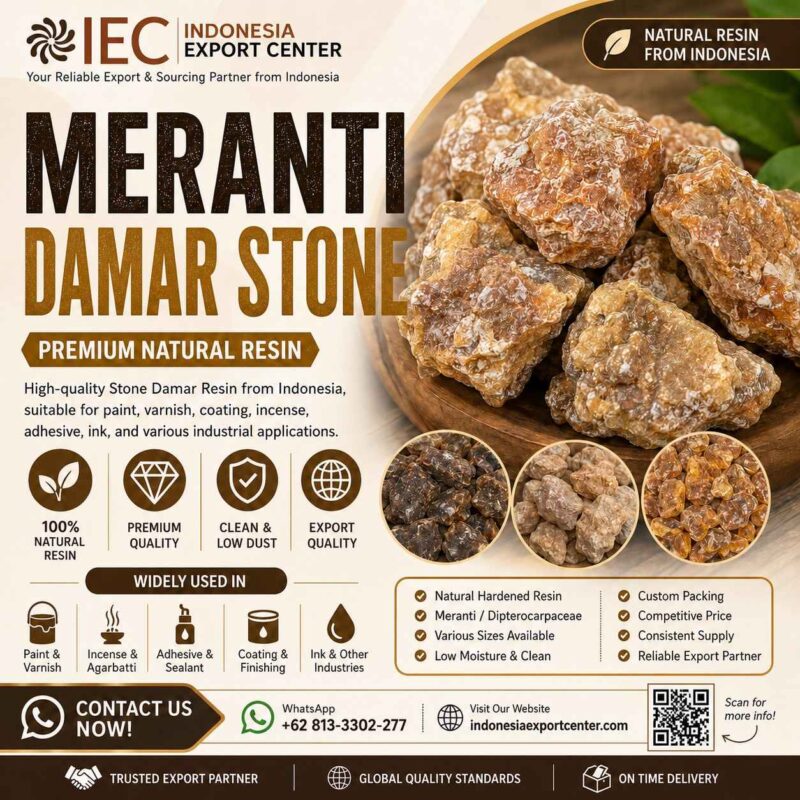
Damar batu is a natural hardened resin that may be evaluated for selected traditional or specialized wood finishing formulations.
However, its suitability depends on the actual resin grade, processing method, and formulation.
Indonesia Export Center (IEC) facilitates sourcing inquiries for international wood polish manufacturers, finishing-material distributors, and industrial buyers interested in Indonesian damar stone.
Product Overview
| Attribute | Procurement Consideration |
|---|---|
| Product | Damar Batu / Meranti Damar Stone |
| Material | Natural hardened resin |
| Origin | Indonesia, subject to verification |
| Physical Form | Resin lumps |
| Color | Lot-dependent |
| Clarity | Laboratory evaluation |
| Solubility | Formulation-specific |
| Moisture | Buyer-specified |
| Impurities | Buyer-specified |
| Packaging | Supplier-confirmed |
| Application Suitability | Buyer testing required |
Wood Polish Applications
Manufacturers may evaluate natural resin for:
- Traditional wood finishing products.
- Decorative surface coatings.
- Selected clear finishing systems.
- Specialized furniture-finishing formulations.
- Restoration-related formulations.
These are potential formulation areas, not guaranteed applications for every damar batu lot.
Color Variation
Why Color Matters
The color of a natural resin can influence the appearance of a wood finish.
A resin with a darker appearance may affect the final color of a transparent coating, especially on light-colored wood.
Color Evaluation
Buyers may assess:
- Raw resin appearance.
- Solution color.
- Color after filtration.
- Appearance on representative wood.
- Color after drying.
- Changes during aging.
An approved reference sample may help define acceptable variation.
Clarity and Transparency
Clarity is important for wood finishes intended to reveal the underlying wood grain.
Potential issues include:
- Undissolved particles.
- Haze.
- Sediment.
- Discoloration.
- Incompatible formulation components.
The manufacturer should evaluate the resin under its actual processing conditions.
Polishing Trials
Laboratory Preparation
The technical team should establish whether the resin can be processed into the intended formulation.
Application on Wood
Test panels should represent the intended wood species and surface preparation.
Appearance Evaluation
Assess gloss, transparency, color, and surface uniformity.
Performance Testing
Depending on the product, evaluate adhesion, drying, water exposure, abrasion, and aging.
Wood Polish Testing Matrix
| Test Area | Buyer Objective |
|---|---|
| Solubility | Suitable processing |
| Clarity | Transparent finish |
| Color | Acceptable appearance |
| Gloss | Target visual finish |
| Adhesion | Substrate compatibility |
| Drying | Practical application |
| Abrasion | Surface durability |
| Water Exposure | Intended-use resistance |
| Aging | Appearance stability |
Lot Consistency
Natural resin characteristics may vary between shipments.
Buyers should establish written acceptance criteria for color, moisture, foreign matter, and any application-critical properties.
Current lot photographs and representative samples can help with incoming inspection.
Supplier Verification
Before commercial purchase, buyers should confirm:
- Supplier identity.
- Resin source.
- Product identification.
- Current lot availability.
- Sorting practices.
- Sample traceability.
- Packaging.
- Export arrangements.
Packaging and Storage
Packaging should protect the resin from contamination and physical loss.
Storage requirements should be agreed based on the material and the buyer’s warehouse conditions.
Procurement Process
Step 1: Define the wood polish application.
Step 2: Request supplier and lot information.
Step 3: Obtain representative samples.
Step 4: Conduct clarity and color tests.
Step 5: Perform wood panel trials.
Step 6: Approve the specification.
Step 7: Request a commercial quotation.
Step 8: Confirm packaging and export terms.
Request for Quotation
Subject: Damar Batu for Wood Polish Manufacturing
Dear IEC Team,
We are seeking Indonesian damar batu for wood polish production.
Company: [Name] Country: [Country] Product Application: [Description] Resin Specification: [Details] Color Tolerance: [Requirement] Clarity Requirement: [Details] Solubility Requirement: [Details] Moisture Limit: [%] Impurity Limit: [%] Sample Quantity: [Amount] Trial Order: [MT] Commercial Quantity: [MT] Packaging: [Details] Destination Port: [Port] Incoterm: [Term]
Please advise on potential supplier lots, samples, technical information, and quotation.
Best regards,
[Name]
Frequently Asked Questions
Can damar batu be used in wood polish?
It may be evaluated for selected formulations, subject to testing.
Is every damar stone grade transparent?
No. Clarity and color depend on the actual material.
Can buyers request selected lumps?
They may request them, subject to supplier capability.
Does IEC guarantee gloss performance?
No. Finished-product performance requires testing.
Can suppliers provide consistent color?
This must be verified through an agreed specification and lot controls.
Request a Sourcing Quote
Explore Indonesian damar batu for wood polish and finishing applications.
REQUEST WOOD POLISH DAMAR STONE SOURCING
INDONESIA EXPORT CENTER
Your Reliable Export & Sourcing Partner from Indonesia
Website: https://indonesiaexportcenter.com/
WhatsApp: +62 813-3302-277
Related Resources
Damar Stone for Varnish Manufacturers
Damar Batu for Polishes and Surface Finishes
Damar Stone Sample Request for Industrial Testing
