

INDONESIA EXPORT CENTER | IEC
COCOPOT – COCONUT FIBER POT
Custom Coconut Fiber Plant Pot Sourcing for OEM Garden Brands, Commercial Nurseries & International Importers
Custom Dimensions | Moulded Coir Pot Designs | Tooling Feasibility | Sample Development | Private-Label Packaging | Bulk Export Inquiries
Looking for a custom size cocopot manufacturer in Indonesia for your nursery product line, private-label garden brand, or wholesale distribution business?
Standard coconut fiber plant pots may not always match the dimensions required by commercial growing systems, nursery trays, retail packaging, or specialized horticultural applications.
OEM buyers often need a specific top diameter, bottom diameter, height, wall thickness, shape, or packaging configuration.
Developing these products requires more than selecting a size. The manufacturer must evaluate tooling availability, production feasibility, material composition, dimensional tolerances, sample performance, and order volume.
Indonesia Export Center (IEC) facilitates sourcing and export inquiries for coconut fiber plant pots from Indonesia.
IEC can receive custom cocopot requirements and coordinate discussions about suitable manufacturing sources, subject to supplier capability and commercial confirmation.
IEC is a sourcing and export facilitation partner, not automatically the physical manufacturer or factory owner.
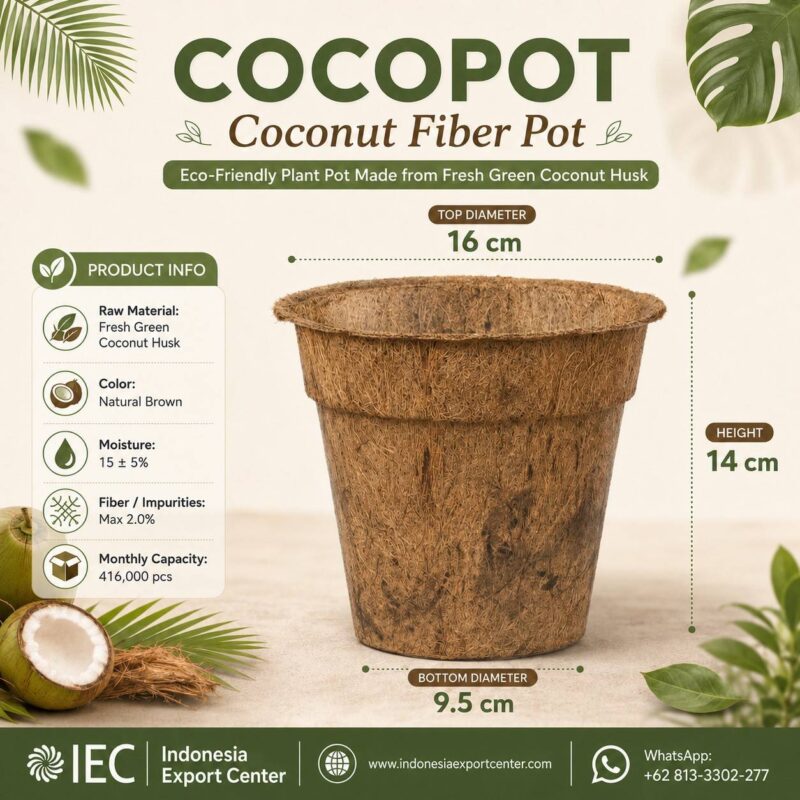
Our supplied cocopot reference is made from fresh green coconut husk and has a top diameter of 16 cm, height of 14 cm, and bottom diameter of 9.5 cm.
Buyers requiring different dimensions or custom moulded designs are invited to submit technical drawings and procurement requirements for feasibility review.
REQUEST A CUSTOM COCOPOT QUOTATION
WhatsApp: https://wa.me/628133302277
Website: https://indonesiaexportcenter.com/
Custom Size Cocopot – Product Reference & OEM Inquiry
| Specification | IEC Reference / Custom Inquiry Status |
|---|---|
| Product | Cocopot / Coconut Fiber Plant Pot |
| Raw Material | Fresh Green Coconut Husk |
| Color | Natural Brown |
| Moisture | 15 ± 5% |
| Fiber / Impurities | Maximum 2.0%, definition to be confirmed |
| Reference Top Diameter | 16 cm |
| Reference Height | 14 cm |
| Reference Bottom Diameter | 9.5 cm |
| Stated Monthly Capacity | 416,000 Pieces |
| Custom Diameters | Subject to Manufacturing Feasibility |
| Custom Heights | Subject to Manufacturing Feasibility |
| Custom Shapes | Subject to Manufacturing Feasibility |
| Wall Thickness | To Be Confirmed |
| Moulding Method | To Be Verified |
| Existing Tooling | To Be Confirmed |
| New Mold Development | Subject to Supplier Capability |
| Sample Development | To Be Confirmed |
| OEM Packaging | Subject to Supplier Confirmation |
| MOQ | To Be Confirmed |
| Custom Product Price | Request Quotation |
| Production Lead Time | To Be Confirmed |
| Export Terms | Subject to Agreement |
Important: The 16 cm × 14 cm × 9.5 cm measurements are supplied reference dimensions. Other sizes and shapes are customization inquiries, not confirmed available models.
1. Custom Size Cocopot Manufacturing: What OEM Buyers Need
Custom-size cocopots are coconut fiber plant pots designed to meet buyer-specific dimensions or product requirements.
A custom project may involve changes to:
- Top diameter
- Bottom diameter
- Pot height
- Wall thickness
- Taper
- Overall shape
- Drainage configuration
- Surface finish
- Packaging arrangement
The feasibility of each modification depends on the manufacturer’s actual equipment, forming process, tooling, and material requirements.
For international OEM buyers, the goal is to establish a repeatable product specification that can be evaluated, approved, and purchased under clear commercial terms.
2. Why Choose Custom Cocopot Dimensions?
Different horticultural applications may require different pot geometries.
Nursery Tray Compatibility
A custom pot may be designed around the dimensions of a specific nursery tray or growing system.
Buyers should supply the tray opening, usable depth, spacing, and handling requirements.
Plant Growing Requirements
Different crops and growth stages may require different growing volumes and pot proportions.
The suitability of a proposed pot should be tested under actual nursery conditions.
Retail Product Differentiation
Custom sizes and shapes may help garden brands develop a distinctive product range.
Packaging Compatibility
Pot dimensions can influence carton utilization, retail box design, and warehouse storage.
Repeat OEM Programs
An approved product drawing and reference sample can provide a consistent basis for future purchase orders.
Repeat manufacturing capability must be confirmed with the supplier.
3. IEC Standard Cocopot Reference
The supplied IEC product reference identifies the following specifications.
| Product Parameter | Reference Value |
|---|---|
| Product | Coconut Fiber Pot |
| Raw Material | Fresh Green Coconut Husk |
| Color | Natural Brown |
| Moisture | 15 ± 5% |
| Fiber / Impurities | Maximum 2.0% |
| Monthly Capacity | 416,000 Pieces |
The precise meaning and measurement method of the “fiber / impurities” parameter require confirmation.
The stated monthly capacity does not establish available production allocation for a custom-size order.
4. Reference Cocopot Dimensions
| Measurement | Reference Dimension |
|---|---|
| Top Diameter | 16 cm / 160 mm |
| Height | 14 cm / 140 mm |
| Bottom Diameter | 9.5 cm / 95 mm |
These measurements can serve as an initial product reference when discussing a custom design.
They do not establish available tooling for alternative dimensions.
5. Custom Cocopot Size Options
OEM buyers may request different size categories according to their intended application.
| Requested Category | Typical Buyer Application | Availability |
|---|---|---|
| Small Cocopots | Propagation and seed-starting programs | To Be Confirmed |
| Medium Cocopots | Nursery and garden retail applications | To Be Confirmed |
| Large Cocopots | Selected landscaping and larger plant applications | To Be Confirmed |
| Custom Diameter | Tray-specific or retail-specific requirements | Feasibility Review |
| Custom Height | Growing volume or packaging requirements | Feasibility Review |
| Custom Shape | OEM product differentiation | Feasibility Review |
No additional size is represented as confirmed available without supplier verification.
6. Technical Specifications for Custom Coir Pots
A complete technical specification helps reduce uncertainty during quotation and sample development.
| Technical Parameter | Buyer Input |
|---|---|
| Top Diameter | Required dimension in mm |
| Bottom Diameter | Required dimension in mm |
| Height | Required dimension in mm |
| Wall Thickness | Required thickness in mm |
| Shape | Round / Square / Polygon / Other |
| Taper | Specify if critical |
| Internal Volume | Specify if required |
| Unit Weight | Target weight in grams |
| Drainage | Required configuration |
| Dimensional Tolerance | Buyer requirement |
| Intended Use | Nursery / Retail / Other |
Buyers should identify critical dimensions separately from non-critical dimensions.
7. Custom Round Cocopots
Round cocopots are relevant to buyers seeking familiar plant pot geometry.
Custom round-pot inquiries may involve changes to the top diameter, bottom diameter, height, and taper.
Important Considerations
- Growing volume
- Nursery tray fit
- Pot stability
- Wall thickness
- Packing arrangement
Existing mold availability must be checked before confirming production.
8. Custom Square and Polygon Cocopots
Some OEM garden brands may seek geometric designs.
Possible inquiry categories include:
- Square pots
- Rectangular pots
- Hexagonal pots
- Octagonal pots
- Other multi-sided shapes
Polygon pots may require dimensions measured across flats and across corners.
Corners, wall thickness, and nesting behavior should be evaluated during development.
These are requested design categories, not confirmed IEC catalog products.
9. Moulded Coir Pots and Manufacturing Feasibility
Custom cocopot production may involve a forming process that uses molds or other tooling.
However, the actual manufacturing method must be verified with the proposed supplier.
Important Questions
- Which forming method is used?
- What equipment is available?
- Are suitable existing molds available?
- What dimensional limits apply?
- Can the requested wall thickness be achieved?
- What material composition is required?
- Can the design be produced consistently?
- What MOQ applies?
The answers should be obtained before the buyer approves tooling expenditure.
10. Existing Mold vs. New Mold Development
An important early decision is whether the proposed manufacturer has suitable existing tooling.
Existing Mold
If a suitable mold is available, the buyer should request its actual product dimensions and sample.
New Mold
If new tooling is required, the supplier should review the proposed design and commercial requirements.
Tooling Review Should Cover
- Design feasibility
- Tooling cost
- Tooling lead time
- Tooling ownership
- Maintenance responsibility
- Design revision costs
- Storage arrangements
- Tool transfer rights
No confirmed mold development service, tooling price, or tooling lead time has been supplied.
11. Tooling Ownership for OEM Buyers
Tooling ownership should be documented before development begins.
OEM buyers may wish to clarify:
- Who pays for the mold
- Who legally owns it
- Whether the mold is dedicated to one buyer
- Who maintains it
- Whether it can be used for other customers
- What happens when the commercial relationship ends
These terms should be agreed in writing.
12. Material Composition of Coconut Fiber Pots
The supplied IEC reference identifies fresh green coconut husk as the raw material.
However, the complete composition of the finished pot has not been established.
Request Confirmation Of
- Coconut fiber content
- Binder materials
- Adhesives
- Coatings
- Other additives
- Material processing methods
A natural coconut fiber raw material description does not automatically establish that the finished pot is plastic-free, binder-free, or certified compostable.
13. Wall Thickness and Product Weight
Wall thickness and unit weight are important design parameters.
They may influence:
- Pot handling
- Structural performance
- Growing volume
- Packaging
- Freight weight
- Material consumption
Buyer Recommendation
Define the target wall thickness and unit weight in the drawing or product specification.
The actual achievable values must be confirmed through supplier evaluation and samples.
14. Dimensional Tolerances
A custom product requires agreed dimensional tolerances.
For example, a buyer may request a top diameter of 160 mm with an allowable variation of ±3 mm.
This would define an acceptance range of 157–163 mm.
This is an illustrative tolerance only, not a confirmed manufacturing capability.
Measurements to Control
- Top diameter
- Bottom diameter
- Height
- Wall thickness
- Shape
- Critical fitting dimensions
Tolerances should be approved after the supplier reviews manufacturing feasibility.
15. OEM Sample Development
Sample approval is an important step before bulk production.
Stage 1 – Product Brief
The buyer submits dimensions, drawings, target quantity, and application.
Stage 2 – Feasibility Review
The prospective manufacturer evaluates the design and available tooling.
Stage 3 – Commercial Proposal
Tooling, sample costs, MOQ, and estimated timelines are discussed.
Stage 4 – Sample Preparation
Samples may be prepared if manufacturing capability and commercial arrangements are confirmed.
Stage 5 – Sample Inspection
The buyer evaluates dimensions, appearance, weight, and intended performance.
Stage 6 – Revision
Design changes may be requested if the first sample does not meet requirements.
Stage 7 – Approval
The final approved sample and drawing become the reference for bulk production.
This is a recommended development workflow, not a guarantee that every stage is currently offered by IEC.
16. Golden Sample and Drawing Revision Control
A golden sample is an approved physical reference used to assess later production.
Recommended Records
- Sample identification
- Drawing revision number
- Approval date
- Material specification
- Dimensions
- Unit weight
- Visual acceptance criteria
- Approved deviations
Why Revision Control Matters
A buyer may change the pot height or wall thickness during development.
Without clear revision records, a supplier could quote one design and manufacture another.
The final purchase order should identify the approved drawing revision.
17. Quality Control for Custom Cocopots
Quality control should be based on the approved specification.
Recommended Inspection Points
- Top diameter
- Bottom diameter
- Height
- Wall thickness
- Unit weight
- Moisture
- Material composition
- Shape consistency
- Surface condition
- Visible defects
- Packaging quantity
Inspection frequency and acceptance criteria should be agreed with the supplier.
18. Moisture Requirements
The supplied IEC reference specifies:
Moisture: 15 ± 5%
If interpreted as percentage points, this corresponds to approximately 10–20% moisture.
The exact test method and contractual acceptance criteria require confirmation.
Moisture management is relevant to product weight, storage, packing, and transport.
19. Nursery Performance Testing
A custom cocopot should be evaluated for its intended horticultural application.
Potential Testing Areas
- Growing media retention
- Pot stability
- Wet handling
- Irrigation performance
- Root development
- Transplanting suitability
- Growing-period durability
No verified nursery performance test results have been supplied for the IEC reference product.
20. Biodegradability and Compostability
Coconut fiber is a natural plant-derived material.
However, finished-product biodegradability depends on complete composition and environmental conditions.
Claims Requiring Evidence
- Fully biodegradable
- Home compostable
- Industrially compostable
- Direct-plantable
- Plastic-free
- Chemical-free
Buyers should request relevant finished-product test evidence before using these claims.
21. OEM and Private-Label Packaging
OEM garden brands may have specific packaging requirements.
Potential Requests
- Retail cartons
- Printed sleeves
- Product labels
- Instruction inserts
- Barcode labels
- Shipping marks
- Buyer-branded cartons
Availability, printing specifications, costs, and MOQ require supplier confirmation.
22. Stacking and Nesting for Custom Cocopots
Stacking and nesting can influence packing efficiency.
Stacking
Placing products or packed units vertically.
Nesting
Placing one pot partly inside another.
Important Design Factors
- Taper
- Wall thickness
- Shape
- Material stiffness
- Dimensional consistency
Actual stacking and nesting feasibility must be tested.
23. Export Carton Specifications
| Packing Parameter | Confirmation Required |
|---|---|
| Pieces per Carton | Yes |
| Carton Length | Yes |
| Carton Width | Yes |
| Carton Height | Yes |
| Net Weight | Yes |
| Gross Weight | Yes |
| Packing Arrangement | Yes |
| Product Protection | Yes |
| Shipping Marks | Yes |
No confirmed carton count or packing configuration has been supplied for custom sizes.
24. Container Loading for Custom Cocopots
Container loading depends on the approved design and packing method.
Main Variables
- Product dimensions
- Unit weight
- Pieces per carton
- Carton dimensions
- Palletization
- Container type
- Loading restrictions
A container loading estimate should be prepared using verified packaging data.
25. Minimum Order Quantity for Custom Sizes
MOQ means Minimum Order Quantity.
Custom-size orders may have different MOQ requirements from existing standard products.
MOQ Factors
- Mold availability
- Tooling development
- Product complexity
- Manufacturing scheduling
- Packaging
- Order quantity
No confirmed MOQ has been supplied for custom-size cocopots.
26. Custom Cocopot Pricing
Custom product pricing depends on the technical and commercial requirements.
Potential Cost Components
- Tooling
- Sample development
- Unit manufacturing
- Packaging
- Quality inspection
- Inland transportation
- Export handling
- Freight
Buyers should request a quotation that separates one-time development costs from recurring unit costs.
27. Production Capacity and Lead Time
IEC’s supplied reference states:
Monthly Capacity: 416,000 Pieces
This figure should not be interpreted as confirmed custom-size production capacity.
Buyers Should Confirm
- Actual manufacturer
- Product-specific output
- Available production allocation
- Tooling lead time
- Sample lead time
- Bulk production lead time
- Shipment readiness
28. Repeat OEM Orders
OEM garden brands may need recurring production of an approved product.
Recommended Repeat-Order Controls
- Approved technical drawing
- Golden sample
- Material specification
- Inspection criteria
- Packaging specification
- Forecast quantities
- Production lead time
- Change approval procedure
Repeat supply commitments must be agreed with the actual supplier.
29. Manufacturer vs. Sourcing Partner
International buyers should distinguish the company physically manufacturing the product from the company facilitating procurement.
| Responsibility | Manufacturer | Sourcing Partner |
|---|---|---|
| Physical Production | Performs manufacturing | May coordinate sourcing |
| Production Equipment | Operates relevant equipment | Does not necessarily own equipment |
| Tooling | May develop or operate tooling | May facilitate tooling discussions |
| Product Quality | Responsible under agreed contracts | May coordinate quality requirements |
| Export Coordination | May participate | May facilitate arrangements |
| Contractual Seller | Depends on transaction | Depends on transaction |
IEC Positioning
Indonesia Export Center is a sourcing and export facilitation partner.
The actual manufacturer, contractual seller, exporter of record, and payment beneficiary should be identified before the transaction.
30. Custom Cocopot Procurement Process
Step 1 – Submit Your Design
Provide the technical drawing, required dimensions, and intended application.
Step 2 – Review Manufacturing Feasibility
Confirm whether a suitable manufacturer and tooling arrangement are available.
Step 3 – Clarify Tooling Requirements
Determine whether existing or new tooling is required.
Step 4 – Request Samples
Discuss sample availability, costs, and development timelines.
Step 5 – Approve the Product
Confirm the golden sample and drawing revision.
Step 6 – Obtain the Commercial Quotation
Review MOQ, unit price, tooling cost, and payment terms.
Step 7 – Approve Packaging
Confirm carton packing and labeling.
Step 8 – Confirm Production
Agree on quality standards and the production schedule.
Step 9 – Arrange Inspection
Apply agreed inspection procedures.
Step 10 – Coordinate Export
Confirm commercial parties, Incoterms, shipping documents, and logistics.
31. Custom Cocopot OEM Procurement Checklist
Design and Tooling
-
Technical drawing completed
-
Top diameter confirmed
-
Bottom diameter confirmed
-
Height confirmed
-
Wall thickness specified
-
Shape confirmed
-
Tolerances defined
-
Existing tooling checked
-
New tooling feasibility reviewed
-
Tooling ownership agreed
Samples and Quality
-
Sample availability confirmed
-
Sample cost confirmed
-
Sample inspection completed
-
Golden sample approved
-
Drawing revision recorded
-
Material composition reviewed
-
Moisture specification agreed
-
Quality criteria agreed
Commercial
-
MOQ confirmed
-
Tooling cost confirmed
-
Unit price confirmed
-
Production allocation confirmed
-
Lead time confirmed
-
Payment terms agreed
Export
-
Packaging approved
-
Pieces per carton confirmed
-
Container loading estimate reviewed
-
Contractual seller identified
-
Exporter of record identified
-
Destination port confirmed
-
Incoterm agreed
32. Why Contact Indonesia Export Center?
Indonesia Export Center (IEC) facilitates sourcing and export inquiries for Indonesian coconut-derived products.
IEC welcomes custom cocopot inquiries from:
- OEM garden brands
- Commercial nurseries
- Garden product importers
- Horticultural distributors
- Private-label retailers
- International procurement teams
Discuss Your Project Requirements
- Custom dimensions
- Product shapes
- Technical drawings
- Mold feasibility
- Samples
- MOQ
- Unit prices
- Quality requirements
- Packaging
- Export quotations
All manufacturing capabilities and commercial arrangements require confirmation.
Request a Custom Size Cocopot Quotation
Develop a Coconut Fiber Pot That Matches Your Product Requirements
Planning a custom cocopot project for your garden brand, nursery supply business, or international distribution network?
Send IEC your technical drawing, required dimensions, expected order quantity, packaging preferences, and destination.
Indonesia Export Center (IEC)
Your Export & Sourcing Partner from Indonesia
Website: https://indonesiaexportcenter.com/
WhatsApp: +62 813-3302-277
REQUEST CUSTOM COCOPOT SOURCING INFORMATION:
https://wa.me/628133302277
Custom Cocopot RFQ Template
Subject: Custom Size Cocopot – OEM Tooling, Samples & Bulk Export Inquiry
Dear Indonesia Export Center Team,
We are interested in sourcing custom-size coconut fiber plant pots from Indonesia for our OEM garden product program.
Please review the following requirements and advise on manufacturing feasibility, tooling, samples, MOQ, pricing, and export arrangements.
Company Name: [Company Name]
Country: [Country]
Contact Person: [Name]
Email: [Email]
WhatsApp: [Number]
Product Application: [Commercial Nursery / Garden Retail / Other]
Required Shape: [Round / Square / Polygon / Other]
Top Diameter: [mm]
Bottom Diameter: [mm]
Height: [mm]
Wall Thickness: [mm]
Target Unit Weight: [g]
Required Tolerances: [Details]
Technical Drawing Available: [Yes / No]
Existing Mold Acceptable: [Yes / No]
Custom Tooling Required: [Yes / No / To Be Confirmed]
Sample Quantity: [Pieces]
Initial Order Quantity: [Pieces]
Estimated Annual Volume: [Pieces]
Packaging Requirements: [Details]
Private-Label Requirements: [Details]
Destination Country: [Country]
Destination Port: [Port]
Preferred Incoterm: [EXW / FCA / FOB / CFR / CIF / Other]
Target Shipment Date: [Date]
Please provide:
- Manufacturing feasibility confirmation
- Proposed manufacturer information
- Existing mold availability
- Custom tooling requirements
- Tooling cost and ownership terms
- Sample development availability
- Sample costs and lead time
- Material composition information
- Achievable dimensional tolerances
- MOQ per size
- Unit price
- Product-specific production capacity
- Production lead time
- Quality inspection procedures
- Packaging specifications
- Estimated container loading
- Export quotation
- Payment terms
- Quotation validity
We look forward to your sourcing proposal.
Best regards,
[Your Name]
[Company Name]
[Country]
SEND YOUR RFQ:
https://wa.me/628133302277
Frequently Asked Questions
Can I request custom cocopot dimensions?
Yes. Buyers can submit custom-dimension inquiries for manufacturing feasibility review. Availability is not guaranteed.
Does IEC manufacture custom cocopots directly?
IEC is positioned as a sourcing and export facilitation partner. The actual manufacturer must be identified for the proposed transaction.
What is the standard IEC reference size?
The supplied reference is 16 cm top diameter, 14 cm height, and 9.5 cm bottom diameter.
Can I request a smaller or larger pot?
Custom-size requests can be evaluated, subject to manufacturer capability and tooling.
Can I request square or polygon cocopots?
Geometric design inquiries may be submitted for feasibility review.
Are custom molds available?
Existing tooling and new mold development capabilities must be confirmed with the proposed manufacturer.
Is a new mold required for every custom size?
Not necessarily. This depends on the requested design and available tooling.
Who owns the custom mold?
Tooling ownership should be agreed in writing.
Can I request samples before bulk production?
Sample inquiries may be submitted, subject to supplier capability and commercial arrangements.
What is a golden sample?
A golden sample is an approved physical product used as a reference for subsequent manufacturing.
What dimensional tolerances are available?
Achievable tolerances must be confirmed after technical review and sample evaluation.
What is the raw material?
The supplied reference identifies fresh green coconut husk.
What is the moisture specification?
15 ± 5%, with test method and acceptance criteria requiring confirmation.
Are cocopots biodegradable?
Finished-product biodegradability depends on composition and test conditions and must be verified.
Can cocopots be planted directly into soil?
Direct-planting suitability requires product-specific evaluation.
What is the MOQ for custom cocopots?
MOQ depends on the design and manufacturing arrangements and must be confirmed.
What is the custom cocopot unit price?
Pricing depends on dimensions, tooling, material requirements, quantity, and packaging.
What is the stated monthly production capacity?
The supplied reference states 416,000 pieces per month, but custom-design capacity must be verified separately.
Can custom cocopots be supplied with private-label packaging?
Private-label packaging inquiries may be submitted, subject to supplier capability and MOQ.
Can custom cocopots be nested for shipping?
Nesting feasibility depends on the finished design and must be tested.
How many custom cocopots fit in a shipping container?
Container loading depends on the actual product dimensions, packaging, and container type.
Can I place recurring OEM orders?
Repeat-order arrangements may be discussed, subject to supplier availability and agreement.
What should I send to request a quotation?
Provide your technical drawing, required dimensions, quantity, packaging requirements, destination country, and destination port.
Custom Size Cocopot Manufacturer Indonesia – Contact IEC
Custom Coconut Fiber Pots for OEM Garden Brands and Wholesale Importers
Reference Raw Material: Fresh Green Coconut Husk
Reference Color: Natural Brown
Reference Moisture: 15 ± 5%
Reference Dimensions: 16 cm Top Diameter × 14 cm Height × 9.5 cm Bottom Diameter
Stated Monthly Capacity: 416,000 Pieces, Subject to Verification
Custom Sizes: Subject to Manufacturing Feasibility
Moulded Designs: Subject to Supplier Confirmation
Tooling: To Be Confirmed
Samples: To Be Confirmed
MOQ: To Be Confirmed
Wholesale Price: Request Quotation
Production Lead Time: To Be Confirmed
Export Terms: Subject to Agreement
INDONESIA EXPORT CENTER | IEC
Website: https://indonesiaexportcenter.com/
WhatsApp: +62 813-3302-277
REQUEST YOUR CUSTOM COCOPOT QUOTATION TODAY
Please include your company name, required dimensions, technical drawing, initial order quantity, and destination country.
Product and Manufacturing Disclaimer: IEC facilitates sourcing and export inquiries. The supplied reference does not independently establish ownership of a cocopot factory, a verified moulded-pot production method, or confirmed custom tooling capabilities. Custom designs, samples, MOQ, available capacity, prices, packaging, and export arrangements require supplier verification.
