

IEC | INDONESIA EXPORT CENTER
Your Global Sourcing Partner
CRUDE PALM OIL VS REFINED PALM OIL
Product Comparison | Refining Process | Quality Specifications | Industrial Applications | B2B Procurement
Understanding the Difference Between Crude Palm Oil and RBD Palm Oil
International buyers often encounter several palm oil product descriptions when sourcing from Indonesia.
Two important categories are Crude Palm Oil (CPO) and RBD Palm Oil, meaning Refined, Bleached and Deodorized Palm Oil.
Although both originate from oil palm fruit, they differ in processing stage, product characteristics, typical applications, and procurement requirements.
Selecting the correct product is essential for refineries, food manufacturers, industrial processors, and commodity traders.
Indonesia Export Center (IEC) facilitates inquiries involving potential Indonesian crude palm oil suppliers.
Availability of RBD palm oil or other refined palm products must be separately confirmed with the actual supplier. IEC does not guarantee a specific refined product portfolio.
What Is Crude Palm Oil?
Crude Palm Oil is an unrefined oil obtained from the fleshy portion of oil palm fruit.
It contains naturally occurring pigments and other components that contribute to its characteristic appearance.
CPO is commonly used as feedstock for further refining and processing.
What Is RBD Palm Oil?
RBD stands for:
Refined – Bleached – Deodorized
RBD palm oil has undergone refining processes intended to reduce or remove selected undesirable components and produce characteristics suitable for its intended downstream application.
Actual product specifications depend on the refining process and commercial grade.
CPO vs RBD Palm Oil Comparison
| Feature | Crude Palm Oil (CPO) | RBD Palm Oil |
|---|---|---|
| Processing Stage | Unrefined | Refined |
| Typical Appearance | Reddish-orange to reddish-brown | Generally lighter in color |
| Pigment Content | Contains natural pigments | Pigments substantially reduced through refining |
| Free Fatty Acids | Depends on crude oil quality | Generally reduced through refining |
| Odor | Characteristic crude oil odor | Reduced through deodorization |
| Main Commercial Role | Refinery feedstock and industrial input | Refined ingredient or further processing feedstock |
| Quality Specifications | Crude oil parameters | Refined oil parameters |
| Purchasing Considerations | Refining suitability and yield | Intended application and finished product requirements |
Actual characteristics must be confirmed through supplier documentation.
1. Difference in Processing
Crude Palm Oil Production
CPO is produced through the processing of oil palm fruit.
The resulting crude oil may require additional refining before use in many finished food applications.
RBD Palm Oil Production
RBD palm oil undergoes refining operations.
Depending on the refinery process, these may involve degumming or pretreatment, bleaching, and deodorization, along with other relevant steps.
The specific process depends on the facility and product requirements.
2. Difference in Appearance
CPO typically has a reddish or reddish-brown appearance due in part to naturally occurring pigments.
RBD palm oil is generally lighter because refining reduces many color-forming components.
Appearance alone is not sufficient to establish product identity or quality.
3. Difference in Free Fatty Acid Content
FFA is a significant parameter in crude palm oil quality evaluation.
Refining can reduce free fatty acid content.
However, the actual FFA specification for RBD palm oil must be obtained from the relevant supplier.
Do not apply a crude palm oil FFA specification automatically to refined palm oil.
4. Difference in Color Measurement
CPO and RBD palm oil may be evaluated using different commercial quality specifications.
The IEC CPO reference lists a Lovibond color target, but the exact method and cell length must be confirmed.
A refined oil color specification should be obtained separately.
5. Difference in Odor
Crude palm oil may retain characteristic odors associated with the unrefined product.
Deodorization is intended to reduce volatile compounds that contribute to unwanted odor or flavor.
Actual sensory characteristics depend on processing and product quality.
6. Difference in Applications
Common CPO Applications
CPO is commonly purchased for:
- Palm oil refining.
- Industrial oil processing.
- Further fractionation after appropriate processing.
- Other suitable industrial applications.
Common RBD Palm Oil Applications
Depending on its grade and applicable standards, RBD palm oil may be used in:
- Food manufacturing.
- Ingredient production.
- Industrial processing.
- Further fractionation.
- Other applications requiring refined oil.
Suitability for any particular food or industrial use must be verified.
7. CPO Reference Specifications
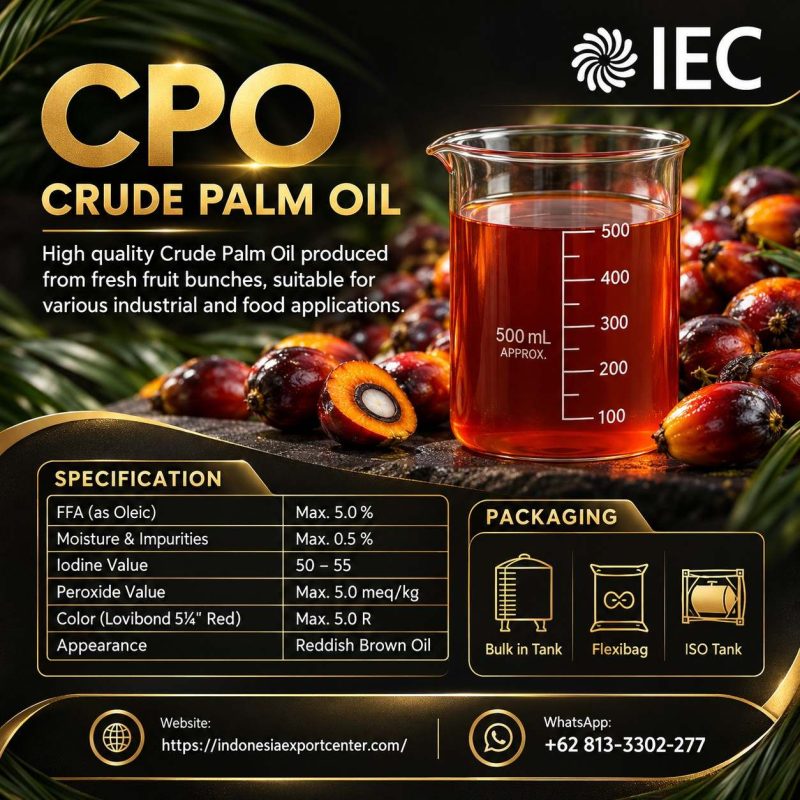
The IEC brochure provides the following CPO reference targets:
| Parameter | Reference Target |
|---|---|
| FFA, as Oleic | Maximum 5.0% |
| Moisture & Impurities | Maximum 0.5% |
| Iodine Value | 50–55 |
| Peroxide Value | Maximum 5.0 meq/kg |
| Lovibond Color, 5¼-inch Red | Maximum 5.0 R |
| Appearance | Reddish Brown Oil |
These figures are not a current COA.
They should not be represented as specifications for RBD palm oil.
8. RBD Palm Oil Specifications
Buyers considering RBD palm oil should request a separate product specification.
Depending on the intended use, relevant parameters may include:
- Free fatty acid content.
- Moisture.
- Color.
- Peroxide value.
- Iodine value.
- Melting or cloud-related characteristics where relevant.
- Other applicable food or industrial quality parameters.
No numerical RBD specification is provided here because it was not included in the supplied product reference.
9. CPO vs RBD Palm Olein
RBD palm olein is not the same product as RBD palm oil.
Palm olein is a liquid fraction obtained through fractionation.
Buyers should distinguish among:
- CPO.
- RBD palm oil.
- RBD palm olein.
- RBD palm stearin.
- Palm kernel oil.
Each product may have different specifications and customs classifications.
10. Refinery Feedstock Considerations
A refinery purchasing CPO may evaluate:
- FFA.
- Moisture and impurities.
- Oxidation indicators.
- Product composition.
- Expected processing performance.
- Handling requirements.
- Supply consistency.
- Commercial price.
Actual refinery performance depends on the feedstock and process.
11. Packaging and Transportation
The IEC CPO brochure mentions:
- Bulk in tank.
- ISO tank.
- Flexibag.
These are proposed arrangements requiring supplier and technical confirmation.
Transport suitability must be evaluated for the specific product, equipment, carrier, and route.
The same packaging or handling arrangement should not automatically be assumed suitable for every refined palm oil product.
12. CPO vs RBD Procurement Cost
The commercial comparison should consider more than the quoted price per metric ton.
Potential factors include:
- Product price.
- Freight.
- Insurance.
- Import duties.
- Storage.
- Handling.
- Refining cost.
- Processing yield.
- Quality.
- Product losses.
- Working capital.
For a refinery, the cost of converting CPO into a refined product may be an important purchasing consideration.
For a manufacturer without refining capability, buying a suitable refined product may be operationally necessary.
13. Which Product Should You Buy?
| Buyer Requirement | Product to Evaluate |
|---|---|
| Refinery feedstock | Crude Palm Oil |
| Refined palm oil ingredient | Appropriate RBD Palm Oil grade |
| Liquid fraction for a specific application | Appropriate Palm Olein grade |
| Higher-melting fraction | Appropriate Palm Stearin grade |
| Palm kernel-derived oil | Palm Kernel Oil |
Final suitability depends on the buyer’s technical requirements and applicable regulations.
14. Quality Verification
For either crude or refined palm oil, buyers should request:
- Correct product description.
- Supplier specification.
- Cargo-specific COA.
- Applicable test methods.
- Inspection requirements.
- Packaging or transport details.
- Relevant regulatory documents.
15. CPO vs RBD Supplier Inquiry Template
Subject: Indonesian Palm Oil Product Comparison and Sourcing Inquiry
Company: [Name]
Country: [Country]
Product Required: [CPO / RBD Palm Oil / Other]
Intended Application: [Details]
Quantity: [MT]
Required Specifications: [Details]
Packaging or Transport: [Details]
Destination Port: [Port]
Preferred Incoterm: [FOB / CFR / CIF]
Shipment Period: [Dates]
Inspection Requirements: [Details]
Please advise on potential Indonesian suppliers, available product types, verified specifications, and commercial quotation.
Frequently Asked Questions
What does CPO stand for?
CPO stands for Crude Palm Oil.
What does RBD mean?
RBD stands for Refined, Bleached and Deodorized.
Is CPO the same as RBD palm oil?
No. RBD palm oil has undergone further refining.
Is RBD palm oil always more expensive?
Not necessarily. Prices depend on market conditions, product specifications, and commercial terms.
Can crude palm oil be used directly in every food application?
No. Suitability depends on the intended use and applicable requirements.
Is RBD palm olein the same as RBD palm oil?
No. Palm olein is a fractionated product.
Does IEC guarantee availability of RBD palm oil?
No. Product availability must be confirmed with the actual supplier.
Can buyers request both CPO and RBD quotations?
Yes. Potential suppliers can be asked to confirm which products they can offer.
Request Indonesian Palm Oil Sourcing Information
Compare crude and refined palm oil options based on your industrial application, quality requirements, and procurement strategy.
REQUEST INDONESIAN PALM OIL QUOTATION
IEC | INDONESIA EXPORT CENTER
Your Global Sourcing Partner
Website: https://indonesiaexportcenter.com/
WhatsApp Inquiry: +62 821-4172-3508
Related Resources
Crude Palm Oil (CPO) Supplier Indonesia
Indonesian CPO Sourcing for Refineries
CPO Technical Specifications and Quality Parameters
