

IEC | INDONESIA EXPORT CENTER
Your Global Sourcing Partner
INDONESIAN CRUDE PALM OIL (CPO)
Bulk CPO | Refinery Feedstock | Industrial Raw Materials | International B2B Procurement
Explore Crude Palm Oil Sourcing Opportunities from Indonesia
Indonesia is a major global producer of palm oil and an important sourcing market for international companies purchasing crude palm oil for refining, food manufacturing, oleochemical processing, and other industrial applications.
For professional buyers, identifying a potential crude palm oil supplier in Indonesia is only the beginning of the procurement process. A successful transaction also requires technical specifications, verified supplier identity, current product availability, appropriate logistics, and clear commercial terms.
Indonesia Export Center (IEC) facilitates B2B sourcing inquiries and introductions to potential Indonesian crude palm oil suppliers.
IEC supports the initial procurement process by helping international buyers communicate their product specifications, commercial requirements, destination markets, and documentation needs.
IEC operates as a sourcing intermediary. The actual producer, seller, and exporter of record must be established for each transaction.
What Is Crude Palm Oil?
Crude Palm Oil, commonly abbreviated as CPO, is an unrefined vegetable oil obtained from the fleshy mesocarp of oil palm fruit.
It is typically produced through industrial processing of harvested fresh fruit bunches.
CPO commonly has a reddish-orange to reddish-brown appearance because it contains naturally occurring pigments and other components.
Before being used in many food applications, CPO undergoes further refining and processing to meet the intended product specifications.
Major Applications of CPO
Edible Oil Refining
CPO is a feedstock for refineries producing refined palm oil and downstream fractions used in food manufacturing.
Food Ingredient Manufacturing
After appropriate refining and processing, palm-derived products may be used in cooking oils, bakery fats, margarine, shortening, and other food applications.
Oleochemical Industry
Palm oil derivatives can serve as raw materials for selected oleochemical manufacturing processes.
Industrial Processing
Depending on the applicable specifications and regulations, palm-derived materials may be used in industrial products and downstream processing.
Biofuel Supply Chains
Palm oil may be relevant to certain biofuel production pathways, subject to technical, sustainability, and regulatory requirements.
Why Source Crude Palm Oil from Indonesia?
International buyers may investigate Indonesia for several reasons:
- Established palm oil production and processing industry.
- Access to potential plantation, mill, trading, and refining supply chains.
- Opportunities for bulk commodity procurement.
- Availability of different commercial arrangements depending on the seller.
- Maritime export infrastructure serving international markets.
- Opportunities to evaluate suppliers against buyer-specific quality and traceability requirements.
These market characteristics do not guarantee that a particular supplier has exportable stock or the capacity to fulfill a specific order.
Reference CPO Product Specifications
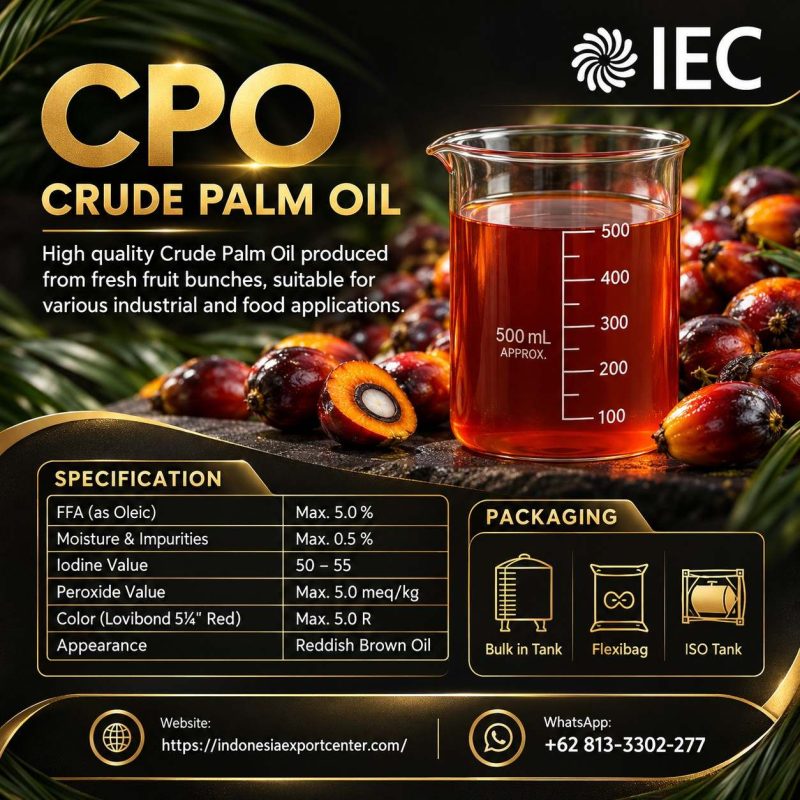
The following table reproduces the reference product targets supplied for IEC’s CPO marketing material. They must be confirmed by a current, lot-specific Certificate of Analysis before being used as an accepted commercial specification.
| Quality Parameter | Reference Target |
|---|---|
| Free Fatty Acid (FFA), as Oleic | Maximum 5.0% |
| Moisture & Impurities | Maximum 0.5% |
| Iodine Value | 50–55 |
| Peroxide Value | Maximum 5.0 meq/kg |
| Color, Lovibond 5¼-inch Red | Maximum 5.0 R |
| Appearance | Reddish Brown Oil |
The FFA analytical basis, test methods, reporting units, sample condition, and acceptance criteria must be agreed with the actual supplier.
A reference specification is not evidence that a particular shipment meets these parameters.
Understanding Key CPO Quality Parameters
Free Fatty Acid (FFA)
FFA indicates the free fatty acid content of the oil and is an important parameter for refinery feedstock evaluation.
Higher FFA may affect refining losses and processing economics.
The reported result must identify the analytical basis, such as oleic acid or palmitic acid, and the method used.
Moisture and Impurities
Moisture and insoluble impurities can affect storage, handling, processing efficiency, and product quality.
Buyers should establish whether moisture and impurities are reported as a combined result or separately.
Iodine Value
Iodine value is used to characterize the degree of unsaturation of oils and fats.
The agreed specification should identify the applicable testing method.
Peroxide Value
Peroxide value is an indicator related to primary oxidation products.
It should be interpreted alongside other quality information, storage history, and the agreed analytical procedure.
Color
Color may be measured using a specified Lovibond cell and reporting method.
The cell path length and color scale must be clearly identified to avoid inconsistent comparisons.
CPO Packaging and Transportation Options
The supplied product information identifies three possible packaging or transport formats.
Bulk in Tank
Bulk tank handling may be suitable for larger industrial cargoes where appropriate storage, loading, and marine transport facilities are available.
Flexibag
Flexibag shipment may be considered only where the selected system, carrier, route, cargo properties, and applicable regulations permit its use.
ISO Tank
ISO tanks may be considered for selected liquid cargo shipments, subject to equipment suitability and operator acceptance.
The availability and suitability of each format must be confirmed for the specific transaction.
Bulk CPO Procurement Requirements
Professional buyers should prepare the following information before requesting a quotation:
- Product: Crude Palm Oil.
- Intended application.
- Required quality specification.
- Required quantity in metric tons.
- Delivery frequency.
- Destination country.
- Destination port.
- Preferred Incoterm.
- Required packaging or bulk shipment format.
- Target delivery schedule.
- Required origin and traceability records.
- Required certifications, if applicable.
- Inspection and testing requirements.
- Payment and contract requirements.
Supplier Verification and Due Diligence
Before purchasing, buyers should confirm the identity and legal standing of the actual contracting seller.
Recommended checks include:
- Company registration.
- Business address and authorized representatives.
- Relationship to the mill, producer, or stockholder.
- Actual control of the offered product.
- Current stock or production allocation.
- Export authorization where required.
- Quality documentation.
- Origin and traceability records.
- Loading terminal arrangements.
- Payment beneficiary details.
- Ability to supply the agreed shipping documents.
Buyers should independently verify commercial claims and avoid relying solely on brochures or informal offers.
Sustainability and Responsible Sourcing
Some international buyers require sustainability and supply-chain documentation.
Depending on the destination and intended use, relevant requests may include:
- Mill identification.
- Plantation or supply-base information.
- Chain-of-custody records.
- Certification evidence where applicable.
- Deforestation-related due diligence.
- Applicable regulatory compliance documentation.
Certification or traceability should never be claimed unless valid supporting evidence is available for the relevant supply chain and product.
Export Documentation
Documents may include:
- Commercial invoice.
- Packing list or bulk cargo quantity statement.
- Bill of lading.
- Certificate of origin where applicable.
- Certificate of Analysis.
- Independent inspection certificate where agreed.
- Cargo insurance documents where applicable.
- Other documents required by Indonesian export rules or the destination market.
The actual exporter and logistics provider must confirm the final documentation requirements.
How IEC Facilitates CPO Sourcing
Step 1 – Buyer Inquiry
Submit the requested product, quantity, specification, and destination.
Step 2 – Preliminary Supplier Identification
IEC may communicate the inquiry to potential suppliers or relevant commercial partners.
Step 3 – Supplier and Product Verification
The buyer reviews the actual seller’s identity, capacity, documents, and product information.
Step 4 – Quality Review
The buyer evaluates a representative COA, sampling arrangement, and inspection requirements.
Step 5 – Commercial Quotation
The actual seller provides a dated quotation with agreed specifications and commercial terms.
Step 6 – Contract and Shipment
The buyer and actual seller finalize the contract, payment terms, logistics, and documentation.
Request a Crude Palm Oil Quotation
Subject: Indonesian Crude Palm Oil (CPO) – B2B Sourcing Inquiry
Company Name: [Company]
Country: [Country]
Buyer Type: [Refinery / Importer / Trader / Manufacturer]
Product: Crude Palm Oil
Required FFA: [Specification and Basis]
Moisture & Impurities: [Requirement]
Iodine Value: [Requirement]
Peroxide Value: [Requirement]
Color: [Requirement]
Quantity: [MT]
Order Type: [Spot / Contract]
Delivery Schedule: [Date or Frequency]
Packaging / Transport: [Bulk Tank / Flexibag / ISO Tank]
Destination Port: [Port]
Preferred Incoterm: [FOB / CFR / CIF / Other]
Inspection Requirement: [Details]
Required Certifications: [If Applicable]
Required Documents: [Details]
Please advise on potential verified suppliers, current availability, COA, MOQ, export arrangements, and commercial quotation.
Frequently Asked Questions
Does IEC directly manufacture crude palm oil?
IEC facilitates sourcing inquiries. The actual manufacturer or seller must be identified separately.
Can IEC connect international buyers with Indonesian CPO suppliers?
IEC can assist with inquiries and potential supplier introductions, subject to supplier availability and verification.
Is CPO with maximum 5% FFA available?
Maximum 5% FFA is a reference target in the supplied marketing material. Actual compliance requires a verified COA and confirmation of the analytical basis.
What is the minimum order quantity?
MOQ depends on the supplier, available cargo, logistics, and commercial arrangement.
Is bulk vessel shipment possible?
Potentially, subject to supplier capacity, loading terminal arrangements, vessel suitability, and contract terms.
Can buyers request a Certificate of Analysis?
Yes. Buyers should request a current COA connected to the proposed lot or cargo.
Can buyers request FOB or CIF terms?
Yes, subject to a verified seller quotation and appropriate Incoterms 2020 arrangements.
Are sustainability certifications guaranteed?
No. Certification status and chain-of-custody coverage must be verified.
Connect with Indonesia Export Center
Looking for a potential Crude Palm Oil supplier in Indonesia?
Submit your technical specifications and purchasing requirements to begin a structured B2B sourcing inquiry.
REQUEST CPO SUPPLIER INFORMATION AND QUOTATION
IEC | INDONESIA EXPORT CENTER
Your Global Sourcing Partner
Website: https://indonesiaexportcenter.com/
WhatsApp Inquiry: +62 821-4172-3508
Explore Related CPO Resources
Bulk Crude Palm Oil Sourcing Indonesia
Indonesian CPO Sourcing for Refineries
CPO Technical Specifications and Quality Parameters
Crude Palm Oil Price Inquiry Indonesia
