

INDONESIA EXPORT CENTER | IEC
COCOPOT – COCONUT FIBER POT
Bulk Coconut Fiber Plant Pots for Container-Scale Importers, Garden Distributors & International Wholesalers
20ft Container Planning | 40ft Container Planning | Bulk Packing | Palletization | Loading Capacity | Export Procurement
Planning a full-container purchase of coconut fiber plant pots?
For large-scale importers and wholesale distributors, sourcing container load coir pots requires more than confirming the product price.
Container loading efficiency, unit weight, nesting arrangements, packaging dimensions, palletization, cargo protection, and freight terms all affect the final landed cost.
Indonesia Export Center (IEC) facilitates sourcing and export inquiries for coconut fiber plant pots from Indonesia, including bulk orders intended for 20ft and 40ft container shipments.
IEC welcomes inquiries covering wholesale product specifications, bulk quantities, packaging configurations, loading calculations, palletized or floor-loaded arrangements, and export quotations.
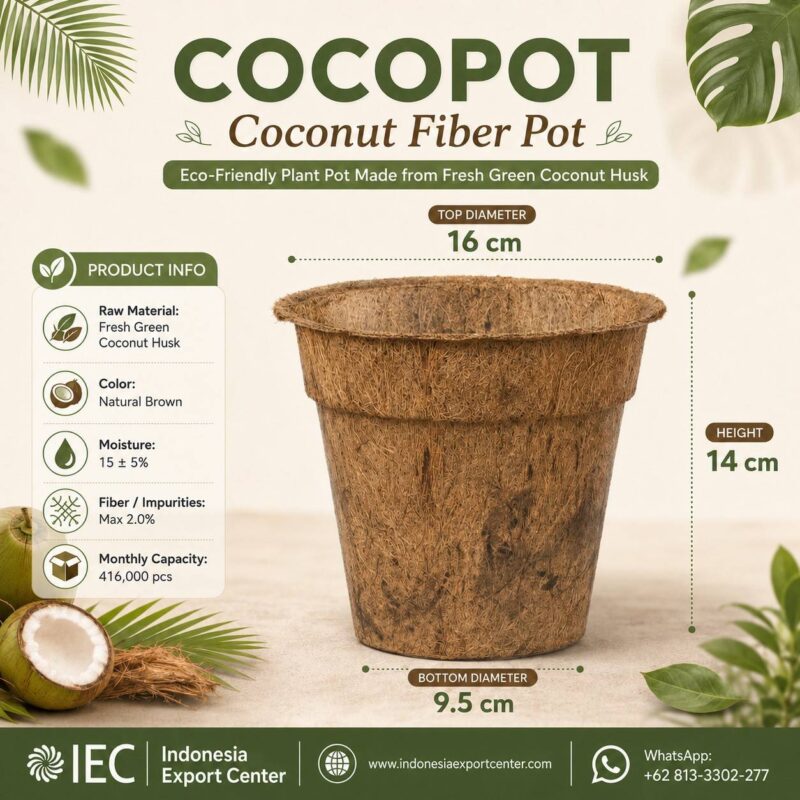
The supplied IEC cocopot reference describes a natural brown coconut fiber plant pot made from fresh green coconut husk, with a top diameter of 16 cm, height of 14 cm, and bottom diameter of 9.5 cm.
The reference states a monthly capacity of 416,000 pieces. This figure requires verification and does not establish stock availability or a confirmed quantity per container.
REQUEST A CONTAINER LOAD COIR POT QUOTATION
WhatsApp: https://wa.me/628133302277
Website: https://indonesiaexportcenter.com/
Container Load Coconut Coir Pots – Product Overview
| Specification | IEC Reference / Confirmation Required |
|---|---|
| Product | Cocopot / Coconut Fiber Plant Pot |
| Sourcing Country | Indonesia |
| Raw Material | Fresh Green Coconut Husk |
| Color | Natural Brown |
| Moisture | 15 ± 5% |
| Fiber / Impurities | Max. 2.0%, definition to be confirmed |
| Top Diameter | 16 cm |
| Height | 14 cm |
| Bottom Diameter | 9.5 cm |
| Stated Monthly Capacity | 416,000 Pieces |
| Order Type | Bulk / Container-Scale Inquiry |
| Container Options | 20ft / 40ft / 40ft HC, subject to availability |
| Units per Carton | To Be Confirmed |
| Gross Carton Weight | To Be Confirmed |
| Palletization | Subject to Supplier and Logistics Arrangements |
| Units per Container | To Be Calculated |
| Wholesale MOQ | To Be Confirmed |
| Bulk Unit Price | Request Quotation |
| Production Lead Time | To Be Confirmed |
| Export Terms | Subject to Agreement |
Important: No verified unit weight, carton dimensions, nesting configuration, pallet loading quantity, or container loading quantity has been supplied.
1. Wholesale Coconut Coir Pots for Container-Scale Buyers
Container-scale purchasing may be relevant to businesses requiring larger quantities of coconut fiber plant pots for distribution or resale.
Potential buyers include:
- Garden product importers
- Horticultural wholesalers
- Nursery supply distributors
- Retail garden chains
- Agricultural product distributors
- International procurement companies
A successful wholesale shipment should combine an agreed product specification with a practical loading and logistics plan.
2. Why Container Loading Matters
Container utilization affects the quantity of products shipped and the freight cost allocated to each unit.
A loading plan should consider:
- Physical product dimensions
- Packed unit dimensions
- Gross cargo weight
- Nesting and stacking
- Carton configuration
- Pallet dimensions
- Container payload
- Cargo securing
The maximum number of pots that can be loaded is not determined by container volume alone.
3. IEC Cocopot Reference Specifications
| Parameter | Reference Value |
|---|---|
| Raw Material | Fresh Green Coconut Husk |
| Color | Natural Brown |
| Moisture | 15 ± 5% |
| Fiber / Impurities | Maximum 2.0% |
| Stated Monthly Capacity | 416,000 Pieces |
The raw material information does not establish the complete finished-product composition. Buyers should confirm any binders, adhesives, coatings, or additives.
The exact meaning and test method for the “fiber / impurities” specification also require clarification.
4. Reference Cocopot Dimensions
| Dimension | Measurement |
|---|---|
| Top Diameter | 16 cm |
| Height | 14 cm |
| Bottom Diameter | 9.5 cm |
These dimensions are useful for an initial packing assessment.
However, they are not sufficient to calculate the actual number of pots per container.
Additional information is required, including unit weight, wall thickness, nesting behavior, packaging, and stacking limitations.
5. 20ft Container Loading for Coconut Coir Pots
A 20ft dry container may be considered for wholesale cocopot shipments, depending on the order quantity and freight arrangement.
Its approximate internal dimensions are:
| Parameter | Approximate Value |
|---|---|
| Internal Length | 5.90 m |
| Internal Width | 2.35 m |
| Internal Height | 2.39 m |
| Internal Volume | 33 m³ |
These figures are general planning references. Actual container dimensions and payload must be verified.
Before Confirming a 20ft Load
Buyers should request:
- Packed unit dimensions
- Gross packed unit weight
- Carton dimensions
- Cartons or units per layer
- Stacking limits
- Practical loading quantity
- Total cargo weight
6. 40ft Container Loading for Coconut Coir Pots
A 40ft dry container provides more internal volume than a 20ft container.
Approximate internal dimensions are:
| Parameter | Approximate Value |
|---|---|
| Internal Length | 12.03 m |
| Internal Width | 2.35 m |
| Internal Height | 2.39 m |
| Internal Volume | 67 m³ |
A larger container does not automatically guarantee a proportional increase in shipped units.
Loading efficiency and payload restrictions still apply.
7. 40ft High-Cube Container
A 40ft high-cube container generally provides additional internal height.
| Parameter | Approximate Value |
|---|---|
| Internal Length | 12.03 m |
| Internal Width | 2.35 m |
| Internal Height | 2.69 m |
| Internal Volume | 76 m³ |
A high-cube container may be worth evaluating when additional usable height improves the packing configuration.
However, its permissible cargo weight must be checked independently.
8. Comparing 20ft and 40ft Container Options
| Planning Factor | 20ft Dry | 40ft Dry | 40ft High Cube |
|---|---|---|---|
| Internal Volume | Approx. 33 m³ | Approx. 67 m³ | Approx. 76 m³ |
| Loading Quantity | Based on Packing Plan | Based on Packing Plan | Based on Packing Plan |
| Payload | Equipment Dependent | Equipment Dependent | Equipment Dependent |
| Freight Cost | Route Dependent | Route Dependent | Route Dependent |
| Palletization | Subject to Layout | Subject to Layout | Subject to Layout |
Buyer recommendation: Compare the total landed cost per usable product unit, not only the container freight rate.
9. How to Calculate Coir Pot Container Loading Capacity
A preliminary calculation should consider both weight and space.
Weight-Based Limit
Maximum Units by Weight = Permitted Cargo Weight ÷ Gross Packed Unit Weight
Volume-Based Limit
Theoretical Units by Volume = Usable Loading Volume ÷ Packed Unit Volume
These calculations provide initial limits only.
A final loading plan must account for actual packing geometry, stacking, nesting, cargo protection, and weight distribution.
10. Why Nesting Is Important
Nesting refers to placing one pot partly inside another.
If the product can be nested without damage, the effective space required per pot may be lower than the volume of an individual pot.
However, nesting cannot be assumed from top and bottom diameter measurements alone.
Information Required
- Actual nesting depth
- Number of pots per stack
- Stack height
- Stack diameter
- Stack weight
- Maximum safe stacking quantity
Buyer Recommendation
Request a physical nesting test and measured stack dimensions.
11. Stacking and Product Protection
Coconut fiber pots may require careful handling to preserve their shape.
The loading plan should consider:
- Maximum stack height
- Compression during transport
- Edge protection
- Shape retention
- Packaging integrity
- Unloading method
The proposed supplier should confirm suitable stacking practices for the finished product.
12. Bulk Packing Options
Possible packing arrangements for evaluation include:
- Grouped pot stacks
- Carton-packed products
- Palletized cartons
- Other agreed bulk packaging configurations
These are potential arrangements, not confirmed IEC packing services.
The final method should be agreed with the actual supplier and freight provider.
13. Palletized Coir Pot Shipments
Palletization may simplify mechanical handling and warehouse receiving.
However, pallets occupy space and add weight.
Required Pallet Information
- Pallet dimensions
- Pallet material
- Pallet weight
- Units per pallet
- Loaded pallet height
- Loaded pallet gross weight
- Pallet securing method
Buyers should also confirm whether the destination warehouse requires pallets.
14. Floor-Loaded vs. Palletized Containers
| Factor | Floor Loaded | Palletized |
|---|---|---|
| Pallet Space | Not Required | Required |
| Mechanical Handling | Depends on Packing | Often Easier |
| Loading Labor | Arrangement Dependent | Arrangement Dependent |
| Container Utilization | Must Be Calculated | Must Be Calculated |
| Product Protection | Packing Dependent | Packing Dependent |
| Destination Unloading | Must Be Planned | Must Be Planned |
Neither method is universally better.
The preferred arrangement depends on product characteristics, destination handling requirements, and total logistics costs.
15. Carton Dimensions and Weight
Before approving container loading, buyers should obtain a packing specification.
| Packing Parameter | Required Information |
|---|---|
| Units per Carton | Pieces |
| Carton Length | cm |
| Carton Width | cm |
| Carton Height | cm |
| Net Carton Weight | kg |
| Gross Carton Weight | kg |
| Maximum Stacking | Layers |
| Pallet Configuration | If Applicable |
A reliable loading estimate cannot be completed without these measurements.
16. Container Payload and Cargo Weight
Container payload is the maximum cargo weight permitted by the equipment specification.
However, legal and operational transport restrictions may reduce the allowable shipment weight.
Factors to Check
- Container tare weight
- Maximum gross weight
- Permitted cargo payload
- Road transport limits
- Axle-load restrictions
- Port requirements
- Carrier requirements
Important: Available container volume and permitted cargo weight are separate constraints.
17. Weight Distribution and Cargo Securing
Cargo should be loaded safely and distributed appropriately.
Potential securing measures may include suitable stacking, blocking, bracing, strapping, or dunnage.
The correct method depends on the actual packing arrangement.
Final loading and securing arrangements should be reviewed by qualified logistics personnel.
18. Container Inspection Before Loading
A pre-loading inspection is recommended.
Inspection Checklist
- Container identification
- Clean interior
- Dry floor
- No visible water ingress
- Suitable structural condition
- Door operation
- Floor condition
- No obvious contamination
Any concerns should be addressed before loading begins.
19. Container Loading Supervision
Buyers may request loading supervision as part of their quality and logistics controls.
A potential inspection scope includes:
- Product count
- Packaging condition
- Container condition
- Loading arrangement
- Cargo securing
- Seal number
- Loading photographs
Inspection availability and costs require separate agreement.
20. Wholesale Production Capacity
The supplied IEC reference states:
Monthly Capacity: 416,000 Pieces
This is a reference figure and does not establish available production allocation for a particular order.
Buyers Should Confirm
- Actual manufacturer
- Product-specific capacity
- Current production schedule
- Available allocation
- Stock availability
- Order lead time
- Packaging capacity
A monthly production figure should not be treated as a guaranteed container shipment quantity.
21. Wholesale MOQ and Full-Container Orders
MOQ refers to the minimum order quantity accepted for a transaction.
A full-container load, or FCL, describes a shipping arrangement.
These are different concepts.
A supplier may have a commercial MOQ that does not match the quantity needed to fill a container.
Buyer Recommendation
Confirm both the supplier’s MOQ and the proposed loading quantity.
22. Bulk Pricing and Freight Efficiency
The total cost of importing coconut coir pots may include:
- Product cost
- Packaging
- Inspection
- Inland transportation
- Export handling
- Ocean freight
- Insurance, where applicable
- Import duties and taxes
- Destination handling
Buyers should evaluate the landed cost rather than the factory unit price alone.
23. Freight Cost per Coir Pot
A simple freight efficiency measure is:
Ocean Freight Cost per Pot = Total Ocean Freight Cost ÷ Number of Pots Shipped
Illustrative Example
If ocean freight costs USD 3,000 and a verified shipment contains 30,000 pots:
USD 3,000 ÷ 30,000 = USD 0.10 per pot
This is a mathematical example only.
It does not represent an actual IEC loading quantity or current freight rate.
24. FOB, FCA, CFR and CIF Quotations
International buyers should confirm the applicable Incoterms 2020 rule and named place.
FCA
Delivery to the buyer’s nominated carrier or another designated party at the agreed place.
FOB
Delivery on board the vessel at the named port of shipment.
CFR
The seller pays the agreed costs and freight to the named destination port, with risk transferring under the applicable rule.
CIF
Similar to CFR, with the required insurance arranged by the seller.
For containerized cargo, FCA, CPT, or CIP may be more appropriate than traditional maritime terms in some arrangements.
The correct term depends on the actual transaction.
25. Export Documentation
Depending on the destination and commercial arrangement, documents may include:
- Commercial invoice
- Packing list
- Bill of lading
- Certificate of Origin, where applicable
- Product specification sheet
- Inspection records, where agreed
- Customs declarations
- Other destination-specific documents
Buyers should verify applicable requirements before shipment.
26. Quality Control for Bulk Orders
Container-scale orders should have defined acceptance criteria.
Recommended Inspection Parameters
- Product dimensions
- Unit weight
- Moisture
- Material composition
- Shape consistency
- Visible defects
- Packaging
- Quantity
The inspection plan should be agreed before production.
27. Moisture Specification
The supplied IEC reference states:
Moisture: 15 ± 5%
If interpreted as percentage points, this corresponds to approximately 10–20% moisture.
The exact test method and acceptance criteria should be confirmed.
Moisture may affect product weight and storage conditions.
28. Product Sampling Before Container Orders
Samples can help buyers evaluate the proposed product before a large order.
Recommended Sample Checks
- Dimensions
- Weight
- Appearance
- Moisture
- Shape retention
- Intended nursery application
Sample availability and costs require confirmation.
29. Repeat Container Orders
Large-scale importers may require recurring shipments.
A repeat-order program should define:
- Approved product specification
- Quality criteria
- Packaging
- Production forecast
- Shipment schedule
- Inspection requirements
- Commercial terms
Repeat-order commitments require supplier agreement.
30. Common Container Loading Mistakes
Mistake 1 – Assuming a Fixed Number of Pots per Container
Actual loading depends on packing and logistics data.
Mistake 2 – Ignoring Nesting
Measured nesting depth can materially affect loading efficiency.
Mistake 3 – Ignoring Pallet Dimensions
Palletization changes the usable loading space.
Mistake 4 – Using Nominal Product Weight Only
Gross packed weight should be used for cargo calculations.
Mistake 5 – Ignoring Container Payload
Cargo weight must remain within applicable limits.
Mistake 6 – Assuming 40ft Capacity Is Exactly Twice 20ft Capacity
Loading efficiency and payload constraints can produce different results.
Mistake 7 – Ignoring Destination Unloading Requirements
The receiving warehouse should be able to unload the agreed packing configuration.
31. Container Load Procurement Checklist
Product
-
Product specifications confirmed
-
Dimensions verified
-
Unit weight confirmed
-
Moisture specification agreed
-
Samples approved
Packing
-
Nesting arrangement tested
-
Units per stack confirmed
-
Units per carton confirmed
-
Carton dimensions confirmed
-
Carton gross weight confirmed
-
Palletization requirements agreed
Container
-
Container type selected
-
Internal dimensions verified
-
Payload checked
-
Loading layout reviewed
-
Cargo securing agreed
-
Practical loading quantity confirmed
Commercial
-
MOQ confirmed
-
Unit price confirmed
-
Production allocation confirmed
-
Lead time agreed
-
Payment terms agreed
Export
-
Contractual seller identified
-
Exporter of record identified
-
Destination port confirmed
-
Incoterm agreed
-
Freight quotation reviewed
-
Export documents checked
32. How to Source Container Load Coir Pots Through IEC
Step 1 – Submit Your Order Requirements
Provide the required product specifications and target quantity.
Step 2 – Confirm Product and Packing Data
Request unit weight, nesting details, carton dimensions, and gross weight.
Step 3 – Compare Container Options
Evaluate 20ft, 40ft, and 40ft high-cube options where available.
Step 4 – Review the Loading Plan
Confirm the proposed quantity and cargo arrangement.
Step 5 – Confirm Production Availability
Verify capacity, allocation, and lead time.
Step 6 – Review the Export Quotation
Confirm the price basis and shipment terms.
Step 7 – Approve Quality Requirements
Agree on samples and inspection criteria.
Step 8 – Coordinate Shipment
Confirm packing, loading, documentation, and logistics responsibilities.
This is a recommended procurement workflow. Actual supplier and logistics services require confirmation.
Container Load Coir Pots Wholesale – RFQ Template
Subject: Container Load Coconut Coir Pots – 20ft / 40ft Wholesale Export Inquiry
Dear Indonesia Export Center Team,
We are interested in purchasing coconut fiber plant pots from Indonesia for container-scale wholesale distribution.
Please review our product, packing, loading, and export requirements.
Buyer Information
Company Name: [Company Name]
Country: [Country]
Business Type: [Importer / Wholesaler / Distributor]
Contact Person: [Name]
Email: [Email]
WhatsApp: [Number]
Product Requirements
Product: Coconut Fiber Plant Pot / Cocopot
Top Diameter: [cm]
Height: [cm]
Bottom Diameter: [cm]
Target Unit Weight: [g]
Material Requirements: [Details]
Moisture Requirement: [Percentage / Tolerance]
Order Quantity
Target Order Quantity: [Pieces]
Expected Annual Volume: [Pieces]
Preferred Shipment Frequency: [Monthly / Quarterly / Other]
Container Requirements
Preferred Container: [20ft / 40ft / 40ft HC]
Loading Method: [Floor Loaded / Palletized]
Nesting Required: [Yes / No]
Preferred Packing: [Stacks / Cartons / Other]
Destination Unloading Method: [Manual / Forklift / Other]
Quality Requirements
Samples Required: [Yes / No]
Pre-Shipment Inspection Required: [Yes / No]
Container Loading Inspection Required: [Yes / No]
Shipping Requirements
Destination Country: [Country]
Destination Port: [Port]
Preferred Incoterm: [FCA / FOB / CFR / CIF / Other]
Target Shipment Date: [Date]
Please provide:
- Proposed manufacturer information
- Product specifications
- Unit weight
- Nesting configuration
- Units per stack
- Units per carton
- Carton dimensions
- Carton gross weight
- Palletization options
- Proposed 20ft loading quantity
- Proposed 40ft loading quantity
- Proposed 40ft HC loading quantity
- Estimated cargo gross weight
- Loading arrangement
- MOQ
- Wholesale unit price
- Available production allocation
- Production lead time
- Quality control procedures
- Inspection options
- Export quotation
- Exporter of record identity
- Payment terms
- Quotation validity
We look forward to receiving your wholesale sourcing proposal.
Best regards,
[Your Name]
[Company Name]
[Country]
SEND YOUR CONTAINER LOAD RFQ VIA WHATSAPP:
https://wa.me/628133302277
Frequently Asked Questions About Container Load Coir Pots
What are container load coir pots?
They are coconut fiber plant pots purchased in quantities intended for shipment by container.
Can I buy coconut coir pots by the container from Indonesia?
Container-scale sourcing inquiries may be submitted, subject to supplier availability and commercial agreement.
How many coconut coir pots fit in a 20ft container?
The quantity depends on the packed dimensions, unit weight, nesting arrangement, and container specifications.
How many coconut coir pots fit in a 40ft container?
A verified packing and loading plan is required to determine the quantity.
Is a 40ft high-cube container better for coir pots?
It may provide additional usable height, but the practical benefit depends on the product and packing configuration.
Can coconut coir pots be nested?
Nesting feasibility must be verified using the actual product.
Can I request palletized shipments?
Palletization inquiries may be submitted, subject to supplier and logistics arrangements.
Is floor loading available?
Floor-loading arrangements may be considered, subject to handling and cargo-securing requirements.
What are the IEC reference dimensions?
16 cm top diameter, 14 cm height, and 9.5 cm bottom diameter.
What is the raw material?
Fresh green coconut husk.
What is the reference color?
Natural brown.
What is the moisture specification?
15 ± 5%.
What is the stated monthly capacity?
416,000 pieces, subject to verification.
Does the monthly capacity indicate how many pots fit in a container?
No. Production capacity and container loading capacity are different measurements.
What is the MOQ for container-scale orders?
MOQ must be confirmed with the proposed supplier.
Can I request wholesale prices?
Yes. Submit your product specifications, order quantity, and destination for quotation review.
Can I request product samples?
Sample inquiries may be submitted, subject to availability and commercial arrangements.
Can I request loading photographs?
Loading documentation may be discussed, subject to the agreed inspection and logistics arrangements.
Are coconut coir pots biodegradable?
Finished-product biodegradability requires product-specific verification.
Can IEC provide FOB or CIF quotations?
Export quotation inquiries may be submitted, subject to the actual seller and logistics arrangements.
How do I request a container load quotation?
Send your product requirements, target quantity, preferred container type, loading preferences, and destination port to IEC via WhatsApp.
Request Container Load Coconut Coir Pots from Indonesia
Plan Your Bulk Coconut Fiber Plant Pot Shipment with Indonesia Export Center
Indonesia Export Center (IEC) welcomes inquiries from large-scale importers, horticultural distributors, garden product wholesalers, and international procurement teams.
Product: Cocopot / Coconut Fiber Plant Pot
Reference Raw Material: Fresh Green Coconut Husk
Reference Color: Natural Brown
Reference Moisture: 15 ± 5%
Reference Fiber / Impurities: Max. 2.0%, Definition Subject to Confirmation
Reference Top Diameter: 16 cm
Reference Height: 14 cm
Reference Bottom Diameter: 9.5 cm
Stated Monthly Capacity: 416,000 Pieces, Subject to Verification
Container Options: 20ft / 40ft / 40ft HC, Subject to Availability
Nesting: To Be Verified
Palletization: Subject to Arrangement
Units per Container: To Be Calculated
Wholesale MOQ: To Be Confirmed
Bulk Price: Request Quotation
Production Lead Time: To Be Confirmed
Export Terms: Subject to Agreement
Contact IEC to discuss bulk coconut coir pot orders, 20ft and 40ft container loading, palletization, packing specifications, wholesale prices, and export quotations.
INDONESIA EXPORT CENTER | IEC
Your Export & Sourcing Partner from Indonesia
Website: https://indonesiaexportcenter.com/
WhatsApp: +62 813-3302-277
REQUEST YOUR CONTAINER LOAD COIR POT QUOTATION
Please include your company name, product specifications, target quantity, preferred container type, packing preferences, and destination country.
Container Loading Disclaimer: IEC facilitates sourcing and export inquiries. The supplied reference does not establish verified container loading quantities, nesting performance, pallet configurations, product-specific production allocation, or guaranteed freight availability. All packing arrangements, loading calculations, payload limits, quality requirements, prices, and export terms must be confirmed with the actual supplier and logistics providers.
