

INDONESIA EXPORT CENTER | IEC
COCOPOT – COCONUT FIBRE POT
Coconut Coir Pot Sourcing for Australian Nurseries, Garden Centres & Horticultural Wholesalers
Wholesale Supply | Nursery Procurement | Product Samples | Biosecurity Verification | Import Documentation | Australian Shipping
Wholesale Coconut Coir Pots for Australia
Looking for a coir pots supplier in Australia or an overseas sourcing partner for coconut fibre plant pots?
Indonesia Export Center (IEC) facilitates sourcing and export enquiries for coconut fibre plant pots from Indonesia, supporting Australian buyers with product information, wholesale quotation requests, packaging discussions and export planning.
For Australian nurseries and horticultural importers, product suitability and import biosecurity requirements are especially important.
Before purchasing coconut-derived plant pots from overseas, buyers should verify the applicable import conditions for the actual finished product, including its material composition, processing and intended use.
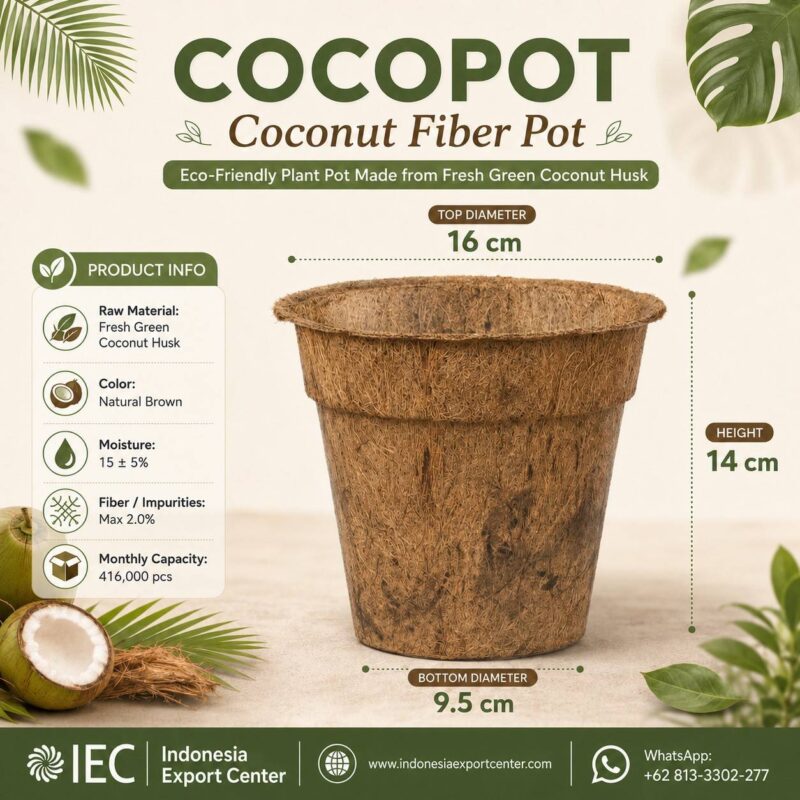
The supplied IEC COCOPOT reference is a natural brown coconut fibre plant pot made from fresh green coconut husk.
Its reference dimensions are:
- Top Diameter: 16 cm
- Height: 14 cm
- Bottom Diameter: 9.5 cm
The stated monthly capacity is 416,000 pieces, subject to verification with the actual manufacturing source.
REQUEST A COCONUT COIR POT QUOTATION FOR AUSTRALIA
WhatsApp: https://wa.me/628133302277
Website: https://indonesiaexportcenter.com/
IEC is a sourcing and export facilitation partner, not automatically the physical manufacturer. Product availability and commercial arrangements require supplier confirmation.
Coconut Coir Pots for Australia – Product Specifications
| Specification | IEC Product Reference |
|---|---|
| Product | COCOPOT – Coconut Fibre Pot |
| Country of Sourcing | Indonesia |
| Raw Material | Fresh Green Coconut Husk |
| Colour | Natural Brown |
| Moisture | 15 ± 5% |
| Fibre / Impurities | Maximum 2.0%, definition to be confirmed |
| Top Diameter | 16 cm |
| Height | 14 cm |
| Bottom Diameter | 9.5 cm |
| Stated Monthly Capacity | 416,000 Pieces |
| Unit Weight | To Be Confirmed |
| Wall Thickness | To Be Confirmed |
| Finished-Product Composition | To Be Confirmed |
| MOQ | To Be Confirmed |
| Packaging | Subject to Supplier Confirmation |
| Wholesale Price | Request Quotation |
| Export Terms | Subject to Agreement |
Important: The specifications above are supplied reference information. The complete finished-product composition, available production allocation and test methods have not been independently verified.
1. Coconut Fibre Pots for Australian Nurseries
Coconut fibre plant pots may be considered for selected horticultural and nursery applications.
Potential buyers include:
- Commercial nurseries
- Plant propagation businesses
- Horticultural wholesalers
- Garden centre distributors
- Garden retail brands
- Landscaping supply businesses
- Agricultural product importers
Before adopting a new pot, professional growers should assess its compatibility with their growing methods, handling systems and nursery conditions.
2. Why Australian Buyers Evaluate Coconut Coir Pots
Coconut fibre is a plant-derived material used in various horticultural products.
Australian buyers may consider coconut fibre pots when evaluating alternative plant pot materials or expanding their nursery product range.
However, the finished product’s performance depends on its actual composition and manufacturing process.
Recommended Evaluation Areas
- Product dimensions
- Wall thickness
- Handling strength
- Moisture characteristics
- Drainage behaviour
- Compatibility with growing media
- Storage conditions
- Packaging durability
Suitability should be established through samples and application testing.
3. IEC Cocopot Reference Dimensions
| Measurement | Dimension |
|---|---|
| Top Diameter | 16 cm |
| Height | 14 cm |
| Bottom Diameter | 9.5 cm |
These dimensions describe the supplied reference product.
Alternative sizes or shapes may be submitted for feasibility review, but their availability has not been confirmed.
4. Raw Material and Finished-Product Composition
The supplied IEC reference identifies fresh green coconut husk as the raw material.
The complete composition of the finished coconut fibre pot has not been supplied.
Australian importers should request clarification concerning:
- Coconut fibre content
- Binders or adhesives
- Coatings
- Other additives
- Material processing
- Product cleanliness
- Relevant laboratory testing
These details can be important when determining the applicable Australian import conditions.
5. Australian Biosecurity Requirements for Coconut Coir Pots
Australia applies biosecurity controls to imported goods that may introduce pests, diseases or other biosecurity risks.
Coconut-derived products should be assessed against the requirements applicable to the specific finished article.
Importers should not assume that the rules for finished coconut fibre pots are identical to those for loose coir, cocopeat, growing media or untreated plant material.
Important Questions Before Importing
- How is the finished product classified for biosecurity purposes?
- What is the complete material composition?
- How has the product been processed?
- Is treatment required?
- Is an import permit required?
- Are specific declarations or certificates required?
- Will inspection be required on arrival?
- Are there packaging or cleanliness conditions?
The answers should be verified before placing a commercial order.
6. BICON Verification Before Ordering
The Australian Government’s Biosecurity Import Conditions (BICON) system provides information about import conditions for goods entering Australia.
Australian buyers should search BICON using the most accurate description of the finished product and its materials.
Recommended BICON Review
- Identify the finished product.
- Confirm its material composition.
- Identify the country of origin.
- Review applicable import conditions.
- Check permit requirements.
- Check treatment or certification requirements.
- Confirm any inspection conditions.
- Retain relevant import guidance for the shipment.
Official BICON website: https://bicon.agriculture.gov.au/
Important Note
IEC does not claim that the reference cocopot has already received Australian biosecurity approval.
Import eligibility must be established for the actual product and shipment.
7. Import Permits, Treatments and Certificates
Depending on the applicable BICON conditions, a shipment may require specific documentation or measures.
Potential requirements may include:
- Import permits
- Treatment evidence
- Manufacturer declarations
- Product composition information
- Phytosanitary documentation
- Biosecurity inspection
- Other specified conditions
These are possible requirements, not a confirmed mandatory document list for the IEC reference product.
Buyer Recommendation
Obtain written confirmation of the applicable conditions before paying for production or arranging shipment.
8. Product Cleanliness and Contamination Prevention
Biosecurity compliance may depend on the product’s condition when exported.
Australian importers should discuss appropriate cleanliness and contamination controls with the proposed supplier.
Potential inspection areas include:
- Visible soil contamination
- Plant debris
- Insects or other pests
- Foreign material
- Packaging cleanliness
- Storage conditions
The applicable acceptance requirements should follow the relevant Australian import conditions.
9. Moisture Specification
The supplied reference states:
Moisture: 15 ± 5%
If interpreted as percentage points, this corresponds to approximately 10–20%.
The test method, sampling procedure and contractual acceptance criteria should be confirmed.
Moisture may also affect product weight and storage conditions.
10. Product Sampling for Australian Nurseries
Samples can help buyers assess the product before committing to bulk purchases.
Recommended Sample Checks
- Dimensions
- Unit weight
- Wall thickness
- Shape consistency
- Surface condition
- Handling strength
- Intended nursery application
- Packaging suitability
Sample availability, cost and delivery arrangements require confirmation.
Important Biosecurity Note
Commercial samples may also be subject to Australian import conditions. Buyers should verify the requirements before shipping samples.
11. Nursery Application Testing
Professional nurseries should test products under their intended operating conditions.
Potential testing areas include:
- Pot stability
- Handling performance
- Water movement
- Growing media retention
- Wet strength
- Storage performance
- Compatibility with nursery trays
- Transplanting procedures
The supplied reference does not include verified nursery performance test results.
12. Are Coconut Coir Pots Biodegradable?
Coconut husk is a natural plant-derived raw material.
However, the finished pot’s biodegradability depends on its complete composition, manufacturing process and conditions of disposal.
A product should not be marketed as biodegradable solely because it contains coconut fibre.
Claims Requiring Evidence
- Biodegradable
- Compostable
- Home compostable
- Plastic-free
- Chemical-free
- Sustainable
- Direct-plantable
Australian businesses should ensure that environmental claims are accurate and supported by appropriate evidence.
13. Environmental Claims in Australia
Environmental marketing claims may be assessed under Australian Consumer Law.
Businesses should avoid broad or unsupported statements about environmental performance.
Buyer Recommendation
Before using environmental claims on retail packaging, request suitable evidence and review guidance from the Australian Competition and Consumer Commission (ACCC).
Official reference: https://www.accc.gov.au/
14. Wholesale MOQ and Pricing
The minimum order quantity for the IEC reference product has not been confirmed.
MOQ may depend on:
- Product specification
- Order volume
- Packaging requirements
- Production scheduling
- Shipping arrangements
Australian buyers should provide the initial order quantity and expected annual purchasing volume when requesting a quotation.
15. Production Capacity and Repeat Orders
The supplied IEC reference states:
Monthly Capacity: 416,000 Pieces
This figure is not independently verified and does not guarantee available production allocation.
Buyers Should Confirm
- Actual manufacturing source
- Product-specific capacity
- Available production allocation
- Lead time
- Quality consistency
- Packaging capacity
- Repeat-order arrangements
16. Packaging for Australian Importers
Packaging should protect the product and comply with applicable shipping and import conditions.
Potential packaging requests include:
- Bulk packing
- Master cartons
- Palletised shipments
- Retail packaging
- Private-label cartons
- Product identification labels
These options require supplier confirmation.
Recommended Packing Data
| Parameter | Information Required |
|---|---|
| Units per Pack | Pieces |
| Units per Carton | Pieces |
| Carton Dimensions | cm |
| Net Carton Weight | kg |
| Gross Carton Weight | kg |
| Pallet Dimensions | If Applicable |
| Pallet Gross Weight | If Applicable |
| Shipping Marks | As Agreed |
17. Wood Packaging and Pallet Requirements
If wood pallets or other timber packaging are used, Australian importers should check the applicable biosecurity requirements.
Depending on the packaging type and origin, ISPM 15 or other conditions may be relevant.
Buyer Recommendation
Confirm the packaging material and any treatment or marking requirements before shipment.
18. Container Shipping to Australia
For larger wholesale orders, container shipping may be considered.
Potential options include:
- 20ft dry container
- 40ft dry container
- 40ft high-cube container
The actual loading quantity depends on product dimensions, weight, nesting, cartons, pallets and container payload.
No verified pieces-per-container quantity has been supplied.
19. Australian Destination Ports
Depending on shipping routes and freight availability, buyers may request quotations for destinations such as:
- Melbourne
- Sydney
- Brisbane
- Fremantle
- Adelaide
These are examples of potential Australian shipping destinations, not confirmed IEC routes.
Buyers should provide their preferred port or final delivery location.
20. Australian Customs Classification and Import Duties
The applicable Australian tariff classification must be established for the finished product.
Importers should verify:
- Tariff classification
- Customs duty
- Goods and Services Tax (GST)
- Import processing charges
- Country-of-origin requirements
- Applicable trade arrangements
- Required declarations
The correct treatment depends on the product and rules in effect at import.
Official reference: https://www.abf.gov.au/
21. Import Documentation
Depending on the applicable conditions and commercial arrangements, documents may include:
- Commercial invoice
- Packing list
- Bill of lading
- Certificate of Origin, where applicable
- Product specification sheet
- Manufacturer declarations, if required
- Treatment documentation, if required
- Import permit, if required
- Inspection records, where agreed
The actual documentation requirements should be confirmed before shipment.
22. Landed Cost Planning in AUD
Australian importers should evaluate the total cost of bringing goods to their destination.
Potential Cost Components
| Cost Component | Description |
|---|---|
| Product Price | Agreed wholesale price |
| Export Packaging | Cartons, labels and pallets |
| Origin Charges | Applicable export and handling costs |
| Ocean Freight | International shipping |
| Cargo Insurance | If applicable |
| Customs Duty | Based on applicable classification |
| GST | Subject to applicable treatment |
| Customs Brokerage | Clearance services |
| Biosecurity Charges | If applicable |
| Inspection or Treatment | If required |
| Destination Charges | Port and terminal costs |
| Inland Transport | Delivery to warehouse |
Buyers should avoid double-counting charges already included under the agreed Incoterm.
23. Landed Cost per Pot
A useful calculation is:
Landed Cost per Pot = Total Applicable Landed Shipment Cost ÷ Number of Usable Pots Received
Illustrative Example
Assume a hypothetical shipment has:
| Cost Component | Example Amount |
|---|---|
| Product Cost | AUD 15,000 |
| Freight and Insurance | AUD 3,500 |
| Customs Duty and Non-Recoverable Fees | AUD 700 |
| Brokerage and Biosecurity Charges | AUD 900 |
| Inland Delivery | AUD 1,000 |
| Total | AUD 21,100 |
If the shipment contains 20,000 usable pots:
AUD 21,100 ÷ 20,000 = AUD 1.055 per pot
This is a mathematical illustration only, not an IEC quotation, verified shipment quantity or current Australian import cost estimate.
Recoverable GST may be treated differently for accounting purposes.
24. FCA, FOB, CFR and CIF Quotations
The appropriate Incoterms 2020 rule and named place should be agreed before purchase.
FCA
Delivery to the nominated carrier or another designated party at the agreed place.
FOB
Delivery on board the vessel at the named port of shipment.
CFR
The seller pays the agreed freight to the named destination port, with risk transferring under the applicable rule.
CIF
Similar to CFR, with the required insurance arranged by the seller.
For containerised shipments, FCA, CPT or CIP may be more appropriate in certain arrangements.
25. Quality Control and Inspection
Australian buyers should agree on product specifications and inspection requirements before production.
Recommended Inspection Parameters
- Dimensions
- Unit weight
- Moisture
- Material composition
- Shape consistency
- Surface condition
- Visible defects
- Packaging
- Quantity
Independent inspection may be requested, subject to an agreed scope and provider availability.
26. Supplier Verification
Before purchasing, Australian importers should identify:
- Actual manufacturer
- Registered supplier identity
- Factory location
- Production capability
- Quality control procedures
- Contractual seller
- Exporter of record
- Payment beneficiary
IEC facilitates sourcing and export enquiries and should not automatically be considered the physical manufacturer.
27. Australian Nursery Procurement Checklist
Product
-
Product dimensions confirmed
-
Finished-product composition reviewed
-
Moisture specification agreed
-
Samples evaluated
-
Nursery application tested
-
Quality criteria approved
Biosecurity
-
BICON requirements checked
-
Product classification confirmed
-
Import permit requirements reviewed
-
Treatment requirements reviewed
-
Certificate requirements reviewed
-
Cleanliness requirements agreed
-
Sample import conditions checked
Supplier
-
Actual manufacturer identified
-
Production capacity checked
-
MOQ confirmed
-
Wholesale price confirmed
-
Lead time agreed
Packaging
-
Packing configuration approved
-
Carton dimensions confirmed
-
Pallet requirements checked
-
Wood packaging conditions reviewed
-
Shipping marks agreed
Import and Shipping
-
Tariff classification verified
-
Customs duty reviewed
-
GST treatment reviewed
-
Destination port confirmed
-
Incoterm agreed
-
Freight quotation reviewed
-
Export documents checked
28. How to Source Coconut Coir Pots for Australia Through IEC
Step 1 – Submit Your Product Requirements
Provide the intended nursery application, dimensions and quantity.
Step 2 – Review Product Composition
Confirm the raw material, finished-product composition and processing information.
Step 3 – Verify BICON Requirements
Check Australian biosecurity import conditions before ordering or shipping samples.
Step 4 – Request Samples
Evaluate samples where available and permitted under the applicable import conditions.
Step 5 – Confirm Packaging
Specify bulk packing, cartons, palletisation or retail packaging.
Step 6 – Request a Quotation
Provide the order quantity, destination and preferred Incoterm.
Step 7 – Agree on Quality Control
Approve specifications and inspection requirements.
Step 8 – Coordinate Shipment
Confirm production allocation, documentation, freight and import responsibilities.
Australia Coconut Coir Pots Wholesale RFQ Template
Subject: Coconut Coir Pots Wholesale – Australia Import and Biosecurity Enquiry
Dear Indonesia Export Center Team,
We are interested in sourcing coconut fibre plant pots from Indonesia for nursery use and wholesale distribution in Australia.
Please review our product, biosecurity, packaging and shipping requirements.
Buyer Information
Company Name: [Company Name]
Country: Australia
State / Territory: [State / Territory]
Business Type: [Nursery / Horticultural Wholesaler / Garden Centre / Importer]
Contact Person: [Name]
Email: [Email]
WhatsApp: [Number]
Product Requirements
Product: Coconut Fibre Plant Pot / Cocopot
Top Diameter: [cm]
Height: [cm]
Bottom Diameter: [cm]
Required Wall Thickness: [mm]
Target Unit Weight: [g]
Material Requirements: [Details]
Moisture Requirement: [Details]
Intended Nursery Application: [Details]
Initial Order Quantity: [Pieces]
Estimated Annual Volume: [Pieces]
Biosecurity Requirements
BICON Import Conditions Reviewed: [Yes / No / Pending]
Import Permit Required: [Yes / No / To Be Confirmed]
Treatment Required: [Yes / No / To Be Confirmed]
Manufacturer Declaration Required: [Yes / No / To Be Confirmed]
Phytosanitary Certificate Required: [Yes / No / To Be Confirmed]
Product Composition Declaration Required: [Yes / No]
Special Cleanliness Requirements: [Details]
Quality Requirements
Samples Required: [Yes / No]
Laboratory Testing Required: [Yes / No]
Pre-Shipment Inspection Required: [Yes / No]
Packaging Requirements
Packing Format: [Bulk / Master Carton / Retail Carton]
Palletisation Required: [Yes / No]
Wood Packaging Restrictions: [Details]
Private-Label Packaging Required: [Yes / No]
Shipping Requirements
Destination Country: Australia
Destination Port: [Melbourne / Sydney / Brisbane / Fremantle / Adelaide / Other]
Final Delivery Location: [City / Postcode]
Preferred Incoterm: [FCA / FOB / CFR / CIF / Other]
Preferred Container: [20ft / 40ft / 40ft HC / To Be Recommended]
Target Delivery Period: [Month / Year]
Please provide:
- Proposed supplier and manufacturer information
- Complete product specifications
- Finished-product material composition
- Manufacturing process information relevant to biosecurity assessment
- Sample availability and costs
- MOQ
- Wholesale unit price
- Production capacity information
- Available production allocation
- Production lead time
- Quality control procedures
- Available laboratory test reports
- Available manufacturer declarations
- Treatment documentation, if applicable
- Packaging options
- Units per carton
- Carton dimensions and gross weight
- Palletisation options
- Estimated container loading
- Export documentation information
- FCA or FOB quotation, as applicable
- CFR or CIF quotation, if available
- Contractual seller and exporter of record
- Payment terms
- Quotation validity
We look forward to receiving your sourcing proposal.
Kind regards,
[Your Name]
[Company Name]
Australia
SEND YOUR AUSTRALIA WHOLESALE ENQUIRY
WhatsApp: https://wa.me/628133302277
Frequently Asked Questions – Coir Pots Supplier Australia
Can I import coconut coir pots from Indonesia into Australia?
Potential imports must comply with applicable Australian biosecurity and customs requirements. Import eligibility should be confirmed for the actual finished product before shipment.
Does IEC manufacture coconut coir pots directly?
IEC facilitates sourcing and export enquiries and should not automatically be considered the physical manufacturer.
What is BICON?
BICON is the Australian Government’s Biosecurity Import Conditions system, which provides information about import requirements for goods entering Australia.
Do coconut coir pots require an Australian import permit?
Permit requirements depend on the specific finished product and applicable BICON conditions.
Is a phytosanitary certificate required?
This must be verified against the applicable import conditions. It should not be assumed to be always required or always unnecessary.
Can coconut coir pots be imported without treatment?
Treatment requirements depend on the product and applicable biosecurity conditions.
What is the raw material of the IEC cocopot?
The supplied reference identifies fresh green coconut husk.
What are the product dimensions?
16 cm top diameter, 14 cm height and 9.5 cm bottom diameter.
What is the reference colour?
Natural brown.
What is the moisture specification?
15 ± 5%.
What is the stated monthly capacity?
416,000 pieces, subject to verification.
What is the MOQ for Australian buyers?
MOQ must be confirmed with the proposed supplier.
Can I request wholesale prices in AUD?
An AUD quotation may be requested, subject to the seller’s agreement.
Can I request samples for nursery testing?
Sample enquiries may be submitted, subject to availability and Australian import conditions.
Are coconut coir pots biodegradable?
Finished-product biodegradability requires product-specific evidence.
Can I request palletised shipments?
Palletisation may be discussed, subject to supplier capability and applicable packaging requirements.
Can IEC provide shipping quotations to Melbourne or Sydney?
Shipping quotation enquiries may be submitted, subject to carrier availability and commercial arrangements.
What is the Australian import duty?
The applicable duty depends on the confirmed tariff classification and rules in effect at import.
Can I request third-party inspection?
Inspection requirements may be discussed, subject to an agreed scope and provider availability.
How do I request a quotation for Australia?
Send your company information, product specifications, quantity, biosecurity requirements, packaging preferences and destination to IEC via WhatsApp.
Request Wholesale Coconut Coir Pots for Australia
Source Coconut Fibre Plant Pots from Indonesia for Australian Nursery and Horticultural Supply
Indonesia Export Center (IEC) welcomes enquiries from Australian nurseries, horticultural wholesalers, garden centres, plant propagation businesses and importers.
Product: COCOPOT – Coconut Fibre Plant Pot
Country of Sourcing: Indonesia
Raw Material: Fresh Green Coconut Husk
Colour: Natural Brown
Reference Moisture: 15 ± 5%
Reference Fibre / Impurities: Max. 2.0%, Definition Subject to Confirmation
Top Diameter: 16 cm
Height: 14 cm
Bottom Diameter: 9.5 cm
Stated Monthly Capacity: 416,000 Pieces, Subject to Verification
MOQ: To Be Confirmed
Packaging: Subject to Supplier Confirmation
Wholesale Price: Request Quotation
Production Lead Time: To Be Confirmed
Container Loading Quantity: To Be Calculated
Australian Biosecurity Requirements: To Be Verified Through BICON
Export Terms: Subject to Commercial Agreement
Contact IEC to discuss coconut coir pot sourcing, product samples, nursery procurement, wholesale quantities, biosecurity documentation, packaging and export quotations for Australia.
INDONESIA EXPORT CENTER | IEC
Your Export & Sourcing Partner from Indonesia
Website: https://indonesiaexportcenter.com/
WhatsApp: +62 813-3302-277
REQUEST YOUR AUSTRALIA COIR POT WHOLESALE QUOTATION
Please include your company name, intended nursery application, product specifications, target quantity, applicable BICON requirements, packaging preferences and Australian destination.
Commercial and Biosecurity Disclaimer: IEC facilitates sourcing and export enquiries. Product specifications, manufacturing capacity, MOQ, packaging, pricing and export arrangements require supplier confirmation. Australian biosecurity import conditions, permits, treatments, certificates, customs classification, duties, GST, packaging obligations and other import requirements must be verified by the importer and qualified advisers under the rules applicable at the time of import. IEC does not represent that the reference product has been approved for import into Australia.
