

INDONESIA EXPORT CENTER | IEC
COCOPOT – COCONUT FIBER PLANT POT
Wholesale Coconut Fiber Pot Sourcing for Tree Sapling Nurseries, Forestry Seedling Producers and Reforestation Planting Programs
Tree Sapling Production | Pot Size Evaluation | Root Development | Larger Format Enquiries | Nursery Trials | Wholesale Export
Coconut Coir Pots for Tree Sapling Nurseries
Looking for coir pots for tree saplings or a sourcing partner for coconut fiber plant pots used in commercial tree nurseries?
Indonesia Export Center (IEC) facilitates sourcing and export enquiries for coconut fiber plant pots from Indonesia, supporting tree nurseries, forestry seedling producers, landscape tree growers and horticultural procurement teams.
Tree sapling production often involves different container requirements from vegetable or flower propagation.
Depending on the tree species and nursery system, growers may need greater root-zone depth, longer production periods, stronger containers and additional handling support.
These requirements make container size and structural suitability especially important.
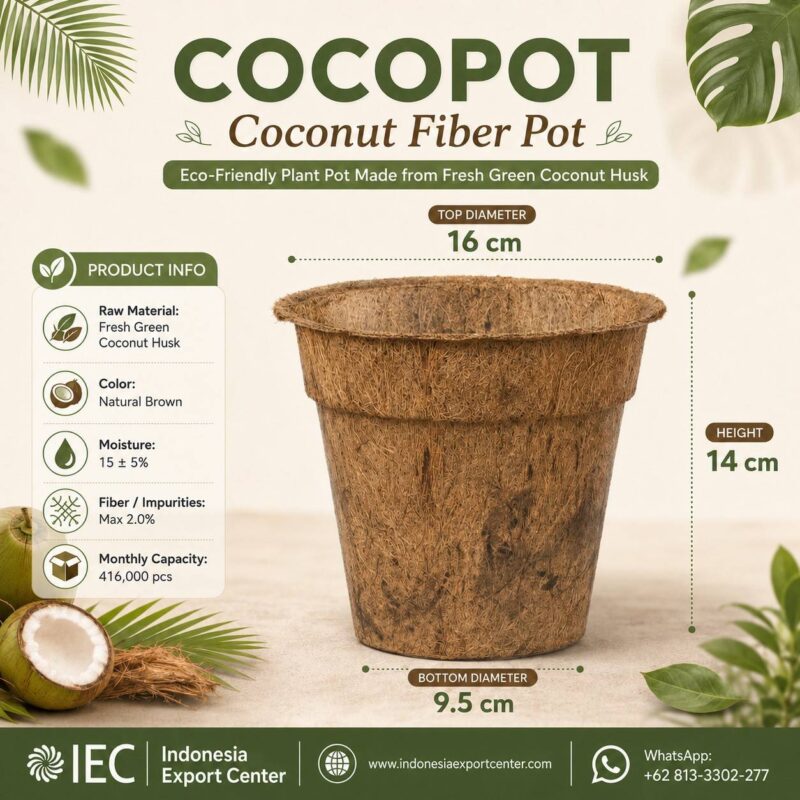
The supplied IEC COCOPOT reference is a natural brown coconut fiber plant pot made using fresh green coconut husk.
Its reference dimensions are:
- Top Diameter: 16 cm
- Height: 14 cm
- Bottom Diameter: 9.5 cm
The supplied product information also states a monthly production capacity of 416,000 pieces, subject to manufacturer verification.
Important: The 16 cm reference pot is not confirmed suitable for every tree species or nursery stage. Larger pot formats have not been confirmed as available and require a separate manufacturing feasibility assessment.
REQUEST A TREE SAPLING COIR POT SOURCING QUOTATION
WhatsApp: https://wa.me/628133302277
Website: https://indonesiaexportcenter.com/
IEC facilitates sourcing and export enquiries. Product suitability, larger format availability, manufacturing capability and commercial terms require supplier confirmation.
COCOPOT Product Specifications
| Specification | IEC Product Reference |
|---|---|
| Product | COCOPOT – Coconut Fiber Plant Pot |
| Country of Sourcing | Indonesia |
| Raw Material | Fresh Green Coconut Husk |
| Colour | Natural Brown |
| Moisture | 15 ± 5% |
| Fiber / Impurities | Max. 2.0%, definition and test method to be confirmed |
| Top Diameter | 16 cm |
| Height | 14 cm |
| Bottom Diameter | 9.5 cm |
| Stated Monthly Capacity | 416,000 Pieces |
| Larger Pot Sizes | Availability Not Confirmed |
| Custom Dimensions | Subject to Manufacturing Feasibility |
| Unit Weight | To Be Confirmed |
| Wall Thickness | To Be Confirmed |
| Dimensional Tolerances | To Be Confirmed |
| Finished-Product Composition | To Be Confirmed |
| Wet Handling Strength | To Be Tested |
| MOQ | To Be Confirmed |
| Packaging | Subject to Supplier Confirmation |
| Wholesale Price | Request Quotation |
| Production Lead Time | To Be Confirmed |
| Export Terms | Subject to Agreement |
The specifications above describe the supplied reference product, not a complete range of tree nursery container sizes.
1. Coconut Fiber Pots for Tree Nursery Applications
Tree nurseries may evaluate coconut fiber pots for selected stages of sapling production.
Potential buyers include:
- Commercial tree nurseries
- Forestry seedling producers
- Reforestation project suppliers
- Agroforestry nurseries
- Landscape tree nurseries
- Environmental restoration contractors
- Horticultural procurement companies
Each application requires an appropriate container specification and nursery trial.
2. Why Tree Saplings Need Different Container Considerations
Tree saplings may develop root systems that require greater container depth or volume than those used for smaller horticultural crops.
Important considerations include:
- Tree species
- Root growth characteristics
- Root-zone depth
- Nursery production duration
- Growing media volume
- Irrigation
- Container stability
- Transport requirements
- Transplant timing
The correct container should be selected based on the actual nursery production system.
3. The Importance of Pot Size for Tree Saplings
Pot size can affect the available root-zone volume and growing media capacity.
A container that is suitable for an early nursery stage may not be suitable for a longer growing period.
Buyers should assess:
- Top diameter
- Bottom diameter
- Container height
- Internal volume
- Root development
- Plant stability
- Expected nursery duration
The IEC reference has a 16 cm top diameter and a 14 cm height.
Its suitability for a particular tree sapling must be established through testing.
4. Larger Coir Pots for Tree Saplings
Some tree nursery operations may require larger containers.
Potential buyer requirements may include:
- Greater top diameter
- Increased container height
- Greater growing media capacity
- Stronger sidewalls
- Improved stability
- Compatibility with nursery handling equipment
Larger formats are not confirmed products in the supplied IEC specification.
Buyers may submit their desired dimensions for a manufacturing feasibility review.
No custom size, mould availability, MOQ or production capability should be assumed before supplier confirmation.
5. Requesting a Larger Pot Format
For a larger tree sapling pot enquiry, buyers should provide:
- Required top diameter
- Required bottom diameter
- Required height
- Desired growing media volume
- Target unit weight, if applicable
- Required wall thickness
- Tree species
- Nursery production duration
- Handling requirements
- Estimated order volume
IEC can use these details to facilitate an appropriate sourcing enquiry.
6. Root Development and Container Depth
Tree nursery containers should be evaluated in relation to the species’ root development.
Important factors may include:
- Root-zone depth
- Root distribution
- Growing media structure
- Irrigation
- Drainage
- Container geometry
- Production duration
No product-specific evidence has been supplied showing that COCOPOT improves root growth or prevents root deformation.
7. Root Circling and Root System Evaluation
Root circling can be a concern in some container-grown tree production systems.
However, it should not be assumed that a coconut fiber pot prevents root circling.
Buyers should examine:
- Root distribution
- Root orientation
- Root density
- Root development near the pot wall
- Root condition at transplanting
- Comparison with existing nursery containers
Any claim about root architecture should be supported by crop-specific trials.
8. Early-Stage Tree Sapling Production
Some tree nurseries may consider smaller containers during early development.
Potential evaluation areas include:
- Seedling establishment
- Root growth
- Growing media volume
- Irrigation frequency
- Container stability
- Handling
- Transplant readiness
The supplied 16 cm pot should be assessed against the nursery’s existing container system.
9. Extended Nursery Growing Periods
Tree saplings may remain in nursery containers for different lengths of time.
Longer production periods may increase the importance of:
- Structural integrity
- Moisture exposure
- Root-zone volume
- Container stability
- Handling strength
- Storage and growing conditions
The supplied product reference does not include verified long-duration nursery performance data.
10. Tree Species and Pot Selection
Different tree species may have different root systems and production requirements.
Potential nursery categories include:
- Native tree species
- Forestry seedlings
- Agroforestry trees
- Fruit tree rootstocks
- Ornamental trees
- Reforestation species
The IEC reference should not be described as universally suitable for these categories.
11. Forestry Seedling Nurseries
Forestry nurseries may require standardised container systems for large-scale seedling production.
Procurement teams should evaluate:
- Container size
- Root development
- Nursery spacing
- Growing media requirements
- Irrigation
- Transport
- Planting method
- Quality consistency
The appropriate specification should be defined before requesting bulk supply.
12. Reforestation and Restoration Projects
Reforestation and environmental restoration projects may require large quantities of nursery-grown trees.
Potential procurement considerations include:
- Species selection
- Nursery production schedules
- Planting season
- Seedling quality
- Container requirements
- Transport distances
- Site conditions
- Delivery phases
The suitability of coconut fiber pots should be evaluated within the specific project plan.
13. Agroforestry Tree Nurseries
Agroforestry nurseries may produce tree seedlings for agricultural landscapes.
Container requirements depend on the tree species, production duration and planting method.
Buyers should evaluate coconut fiber pots against existing nursery practices rather than assume compatibility.
14. Landscape Tree Nursery Applications
Landscape tree nurseries may supply plants for commercial developments, public spaces and landscape projects.
Potential considerations include:
- Plant size
- Root system
- Nursery duration
- Container stability
- Transport
- Installation requirements
Larger landscape trees may require containers beyond the supplied 16 cm reference.
15. Growing Media Compatibility
Tree nurseries may use different growing media formulations.
Potential media include:
- Cocopeat-based mixes
- Bark-based substrates
- Compost-containing mixes
- Peat-based mixes
- Perlite-containing blends
- Other nursery substrates
Compatibility should be tested using the nursery’s actual growing medium.
16. Coconut Fiber Pots vs Cocopeat
Coconut fiber pots and cocopeat are different horticultural products.
Coconut Fiber Pot: A plant container made using coconut-derived fibrous material.
Cocopeat: Coconut coir pith commonly used as a growing media component.
Cocopeat specifications, such as EC and pH, should not be assumed to describe the finished coconut fiber pot.
17. Irrigation Compatibility for Tree Nurseries
Tree nurseries may use:
- Drip irrigation
- Overhead irrigation
- Manual watering
- Other nursery irrigation systems
Buyers should evaluate:
- Growing media moisture
- Water distribution
- Drainage
- Pot stability
- Repeated wetting
- Wet handling strength
No verified irrigation performance data has been supplied for the IEC reference.
18. Wet Handling and Structural Strength
Tree sapling containers may need to withstand repeated movement and watering.
Potential evaluation areas include:
- Lifting
- Moving
- Irrigation exposure
- Tray or bench handling
- Loading
- Unloading
- Transplant preparation
The supplied product reference does not include verified wet handling strength data.
19. Pot Stability for Taller Saplings
Taller plants may place different demands on container stability.
Buyers should assess:
- Pot base dimensions
- Plant height
- Growing media weight
- Root system
- Nursery spacing
- Wind exposure
- Handling conditions
The supplied 9.5 cm bottom diameter may be relevant to stability assessment, but no stability performance claim has been verified.
20. Tree Sapling Transplanting
Transplanting procedures depend on the species, container and planting method.
Relevant considerations include:
- Root ball integrity
- Container removal
- Root condition
- Plant handling
- Planting hole preparation
- Soil conditions
- Post-planting irrigation
The supplied reference does not establish that the pot can be planted directly into soil.
21. Can Coconut Fiber Pots Be Planted Directly?
Direct planting should not be assumed solely because the pot contains coconut fiber.
Before considering direct planting, buyers should verify:
- Complete finished-product composition
- Root penetration
- Structural breakdown
- Soil conditions
- Tree species compatibility
- Field trial results
Until direct planting is validated, tree nurseries should follow their established transplanting procedures.
22. Biodegradability and Environmental Claims
The supplied reference identifies fresh green coconut husk as the raw material.
However, the complete finished-product composition has not been supplied.
No product-specific biodegradability or compostability certification has been established.
Environmental claims should be supported by appropriate finished-product evidence.
23. Raw Material and Manufacturing Information
Tree nursery buyers should request information about:
- Coconut fiber content
- Binders or adhesives
- Coatings
- Other additives
- Manufacturing process
- Material consistency
- Available laboratory test reports
These factors may affect the finished product’s performance and suitability.
24. Moisture Specification
The supplied reference states:
Moisture: 15 ± 5%
If interpreted as percentage points, this corresponds to approximately 10–20%.
The measurement method, sampling procedure and acceptance criteria should be agreed with the supplier.
25. Tree Sapling Nursery Trial Protocol
A structured nursery trial is recommended before large-scale procurement.
Stage 1 – Define the Tree Species
Identify the tree species and production stage.
Stage 2 – Define the Container Requirements
Specify pot dimensions, growing media volume and expected nursery duration.
Stage 3 – Select a Comparison Container
Use the nursery’s current container as a comparison.
Stage 4 – Standardise Growing Conditions
Maintain consistent:
- Growing media
- Irrigation
- Fertilisation
- Light
- Temperature
- Trial duration
Stage 5 – Monitor Root Development
Record:
- Root distribution
- Root condition
- Root-zone utilisation
- Root circling observations
- Root condition at transplanting
Stage 6 – Evaluate Container Performance
Record:
- Shape stability
- Wet handling strength
- Visible defects
- Growing media containment
- Transport performance
Stage 7 – Evaluate Transplanting
Assess the nursery’s actual transplanting procedure and plant condition.
Stage 8 – Review Results
Approve, reject or request additional testing based on predefined criteria.
26. Suggested Tree Sapling Trial Record
| Trial Parameter | Information to Record |
|---|---|
| Tree Species | To Be Specified |
| Nursery Stage | To Be Specified |
| Growing Media | To Be Specified |
| Pot Type | Coconut Fiber / Comparison |
| Pot Dimensions | Measured Values |
| Growing Media Volume | Measured Value |
| Trial Quantity | Pieces |
| Trial Duration | Weeks / Months |
| Irrigation Method | To Be Specified |
| Root Development | Recorded Observations |
| Root Circling | Recorded Observations |
| Pot Stability | Recorded Observations |
| Wet Handling Performance | Recorded Observations |
| Transplant Readiness | Recorded Results |
| Final Assessment | Approved / Rejected / Further Testing |
27. Sample Evaluation Before Bulk Procurement
Product samples may help tree nurseries evaluate suitability.
Recommended Sample Checks
- Confirm dimensions.
- Measure unit weight.
- Review wall thickness.
- Inspect surface condition.
- Evaluate pot stability.
- Assess dry handling.
- Assess wet handling.
- Conduct root development trials.
- Review transplanting requirements.
- Document the results.
Sample availability and shipping arrangements require confirmation.
28. Larger Format Prototype Evaluation
If a larger pot is requested, buyers should not proceed directly to bulk purchasing without validating the proposed format.
Potential prototype checks include:
- Dimensional accuracy
- Growing media capacity
- Wall thickness
- Structural integrity
- Base stability
- Wet handling
- Root development
- Transport performance
Prototype availability, development cost and tooling requirements depend on manufacturer feasibility.
29. Golden Sample Approval
An approved golden sample may serve as a physical reference for future orders.
The approval record should include:
- Product identification
- Sample reference number
- Dimensions
- Wall thickness
- Unit weight
- Material information
- Visual acceptance criteria
- Approval date
The approved sample should be linked to the written purchase specification.
30. Quality Control for Tree Nursery Pots
Buyers should define inspection requirements before placing an order.
Potential inspection parameters include:
- Top diameter
- Bottom diameter
- Height
- Dimensional tolerances
- Wall thickness
- Unit weight
- Moisture
- Shape consistency
- Surface condition
- Visible defects
- Packaging
Inspection methods and acceptable tolerances should be agreed in writing.
31. Supplier Quality Assurance Checklist
Manufacturer Verification
-
Actual manufacturer identified
-
Factory location verified
-
Production capability reviewed
-
Larger format feasibility confirmed, if required
-
Available production allocation confirmed
Product Specifications
-
Dimensions confirmed
-
Wall thickness defined
-
Unit weight defined
-
Material composition reviewed
-
Moisture specification agreed
-
Dimensional tolerances agreed
Nursery Suitability
-
Tree species identified
-
Root-zone requirements reviewed
-
Nursery duration defined
-
Root development trial completed
-
Pot stability assessed
-
Wet handling tested
-
Transplant workflow evaluated
Commercial Requirements
-
MOQ confirmed
-
Wholesale price confirmed
-
Production lead time agreed
-
Packaging approved
-
Payment terms agreed
-
Export terms agreed
32. Wholesale MOQ
The minimum order quantity has not been confirmed.
MOQ may depend on:
- Product dimensions
- Existing or custom mould requirements
- Order quantity
- Packaging
- Production scheduling
Larger formats may have different commercial requirements, subject to manufacturer confirmation.
33. Monthly Production Capacity
The supplied IEC reference states:
Monthly Capacity: 416,000 Pieces
This figure is not independently verified.
It should not be interpreted as guaranteed available production capacity for larger or customised tree nursery pots.
Buyers should confirm the actual product-specific capacity and available allocation.
34. Production Planning for Tree Nurseries
Tree nursery buyers may need to align container purchasing with seasonal production schedules.
Potential planning inputs include:
- Planned seedling production
- Container quantity
- Trial allowance
- Expected losses
- Required delivery dates
- Nursery production cycle
- Planting season
- Repeat-order requirements
The final order plan should use the supplier’s confirmed lead time.
35. Packaging and Bulk Supply
Potential packaging enquiries include:
- Bulk packing
- Master cartons
- Palletisation
- Product identification
- Lot identification
- Shipping marks
Actual packaging options require supplier confirmation.
Packing Information to Request
| Parameter | Information Required |
|---|---|
| Pieces per Pack | To Be Confirmed |
| Pieces per Carton | To Be Confirmed |
| Carton Dimensions | To Be Confirmed |
| Net Weight | To Be Confirmed |
| Gross Weight | To Be Confirmed |
| Pallet Configuration | To Be Confirmed |
| Lot Identification | If Available |
36. Storage and Handling
Storage conditions may affect natural fiber products.
Buyers should evaluate:
- Warehouse temperature
- Humidity
- Ventilation
- Stacking pressure
- Packaging integrity
- Storage duration
No verified shelf-life has been supplied for the IEC reference.
37. International Container Shipping
Large wholesale orders may be shipped in:
- 20ft dry containers
- 40ft dry containers
- 40ft high-cube containers
The appropriate option depends on the actual product size, packing configuration, weight and destination.
No verified container loading quantity has been supplied.
Larger pot formats may significantly change the number of pieces per shipment.
38. Export Documentation
Depending on the destination and shipment, relevant documents may include:
- Commercial invoice
- Packing list
- Bill of lading
- Certificate of Origin, where applicable
- Product specification
- Material declarations, if required
- Inspection records, if agreed
- Other applicable certificates or declarations
The importer should confirm destination-specific requirements before shipment.
39. Destination Import Requirements
Import requirements differ by country.
Tree nursery buyers should verify:
- Tariff classification
- Customs duty
- Applicable taxes
- Plant-health requirements
- Product composition
- Packaging rules
- Required certificates
- Import permits, where applicable
The finished product and destination determine the applicable requirements.
40. Total Cost of Ownership
Tree nursery procurement teams should consider more than the purchase price.
Potential cost components include:
- Unit price
- Freight
- Import charges
- Storage
- Nursery handling
- Container damage
- Irrigation management
- Transplanting labour
- Plant losses
- Waste handling
A cost comparison should use the nursery’s actual operating data.
41. Cost per Usable Tree Sapling
A useful internal metric is:
Pot-Related Cost per Usable Sapling = Total Relevant Pot Procurement and Handling Costs ÷ Number of Usable Tree Saplings Produced
This calculation may help compare different nursery container systems.
It should use consistent assumptions and verified trial results.
42. Supplier Verification
Before purchasing, buyers should identify:
- Actual manufacturer
- Registered supplier identity
- Factory location
- Production capability
- Quality control procedures
- Contractual seller
- Exporter of record
- Payment beneficiary
IEC facilitates sourcing and export enquiries and should not automatically be considered the physical manufacturer.
43. How to Source Coconut Coir Pots for Tree Saplings Through IEC
Step 1 – Submit Your Tree Nursery Requirements
Provide tree species, production stage, required dimensions and estimated quantity.
Step 2 – Review the 16 cm Reference Product
Evaluate whether the supplied reference dimensions are appropriate.
Step 3 – Submit Larger Format Requirements
If a larger container is needed, provide detailed dimensions for feasibility assessment.
Step 4 – Confirm Manufacturing Feasibility
Verify mould availability, production capability and commercial requirements.
Step 5 – Request Samples
Evaluate available samples or prototypes.
Step 6 – Conduct Tree Nursery Trials
Test root development, irrigation, stability and handling.
Step 7 – Review Quality Assurance
Confirm specifications, inspection methods and acceptance criteria.
Step 8 – Confirm Packaging and Shipping
Agree on packing configuration and logistics requirements.
Step 9 – Request a Wholesale Quotation
Provide quantity, destination and preferred Incoterm.
Step 10 – Finalise Procurement
Confirm the manufacturer, commercial terms, production schedule and export arrangements.
Tree Sapling Coir Pots Wholesale RFQ Template
Subject: Coconut Coir Pots for Tree Sapling Nurseries – Wholesale Sourcing Enquiry
Dear Indonesia Export Center Team,
We are interested in sourcing coconut fiber plant pots from Indonesia for tree sapling nursery production.
Please review our container size requirements, root development needs, larger format feasibility and wholesale purchasing specifications.
Buyer Information
Company Name: [Company Name]
Country: [Country]
Business Type: [Tree Nursery / Forestry Seedling Producer / Agroforestry Nursery / Reforestation Contractor / Distributor]
Contact Person: [Name]
Email: [Email]
WhatsApp: [Number]
Tree Nursery Application
Tree Species: [Species]
Nursery Production Stage: [Early / Intermediate / Extended Growing]
Expected Nursery Duration: [Weeks / Months]
Growing Media: [Details]
Irrigation Method: [Details]
Root-Zone Requirements: [Details]
Transplanting Method: [Details]
Product Requirements
Product: Coconut Fiber Plant Pot / COCOPOT
Reference Size Acceptable: [Yes / No / Trial Required]
Required Top Diameter: [mm]
Required Height: [mm]
Required Bottom Diameter: [mm]
Required Growing Media Volume: [Litres]
Required Wall Thickness: [mm]
Target Unit Weight: [g]
Required Dimensional Tolerance: [± mm]
Material Requirements: [Details]
Initial Order Quantity: [Pieces]
Estimated Annual Demand: [Pieces]
Larger Format Requirements
Larger Format Required: [Yes / No]
Custom Mould Required: [To Be Assessed]
Prototype Required: [Yes / No]
Structural Testing Required: [Yes / No]
Pot Stability Testing Required: [Yes / No]
Root Development Trial Required: [Yes / No]
Extended Nursery Trial Required: [Yes / No]
Quality Requirements
Samples Required: [Yes / No]
Golden Sample Approval: [Yes / No]
Wet Handling Test: [Yes / No]
Material Composition Declaration: [Yes / No]
Laboratory Testing: [Yes / No]
Pre-Shipment Inspection: [Yes / No]
Packaging Requirements
Packing Format: [Bulk / Carton / Other]
Units per Carton: [Pieces]
Palletisation: [Required / Not Required]
Lot Identification: [Required / Not Required]
Shipping Requirements
Destination Country: [Country]
Destination Port: [Port]
Final Delivery Location: [City / Warehouse]
Preferred Incoterm: [FCA / FOB / CFR / CIF / Other]
Target Delivery Period: [Month / Year]
Please provide:
- Proposed manufacturer information
- Available reference pot specifications
- Larger format manufacturing feasibility
- Custom mould requirements, if applicable
- Prototype availability and cost
- Dimensional tolerances
- Unit weight and wall thickness
- Finished-product material composition
- Sample availability and costs
- MOQ
- Wholesale unit price
- Product-specific production capacity
- Available production allocation
- Production lead time
- Quality control procedures
- Available test reports
- Inspection options
- Packaging specifications
- Carton dimensions and gross weight
- Palletisation options
- Estimated container loading
- Export documentation information
- Available shipping quotation options
- Contractual seller and exporter of record
- Payment terms
- Quotation validity
We look forward to receiving your sourcing proposal.
Kind regards,
[Your Name] [Company Name] [Country]SEND YOUR TREE SAPLING COIR POT ENQUIRY
WhatsApp: https://wa.me/628133302277
Frequently Asked Questions – Coir Pots for Tree Sapling Nurseries
Are coconut coir pots suitable for tree saplings?
They may be evaluated for selected tree nursery applications. Suitability depends on the species, container dimensions, root development and production duration.
Is the IEC 16 cm COCOPOT suitable for all tree species?
No. Suitability must be evaluated for each tree species and nursery stage.
Are larger coconut coir pots available for tree nurseries?
Larger formats may be submitted for manufacturing feasibility review. Availability has not been confirmed.
Can IEC source custom-sized coir pots for tree saplings?
Custom size requirements may be submitted for supplier assessment. Manufacturing capability and commercial terms require confirmation.
What are the supplied COCOPOT dimensions?
16 cm top diameter, 14 cm height and 9.5 cm bottom diameter.
Do coconut coir pots prevent root circling?
No verified product-specific evidence has been supplied to support that claim.
Can coconut coir pots be used for forestry seedlings?
Potential applications should be evaluated through species-specific nursery trials.
Can coconut coir pots be used for reforestation projects?
They may be considered, but container suitability, project requirements and field performance should be verified.
Can tree saplings be planted directly with the pot?
Direct planting should not be assumed without product-specific testing.
Are coconut coir pots biodegradable?
Finished-product biodegradability requires appropriate evidence.
What is the raw material?
The supplied reference identifies fresh green coconut husk.
What is the moisture specification?
15 ± 5%.
What is the stated monthly capacity?
416,000 pieces, subject to manufacturer verification. This does not establish capacity for larger custom formats.
What is the MOQ?
MOQ must be confirmed with the proposed supplier.
Can I request product samples?
Sample enquiries may be submitted, subject to availability and applicable import conditions.
Does IEC manufacture coconut coir pots directly?
IEC facilitates sourcing and export enquiries and should not automatically be considered the physical manufacturer.
Can IEC support international wholesale enquiries?
IEC welcomes international sourcing enquiries, subject to supplier availability and agreed commercial arrangements.
Request Coconut Coir Pots for Tree Sapling Nurseries
Explore Coconut Fiber Plant Pot Sourcing from Indonesia for Tree Nursery Production
Indonesia Export Center (IEC) welcomes enquiries from commercial tree nurseries, forestry seedling producers, agroforestry businesses, reforestation project suppliers and horticultural procurement teams worldwide.
Product: COCOPOT – Coconut Fiber Plant Pot
Country of Sourcing: Indonesia
Raw Material: Fresh Green Coconut Husk
Colour: Natural Brown
Moisture: 15 ± 5%
Fiber / Impurities: Max. 2.0%, Definition Subject to Confirmation
Reference Top Diameter: 16 cm
Reference Height: 14 cm
Reference Bottom Diameter: 9.5 cm
Stated Monthly Capacity: 416,000 Pieces, Subject to Verification
Larger Pot Sizes: Availability Not Confirmed
Custom Dimensions: Subject to Manufacturing Feasibility
Tree Sapling Suitability: Requires Species-Specific Trials
MOQ: To Be Confirmed
Packaging: Subject to Supplier Confirmation
Wholesale Price: Request Quotation
Production Lead Time: To Be Confirmed
Export Terms: Subject to Commercial Agreement
Contact IEC to discuss coconut fiber pot sourcing, tree sapling container requirements, larger format feasibility, root development trials, nursery quality control, bulk procurement and international export quotations.
INDONESIA EXPORT CENTER | IEC
Your Export & Sourcing Partner from Indonesia
Website: https://indonesiaexportcenter.com/
WhatsApp: +62 813-3302-277
REQUEST YOUR TREE SAPLING COIR POT WHOLESALE QUOTATION
Please include your company name, tree species, nursery duration, required pot dimensions, target quantity and destination.
Commercial and Product Disclaimer: IEC facilitates sourcing and export enquiries. Product specifications, larger format availability, manufacturing capability, production capacity, MOQ, packaging, pricing and export arrangements require supplier confirmation. Suitability for tree saplings, root development, root circling prevention, transplanting, direct planting, biodegradability and other performance claims must be established through appropriate testing. Destination import requirements must be verified by the importer under the rules applicable at the time of import.
