

INDONESIA EXPORT CENTER | IEC
COCOPOT – COCONUT FIBER POT
Export Documentation, Customs Classification and Import Compliance Guidance for International Buyers
Commercial Invoice | Packing List | Bill of Lading | HS Classification | Phytosanitary Requirements | Certificate of Origin | Customs Clearance
Coir Pots Export Documents and Compliance Requirements
Planning to import coconut fiber plant pots and need to understand the required coir pots export documents?
For international importers, customs compliance teams, purchasing managers and freight forwarders, preparing accurate shipping documents is essential to managing cross-border trade.
Coconut coir pots are manufactured using coconut-derived materials, but their regulatory treatment can vary according to the finished-product composition, manufacturing process, intended use and destination country.
Importers should not assume that every coconut coir pot shipment requires the same certificates or falls under the same customs classification.
Indonesia Export Center (IEC) facilitates sourcing and export enquiries for coconut fiber plant pots from Indonesia.
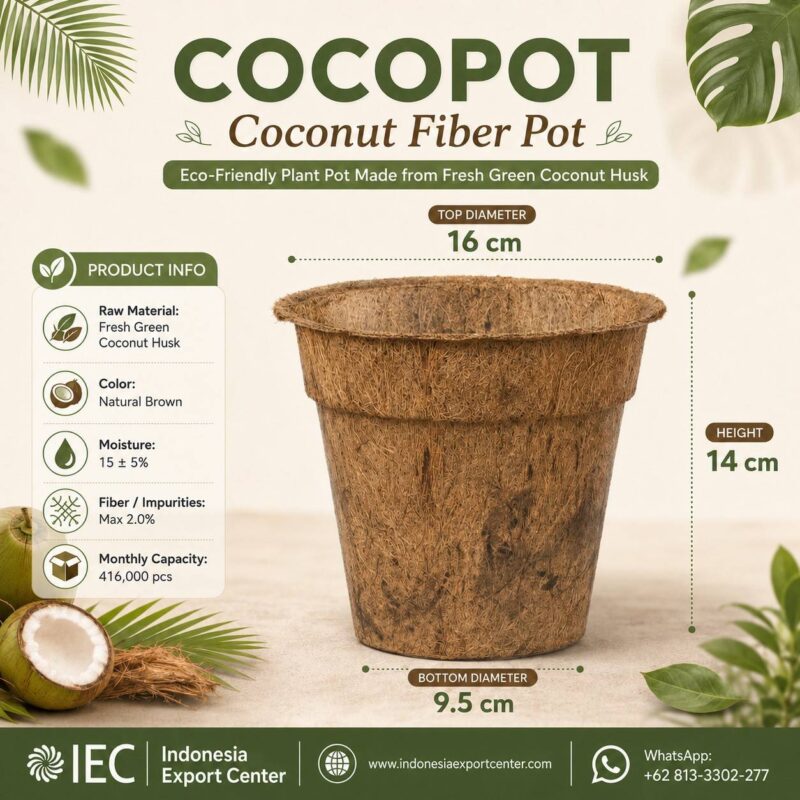
The supplied COCOPOT reference is a natural brown coconut fiber plant pot made using fresh green coconut husk.
Its reference dimensions are:
- Top Diameter: 16 cm
- Height: 14 cm
- Bottom Diameter: 9.5 cm
This guide explains the principal documents and compliance checks that buyers should consider before importing coir pots.
Important: The exact HS classification, phytosanitary requirements, permits, inspections and customs documents must be verified for the specific product and destination market.
REQUEST COCOPOT EXPORT DOCUMENTATION AND SOURCING INFORMATION
WhatsApp: https://wa.me/628133302277
Website: https://indonesiaexportcenter.com/
IEC facilitates sourcing and export enquiries. The contractual seller, exporter of record, document issuer and responsibility for customs formalities must be confirmed for each transaction.
1. COCOPOT Product Information for Customs and Compliance
| Product Parameter | Supplied Reference |
|---|---|
| Product | COCOPOT – Coconut Fiber Pot |
| Product Description | Coconut Fiber Plant Pot |
| Country of Sourcing | Indonesia |
| Raw Material | Fresh Green Coconut Husk |
| Colour | Natural Brown |
| Top Diameter | 16 cm / 160 mm |
| Height | 14 cm / 140 mm |
| Bottom Diameter | 9.5 cm / 95 mm |
| Moisture | 15 ± 5% |
| Fiber / Impurities | Max. 2.0%, definition to be confirmed |
| Stated Monthly Capacity | 416,000 Pieces |
| Finished-Product Composition | To Be Confirmed |
| Binder Composition | To Be Confirmed |
| Manufacturing Process | To Be Confirmed |
| HS Classification | Requires Verification |
| Phytosanitary Requirement | Destination-Specific |
| Import Permit Requirement | Destination-Specific |
| Certificate of Origin | Subject to Applicable Requirements |
| Export Documentation | Subject to Transaction and Destination |
A customs product description should reflect the actual finished goods rather than rely only on the marketing name.
2. Why Export Documentation Matters
Export documentation supports:
- Customs declarations
- Cargo identification
- Shipment tracking
- Payment processing
- Origin verification
- Regulatory compliance
- Import clearance
- Buyer receiving procedures
Incorrect or inconsistent documents can lead to delays, additional costs or clearance difficulties.
3. Standard Commercial Export Documents
Depending on the transaction, common documents may include:
- Commercial invoice
- Packing list
- Transport document
- Certificate of Origin, if required
- Insurance documentation, where applicable
- Relevant permits or certificates
- Other destination-specific documents
Not every document is mandatory for every shipment.
4. Commercial Invoice
A commercial invoice normally identifies the goods and transaction.
Typical information includes:
- Seller
- Buyer
- Invoice number
- Invoice date
- Product description
- Quantity
- Unit price
- Total value
- Currency
- Agreed Incoterm
- Named place or port
- Country of origin, where applicable
The invoice should be consistent with the contract and customs declaration.
5. Packing List
A packing list helps identify how the goods are packed.
Potential information includes:
- Product description
- Carton count
- Pieces per carton
- Total quantity
- Package dimensions
- Net weight
- Gross weight
- Shipping marks
No verified COCOPOT carton dimensions or pieces-per-carton quantity have been supplied.
6. Bill of Lading
For relevant sea shipments, a bill of lading may serve as a transport document.
It may identify:
- Shipper
- Consignee
- Notify party
- Vessel or voyage information
- Port of loading
- Port of discharge
- Cargo description
- Package count
- Container number
- Seal number
The required document format depends on the transport arrangement.
7. Air Waybill
For air cargo shipments, an air waybill may be used.
The transport documentation should match the actual mode of shipment.
8. Certificate of Origin
A Certificate of Origin may be required or requested for certain shipments.
It may support:
- Origin identification
- Customs processing
- Preferential tariff claims, where applicable
The type of certificate and applicable origin rules depend on the destination and trade arrangement.
9. Preferential vs Non-Preferential Origin
Preferential origin may support reduced customs duties under an applicable trade agreement.
Non-preferential origin may be used for other customs or trade measures.
A product sourced from Indonesia does not automatically qualify for preferential tariff treatment.
The applicable rules of origin must be verified.
10. HS Code Classification for Coconut Coir Pots
The Harmonized System provides an international framework for classifying traded goods.
However, the correct classification depends on the actual finished product.
Relevant factors may include:
- Material composition
- Manufacturing process
- Product function
- Finished-product characteristics
- Applicable tariff descriptions
- National tariff subdivisions
No verified HS code has been established for the supplied COCOPOT reference.
Buyers should obtain a classification review from a qualified customs specialist or the relevant customs authority.
11. Why a Generic Coconut Product HS Code May Be Incorrect
Coconut-derived materials can be traded in different forms.
Examples include:
- Raw coconut fiber
- Processed coir
- Coir growing media
- Finished molded plant pots
These goods should not automatically be assigned the same tariff classification.
The physical characteristics and function of the finished product matter.
12. HS Classification Verification Procedure
A practical process may include:
- Obtain the full product description.
- Confirm finished-product composition.
- Identify the manufacturing process.
- Review product photographs and samples.
- Examine applicable tariff headings and legal notes.
- Review relevant classification guidance.
- Confirm the destination-country tariff code.
- Seek an official ruling where appropriate.
The importer should retain the classification rationale.
13. Import Duty and Tax Verification
Import duty depends on the destination tariff classification and applicable trade measures.
Other charges may include:
- Import VAT or GST
- Customs processing fees
- Brokerage fees
- Port charges
- Other applicable taxes
No universal duty rate applies to all markets.
14. Phytosanitary Requirements
Phytosanitary measures address risks associated with plant pests and regulated plant materials.
Because coconut coir pots contain plant-derived material, buyers should investigate whether destination phytosanitary requirements apply.
However, a phytosanitary certificate should not be assumed mandatory for every shipment.
Requirements depend on the importing country’s rules and the actual product.
15. Does Every Coconut Coir Pot Shipment Need a Phytosanitary Certificate?
Not necessarily.
The requirement may depend on:
- Destination country
- Finished-product classification
- Degree of processing
- Product composition
- Pest risk
- Intended use
- Applicable import conditions
Importers should obtain a written determination from the relevant authority or qualified compliance provider where needed.
16. Processed Plant Material vs Unprocessed Plant Material
Regulatory treatment may differ according to the degree of processing.
Potential considerations include:
- Heat treatment
- Drying
- Manufacturing process
- Material cleanliness
- Residual biological risk
The supplied COCOPOT reference does not establish a verified treatment or processing method.
17. Phytosanitary Certificate vs Fumigation Certificate
These are different documents.
A phytosanitary certificate is issued under the relevant official plant-health certification framework.
A fumigation certificate may document a particular treatment.
One does not automatically replace the other.
Buyers should verify the actual destination requirements before requesting either document.
18. Treatment Requirements
Some markets may impose treatment or processing conditions on certain regulated goods.
Potential requirements could relate to:
- Approved treatments
- Processing standards
- Inspection
- Pest-risk controls
- Documentation
No specific treatment requirement has been established for COCOPOT.
19. Biosecurity and Quarantine Checks
Destination authorities may assess imported plant-derived products for biosecurity risks.
Buyers should review:
- Product eligibility
- Import conditions
- Pest restrictions
- Inspection requirements
- Documentation
- Packaging conditions
The actual requirements depend on the market.
20. Import Permits
Some products and destinations may require import permits or other advance approvals.
The importer should verify whether a permit is needed before shipment.
Do not assume that a general business import licence satisfies every product-specific requirement.
21. Customs Product Description
A clear product description may help customs authorities identify the goods.
A proposed descriptive format is:
Molded Coconut Fiber Plant Pots for Horticultural Use
This is a general descriptive example, not a confirmed customs classification.
The final wording should match the actual goods and supporting documents.
22. Material Composition Declaration
A material declaration may help buyers assess:
- Customs classification
- Import restrictions
- Environmental claims
- Product safety
- Buyer specifications
The supplied COCOPOT reference does not disclose the complete finished-product formulation.
23. Binder and Additive Documentation
Buyers should request information about:
- Binder presence
- Binder type
- Binder content
- Coatings
- Additives
- Relevant restricted substances
Such information may be relevant to product compliance and environmental marketing.
24. Moisture and Product Quality Information
The supplied reference states:
Moisture: 15 ± 5%
The measurement method and basis have not been provided.
If a destination or buyer requires moisture testing, the applicable procedure should be agreed.
25. Fiber / Impurities Information
The supplied reference states:
Fiber / Impurities: Maximum 2.0%
The exact meaning and test method require clarification.
This value should not be represented as an independently verified customs or phytosanitary compliance result.
26. Packaging Compliance
Export packaging may need to meet:
- Cargo protection requirements
- Handling requirements
- Labelling requirements
- Destination import rules
- Buyer specifications
Actual packaging details require supplier confirmation.
27. Wood Packaging and ISPM 15
If wooden pallets, crates or dunnage are used, applicable wood packaging rules should be reviewed.
ISPM 15 may be relevant to regulated wood packaging material in international trade.
Its applicability depends on the material and destination requirements.
ISPM 15 compliance for wooden packaging should not be confused with phytosanitary requirements for the coir pots themselves.
28. Shipping Marks
Shipping marks may include:
- Buyer reference
- Product code
- Carton number
- Total carton count
- Destination
- Lot identification
- Handling instructions
Requirements should be agreed before shipment.
29. Container Inspection
Before loading, the logistics provider may inspect:
- Container condition
- Cleanliness
- Water ingress
- Floor condition
- Door seals
- Suitability for cargo
The inspection scope should match the shipment requirements.
30. Pre-Shipment Inspection
A pre-shipment inspection may review:
- Product identity
- Quantity
- Dimensions
- Appearance
- Packaging
- Shipping marks
- Relevant quality documents
Inspection availability and costs require confirmation.
31. Document Consistency
Commercial and transport documents should use consistent information.
Important fields include:
- Product description
- Quantity
- Package count
- Weights
- Seller and buyer
- Shipping references
- Country of origin
Discrepancies should be resolved before submission.
32. Incoterms and Customs Responsibilities
The agreed Incoterm helps define delivery, cost and risk responsibilities.
However, it does not replace customs regulations or determine the legal importer or exporter in every jurisdiction.
Buyers should confirm:
- Export clearance responsibility
- Import clearance responsibility
- Duties and taxes
- Transport insurance
- Delivery location
33. Exporter of Record
The exporter of record is the party responsible for relevant export declarations and obligations under applicable law.
IEC facilitates sourcing and export enquiries and should not automatically be considered the exporter of record.
The actual responsible party must be identified for each transaction.
34. Importer of Record
The importer of record is responsible for applicable import obligations in the destination jurisdiction.
Buyers should confirm who will act in this capacity and ensure that the necessary registrations and permissions are in place.
35. Customs Broker Coordination
A customs broker may help with:
- Tariff classification
- Import declarations
- Document review
- Duty and tax assessment
- Permit verification
- Customs clearance
Buyers should engage a qualified provider where appropriate.
36. Freight Forwarder Coordination
Freight forwarders may coordinate:
- Shipment booking
- Cargo collection
- Transport documents
- Consolidation
- Container arrangements
- Freight quotations
The precise scope depends on the service agreement.
37. Destination-Specific Compliance: United States
US importers should review the applicable requirements with relevant authorities and customs specialists.
Potential areas include:
- US tariff classification
- Customs entry
- Plant-derived product restrictions
- USDA/APHIS requirements where applicable
- Origin declarations
- Other relevant regulations
No product-specific US import clearance determination has been established for COCOPOT.
38. Destination-Specific Compliance: European Union
EU importers should verify:
- EU customs classification
- Applicable duties and taxes
- Plant-health requirements
- Product composition
- Packaging obligations
- Relevant market regulations
Requirements may vary according to the actual product and member-state procedures.
39. Destination-Specific Compliance: United Kingdom
UK importers should review:
- UK tariff classification
- Customs procedures
- Plant-health requirements
- Applicable import controls
- Product and packaging documentation
No UK-specific exemption or certification requirement has been confirmed for COCOPOT.
40. Destination-Specific Compliance: Australia
Australia applies biosecurity controls to relevant imported goods.
Importers should verify the applicable import conditions for the finished coconut fiber pots.
Potential considerations include:
- Product composition
- Processing
- Biosecurity risk
- Treatment conditions
- Inspection
- Packaging
A product-specific determination is required.
41. Destination-Specific Compliance: Canada
Canadian importers should verify:
- Customs classification
- Import duties and taxes
- Applicable plant-health controls
- Product eligibility
- Required documentation
The actual requirements depend on the finished product.
42. Destination-Specific Compliance: Japan
Japanese importers should verify:
- Tariff classification
- Customs declaration requirements
- Applicable plant quarantine rules
- Product processing information
- Relevant documentation
No product-specific Japanese phytosanitary determination has been established.
43. Destination-Specific Compliance: Middle East Markets
Import requirements may differ among countries such as:
- United Arab Emirates
- Saudi Arabia
- Qatar
- Kuwait
- Oman
- Bahrain
Buyers should verify the applicable customs, plant-health and documentation requirements for their specific destination.
44. Country Compliance Comparison Worksheet
| Compliance Item | Destination Requirement |
|---|---|
| Destination Country | [Country] |
| Importer of Record | [Company] |
| Product Description | [Confirmed Description] |
| HS Code | [Verified Code] |
| Import Duty | [Rate] |
| Import Tax | [Rate] |
| Import Permit | [Required / Not Required] |
| Phytosanitary Certificate | [Required / Not Required] |
| Treatment Certificate | [Required / Not Required] |
| Certificate of Origin | [Required / Not Required] |
| Material Declaration | [Required / Not Required] |
| Wood Packaging Compliance | [Applicable / Not Applicable] |
| Inspection Requirement | [Details] |
| Customs Broker | [Provider] |
| Verification Source | [Authority / Reference] |
| Verification Date | [Date] |
45. Import Compliance Workflow
A practical workflow may include:
- Identify the actual finished product.
- Obtain the complete material composition.
- Confirm the manufacturer.
- Determine the destination-country HS classification.
- Verify applicable duties and taxes.
- Review plant-health and biosecurity rules.
- Confirm permit requirements.
- Identify required certificates.
- Agree on Incoterms.
- Confirm exporter and importer of record.
- Review draft commercial documents.
- Verify packaging requirements.
- Arrange inspections if required.
- Confirm shipment readiness.
- Submit documents for clearance.
46. Common Export Documentation Mistakes
Buyers should avoid:
- Using an unverified HS code
- Assuming phytosanitary certification is always mandatory
- Assuming phytosanitary certification is never necessary
- Confusing a fumigation certificate with a phytosanitary certificate
- Using inconsistent product descriptions
- Ignoring binder composition
- Overlooking wood packaging requirements
- Shipping before import permit verification
- Assuming a sourcing facilitator is automatically the exporter of record
- Treating generic online advice as an official import ruling
47. Export Documentation and Compliance Checklist
Product Identification
-
Actual manufacturer identified
-
Finished-product description confirmed
-
Material composition obtained
-
Binder information obtained
-
Product dimensions confirmed
Customs
-
HS classification verified
-
Destination tariff code confirmed
-
Import duty checked
-
Import taxes checked
-
Customs broker consulted
Plant Health and Biosecurity
-
Phytosanitary applicability verified
-
Import permit requirements checked
-
Treatment requirements checked
-
Inspection requirements checked
-
Official authority guidance reviewed
Commercial Documents
-
Commercial invoice prepared
-
Packing list prepared
-
Transport document arranged
-
Certificate of Origin reviewed
-
Insurance documentation reviewed if applicable
Logistics
-
Packaging specification confirmed
-
Wood packaging requirements checked
-
Container inspection arranged
-
Shipping marks verified
-
Exporter of record confirmed
-
Importer of record confirmed
Final Approval
-
Document consistency checked
-
Required certificates obtained
-
Customs requirements reviewed
-
Shipment approved for dispatch
COCOPOT Export Documents and Compliance RFQ Template
Subject: COCOPOT Export Documentation and Import Compliance Enquiry
Dear Indonesia Export Center Team,
We are planning to import coconut fiber plant pots from Indonesia.
Please provide the available product information and export documentation details to support our customs and import compliance review.
Buyer Information
Company Name: [Company Name]
Destination Country: [Country]
Importer of Record: [Company]
Contact Person: [Name]
Email: [Email]
WhatsApp: [Number]
Product Requirements
Product: COCOPOT – Coconut Fiber Pot
Required Dimensions: [mm]
Order Quantity: [Pieces]
Intended Use: [Details]
Product Composition Declaration: Required
Binder Information: Required
Customs and Compliance
Proposed HS Code: [If Available]
HS Classification Verification: Required
Phytosanitary Requirement: [To Be Verified]
Import Permit: [To Be Verified]
Treatment Requirement: [To Be Verified]
Certificate of Origin: [Required / Not Required / To Be Verified]
Other Required Documents: [Details]
Shipping Requirements
Destination Port: [Port]
Preferred Incoterm: [FCA / FOB / CFR / CIF / Other]
Target Shipping Period: [Month / Year]
Packaging Requirements: [Details]
Please provide:
- Actual manufacturer information
- Contractual seller information
- Exporter of record information
- Complete product description
- Finished-product material composition
- Binder and additive information
- Manufacturing process information
- Available product specifications
- Proposed customs classification information, if available
- Available phytosanitary documentation information
- Treatment information, if applicable
- Certificate of Origin arrangements
- Commercial invoice format
- Packing list format
- Transport document arrangements
- Packaging specifications
- Wood packaging information, if applicable
- Sample availability
- MOQ
- Wholesale unit price
- Production lead time
- Payment terms
- Quotation validity
We will verify the destination import requirements with our customs broker and relevant authorities before shipment.
Kind regards,
[Your Name] [Company Name] [Country]SEND YOUR COCOPOT EXPORT DOCUMENTATION ENQUIRY
WhatsApp: https://wa.me/628133302277
Frequently Asked Questions – Coir Pots Export Documents
What documents are needed to export coconut coir pots from Indonesia?
Depending on the shipment, documents may include a commercial invoice, packing list, transport document, Certificate of Origin and applicable regulatory certificates.
What is the HS code for coconut coir pots?
No verified HS code has been established for the supplied COCOPOT reference. Classification must be confirmed for the finished product and destination.
Do coconut coir pots need a phytosanitary certificate?
Not necessarily. The requirement depends on the importing country’s rules and the actual product.
Are phytosanitary and fumigation certificates the same?
No. They document different regulatory or treatment matters.
Does a Certificate of Origin guarantee preferential duty?
No. Preferential treatment depends on the applicable trade agreement and rules of origin.
Are import permits required?
Permit requirements vary by destination and product classification.
Are coconut coir pots subject to quarantine inspection?
They may be subject to applicable plant-health or biosecurity controls, depending on the destination.
Does the binder composition affect import compliance?
It may be relevant to classification, material restrictions and product declarations.
Are wooden pallets subject to special requirements?
Applicable wood packaging rules, including ISPM 15 where relevant, should be verified.
What is the difference between an exporter of record and a sourcing facilitator?
The exporter of record has relevant legal export responsibilities, while a sourcing facilitator helps coordinate sourcing and commercial enquiries.
Can IEC provide export documentation?
Document availability and arrangements must be confirmed for the actual transaction and responsible exporting party.
Can I import COCOPOT into the United States?
Import eligibility and requirements must be verified with the relevant US authorities for the specific finished product.
Can I import COCOPOT into the European Union?
Applicable EU customs and plant-health requirements must be verified before shipment.
Can I import COCOPOT into Australia?
Australian biosecurity import conditions must be checked for the actual product.
What are the supplied COCOPOT dimensions?
16 cm top diameter, 14 cm height and 9.5 cm bottom diameter.
What is the stated monthly capacity?
416,000 pieces, subject to manufacturer verification.
How do I request export documentation information?
Contact IEC with the product specification, order quantity, destination country and required documents.
Request COCOPOT Export Documentation and Wholesale Sourcing Information
Plan Coconut Fiber Pot Imports from Indonesia with Proper Customs and Compliance Preparation
Indonesia Export Center (IEC) welcomes enquiries from international importers, customs compliance teams, freight forwarders, procurement managers and horticultural distributors.
Product: COCOPOT – Coconut Fiber Pot
Country of Sourcing: Indonesia
Raw Material: Fresh Green Coconut Husk
Colour: Natural Brown
Reference Top Diameter: 16 cm
Reference Height: 14 cm
Reference Bottom Diameter: 9.5 cm
Reference Moisture: 15 ± 5%
Reference Fiber / Impurities: Max. 2.0%, Definition Subject to Confirmation
Stated Monthly Capacity: 416,000 Pieces, Subject to Verification
Finished-Product Composition: To Be Confirmed
HS Classification: Requires Verification
Phytosanitary Requirements: Destination-Specific
Import Permit Requirements: Destination-Specific
Certificate of Origin: Subject to Applicable Requirements
Exporter of Record: To Be Confirmed
MOQ: To Be Confirmed
Wholesale Price: Request Quotation
Production Lead Time: To Be Confirmed
Contact IEC to discuss product information, export documentation, sourcing requirements and international wholesale enquiries.
INDONESIA EXPORT CENTER | IEC
Your Export & Sourcing Partner from Indonesia
Website: https://indonesiaexportcenter.com/
WhatsApp: +62 813-3302-277
REQUEST COCOPOT EXPORT DOCUMENTATION AND WHOLESALE SOURCING DETAILS
Please include your company name, destination country, destination port, order quantity, required documents and preferred Incoterm.
Trade Compliance Disclaimer: This guide provides general export and import planning information, not a binding customs classification, official phytosanitary determination or legal opinion. HS codes, import duties, permits, certificates, inspections and biosecurity requirements vary by destination and product characteristics. Importers should confirm requirements with relevant customs, plant-health and regulatory authorities before shipment. IEC facilitates sourcing and export enquiries; the responsible manufacturer, contractual seller and exporter of record must be confirmed for each transaction.
