

INDONESIA EXPORT CENTER | IEC
COCOPOT – COCONUT FIBER PLANT POT
Packaging Specifications, Carton Measurements, Palletisation and Container Loading Planning for International Buyers
Bulk Packaging | Carton Dimensions | Packing Tolerances | Nesting Configuration | CBM Calculation | 20ft & 40ft Containers | Export Logistics
Cocopot Packaging and Container Loading for International Wholesale Buyers
Planning a bulk shipment and looking for information about cocopot container loading packaging from Indonesia?
For international importers, horticultural wholesalers and logistics procurement teams, packaging and container loading are important components of total landed cost.
A product’s nominal dimensions alone are not enough to calculate how many coconut fiber pots can be loaded into a shipping container.
Buyers also need to understand:
- How the pots are packed
- Whether the finished pots can be nested
- The number of pieces per carton
- External carton dimensions
- Carton gross weight
- Pallet dimensions
- Stacking limitations
- Packing tolerances
- Container payload restrictions
Indonesia Export Center (IEC) facilitates sourcing and export enquiries for coconut fiber plant pots from Indonesia.
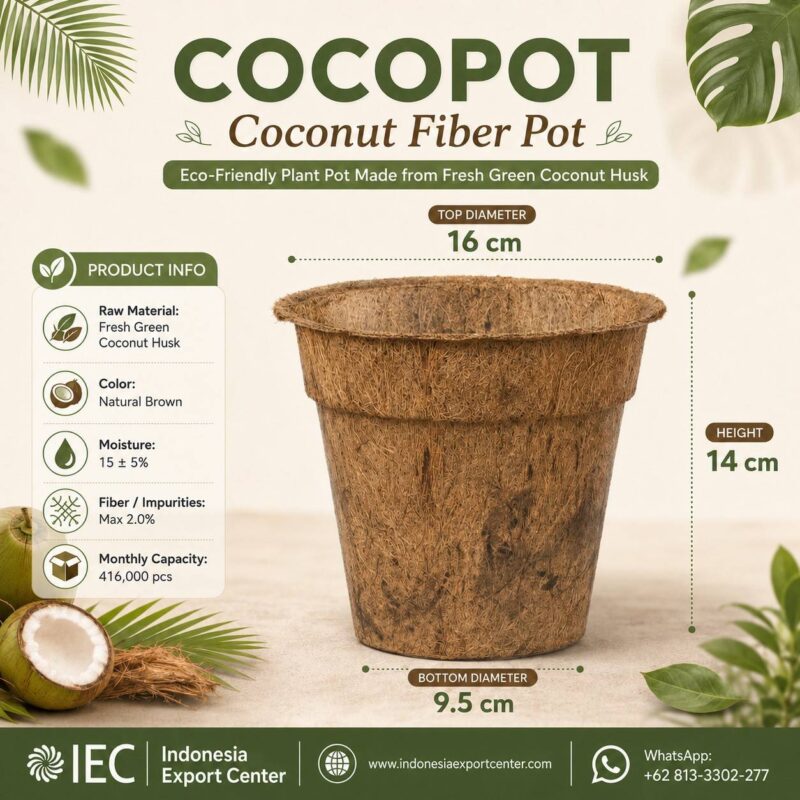
The supplied COCOPOT reference is a natural brown coconut fiber plant pot made using fresh green coconut husk.
Its stated dimensions are:
- Top Diameter: 16 cm
- Height: 14 cm
- Bottom Diameter: 9.5 cm
The supplied reference also states a monthly production capacity of 416,000 pieces, subject to manufacturer verification.
Important: The supplied product information does not include verified carton dimensions, packing quantities, unit weight, nesting measurements or container loading capacity.
These values must be confirmed through supplier packing data and an approved loading plan.
REQUEST COCOPOT PACKAGING AND CONTAINER LOADING DETAILS
WhatsApp: https://wa.me/628133302277
Website: https://indonesiaexportcenter.com/
IEC facilitates sourcing and export enquiries. Packaging formats, loading quantities, freight arrangements and commercial terms require supplier confirmation.
1. COCOPOT Product Specifications for Logistics Planning
| Specification | IEC Supplied Reference |
|---|---|
| Product | COCOPOT – Coconut Fiber Plant Pot |
| Country of Sourcing | Indonesia |
| Raw Material | Fresh Green Coconut Husk |
| Colour | Natural Brown |
| Top Diameter | 16 cm / 160 mm |
| Height | 14 cm / 140 mm |
| Bottom Diameter | 9.5 cm / 95 mm |
| Moisture | 15 ± 5% |
| Fiber / Impurities | Max. 2.0%, definition to be confirmed |
| Stated Monthly Capacity | 416,000 Pieces |
| Unit Weight | To Be Confirmed |
| Dimensional Tolerances | To Be Confirmed |
| Pieces per Pack | To Be Confirmed |
| Pieces per Carton | To Be Confirmed |
| Carton Dimensions | To Be Confirmed |
| Carton Gross Weight | To Be Confirmed |
| Nesting Configuration | To Be Confirmed |
| Pallet Configuration | To Be Confirmed |
| Container Loading Quantity | To Be Calculated |
| Export Packaging | Subject to Supplier Confirmation |
The reference dimensions describe the pot, not the dimensions of its shipping carton.
2. Why Packaging Matters in Wholesale Coir Pot Imports
Packaging affects:
- Freight cost
- Cargo volume
- Handling efficiency
- Warehouse storage
- Container utilisation
- Product protection
- Customs inspection
- Receiving operations
A suitable packaging specification should balance shipping efficiency and product protection.
3. Packaging Options for Coconut Fiber Pots
International buyers may request different packaging configurations.
Potential enquiries include:
- Bulk packing
- Master cartons
- Inner packs
- Palletised cartons
- Product identification labels
- Lot identification
- Shipping marks
These are potential packaging requirements, not confirmed standard IEC COCOPOT packaging options.
4. Bulk Packing
Bulk packing may be considered for commercial nursery or wholesale distribution orders.
Potential evaluation areas include:
- Product protection
- Handling efficiency
- Packing density
- Lot identification
- Cargo stability
- Unloading procedures
The actual feasibility of bulk packing must be confirmed with the supplier.
5. Master Carton Packaging
Master cartons may support:
- Product protection
- Counting
- Warehouse handling
- Shipping identification
- Inventory control
Buyers should confirm the carton material, construction, dimensions and load capacity.
6. Pieces per Carton
The number of pots per carton is a critical logistics parameter.
It affects:
- Carton size
- Gross weight
- Handling
- Container loading
- Freight cost
- Warehouse receiving
No verified pieces-per-carton quantity has been supplied.
Buyers should request the confirmed packing quantity for the exact product specification.
7. Carton Dimensions
Carton dimensions should be recorded using an agreed unit of measurement.
A standard reporting format is:
Length × Width × Height
For example, the buyer’s packing sheet should include:
| Carton Parameter | Required Information |
|---|---|
| External Length | To Be Confirmed |
| External Width | To Be Confirmed |
| External Height | To Be Confirmed |
| Internal Dimensions | If Required |
| Carton Material | To Be Confirmed |
| Carton Construction | To Be Confirmed |
| Pieces per Carton | To Be Confirmed |
| Carton Net Weight | To Be Confirmed |
| Carton Gross Weight | To Be Confirmed |
External carton dimensions are normally used for freight volume calculations.
8. Carton Dimensional Tolerances
Carton dimensions may vary due to manufacturing and packing conditions.
Buyers should agree on acceptable tolerances for:
- Carton length
- Carton width
- Carton height
- Carton bulging
- Packed carton shape
- Pallet overhang
No packaging tolerances have been supplied for the IEC reference.
9. Carton Gross Weight Tolerances
Carton gross weight includes the products and packaging.
Buyers should request:
- Net weight per carton
- Gross weight per carton
- Weight tolerance
- Weighing method
- Measurement conditions
The product’s moisture content may be relevant when assessing shipment weight, but no verified relationship has been established for this reference.
10. Coconut Coir Pot Unit Weight
Unit weight is necessary for accurate freight and handling calculations.
The supplied reference does not include unit weight.
Buyers should request:
- Average unit weight
- Weight tolerance
- Measurement method
- Sample size
- Product condition during weighing
11. Nesting Configuration
Some pot shapes may allow nesting, but the actual nesting behaviour depends on the finished product.
Potential evaluation areas include:
- Pot geometry
- Wall thickness
- Surface friction
- Shape consistency
- Structural strength
- Stack height
- Ease of separation
The supplied reference does not confirm a particular nesting configuration or nesting efficiency.
12. Nesting Depth and Stack Height
If nesting is feasible, buyers should request measured stack data.
Potential measurements include:
- Height of one pot
- Height of a defined stack
- Additional height per nested pot
- Maximum stable stack quantity
- Stack diameter
- Handling requirements
These measurements can support packaging design.
13. Packing Density
Packing density describes how efficiently products use available packaging volume.
Potential influencing factors include:
- Pot dimensions
- Nesting behaviour
- Carton geometry
- Product orientation
- Protective materials
- Packing tolerances
Packing density should be established using actual packing trials.
14. Packing Trial Procedure
A practical packing trial may include:
- Select the approved product sample.
- Confirm product dimensions.
- Measure unit weight.
- Test nesting, if feasible.
- Select a proposed carton.
- Pack a defined quantity.
- Measure external carton dimensions.
- Weigh the packed carton.
- Assess carton stability.
- Record the final packing specification.
15. Carton Packing Specification Sheet
| Parameter | Supplier-Confirmed Value |
|---|---|
| Product Code | To Be Confirmed |
| Product Dimensions | 160 × 140 × 95 mm reference measurements, by diameter/height |
| Pieces per Inner Pack | To Be Confirmed |
| Inner Packs per Carton | To Be Confirmed |
| Total Pieces per Carton | To Be Confirmed |
| Carton Length | To Be Confirmed |
| Carton Width | To Be Confirmed |
| Carton Height | To Be Confirmed |
| Carton Net Weight | To Be Confirmed |
| Carton Gross Weight | To Be Confirmed |
| Carton Material | To Be Confirmed |
| Carton Markings | To Be Agreed |
| Dimensional Tolerances | To Be Agreed |
16. CBM Calculation for Export Cartons
CBM means cubic metres.
For a rectangular carton, the external volume can be calculated as:
Carton CBM = Length (m) × Width (m) × Height (m)
If carton dimensions are measured in centimetres:
Carton CBM = [Length (cm) × Width (cm) × Height (cm)] ÷ 1,000,000
This calculation gives the nominal rectangular volume of one carton.
17. Total Shipment CBM
Once the carton CBM is confirmed:
Total Carton CBM = Carton CBM × Number of Cartons
This provides the sum of the nominal carton volumes.
It does not establish that all cartons can physically fit into a container.
18. Pieces per Shipment Calculation
Once the packing quantity is confirmed:
Total Pieces = Pieces per Carton × Number of Cartons
This calculation should be checked against the commercial invoice and packing list.
19. Gross Shipment Weight
A simplified calculation is:
Total Carton Gross Weight = Gross Weight per Carton × Number of Cartons
Additional pallet or securing materials may need to be included separately.
The actual cargo weight must be confirmed using measured packing data.
20. Why Nominal CBM Is Not the Same as Container Loading Capacity
Container loading depends on more than the sum of carton volumes.
Practical constraints include:
- Container internal dimensions
- Door opening dimensions
- Carton orientation
- Stacking limitations
- Cargo weight
- Pallet dimensions
- Weight distribution
- Securing requirements
- Unusable spaces
Therefore, dividing container volume by carton CBM does not produce a verified loading quantity.
21. 20ft Container Loading Considerations
A 20ft dry container may be considered for certain wholesale shipments.
Buyers should confirm:
- Container internal dimensions
- Payload
- Door dimensions
- Carton dimensions
- Pallet configuration
- Stacking limitations
- Cargo weight distribution
No verified COCOPOT loading quantity has been supplied for a 20ft container.
22. 40ft Container Loading Considerations
A 40ft dry container may be considered for larger shipments.
The actual loading quantity depends on the packed cargo.
Buyers should request a supplier-confirmed loading plan.
23. 40ft High-Cube Container Loading Considerations
A 40ft high-cube container provides additional internal height compared with a standard 40ft dry container.
However, additional height does not automatically translate into proportionally more COCOPOT pieces.
Stacking strength, pallet height and cargo securing requirements must be considered.
24. Container Loading Comparison Worksheet
| Loading Parameter | 20ft | 40ft | 40ft HC |
|---|---|---|---|
| Container Internal Dimensions | Verify | Verify | Verify |
| Maximum Payload | Verify | Verify | Verify |
| Door Opening | Verify | Verify | Verify |
| Pieces per Carton | Confirm | Confirm | Confirm |
| Cartons per Container | Calculate | Calculate | Calculate |
| Pieces per Container | Calculate | Calculate | Calculate |
| Total Cargo Gross Weight | Calculate | Calculate | Calculate |
| Pallet Configuration | Confirm | Confirm | Confirm |
| Loading Plan Approved | Pending | Pending | Pending |
The appropriate container should be selected using actual cargo and carrier information.
25. Palletised vs Floor-Loaded Shipments
Buyers may compare palletised and floor-loaded configurations.
Palletised Loading
Potential advantages include:
- Mechanical handling
- Warehouse efficiency
- Unitised cargo
- Easier receiving
Potential limitations include:
- Pallet weight
- Pallet volume
- Reduced usable loading space
Floor Loading
Potential considerations include:
- Manual handling
- Loading time
- Cargo stability
- Unloading requirements
- Product protection
Neither configuration should be assumed to be standard for IEC COCOPOT.
26. Pallet Specifications
If palletisation is required, buyers should confirm:
- Pallet dimensions
- Pallet material
- Pallet weight
- Cartons per layer
- Layers per pallet
- Total pallet height
- Gross pallet weight
- Stretch wrapping or securing method
Wood packaging requirements may apply depending on the destination and pallet construction.
27. Pallet Loading Tolerances
A pallet loading plan should address:
- Carton alignment
- Overhang
- Stack height
- Weight distribution
- Pallet stability
- Wrapping
- Handling conditions
Acceptable tolerances should be agreed with the supplier and logistics provider.
28. Container Loading Plan
A container loading plan should identify:
- Container type
- Cargo dimensions
- Carton quantity
- Pallet quantity, if applicable
- Cargo weight
- Loading sequence
- Cargo orientation
- Securing method
- Weight distribution
- Door clearance
The plan should be reviewed against the actual container and shipment requirements.
29. Container Loading Diagram Requirements
For larger shipments, buyers may request a loading diagram.
A useful diagram should show:
- Carton or pallet arrangement
- Loading direction
- Layer configuration
- Cargo height
- Securing areas
- Door clearance
- Total cargo quantity
Any diagram should be based on confirmed packing measurements rather than assumed carton sizes.
30. Cargo Securing
Cargo securing should be appropriate to the transport mode and loading arrangement.
Potential considerations include:
- Cargo movement
- Weight distribution
- Stack stability
- Void spaces
- Securing materials
- Container condition
The logistics provider should confirm the applicable securing requirements.
31. Moisture Protection During Shipping
The supplied reference states:
Moisture: 15 ± 5%
The measurement basis and test method require confirmation.
Shipping conditions may expose cargo to temperature and humidity changes.
Buyers should evaluate:
- Packaging suitability
- Container condition
- Cargo moisture exposure
- Condensation risk
- Ventilation
- Storage duration
Any moisture protection measures should be based on the actual cargo and shipping route.
32. Container Inspection Before Loading
A pre-loading container check may include:
- Container identification
- Structural condition
- Floor condition
- Cleanliness
- Water ingress
- Unusual odours
- Door seals
- Suitability for the cargo
The inspection scope should be agreed with the logistics provider.
33. Pre-Loading Product Inspection
Before loading, buyers may request checks covering:
- Product identification
- Carton count
- Carton dimensions
- Carton weight
- Packaging condition
- Shipping marks
- Lot identification
- Visible damage
Inspection procedures should be agreed in advance.
34. Container Loading Supervision
Loading supervision may help verify:
- Correct product
- Correct quantity
- Container condition
- Loading arrangement
- Cargo securing
- Container seal information
- Photographic records
Availability and cost of supervision require confirmation.
35. Packing List Requirements
A packing list may include:
- Shipper
- Consignee
- Product description
- Product code
- Number of cartons
- Pieces per carton
- Total pieces
- Net weight
- Gross weight
- Package dimensions
- Shipment volume
The final format should match the transaction and customs requirements.
36. Shipping Marks and Carton Identification
Shipping marks may help identify cargo during transport and receiving.
Potential information includes:
- Buyer name or code
- Product code
- Carton number
- Total carton count
- Destination
- Lot number
- Handling instructions
Marking requirements should be agreed before packing.
37. Export Documentation
Depending on the shipment and destination, documents may include:
- Commercial invoice
- Packing list
- Bill of lading
- Certificate of Origin, where applicable
- Product specification
- Material declaration, if required
- Inspection report, if agreed
- Other applicable documents
The importer should verify the destination requirements.
38. Incoterms and Freight Quotations
Common international trade terms may include:
- FCA
- FOB
- CFR
- CIF
The appropriate term depends on the transport arrangement.
Buyers should specify the named place or port and applicable Incoterms version.
For containerised cargo, FCA may be more appropriate than FOB depending on the actual delivery arrangement.
39. Freight Cost per Pot
A simplified calculation is:
Freight Cost per Pot = Relevant Freight Cost ÷ Number of Pots Shipped
The calculation should use actual freight quotations and confirmed loading quantities.
For a more complete comparison, buyers should calculate total landed cost per usable pot.
40. Packaging Cost vs Freight Savings
Packaging decisions may affect:
- Carton cost
- Packing labour
- Container utilisation
- Freight cost per unit
- Damage risk
- Warehouse handling
Buyers should compare different packaging options using actual supplier and freight data.
41. Supplier Packaging Verification Checklist
Product Data
-
Product dimensions confirmed
-
Unit weight confirmed
-
Dimensional tolerances agreed
-
Finished-product condition defined
Packing Data
-
Packing format confirmed
-
Pieces per carton confirmed
-
Carton dimensions confirmed
-
Carton gross weight confirmed
-
Nesting configuration verified
-
Packing tolerances agreed
Pallet Data
-
Palletisation requirement confirmed
-
Pallet dimensions confirmed
-
Cartons per pallet confirmed
-
Pallet gross weight confirmed
-
Pallet height confirmed
Container Loading
-
Container type selected
-
Loading quantity calculated
-
Cargo weight checked
-
Loading plan approved
-
Cargo securing requirements agreed
-
Container inspection arranged
Shipping Documents
-
Commercial invoice prepared
-
Packing list prepared
-
Shipping marks verified
-
Export documentation reviewed
Cocopot Packaging and Container Loading RFQ Template
Subject: RFQ – COCOPOT Packaging Specifications and Container Loading Plan
Dear Indonesia Export Center Team,
We are interested in sourcing coconut fiber plant pots from Indonesia for international wholesale import.
Please provide the available packaging specifications and container loading information for the COCOPOT reference product.
Buyer Information
Company Name: [Company Name]
Country: [Country]
Business Type: [Importer / Wholesaler / Nursery / Distributor / Other]
Contact Person: [Name]
Email: [Email]
WhatsApp: [Number]
Product Requirements
Product: COCOPOT – Coconut Fiber Plant Pot
Top Diameter: [mm]
Height: [mm]
Bottom Diameter: [mm]
Required Order Quantity: [Pieces]
Expected Annual Demand: [Pieces]
Packaging Requirements
Preferred Packaging: [Bulk / Carton / Palletised / Other]
Pieces per Pack: [Pieces]
Pieces per Carton: [Pieces]
Carton Material: [Details]
Maximum Carton Gross Weight: [kg]
Carton Dimensional Tolerances: [Details]
Product Identification: [Required / Not Required]
Lot Identification: [Required / Not Required]
Shipping Marks: [Details]
Palletisation Requirements
Palletisation: [Required / Not Required]
Preferred Pallet Dimensions: [mm]
Maximum Pallet Height: [mm]
Maximum Pallet Gross Weight: [kg]
Pallet Material: [Details]
Container Loading Requirements
Preferred Container: [20ft / 40ft / 40ft HC / To Be Recommended]
Floor Loading: [Acceptable / Not Acceptable]
Palletised Loading: [Required / Optional]
Loading Diagram: [Required / Not Required]
Loading Supervision: [Required / Not Required]
Container Inspection: [Required / Not Required]
Cargo Securing Requirements: [Details]
Shipping Requirements
Destination Country: [Country]
Destination Port: [Port]
Final Delivery Location: [City / Warehouse]
Preferred Incoterm: [FCA / FOB / CFR / CIF / Other]
Target Shipping Period: [Month / Year]
Please provide:
- Actual manufacturer information
- Product dimensions and tolerances
- Unit weight
- Available packing formats
- Pieces per pack
- Pieces per carton
- External carton dimensions
- Carton net weight
- Carton gross weight
- Carton dimensional tolerances
- Nesting configuration
- Stack height data, if applicable
- Pallet specifications
- Cartons per pallet
- Pallet gross weight
- Estimated 20ft container loading
- Estimated 40ft container loading
- Estimated 40ft HC container loading
- Loading plan or diagram
- Cargo securing recommendations
- Packaging cost
- Production lead time
- Available Incoterm quotations
- Export documentation information
- Contractual seller and exporter of record
- Payment terms
- Quotation validity
We look forward to receiving your packaging and logistics proposal.
Kind regards,
[Your Name] [Company Name] [Country]SEND YOUR COCOPOT PACKAGING AND CONTAINER LOADING ENQUIRY
WhatsApp: https://wa.me/628133302277
Frequently Asked Questions – Cocopot Packaging and Container Loading
How are coconut coir pots packed for export?
Packaging depends on supplier capability and buyer requirements. The supplied reference does not establish a standard packing configuration.
How many COCOPOT pieces fit in one carton?
No verified pieces-per-carton quantity has been supplied.
What are the carton dimensions?
Carton dimensions have not been supplied and require manufacturer confirmation.
Can coconut coir pots be nested?
Nesting feasibility and efficiency must be confirmed through actual product and packing trials.
How many COCOPOT pieces fit in a 20ft container?
No verified loading quantity has been supplied. It requires confirmed packaging and loading data.
How many COCOPOT pieces fit in a 40ft container?
The quantity must be calculated using the actual packing configuration.
Is a 40ft high-cube container suitable?
Suitability depends on the cargo dimensions, stacking limitations, weight and shipping arrangements.
Can buyers request palletised shipments?
Palletisation requirements may be submitted for supplier feasibility review.
Can buyers request floor-loaded containers?
Floor-loading requirements may be submitted for supplier and logistics assessment.
What is the unit weight of COCOPOT?
Unit weight has not been supplied.
What are the supplied COCOPOT dimensions?
16 cm top diameter, 14 cm height and 9.5 cm bottom diameter.
What is the moisture specification?
15 ± 5%, with the measurement method subject to confirmation.
What is the stated monthly production capacity?
416,000 pieces, subject to manufacturer verification.
Can I request a container loading diagram?
A loading diagram may be requested, subject to the availability of confirmed packing data and supplier capability.
Can I request carton dimensional tolerances?
Yes. Buyers should include required tolerances in the packaging specification enquiry.
Does IEC manufacture COCOPOT directly?
IEC facilitates sourcing and export enquiries and should not automatically be considered the physical manufacturer.
Can IEC provide freight quotations?
Freight quotation enquiries may be submitted, subject to route availability and commercial arrangements.
How do I request packaging and loading information?
Send your product requirements, order quantity, preferred packing format, destination and container preference to IEC via WhatsApp.
Request COCOPOT Packaging and Container Loading Information
Plan Coconut Fiber Pot Wholesale Shipments from Indonesia with Supplier-Confirmed Packing Data
Indonesia Export Center (IEC) welcomes enquiries from international importers, logistics buyers, wholesale distributors, commercial nurseries and procurement teams.
Product: COCOPOT – Coconut Fiber Plant Pot
Country of Sourcing: Indonesia
Raw Material: Fresh Green Coconut Husk
Colour: Natural Brown
Reference Top Diameter: 16 cm
Reference Height: 14 cm
Reference Bottom Diameter: 9.5 cm
Reference Moisture: 15 ± 5%
Reference Fiber / Impurities: Max. 2.0%, Definition Subject to Confirmation
Stated Monthly Capacity: 416,000 Pieces, Subject to Verification
Unit Weight: To Be Confirmed
Pieces per Carton: To Be Confirmed
Carton Dimensions: To Be Confirmed
Carton Gross Weight: To Be Confirmed
Nesting Configuration: To Be Confirmed
Palletisation: Subject to Supplier Confirmation
Container Loading Quantity: To Be Calculated
Packaging Tolerances: To Be Agreed
MOQ: To Be Confirmed
Wholesale Price: Request Quotation
Production Lead Time: To Be Confirmed
Export Terms: Subject to Commercial Agreement
Contact IEC to discuss carton specifications, bulk packing, nesting, palletisation, container loading plans, freight quotations and international wholesale procurement.
INDONESIA EXPORT CENTER | IEC
Your Export & Sourcing Partner from Indonesia
Website: https://indonesiaexportcenter.com/
WhatsApp: +62 813-3302-277
REQUEST YOUR COCOPOT PACKAGING AND CONTAINER LOADING QUOTATION
Please include your company name, order quantity, preferred packaging, destination country, destination port and container preference.
Packaging and Logistics Disclaimer: IEC facilitates sourcing and export enquiries. No verified carton dimensions, pieces-per-carton quantity, nesting efficiency, pallet configuration, container loading capacity or freight rate has been supplied for the reference product. All packing and loading figures must be confirmed through actual measurements, supplier documentation and appropriate logistics planning. Production capacity, MOQ, pricing, lead time and shipping terms require supplier confirmation.
