

Cocopeat Quality Specifications: EC, pH, Moisture & Expansion Standards
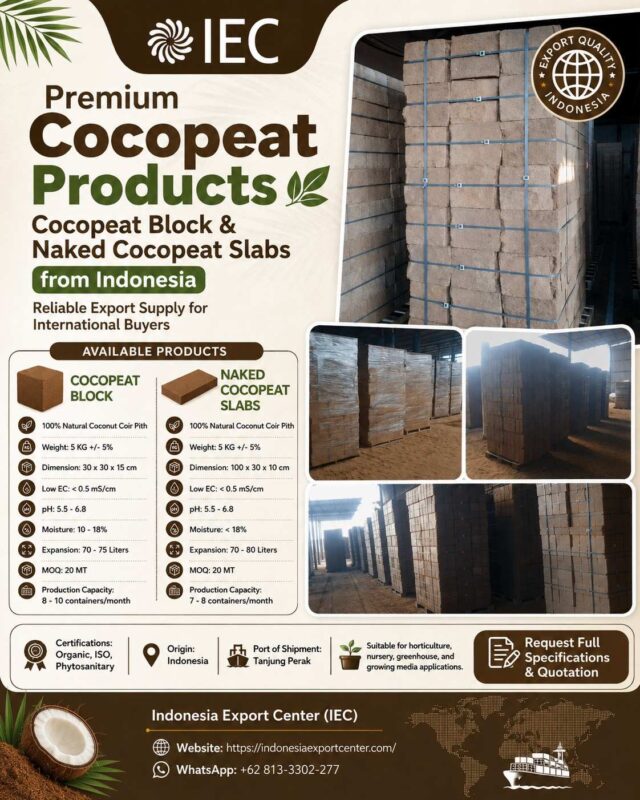
Premium Cocopeat Blocks & Naked Cocopeat Slabs from Indonesia
Reliable Export Supply for International Buyers
Looking for cocopeat quality specifications before placing a bulk import order?
Understanding electrical conductivity (EC), pH levels, moisture content, expansion volume, product weight, and physical dimensions is essential when evaluating cocopeat for international agricultural and horticultural applications.
Indonesia Export Center (IEC) offers premium 5 KG cocopeat blocks and naked cocopeat slabs, manufactured from 100% natural coconut coir pith and supplied for international wholesale markets.
Our cocopeat products feature specified Low EC levels below 0.5 mS/cm, a pH range of 5.5–6.8, and defined moisture and expansion characteristics.
This guide provides a detailed overview of our cocopeat product specifications and the key quality parameters that importers, procurement teams, and quality control managers should evaluate before purchasing.
Request Full Cocopeat Specifications & Quotation:
https://wa.me/628133302277
Cocopeat Quality Specifications at a Glance
Indonesia Export Center offers two compressed cocopeat formats with defined technical specifications.
| Quality Parameter | Cocopeat Block | Naked Cocopeat Slabs |
|---|---|---|
| Material | 100% Natural Coconut Coir Pith | 100% Natural Coconut Coir Pith |
| Weight | 5 KG ± 5% | 5 KG ± 5% |
| Dimensions | 30 × 30 × 15 cm | 100 × 30 × 10 cm |
| Electrical Conductivity (Low EC) | < 0.5 mS/cm | < 0.5 mS/cm |
| pH Range | 5.5–6.8 | 5.5–6.8 |
| Moisture Content | 10–18% | < 18% |
| Expansion Volume | 70–75 Liters | 70–80 Liters |
| Minimum Order Quantity | 20 MT | 20 MT |
| Production Capacity | 8–10 containers/month | 7–8 containers/month |
These specifications provide a starting point for evaluating product suitability and establishing purchasing requirements.
For formal quality acceptance, buyers should agree on testing methods, sampling procedures, and allowable tolerances before shipment.
1. Cocopeat Electrical Conductivity (EC): Below 0.5 mS/cm
What Is EC in Cocopeat?
Electrical conductivity (EC) measures the ability of a solution or extract to conduct electricity and is commonly used as an indicator of dissolved ionic content.
In cocopeat quality evaluation, EC is an important parameter because excessive soluble salts may affect the suitability of a growing medium for salt-sensitive crops.
Our Cocopeat EC Specification
Low EC: < 0.5 mS/cm
This specification applies to both:
- 5 KG Cocopeat Blocks
- 5 KG Naked Cocopeat Slabs
Low EC cocopeat is commonly requested by commercial growers, greenhouse operators, nurseries, and substrate manufacturers.
Why EC Matters for Import Quality Control
Import QC managers should review EC specifications to assess whether the product is appropriate for the intended crop and growing system.
When comparing EC values between suppliers, it is important to confirm:
- The laboratory extraction method
- The cocopeat-to-water ratio
- The testing temperature or temperature compensation
- Whether the result is reported for a saturated extract or another extraction method
- The agreed acceptance limit
Important: EC values obtained using different testing methods may not be directly comparable. The stated specification of less than 0.5 mS/cm should therefore be linked to an agreed testing procedure before contractual acceptance.
2. Cocopeat pH Specification: 5.5–6.8
What Is pH in Cocopeat?
pH indicates the acidity or alkalinity of a growing medium or its extract.
It is an important factor in horticultural substrate selection because pH influences nutrient availability and growing media management.
Our Cocopeat pH Range
pH: 5.5–6.8
Both cocopeat blocks and naked cocopeat slabs are specified within this range.
Why pH Matters
A defined pH range helps agricultural buyers assess cocopeat compatibility with their intended growing media formulations.
However, the optimal pH depends on the crop, irrigation water, fertilizer program, and overall substrate composition.
Recommended QC Considerations
Before accepting a shipment, buyers should confirm:
- The specified pH range
- The measurement method
- Sample preparation procedures
- Testing consistency between batches
- Any crop-specific requirements
For accurate supplier comparisons, pH should be measured using a consistent and agreed laboratory method.
3. Cocopeat Moisture Content: Quality and Storage Considerations
Moisture content is an important quality parameter for compressed cocopeat products.
It influences product weight, storage conditions, handling, and shipment planning.
Our Moisture Specifications
Cocopeat Block: 10–18%
Naked Cocopeat Slabs: < 18%
Why Moisture Content Matters
Moisture specifications are relevant to international buyers for several reasons.
Product Weight Consistency
Changes in moisture content can affect the actual weight of compressed cocopeat products.
Storage and Handling
Appropriate moisture management helps reduce the risk of undesirable product deterioration during storage and transportation.
Shipment Planning
Moisture content contributes to cargo weight and should be considered when planning bulk container shipments.
Moisture Quality Control Checklist
Import QC managers should verify:
- The agreed moisture specification
- The sampling method
- The moisture testing procedure
- Product condition before loading
- Storage and transportation requirements
A consistent testing method is necessary to compare moisture results across shipments.
4. Cocopeat Expansion Volume: 70–80 Liters
What Is Cocopeat Expansion?
Expansion volume refers to the approximate volume obtained when compressed cocopeat is hydrated under specified conditions.
It is an important purchasing parameter because buyers often evaluate cocopeat according to the volume of usable growing media produced after hydration.
Our Expansion Specifications
5 KG Cocopeat Block: 70–75 Liters
5 KG Naked Cocopeat Slabs: 70–80 Liters
Why Expansion Volume Matters
Expansion characteristics help buyers estimate the amount of growing media obtainable from compressed cocopeat products.
This information is relevant to:
- Commercial greenhouse operations
- Growing media manufacturers
- Agricultural distributors
- Nursery operators
- Wholesale importers
How to Evaluate Cocopeat Expansion
For reliable comparisons, buyers should establish a consistent hydration and measurement procedure.
Important variables include:
- Quantity of water added
- Water quality
- Hydration time
- Measurement container
- Final moisture condition
- Method used to determine expanded volume
Important: Expansion figures should be evaluated using an agreed test method. Different hydration and measurement procedures can produce different results.
5. Cocopeat Weight and Dimension Specifications
Consistent product weight and dimensions are important for procurement planning, warehouse management, and export logistics.
Cocopeat Block
- Nominal Weight: 5 KG
- Weight Tolerance: ± 5%
- Dimensions: 30 × 30 × 15 cm
Naked Cocopeat Slabs
- Nominal Weight: 5 KG
- Weight Tolerance: ± 5%
- Dimensions: 100 × 30 × 10 cm
Understanding the Weight Tolerance
A nominal weight of 5 KG ± 5% corresponds to an individual unit weight range of:
4.75 KG–5.25 KG
This range applies to both product formats based on the supplied specification.
Why Dimensions Matter for QC
Physical dimensions are relevant for:
- Product identification
- Packaging consistency
- Warehouse storage planning
- Container loading calculations
- Product handling requirements
For import inspections, buyers should confirm whether dimensional tolerances apply and how dimensions will be measured.
The stated naked cocopeat slab dimensions should also be confirmed as compressed shipping dimensions before finalizing container loading plans.
6. Cocopeat Material Quality: 100% Natural Coconut Coir Pith
Both product formats are specified as being manufactured from 100% natural coconut coir pith.
Coconut coir pith is a fibrous, porous material derived from coconut husk processing and commonly used in horticultural growing media.
Why Material Composition Matters
Material composition influences the physical properties and intended use of cocopeat products.
For commercial buyers, quality evaluation may include:
- Material composition
- Particle size distribution
- Fiber content
- Presence of foreign materials
- Product cleanliness
- Physical consistency between batches
These are useful inspection considerations, but no specific particle size, fiber percentage, or foreign-material tolerance has been provided for these products.
Buyers requiring additional physical quality parameters should request a detailed technical specification before ordering.
7. Cocopeat Quality Control Checklist for Importers
Import QC managers can use the following checklist when evaluating cocopeat products.
| QC Parameter | Supplied Specification | Inspection Focus |
|---|---|---|
| Material | 100% Natural Coconut Coir Pith | Material identity and composition |
| Weight | 5 KG ± 5% | Individual unit weight |
| Dimensions – Block | 30 × 30 × 15 cm | Physical dimensions |
| Dimensions – Slab | 100 × 30 × 10 cm | Physical dimensions |
| Low EC | < 0.5 mS/cm | Laboratory EC measurement |
| pH | 5.5–6.8 | Laboratory pH measurement |
| Moisture – Block | 10–18% | Moisture testing |
| Moisture – Slab | < 18% | Moisture testing |
| Expansion – Block | 70–75 Liters | Hydration and volume testing |
| Expansion – Slab | 70–80 Liters | Hydration and volume testing |
Additional Quality Assurance Considerations
Depending on the buyer’s requirements, further inspection may include:
- Batch identification and traceability
- Representative shipment sampling
- Packaging integrity
- Visual cleanliness
- Foreign-material inspection
- Laboratory test reports
- Documentation verification
- Pre-shipment inspection
These additional procedures should be agreed upon with the supplier before purchase. They are not presented as existing IEC inspection guarantees.
8. How to Verify Cocopeat Quality Before Importing
A structured inspection process can help reduce uncertainty when purchasing cocopeat in bulk.
Step 1 – Request the Technical Specification
Obtain the full specifications for the selected cocopeat product.
Review EC, pH, moisture, expansion, dimensions, weight, and material composition.
Step 2 – Confirm Testing Methods
Agree on the testing procedures for each quality parameter.
This is especially important for EC, pH, moisture, and expansion measurements.
Step 3 – Define Sampling Requirements
Establish how samples will be selected from production batches or finished shipments.
Sampling should be representative of the agreed inspection lot.
Step 4 – Request Supporting Documentation
Where required, request relevant laboratory reports, certification details, and applicable export documentation.
Step 5 – Agree on Acceptance Criteria
Before shipment, confirm the specifications and procedures that will determine whether a batch is accepted.
Step 6 – Verify Shipment Documentation
Review the commercial invoice, packing list, applicable certificates, and other agreed export documents.
These steps provide a practical framework for procurement teams seeking consistent product quality across international shipments.
9. Cocopeat Certifications and Export Documentation
Indonesia Export Center lists the following certification and documentation categories:
- Organic
- ISO
- Phytosanitary
Country of Origin: Indonesia
Port of Shipment: Tanjung Perak
International buyers should verify the exact certification type, issuing body, validity period, scope, and availability for the relevant product or shipment.
A phytosanitary certificate is an official plant-health document where applicable; it is not a substitute for a cocopeat laboratory quality test report.
Similarly, an ISO certification should be evaluated according to the specific ISO standard and its certified scope.
10. Cocopeat Applications and Quality Requirements
Commercial Horticulture
Cocopeat can be used as a component of growing media for horticultural production.
EC, pH, moisture, and physical characteristics should be evaluated according to the intended crop.
Greenhouse Cultivation
Greenhouse operators may require defined substrate specifications to support consistent growing media management.
Plant Nurseries
Cocopeat is used in nursery substrate mixtures for seedlings, young plants, and propagation applications.
Growing Media Manufacturing
Substrate manufacturers can use cocopeat as a raw material for producing commercial growing media blends.
Agricultural Wholesale Distribution
Importers and distributors can source compressed cocopeat products for resale to growers and agricultural supply businesses.
11. Wholesale Cocopeat Supply from Indonesia
Indonesia Export Center offers two cocopeat product formats for international wholesale inquiries.
Cocopeat Block
- MOQ: 20 MT
- Production Capacity: 8–10 containers/month
Naked Cocopeat Slabs
- MOQ: 20 MT
- Production Capacity: 7–8 containers/month
Export Origin: Indonesia
Port of Shipment: Tanjung Perak
Production capacity figures describe the supplied monthly capacity information and should not be interpreted as a guarantee of immediate stock availability.
For shipment planning, buyers should confirm current production schedules, available quantities, and commercial terms.
Frequently Asked Questions About Cocopeat Quality
What is a good EC level for cocopeat?
The appropriate EC level depends on the crop, growing system, and measurement method.
Our cocopeat blocks and naked cocopeat slabs are specified with Low EC below 0.5 mS/cm. Buyers should confirm the test method before comparing this value with other products.
What is the pH range of your cocopeat?
Both cocopeat blocks and naked cocopeat slabs have a specified pH range of 5.5–6.8.
What is the moisture content of your cocopeat?
Our cocopeat blocks have a specified moisture content of 10–18%, while naked cocopeat slabs have a specified moisture content below 18%.
How much does a 5 KG cocopeat block expand?
Our 5 KG cocopeat blocks have a specified expansion volume of 70–75 liters under the applicable measurement conditions.
What is the expansion volume of naked cocopeat slabs?
Our 5 KG naked cocopeat slabs have a specified expansion volume of 70–80 liters.
Are your cocopeat products made from natural coconut material?
Yes. Both product formats are specified as 100% natural coconut coir pith.
What is the weight tolerance of your cocopeat products?
Both products have a nominal weight of 5 KG ± 5%, equivalent to 4.75–5.25 KG per unit.
Can importers request laboratory test reports?
Importers can inquire about laboratory testing information and supporting quality documentation. Availability and testing scope should be confirmed during the procurement process.
What is the minimum order quantity?
The minimum order quantity is 20 MT for both cocopeat blocks and naked cocopeat slabs.
Which port is used for export?
The specified port of shipment is Tanjung Perak, Indonesia.
Request Full Cocopeat Quality Specifications & Wholesale Quotation
Need reliable cocopeat specifications for your next import order?
Indonesia Export Center (IEC) welcomes inquiries from international importers, quality control managers, procurement teams, greenhouse operators, and agricultural growing media distributors.
Our 5 KG cocopeat blocks and naked cocopeat slabs are available for wholesale export inquiries with defined EC, pH, moisture, expansion, weight, and dimension specifications.
Contact us to discuss product requirements, quality documentation, minimum order quantities, and export quotations.
Available Products: Cocopeat Blocks & Naked Cocopeat Slabs
Minimum Order Quantity: 20 MT
Country of Origin: Indonesia
Port of Shipment: Tanjung Perak
Indonesia Export Center (IEC)
Website: https://indonesiaexportcenter.com/
WhatsApp: +62 813-3302-277
Request Full Specifications & Quotation:
https://wa.me/628133302277
Please include your required product, order quantity, destination country, and any specific quality testing or documentation requirements when requesting a quotation.
