![Indonesia Export Center [IEC]](https://indonesiaexportcenter.com/wp-content/uploads/2023/07/logo-no-background.svg)
![Indonesia Export Center [IEC]](https://indonesiaexportcenter.com/wp-content/uploads/2023/07/svgviewer-output.svg)
Abstract
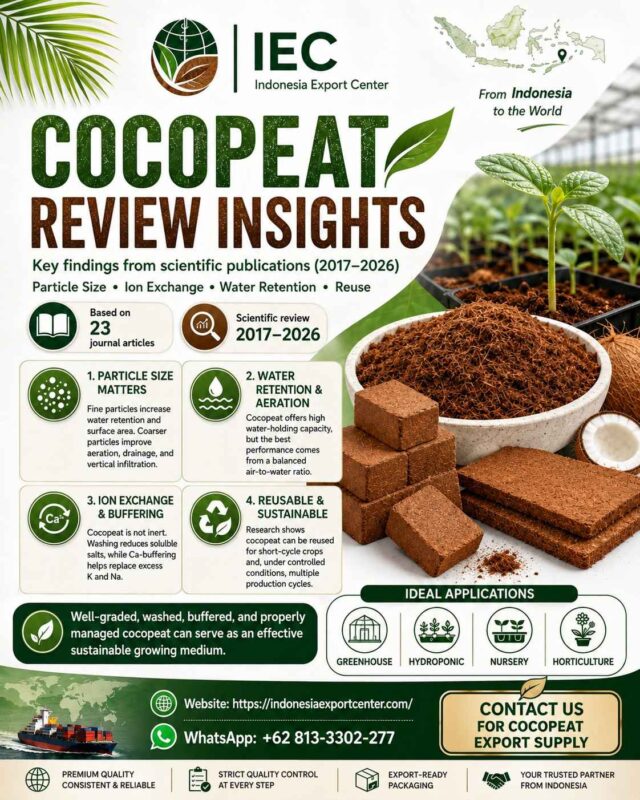
Cocopeat, also known as coir pith or coir dust, is a lignocellulosic by-product of coconut fiber processing that is increasingly used as a component of soilless growing media. Its low bulk density, high porosity, high water-holding capacity, and renewable origin make it a potential substitute for peat and other conventional substrates. Nevertheless, cocopeat performance is highly variable because it is influenced by particle-size distribution, pith-to-fiber ratio, processing method, compression, initial moisture content, soluble salt concentration, cation-exchange behavior, and previous cropping history. This integrative review synthesizes 23 peer-reviewed journal articles published between 2017 and 2026 that investigated the chemical, physicochemical, hydraulic, agronomic, and reuse-related properties of cocopeat-based growing media. The reviewed evidence demonstrates that fine cocopeat particles generally increase surface area, bulk density, microporosity, and water retention, whereas coarse particles improve macroporosity, vertical infiltration, aeration, and drainage. A balanced mixture of particle fractions is therefore more desirable than a substrate dominated by a single size fraction. Cocopeat is also chemically active rather than completely inert. Its exchange sites can retain and release potassium, sodium, calcium, and magnesium, making washing and calcium-based buffering essential when the raw material contains excessive soluble or exchangeable salts. Studies on substrate reuse indicate that cocopeat can remain productive for more than one cropping cycle and, under controlled conditions, for as many as three strawberry production cycles. However, reuse requires monitoring of electrical conductivity, nutrient accumulation, structural degradation, pathogens, and sanitation practices. Future research should prioritize standardized analytical methods, coupled physical–chemical characterization, long-term reuse experiments, life-cycle assessment, and digital monitoring of substrate moisture. Overall, properly graded, washed, buffered, and managed cocopeat can function as an effective and comparatively sustainable growing medium.
Keywords: cocopeat; coir pith; particle size; cation exchange capacity; electrical conductivity; water retention; hydraulic conductivity; substrate reuse; soilless cultivation.
Introduction
The expansion of container cultivation, greenhouse production, vertical farming, hydroponics, and other soilless systems has increased the demand for growing media with predictable physical, chemical, and biological characteristics. An ideal substrate should provide sufficient water and nutrients while maintaining adequate oxygen diffusion around plant roots. It should also have low bulk density, structural stability, acceptable pH and electrical conductivity, and resistance to excessive shrinkage or compaction during cultivation. Cocopeat has attracted considerable attention because it combines high porosity and moisture retention with the utilization of a renewable agricultural by-product [1]–[3].
Cocopeat is obtained during the mechanical processing of coconut husks for coir fiber production. The material remaining after fiber extraction consists of pith particles, short fibers, and fragments of different sizes. Depending on the processing system, cocopeat may be sold as loose material, compressed blocks, grow bags, slabs, plugs, or as a component of blended substrates. The terms cocopeat, coir pith, and coir dust are frequently used interchangeably, although commercial products may contain different proportions of pith, fiber, and chips.
The agronomic performance of cocopeat cannot be predicted solely from its botanical origin. Material from different geographical areas, coconut varieties, retting systems, washing procedures, particle-separation techniques, drying conditions, and compression ratios may have markedly different characteristics. Published studies have reported substantial differences in bulk density, total porosity, air-filled porosity, water-holding capacity, pH, electrical conductivity, nutrient composition, and hydraulic conductivity among coir-based products [5], [7], [8].
Particle-size distribution is particularly important because it determines the proportion, continuity, and connectivity of macro- and micropores. Fine particles increase the surface area available for water adsorption and ion exchange but may reduce oxygen diffusion and hydraulic conductivity when the substrate becomes densely packed. Coarse particles create larger pores that facilitate drainage and aeration but may decrease the volume of water retained after irrigation. Thus, the selection of an appropriate particle-size distribution requires balancing water retention with air availability.
Cocopeat also cannot be regarded as a completely chemically inert substrate. Raw coir products can contain significant concentrations of potassium, sodium, chloride, and other soluble salts. In addition, the negatively charged functional groups of lignocellulosic components provide exchange sites that can retain or release nutrient cations. Consequently, washing, buffering, and fertigation strategies strongly influence the chemical environment surrounding plant roots. Improperly processed cocopeat may create high initial electrical conductivity or imbalances between potassium, calcium, and magnesium.
The possibility of reusing cocopeat provides an additional sustainability advantage. Reuse could reduce substrate costs, waste generation, and the demand for new material. However, repeated use may also cause salt accumulation, nutrient imbalance, decomposition, compaction, changes in pore distribution, and the persistence of plant pathogens. Reuse therefore requires evidence concerning both crop productivity and the stability of the substrate itself.
This review aims to synthesize recent scientific evidence concerning four interconnected dimensions of cocopeat performance: particle size and pore structure, water retention and hydraulic behavior, ion exchange and salinity management, and substrate reuse. It also evaluates the implications of these properties for substrate formulation, irrigation, nutrient management, crop performance, and the sustainability of soilless cultivation.
Literature Search Method
An integrative narrative review approach was used because the available studies were highly heterogeneous in experimental design, crop species, container dimensions, substrate formulations, analytical methods, irrigation systems, and reported measurement units. Consequently, quantitative meta-analysis was not considered appropriate.
The literature search covered peer-reviewed journal articles published from January 2017 to July 2026. Searches were conducted through journal publisher platforms, DOI databases, and scholarly search engines. The principal search terms included combinations of:
- “cocopeat”;
- “coconut coir”;
- “coir pith”;
- “coir dust”;
- “growing medium”;
- “soilless substrate”;
- “particle size”;
- “pore structure”;
- “water retention”;
- “hydraulic conductivity”;
- “infiltration”;
- “cation exchange capacity”;
- “electrical conductivity”;
- “washing”;
- “calcium buffering”; and
- “substrate reuse.”
Articles were included when they fulfilled the following criteria:
- They were published in peer-reviewed scientific journals.
- Cocopeat, coir pith, coir dust, or a coir-based mixture was a principal experimental material.
- They reported direct data on physical, chemical, physicochemical, hydraulic, nutritional, agronomic, or reuse-related properties.
- Their bibliographic information and DOI or official journal page could be verified.
- They were available in English or provided an English abstract containing sufficient information for thematic classification.
Non-peer-reviewed reports, commercial documents, conference abstracts, and articles that only mentioned cocopeat without reporting relevant substrate data were excluded. Studies published before 2017 were not included in the principal evidence matrix, although earlier foundational studies may be useful for historical comparison.
A total of 23 articles met the selection criteria. The studies were classified into five interconnected themes:
- baseline physicochemical characteristics;
- particle-size distribution and pore architecture;
- water retention and hydraulic behavior;
- ion exchange, salinity, and nutrient balance; and
- substrate formulation, crop performance, reuse, and sustainability.
Data extracted from each article included the substrate source or formulation, experimental treatment, measured variables, principal findings, novelty, limitations, and implications for the development of cocopeat-based growing media.
Discussion
Baseline Chemical and Physicochemical Characteristics
Cocopeat generally has a low bulk density, relatively high total porosity, high organic matter content, and a strong capacity to retain water. However, these characteristics vary substantially among products. Gohardoust et al. demonstrated that the physical and hydraulic behavior of coir and coir–mineral mixtures could not always be predicted by calculating the weighted average of the individual components [5]. Interactions among particles affected pore continuity, permeability, and nutrient adsorption, indicating that substrate mixtures must be tested directly rather than characterized only from their constituent materials.
Anbarasu and Gurusamy reported a pH of approximately 6.23, electrical conductivity of 5.02 dS m⁻¹, total porosity of 75.81%, maximum water-holding capacity of approximately 769%, and an expansion value of approximately 186% for the tested cocopith material [8]. The high water-holding capacity and expansion illustrate the physical advantages of compressed cocopeat, while the relatively high initial electrical conductivity demonstrates that raw products may require washing and buffering before use.
Jana and Boxi similarly emphasized pH, electrical conductivity, and moisture-retention capacity as essential quality indicators for assessing whether coir pith is suitable for plant cultivation [7]. These parameters are interdependent. A suitable pH does not compensate for excessive salinity, while high water retention does not guarantee that the retained water is readily available to roots.
Reported numerical values should nevertheless be interpreted cautiously because analytical methods differ among studies. Electrical conductivity may be measured using different substrate-to-water extraction ratios, saturated media extracts, displacement methods, or direct leachate measurements. Water-holding capacity may be expressed on a dry-mass, wet-mass, or volume basis and may be determined under different matric potentials. Similarly, total porosity, container capacity, and air-filled porosity depend on sample preparation, container geometry, compaction, and measurement procedures.
Therefore, commercial cocopeat specifications should identify not only the analytical result but also the method used. At minimum, specifications should report pH, electrical conductivity, moisture content, bulk density, expansion volume, particle-size distribution, total porosity, air-filled porosity, water-holding capacity, and the concentrations of potassium, sodium, calcium, magnesium, and chloride.
Particle Size, Surface Area, and Pore Architecture
Particle-size distribution is one of the strongest determinants of cocopeat performance. Ilahi and Ahmad reported that approximately 82.93% of the particles in a cocopeat–perlite growing medium were between 0.425 and 4 mm. The mixture had a bulk density of approximately 0.09 g cm⁻³ and total porosity of approximately 79% [1]. Perlite improved the balance between water retention and air-filled pore space by introducing rigid and relatively coarse mineral particles.
Anbarasu, Gurusamy, and Saravanan directly evaluated graded raw and composted coir pith. The 0.25-mm fractions had bulk densities of approximately 0.60 g cm⁻³ for raw coir pith and 0.48 g cm⁻³ for composted material. The corresponding water-holding capacities were approximately 817.93% and 806.97%, respectively [17]. These results demonstrate that smaller particles provide greater surface area and a higher proportion of small pores capable of retaining water. At the same time, the higher bulk density indicates that fine particles can pack closely and reduce the volume of large, air-filled pores.
The effect of particle size is not limited to laboratory water-retention measurements. Boxi and Jana compared two coir-pith particle ranges in tomato cultivation and found that a mixture containing 50% coir pith with a particle size of 212–425 µm and 50% soil produced the strongest plant response among the tested treatments [20]. This finding suggests that relatively fine coir can improve water distribution and root contact when it is combined with a denser mineral soil. However, the result should not be interpreted as evidence that the finest fraction is optimal for every soilless system, because the accompanying soil also influenced aeration and structural stability.
Recent micro-computed tomography research has provided a more detailed understanding of the internal structure of cocopeat-based media. Yao et al. reported that more than 90% of the detected pore diameters were within the range of 0–400 µm. Changes in particle size and perlite addition affected average pore diameter, porosity, fractal characteristics, tortuosity, pore connectivity, and permeability [21]. These findings show that total porosity alone cannot fully explain water and air transport. Two substrates may have similar total pore volumes but markedly different pore connectivity and hydraulic behavior.
Feng et al. further demonstrated that coarse coconut-coir particles promoted rapid vertical infiltration, whereas fine particles retained more water and slowed downward movement. Mixed coarse and fine fractions, particularly at initial moisture contents of 20–30%, produced a more balanced combination of infiltration and retention [23]. This finding is important for compressed blocks and slabs because their behavior after expansion depends on both particle grading and initial wetting conditions.
The collective evidence supports a practical conceptual model:
- Fine particles increase surface area, microporosity, water retention, capillary continuity, and potentially the number of ion-exchange sites per unit volume.
- Coarse particles and fibers increase macroporosity, drainage, air exchange, and rapid vertical infiltration.
- Excessive fine material can increase bulk density, compaction, waterlogging risk, and resistance to gas diffusion.
- Excessive coarse material can reduce water retention and increase the frequency of irrigation.
- Blended particle fractions are generally better able to balance water storage, aeration, root penetration, and hydraulic conductivity.
Commercial grading should therefore be based on complete particle-size distributions rather than labels such as fine, medium, and coarse without corresponding sieve ranges.
Water Retention, Available Water, and Hydraulic Behavior
High water-holding capacity is frequently presented as the principal advantage of cocopeat. However, total water retention is not equivalent to plant-available water. Some water may be held too strongly within small pores to be readily extracted by roots, while water in large pores drains rapidly after irrigation.
Londra, Paraskevopoulou, and Psychogiou showed that coir type and substrate composition influenced water-retention curves and hydraulic conductivity in peat- and coir-based substrates [3]. Perlite generally increased air space and reduced water-holding capacity. Hydraulic conductivity decreased sharply as substrates dried between irrigation events, demonstrating that water movement can become restricted even when some water remains in the medium.
Gohardoust et al. similarly found that the hydraulic behavior of substrate mixtures was not always additive [5]. Particle interactions could reduce permeability or alter pore continuity beyond what would be expected from the characteristics of the individual components. This non-additive behavior has direct implications for substrate formulation because simply combining a high-water-retention component with a high-aeration component does not guarantee an optimal result.
Basiri Jahromi et al. evaluated increasing rates of coir amendment in pine-bark substrates. Increasing the proportion of coir increased water storage, plant-available water, gas exchange, and plant performance. Among the proportions tested, the substrate containing 65% coir produced the most favorable overall response [6]. The study is particularly useful because it distinguished water that was present in the substrate from water that was sufficiently available to support plant physiological processes.
Initial substrate moisture and irrigation technique also influence water capture. Schulker et al. reported that coir had favorable rewetting behavior compared with more hydrophobic substrates and was less sensitive to low initial moisture content. Irrigation depth and the division of irrigation into multiple pulses improved water capture and distribution [9]. Pulse irrigation can therefore be particularly useful in coarse or partially dry substrates where a single rapid irrigation event may cause preferential flow and drainage losses.
The practical management of cocopeat should consequently consider:
- container height and geometry;
- substrate compaction;
- initial moisture before planting;
- particle-size distribution;
- irrigation volume per event;
- irrigation frequency;
- pulse duration;
- drainage fraction; and
- changes in root density during the crop cycle.
Field and greenhouse studies support the agronomic importance of this water–air balance. In a Mediterranean persimmon orchard, the use of cocopeat substrate bags improved root-zone control and increased third-year fruit yield by approximately 40% compared with the evaluated soil-based system [13]. In rose cultivation, cocopeat provided high water-holding capacity and favorable conditions for photosynthetic activity and root-zone water movement [18].
Nevertheless, high water retention can become a disadvantage when irrigation is excessive or when the substrate contains too many fine particles. Water-filled pores restrict oxygen diffusion, increase the risk of hypoxic root conditions, and may favor certain root diseases. Irrigation scheduling should therefore be based on crop demand and substrate hydraulic behavior rather than on a general assumption that cocopeat should always be kept close to saturation.
Cation Exchange, Salinity, and Nutrient Balance
Cocopeat contains functional groups capable of retaining positively charged ions. Its cation-exchange behavior is associated with lignin, cellulose, hemicellulose, and other organic components containing carboxyl and phenolic groups. The magnitude and practical effect of this capacity vary according to particle size, decomposition, washing, and the composition of the solution contacting the substrate.
Paramanandham and Ronald Ross confirmed that sieved coir pith had measurable cation-exchange capacity and that calcium could replace sodium and potassium from exchange sites [4]. Particle grading affected this behavior, most likely because smaller particles presented greater exposed surface area. The study provides a mechanistic explanation for why rinsing with water and buffering with calcium salts produce different results.
Washing primarily removes soluble salts from pore water. It can reduce the electrical conductivity associated with freely dissolved sodium, potassium, chloride, and other ions. However, water alone may not remove a substantial proportion of ions adsorbed onto exchange sites.
Buffering, in contrast, exposes cocopeat to a solution containing calcium, or sometimes calcium and magnesium. The divalent ions compete for exchange sites and displace exchangeable potassium and sodium. The released ions can subsequently be removed by drainage and washing.
Gbollie, Mwonga, and Kibe evaluated calcium-nitrate concentration and soaking duration. Treatment with 100 g of calcium nitrate per 1.5 kg of cocopeat in 15 L of water for 36 h reduced potassium by approximately 78.44% and sodium by approximately 92%, while increasing calcium and nitrogen concentrations. Subsequent washing reduced electrical conductivity to below 1 mS cm⁻¹ under the study conditions [10].
These results demonstrate that buffering protocols should specify:
- the initial mass and moisture content of cocopeat;
- calcium-salt type and purity;
- concentration of the buffering solution;
- solution-to-substrate ratio;
- duration of contact;
- number and volume of rinsing cycles;
- final electrical conductivity;
- residual potassium and sodium; and
- calcium and magnesium concentrations after treatment.
Nutrient management after planting must also account for the chemical contribution of cocopeat. Xiong et al. compared coconut coir, rockwool, and peat–vermiculite in tomato cultivation. Coir increased potassium and sulfur uptake, photosynthesis, fruit weight, and total yield. Tomato yield reached approximately 84.9 t ha⁻¹ in coir, compared with 76.9 t ha⁻¹ in peat–vermiculite and 67.5 t ha⁻¹ in rockwool [2]. However, the release of potassium from coir also meant that the potassium-to-calcium balance required careful management.
Excessive potassium can antagonize calcium and magnesium uptake. This interaction is particularly important in fruiting crops susceptible to calcium-related physiological disorders. Fertigation recipes developed for inert media such as rockwool should therefore not automatically be applied to fresh cocopeat without analyzing the initial substrate and drainage solution.
The use of ash, compost, and biochar can further modify pH, electrical conductivity, cation-exchange capacity, and nutrient availability. Amran et al. found that coconut ash and palm-kernel-shell biochar changed the chemical and physical quality of coconut coir dust [19]. Although such materials may improve nutrient retention and contribute to circular utilization of agricultural residues, excessive ash or biochar may raise pH and electrical conductivity beyond desirable levels.
Consequently, the chemical management of cocopeat should be regarded as a dynamic process. Initial laboratory specifications are important, but monitoring of irrigation water, nutrient solution, root-zone solution, leachate electrical conductivity, pH, and ion ratios is required throughout production.
Cocopeat-Based Mixtures and Crop Performance
Cocopeat is frequently blended with perlite, pine bark, compost, biochar, mineral soil, volcanic tuff, or other materials. The purpose of blending may be to increase aeration, improve structural stability, supply nutrients, reduce cost, or replace non-renewable components.
Machado et al. compared different physical forms of coir in spinach cultivation and showed that coir pith, chips, fibers, and their mixtures did not perform identically [11]. Coir pith supported high fresh yield and could influence flavonoid accumulation, while irrigation and nutrient management had to be adjusted according to coir type. This finding reinforces the need to describe the physical composition of coir products rather than referring to them generically as cocopeat.
In a subsequent study, Machado et al. evaluated coir-based media containing municipal solid-waste compost or biochar [12]. The amendments altered plant mineral nutrition and phytochemical accumulation. Carefully formulated mixtures maintained plant growth while replacing part of the conventional substrate with recovered organic materials.
Martins et al. reported that coir-based media containing 12% municipal compost and 10% biochar achieved cumulative lettuce-seedling emergence of approximately 90–99% and maintained acceptable seedling vigor [14]. These findings indicate that compost and biochar can be incorporated into coir-based propagation media, provided that maturity, particle size, pH, electrical conductivity, and potentially phytotoxic compounds are controlled.
Dias et al. evaluated pine bark as a substitute for perlite in a mixture containing 80% coir and 12% compost under two nutrient-solution electrical-conductivity levels. Replacing 8% perlite with pine bark slightly changed substrate pH, electrical conductivity, bulk density, and total porosity but did not reduce lettuce biomass or quality. The pine-bark treatment also increased leaf iron and boron concentrations [22].
These studies indicate that sustainable substrate formulation should not be evaluated solely by replacing one ingredient with another. The complete mixture must be assessed in terms of:
- particle-size compatibility;
- total and air-filled porosity;
- container capacity;
- hydraulic conductivity;
- pH and electrical conductivity;
- nutrient release and adsorption;
- biological stability;
- crop duration; and
- irrigation and fertigation requirements.
The agronomic response of a crop is the result of the entire root-zone system. A formulation that performs well for short-cycle lettuce seedlings may not remain structurally stable during long-term tomato, strawberry, rose, or perennial-fruit production.
Reuse, Durability, and Circularity
The possibility of reusing cocopeat is central to its sustainability assessment. Reuse extends the functional life of the substrate and may reduce procurement costs and waste. However, agronomic productivity alone is not sufficient to establish that a substrate is safe and stable for repeated use.
Machado et al. reused coir-based substrates that had previously been used to produce spinach for a subsequent lettuce crop [15]. The reused media maintained lettuce yield and phytonutrient accumulation. Some plant-quality parameters were comparable with or higher than those obtained using new material. This study demonstrates that coir-based media can be reused for at least one additional short-duration crop under controlled conditions.
Woznicki et al. provided stronger multi-cycle evidence by comparing coir, peat, and wood fiber across three strawberry production cycles [16]. Coir maintained crop productivity without a significant decline in yield. Its organic carbon and lignin fractions remained relatively stable, while potassium accumulation decreased during repeated use. Coir and peat were more chemically and structurally stable than wood fiber in the tested system.
These findings suggest that cocopeat has potential for multi-cycle cultivation, but reuse decisions should be based on a quality-control protocol. Before reuse, the substrate should be evaluated for:
- electrical conductivity and pH;
- concentrations of potassium, sodium, calcium, magnesium, chloride, and nitrate;
- bulk density and compaction;
- shrinkage and loss of expansion capacity;
- total and air-filled porosity;
- water-holding and rewetting characteristics;
- root residues and undecomposed organic matter;
- pathogen and pest contamination;
- effectiveness of steam, chemical, or biological sanitation; and
- compatibility with the nutrient requirements of the next crop.
Repeated disinfection can itself alter substrate characteristics. Heat treatment may affect organic matter, wettability, microbial communities, and nutrient release. Chemical disinfectants may leave residues or change pH and electrical conductivity. Future reuse research should therefore evaluate sanitation treatments together with structural and chemical changes.
A further distinction should be made between reuse within the same production site and collection and redistribution of used substrate. On-site reuse allows greater control over crop history and pathogen risk. Redistribution requires traceability, sanitation standards, and clear product specifications.
Sustainability Considerations
Cocopeat is often described as sustainable because it uses a by-product of coconut processing and may replace peat or mineral components. This conclusion is directionally reasonable but should not be treated as automatic. Sustainability depends on the complete supply chain.
Important factors include:
- the energy required for milling, screening, drying, compressing, and transportation;
- freshwater consumption during washing and buffering;
- management of wastewater containing sodium, potassium, chloride, nitrate, and other ions;
- chemical inputs used for buffering;
- transportation distance between tropical production regions and international users;
- substrate lifespan and number of reuse cycles;
- packaging material;
- end-of-life utilization or disposal; and
- the quantity of peat, rockwool, or perlite actually displaced.
Compression greatly reduces shipping volume, but compressed blocks must be rehydrated and expanded at the destination. Washing and buffering can improve agronomic quality but may generate saline effluent. Therefore, water recirculation, recovery of dissolved nutrients, renewable-energy use, and optimized compression should be included in future sustainability assessments.
The incorporation of compost, bark, and biochar may increase circularity, as demonstrated in several recent studies [12], [14], [19], [22]. However, these components can also introduce variability, salts, immature organic matter, heavy metals, or phytotoxic compounds. A sustainable formulation must remain agronomically safe and reproducible.
Research Gaps and Future Directions
Despite considerable progress, several research gaps remain.
Standardization of particle-size classifications
Terms such as fine, medium, and coarse are used inconsistently. Future studies should report complete sieve distributions in micrometers or millimeters, together with the proportion of pith, short fiber, and chips.
Standardization of analytical methods
Values for pH, electrical conductivity, cation-exchange capacity, porosity, and water-holding capacity cannot be reliably compared when different extraction ratios, tensions, compaction levels, and container geometries are used. Internationally harmonized methods are needed for both research and trade specifications.
Coupled physical and chemical characterization
Particle-size studies frequently focus on water retention, whereas ion-exchange studies focus on nutrient displacement. Few experiments simultaneously measure particle-size distribution, specific surface area, pore architecture, cation-exchange capacity, ion release, and hydraulic behavior. Integrated experiments are needed to determine whether fine particles increase ion retention in addition to water retention.
Variability among origins and processing systems
Many experiments use one commercial source of cocopeat. Multi-origin studies should compare coconut variety, husk age, retting method, milling intensity, washing, composting, drying, compression, and storage.
Long-term reuse and sanitation
More multi-cycle studies are required for fruiting vegetables, ornamentals, berries, and perennial crops. Measurements should include pore degradation, decomposition, nutrient accumulation, microbial-community changes, pathogen survival, sanitation efficiency, and crop productivity.
Digital water monitoring
Micro-computed tomography and pore-scale simulations have improved understanding of internal substrate structure [21]. RGB image recognition and machine-learning models have also shown potential for estimating moisture distribution and infiltration behavior in coconut-coir substrates [23]. Feng et al. reported coefficients of determination of approximately 0.89 for a support-vector regression model applied to coarse material and approximately 0.861 for a polynomial model applied to mixed material [23].
Future systems could integrate substrate-specific moisture models with sensors, automated irrigation, drainage-electrical-conductivity monitoring, and crop-demand prediction.
Life-cycle assessment
A complete environmental comparison should quantify greenhouse-gas emissions, freshwater consumption, nutrient-rich effluent, transport, compression, substrate lifespan, reuse, and end-of-life options. Sustainability should be assessed per unit of crop yield or quality rather than per kilogram of unused substrate.
Conclusion
Cocopeat is a promising growing medium whose performance is determined by interacting physical, hydraulic, and chemical properties. It should not be treated as a uniform material or as a completely inert substrate.
Particle-size distribution controls the arrangement and connectivity of pores. Fine fractions increase surface area, bulk density, capillary water retention, and potentially ion-exchange activity, while coarse fractions improve macroporosity, aeration, drainage, and vertical infiltration. Substrates containing a balanced mixture of particle sizes generally provide a better compromise between water retention and oxygen availability.
High water-holding capacity is beneficial only when the retained water remains available to roots and the substrate maintains sufficient air-filled porosity. Hydraulic conductivity, rewetting behavior, initial moisture, compaction, container geometry, and irrigation-pulse management are therefore as important as maximum water-holding capacity.
Chemically, cocopeat can retain and release potassium, sodium, calcium, and magnesium. Washing removes soluble salts, whereas calcium-based buffering displaces exchangeable potassium and sodium. The two processes should not be considered interchangeable. Fertigation programs must account for the initial nutrient composition and exchange behavior of the substrate, particularly the balance among potassium, calcium, and magnesium.
Available evidence indicates that cocopeat can be reused for subsequent short-cycle crops and, in controlled strawberry production, for as many as three cultivation cycles. Nevertheless, reuse requires monitoring of electrical conductivity, nutrient accumulation, compaction, pore structure, sanitation, and pathogen risk.
Cocopeat can contribute to more sustainable horticultural production when it is properly sourced, graded, washed, buffered, formulated, irrigated, and reused. Future research should establish standardized quality methods, directly connect particle architecture with ion exchange and hydraulic behavior, evaluate materials from multiple origins, investigate long-term reuse, and quantify environmental impacts across the entire substrate life cycle.
