

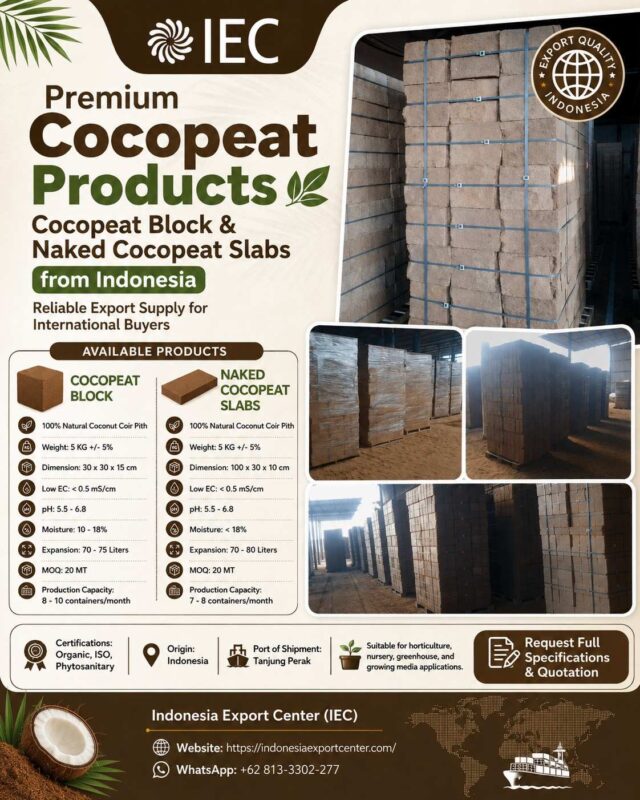
Plan Cocopeat Shipments from Indonesia with Confidence
Understanding cocopeat container loading capacity is essential when planning international shipments from Indonesia. For freight coordinators, procurement teams, importers, and wholesale buyers, the right loading plan helps estimate shipment requirements, compare freight quotations, and coordinate cargo handling.
The quantity of cocopeat that fits into a shipping container depends on several factors, including product format, compression level, packaging dimensions, cargo weight, and the type of container used.
Indonesia Export Center (IEC) facilitates connections between international buyers and Indonesian suppliers, helping businesses discuss cocopeat sourcing requirements and coordinate product and shipment inquiries with relevant suppliers.
What Determines Cocopeat Container Loading Capacity?
Container capacity is not determined by container volume alone. The actual quantity that can be loaded depends on the relationship between the cargo’s physical dimensions, total weight, and loading configuration.
Key considerations include:
- Product format: Loose cocopeat, compressed blocks, bricks, grow bags, and grow slabs have different dimensions and packing characteristics.
- Compression level: Compressed products generally occupy less space than loose material of comparable composition, but the actual packing efficiency varies.
- Packaging dimensions: Individual unit size, outer packaging, bags, cartons, and palletization affect how cargo fits inside a container.
- Cargo weight: The combined weight of the product, packaging, pallets, and other loading materials must remain within the applicable limits.
- Container type: Available internal dimensions, door opening, maximum payload, and container condition influence loading arrangements.
- Loading method: Floor loading and palletized loading can produce different usable capacities.
- Transport restrictions: Carrier requirements, terminal rules, road weight limits, and destination regulations may restrict the permissible shipment weight.
For an accurate loading estimate, buyers should obtain the selected product’s packing details and the specifications of the proposed container before confirming shipment quantities.
Cocopeat Container Loading by Product Format
Different cocopeat formats require different loading calculations. The following guide explains what freight and procurement teams should check for each format.
1. Compressed Cocopeat Blocks
Compressed cocopeat blocks are designed to reduce shipping and storage volume compared with loose material. They are commonly considered by wholesale buyers and growing media distributors.
Before calculating container capacity, confirm:
- Weight and dimensions of each block
- Compression and moisture conditions
- Number of blocks per outer package, if applicable
- Packaging configuration and pallet requirements
- Total gross weight per package or pallet
The supplier’s confirmed block dimensions and packing list can be used to estimate how many units fit within the available container space, subject to weight and loading restrictions.
2. Cocopeat Bricks
Cocopeat bricks are smaller compressed units that may be supplied to garden retailers, distributors, and horticultural businesses.
Loading calculations should account for individual brick dimensions, unit weight, cartons or bags, and the number of units packed together. If cartons are palletized, the dimensions and weight of each completed pallet must also be included.
3. Loose Cocopeat
Loose cocopeat typically requires a different loading approach because it is not packed into the same compact unit shape as compressed blocks or bricks.
Freight teams should confirm the material’s bulk density, moisture content, packaging method, and handling requirements. These characteristics influence both the space occupied by the cargo and its total weight.
Loose cocopeat may also require different handling arrangements from packaged products, so loading feasibility should be confirmed with the supplier and freight provider.
4. Cocopeat Grow Bags and Grow Slabs
Grow bags and coco coir slabs are often supplied in specific dimensions for commercial greenhouse and hydroponic applications.
When planning container loading, confirm the dimensions of each product, whether the items are compressed or ready to use, their packaging configuration, and any requirements for palletized handling. Do not assume that loading capacity for compressed blocks will apply to grow bags or slabs.
Container Volume vs. Maximum Payload
One of the most important steps in estimating cocopeat container loading capacity is distinguishing between the available space inside a container and the maximum weight it can carry.
Container volume refers to the internal space available for cargo. Payload refers to the maximum cargo weight permitted by the container’s applicable specifications.
The usable loading capacity is limited by whichever constraint is reached first: available space or the permitted cargo weight.
| Loading factor | What to verify |
|---|---|
| Internal container dimensions | Length, width, height, and usable loading space |
| Door opening dimensions | Whether packaged units can pass through the container doors |
| Maximum payload | The container’s permitted cargo weight, shown on its markings or equipment documentation |
| Cargo gross weight | Product weight plus packaging and any pallets or loading materials |
| Packing configuration | Unit dimensions, orientation, stacking arrangement, and unused spaces |
| Transport weight restrictions | Applicable carrier, terminal, road, and destination-country requirements |
Container dimensions and payload vary by equipment type and container specification. Always use the actual container details provided by the carrier or freight forwarder rather than relying solely on a general container-size estimate.
How to Estimate Cocopeat Container Loading Capacity
Freight and procurement teams can follow these steps to develop an initial loading plan.
Step 1: Confirm the Cocopeat Specifications
Request the product format, unit dimensions, net weight, gross packed weight, moisture information, and packaging details from the supplier.
For compressed cocopeat, confirm whether the stated dimensions refer to individual blocks, bundled units, cartons, or pallets.
Step 2: Obtain the Container Specifications
Ask the freight forwarder or carrier to confirm the proposed container type, internal dimensions, door opening dimensions, and maximum payload.
The actual equipment specification should take precedence over generic reference dimensions.
Step 3: Calculate the Space Required
For regularly shaped packaged units, a preliminary estimate can be made by comparing the usable container volume with the volume occupied by the packages.
However, dividing container volume by the volume of one package only provides a theoretical upper estimate. It does not account for gaps, orientation, door access, stacking restrictions, or the actual loading pattern.
A practical loading plan should therefore be based on the packages’ external dimensions and a feasible arrangement inside the container.
Step 4: Check the Total Cargo Weight
Calculate the combined gross weight of the proposed cargo, including product, packaging, pallets, and other materials counted as cargo.
Confirm that this total is within the container’s permitted payload and all applicable transport weight restrictions. The permitted shipment weight may be lower than the container’s stated payload limit because of other transport requirements.
Step 5: Confirm the Final Loading Plan
Before dispatch, have the supplier and freight provider confirm the loading quantity, packing list, container suitability, cargo securing arrangements, and any required weight documentation.
The final quantity should be based on the actual packed cargo and approved transport arrangements, not a theoretical volume calculation alone.
Example of a Preliminary Loading Calculation
Suppose a buyer is considering compressed cocopeat blocks and has received the following information from a supplier:
- External dimensions of each packed unit
- Gross weight per packed unit
- Total usable container space
- Maximum permitted cargo weight
The buyer can calculate two preliminary limits:
Volume-based estimate
Estimate the number of packed units that can physically fit within the container using the package dimensions and a feasible loading arrangement.
Weight-based estimate
Divide the permitted cargo weight by the gross weight of one packed unit, then round down to a whole unit.
The preliminary loading quantity cannot exceed either limit. It may need to be reduced further to account for practical loading restrictions, cargo securing, and transport requirements.
This method is an initial planning exercise, not a guarantee of final loading capacity. Actual quantities must be confirmed using the selected product’s packing details and the carrier’s container specifications.
Common Container Loading Mistakes to Avoid
Using a Generic Capacity Figure for Every Cocopeat Product
Compressed blocks, loose cocopeat, bricks, and grow bags have different packing characteristics. Use specifications for the exact product being purchased.
Calculating by Volume Without Checking Weight
A container may reach its permitted payload before all available space is used. Both volume and weight must be assessed.
Ignoring Packaging and Pallets
Net product weight does not include every item that contributes to shipment weight. Use gross packed weights and include pallets or other loading materials where applicable.
Assuming Every Container Has Identical Dimensions
Container dimensions and payload vary by equipment. Obtain the actual specifications for the proposed shipment.
Finalizing Freight Costs Before Confirming the Packing Plan
The product format, packing configuration, shipment quantity, origin, destination, and trade terms can affect freight planning. Request a quotation using the intended cargo details and confirm any assumptions with the freight provider.
Information Required for a Cocopeat Container Loading Quotation
To help suppliers and logistics providers assess your shipment, prepare the following information:
| Required information | Purpose |
|---|---|
| Product type | Identifies loose cocopeat, blocks, bricks, grow bags, or another format |
| Unit dimensions | Supports packing and space calculations |
| Net and gross weight | Supports cargo and payload calculations |
| Packaging configuration | Identifies cartons, bags, bundles, pallets, or other arrangements |
| Target shipment quantity | Establishes the intended order volume |
| Loading location | Helps determine origin-side logistics requirements |
| Destination country and port | Supports route and freight planning |
| Preferred trade terms | Clarifies the agreed allocation of shipping costs and responsibilities |
| Special requirements | Covers inspections, labeling, documentation, or cargo handling requirements |
Where product or packaging details are not yet available, ask the supplier to confirm them before making a final container booking.
Why Work with Indonesia Export Center?
Indonesia Export Center (IEC) facilitates connections between international buyers and Indonesian suppliers. For cocopeat sourcing inquiries, IEC provides a point of contact for discussing product requirements and exploring potential supply arrangements.
Buyers can inquire about:
- Available cocopeat product formats
- Product dimensions and packaging details
- Bulk order quantities and supplier quotations
- Shipment planning and export requirements
- Documentation and commercial terms, subject to supplier confirmation
IEC does not guarantee a particular container loading quantity. Product availability, technical specifications, packaging details, order acceptance, and final shipment arrangements must be confirmed with the relevant supplier and logistics provider.
Frequently Asked Questions
1. What is the container loading capacity for cocopeat?
There is no single loading quantity for every cocopeat shipment. Capacity depends on the product format, package dimensions, compression, packing configuration, container specifications, and permitted cargo weight.
2. How many compressed cocopeat blocks fit in one container?
The quantity depends on the dimensions and gross weight of each packed block, the container’s usable dimensions and payload, and the loading arrangement. Obtain the supplier’s packing specifications and ask the freight provider to verify the loading plan.
3. Is container loading capacity different for loose cocopeat and compressed blocks?
Yes. Loose material and compressed blocks occupy space differently and may require different packaging and handling arrangements. Their loading capacities should be calculated separately.
4. Should I calculate cocopeat loading by volume or weight?
Both must be checked. The usable container space determines the volume limit, while the permitted cargo weight determines the payload limit. The final loading quantity must satisfy both constraints and all applicable transport requirements.
5. Does palletized cocopeat have the same capacity as floor-loaded cargo?
Not necessarily. Pallets occupy space and add weight, which can change the quantity that fits in a container. The actual result depends on package dimensions, pallet configuration, loading equipment, and handling requirements.
6. What documents are needed to plan a cocopeat export shipment?
Depending on the transaction and destination, relevant documents may include a commercial invoice, packing list, transport document, and applicable customs or product-related documentation. The supplier, freight forwarder, and customs broker should confirm the documents required for the specific shipment.
7. Can Indonesia Export Center help with a cocopeat container loading inquiry?
IEC facilitates connections between international buyers and Indonesian suppliers. Buyers can share their required product format, target quantity, packaging needs, and destination to begin discussing sourcing and shipment requirements.
Plan Your Cocopeat Shipment from Indonesia
Planning a bulk cocopeat shipment? Contact Indonesia Export Center to discuss your sourcing requirements and request information about available product formats, packaging specifications, and supplier quotations.
For a more useful loading estimate, include your intended cocopeat format, target quantity, destination port, and any available package dimensions and weight information.
Indonesia Export Center (IEC)
Website: https://indonesiaexportcenter.com/
WhatsApp: +62 813-3302-277
Direct WhatsApp: https://wa.me/628133302277
Indonesia Export Center — Connecting Global Buyers with Indonesian Suppliers.
