

IEC | INDONESIA EXPORT CENTER
UNDERSTANDING COCONUT BLOSSOM SUGAR AND ARENGA PALM SUGAR FOR B2B PROCUREMENT
Botanical Identity | Flavor | Product Specifications | Labeling | Supplier Selection
Coconut Sugar vs Palm Sugar: What Importers Need to Know
When comparing coconut sugar vs palm sugar, international buyers should begin by identifying the botanical source.
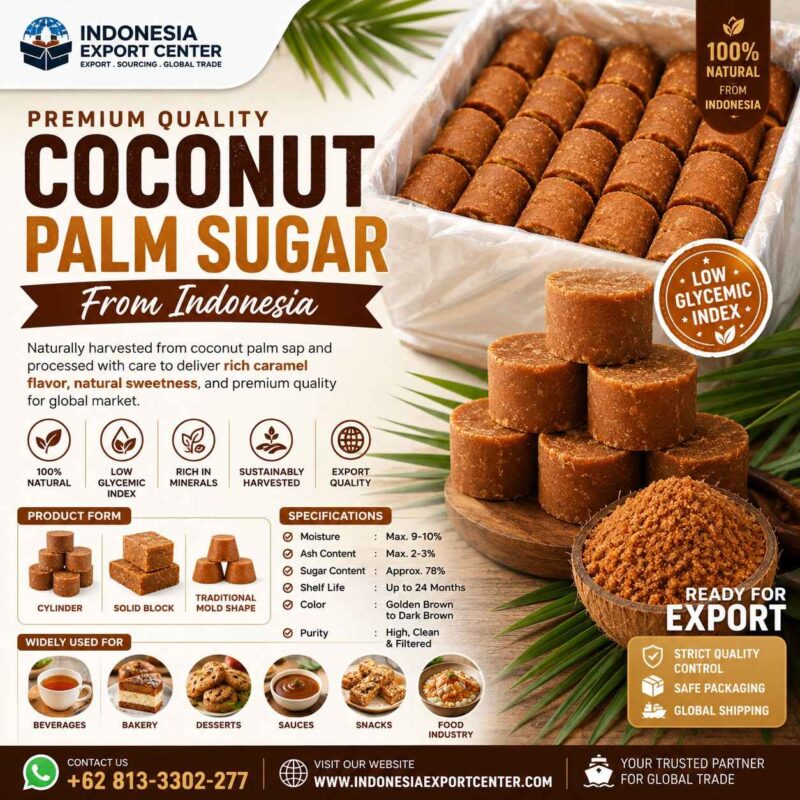
Coconut sugar is produced from the sap of Cocos nucifera.
Arenga palm sugar is produced from the sap of Arenga pinnata.
Although both are palm-derived sweeteners, they are separate commercial products.
The term palm sugar may also be used broadly in different markets, making accurate product identification particularly important.
IEC | Indonesia Export Center facilitates sourcing enquiries for both categories, subject to supplier availability.
REQUEST COCONUT OR ARENGA SUGAR SOURCING
Botanical Differences
| Parameter | Coconut Sugar | Arenga Palm Sugar |
|---|---|---|
| Botanical Name | Cocos nucifera | Arenga pinnata |
| Raw Material | Coconut Palm Sap | Arenga Palm Sap |
| Indonesian Name | Gula Kelapa | Gula Aren |
| Common Forms | Granulated, Powder, Molded | Granulated, Powder, Molded |
| Origin in This Sourcing Context | Indonesia | Indonesia |
| Labeling | Coconut Source Must Be Accurate | Arenga Source Must Be Accurate |
Flavor and Color
Both products may have caramel-like characteristics.
However, flavor and color vary according to raw material and processing conditions.
Buyers should not assume that all coconut sugar or arenga sugar products share identical sensory profiles.
Granule Texture and Particle Size
Granulated products can vary in particle size and flowability.
Industrial buyers should establish measurable particle-size requirements.
Nutritional and Health Claims
Claims such as low glycemic index, rich in minerals, or healthier than conventional sugar require appropriate substantiation.
Neither product should be assumed to have a specific glycemic index or nutritional advantage without relevant evidence.
Labeling Considerations
Product labels and ingredient declarations should accurately reflect the botanical source.
Buyers should verify destination-market naming requirements.
Choosing the Right Product
Choose Based on Botanical Requirements
If your product specification requires Cocos nucifera, request coconut blossom sugar.
If your specification requires Arenga pinnata, request arenga palm sugar.
Choose Based on Application
Evaluate flavor, color, particle size, dissolution, and formulation compatibility.
Choose Based on Supplier Documentation
Request accurate ingredient declarations, product specifications, and relevant quality documents.
Procurement Checklist
Before purchasing, confirm:
- Botanical species
- Ingredient composition
- Product form
- Moisture specification
- Particle size
- Color and flavor reference
- Food safety requirements
- Packaging
- Certification status
- Commercial quantity and delivery terms
Frequently Asked Questions
Is coconut sugar a type of palm sugar?
Yes, in the broad botanical sense. However, commercial terminology varies, and coconut sugar should be distinguished from arenga palm sugar.
Can coconut sugar replace arenga palm sugar?
Possibly in some formulations, but substitution requires application testing.
Which is healthier?
Health comparisons require reliable nutritional and clinical evidence and should not be inferred from product names.
Can IEC help source both?
IEC can facilitate enquiries for both product categories, subject to supplier availability.
Request the Right Palm-Derived Sweetener
Share your botanical requirements, intended application, specifications, destination country, and estimated order quantity.
WhatsApp: +62 813-3302-277
Website: https://www.indonesiaexportcenter.com
YOUR TRUSTED PARTNER FOR GLOBAL TRADE
