

IEC | INDONESIA EXPORT CENTER
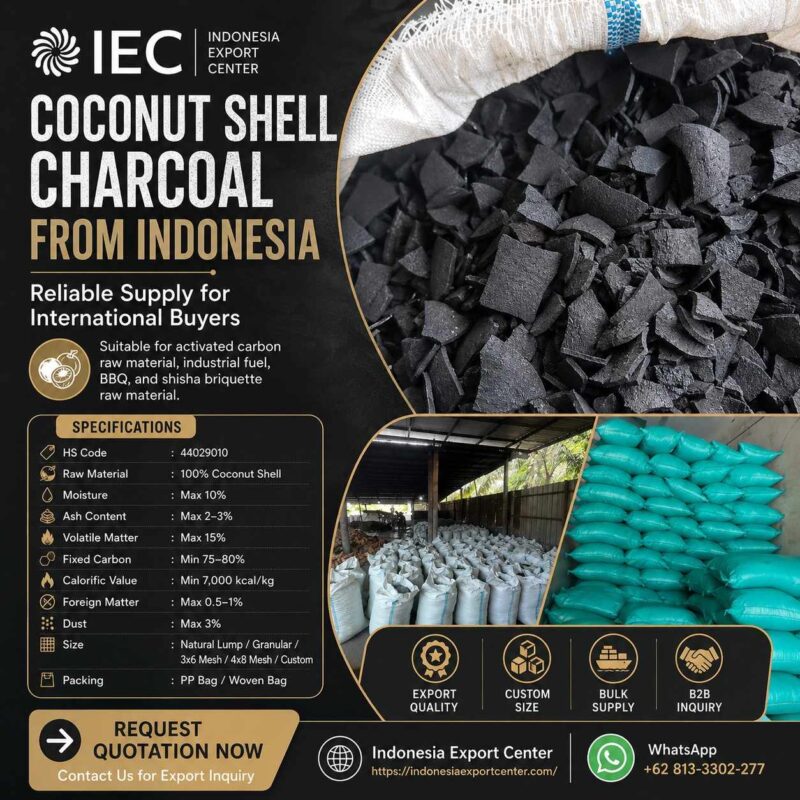
COCONUT SHELL CHARCOAL FROM INDONESIA
Reliable Supply for International Buyers
Looking for a coconut shell charcoal supplier in Indonesia for bulk import, industrial processing, or wholesale distribution?
Indonesia Export Center (IEC) offers coconut shell charcoal for international B2B sourcing inquiries, with product specifications designed for buyers evaluating charcoal raw materials for industrial and commercial applications.
Made from 100% coconut shells, our listed charcoal product specifications include moisture content of maximum 10%, ash content of maximum 2–3%, fixed carbon of minimum 75–80%, and a calorific value of at least 7,000 kcal/kg.
Available size options include natural lump charcoal, granular charcoal, 3×6 mesh, 4×8 mesh, and custom sizes subject to confirmation.
Coconut shell charcoal can be used as a raw material for activated carbon manufacturing, industrial fuel applications, BBQ charcoal products, and shisha charcoal briquette production, depending on the required product grade and processing specifications.
Whether you are an industrial importer, activated carbon manufacturer, charcoal distributor, or briquette producer, IEC welcomes inquiries about bulk supply, product specifications, packaging, inspection requirements, and export quotations.
Request Coconut Shell Charcoal Quotation:
https://wa.me/628133302277
Coconut Shell Charcoal Supplier in Indonesia for International Buyers
Indonesia is an established source of coconut-based raw materials, including coconut shell charcoal used in industrial processing and charcoal manufacturing.
For international buyers, selecting a supplier involves evaluating product quality, raw material consistency, size requirements, packaging, export readiness, and commercial terms.
Indonesia Export Center (IEC) provides a contact point for global buyers seeking coconut shell charcoal from Indonesia.
Why Source Coconut Shell Charcoal from Indonesia?
Coconut-Based Raw Material
Coconut shell charcoal is produced through the carbonization of coconut shells and can serve as a carbon-rich raw material for further processing.
Industrial Applications
Depending on its characteristics, coconut shell charcoal can be used in activated carbon manufacturing, fuel applications, and charcoal briquette production.
Multiple Size Options
Different buyers may require natural lumps, granular material, or screened mesh sizes for their processing operations.
Bulk Procurement Opportunities
International importers can request quotations based on their required quantity, destination, packaging, and product specifications.
Defined Quality Parameters
Technical specifications help buyers establish purchasing requirements and compare supplier quotations.
Coconut Shell Charcoal Product Specifications
IEC’s supplied coconut shell charcoal specifications are summarized below.
| Parameter | Specification |
|---|---|
| HS Code | 44029010 |
| Raw Material | 100% Coconut Shell |
| Moisture | Max 10% |
| Ash Content | Max 2–3% |
| Volatile Matter | Max 15% |
| Fixed Carbon | Min 75–80% |
| Calorific Value | Min 7,000 kcal/kg |
| Foreign Matter | Max 0.5–1% |
| Dust | Max 3% |
| Size | Natural Lump / Granular / 3×6 Mesh / 4×8 Mesh / Custom |
| Packing | PP Bag / Woven Bag |
Important specification note: The stated ash, fixed carbon, and foreign matter figures are expressed as ranges of possible limits. The exact contractual acceptance limits, analytical basis, testing methods, and product grade should be confirmed in the quotation and purchase agreement.
The HS code shown is the supplied product classification reference. Buyers should confirm the applicable tariff classification with their customs broker or relevant customs authority.
Understanding Coconut Shell Charcoal Quality Parameters
International charcoal buyers commonly evaluate several physical and chemical characteristics before placing a bulk order.
1. Moisture Content – Maximum 10%
Moisture measures the water content of the charcoal.
Excessive moisture can influence storage conditions, handling, transportation weight, and fuel performance.
IEC Listed Specification: Max 10%
Buyers should confirm the testing method and moisture acceptance criteria before shipment.
2. Ash Content – Maximum 2–3%
Ash content represents the inorganic residue remaining after combustion under specified laboratory conditions.
For certain industrial applications, lower ash content may be desirable because mineral residue can affect processing performance.
IEC Listed Specification: Max 2–3%
The exact maximum, whether 2% or 3%, should be agreed upon for the selected product grade.
3. Volatile Matter – Maximum 15%
Volatile matter refers to substances released when charcoal is heated under defined test conditions.
It is an important parameter for evaluating charcoal characteristics and potential performance in combustion or further processing.
IEC Listed Specification: Max 15%
Testing conditions should be specified when comparing laboratory results.
4. Fixed Carbon – Minimum 75–80%
Fixed carbon is a commonly used indicator of the carbonaceous solid remaining after accounting for moisture, volatile matter, and ash under the relevant analytical method.
IEC Listed Specification: Min 75–80%
The final minimum should be defined in the purchase agreement.
Fixed carbon values should also be compared using the same analytical basis, such as as-received or dry basis, because results may differ.
5. Calorific Value – Minimum 7,000 kcal/kg
Calorific value indicates the energy released during combustion under defined testing conditions.
IEC Listed Specification: Min 7,000 kcal/kg
This is equivalent to approximately 29.3 MJ/kg.
Buyers should confirm whether the reported value refers to gross or net calorific value and the moisture basis used.
6. Foreign Matter – Maximum 0.5–1%
Foreign matter refers to unwanted material mixed with the charcoal.
Depending on the buyer’s requirements, foreign matter may include soil, stones, non-charcoal debris, or other contaminants.
IEC Listed Specification: Max 0.5–1%
The exact limit and inspection method should be agreed upon.
7. Dust Content – Maximum 3%
Dust content can affect handling, screening, material losses, and processing operations.
IEC Listed Specification: Max 3%
For buyers using automated feeding or size-specific processing systems, dust and fines limits may be especially important.
Available Coconut Shell Charcoal Sizes
Different industrial applications require different charcoal particle sizes.
IEC’s listed size options include the following.
Natural Lump Coconut Shell Charcoal
Natural lump charcoal consists of irregular charcoal pieces produced from coconut shells.
It may be suitable for buyers who require lump material for subsequent crushing, screening, or industrial processing.
Granular Coconut Shell Charcoal
Granular charcoal consists of smaller particles prepared for applications requiring more controlled particle dimensions.
Buyers should specify the desired particle size distribution.
3×6 Mesh Coconut Shell Charcoal
This is a listed screened-size option for buyers requiring a particular granular fraction.
The exact sieve standard, aperture dimensions, and permitted oversize or undersize material should be confirmed.
4×8 Mesh Coconut Shell Charcoal
This is another listed screened-size option that may be relevant to certain processing requirements.
As with other mesh grades, buyers should specify the applicable sieve standard and particle size tolerances.
Custom Charcoal Sizes
Buyers with specific processing requirements can inquire about custom sizes.
Custom sizing availability, minimum quantities, production requirements, and pricing should be confirmed before ordering.
Request Your Preferred Charcoal Size:
https://wa.me/628133302277
Coconut Shell Charcoal Applications
Coconut shell charcoal is used as a raw material in several industrial and commercial sectors.
Suitability depends on the required grade, physical characteristics, chemical specifications, and intended processing method.
Activated Carbon Manufacturing
Coconut shell charcoal can serve as a precursor for activated carbon production.
Manufacturers may evaluate:
- Fixed carbon content
- Ash content
- Moisture
- Particle size
- Raw material consistency
- Suitability for the intended activation process
Important: Coconut shell charcoal is not the same as finished activated carbon. Activation is a separate processing stage.
Industrial Fuel
Coconut shell charcoal may be used as a solid fuel in applications compatible with its combustion characteristics.
Buyers should evaluate calorific value, ash, moisture, volatile matter, and equipment requirements.
BBQ Charcoal Production
Coconut shell charcoal can be used in the manufacture of certain charcoal fuel products.
Manufacturers should assess the appropriate grade and processing requirements for their intended finished products.
Shisha Charcoal Briquette Manufacturing
Coconut shell charcoal can be used as a raw material for shisha or hookah charcoal briquette production.
Manufacturers may require additional specifications relating to odor, smoke characteristics, ash behavior, particle size, and other production requirements.
The supplied IEC specifications do not independently establish suitability for every finished shisha briquette formulation.
Coconut Shell Charcoal Export Packaging
Packaging is an important consideration for international charcoal transportation.
Listed Packaging Options
PP Bags
Polypropylene bags are commonly used for packaging bulk agricultural and industrial materials.
Woven Bags
Woven bags may be used for bulk charcoal handling and transportation, subject to the required bag specification.
Packaging Details to Confirm
International buyers should request confirmation of:
- Net weight per bag
- Gross weight per bag
- Bag dimensions
- Packaging material
- Bag strength and closure method
- Labeling requirements
- Palletization, if required
- Container loading arrangement
The supplied product information identifies PP bags and woven bags but does not specify bag weights or guarantee palletization.
Charcoal Transportation and Safety
Charcoal can present transport safety concerns, including self-heating under certain conditions.
Shipping arrangements must comply with the applicable dangerous-goods classification and transport requirements.
For ocean freight, buyers and exporters should verify the current International Maritime Dangerous Goods (IMDG) Code requirements, applicable classification, packaging, documentation, and any relevant testing or exemption conditions.
Do not assume that charcoal can be shipped as unrestricted general cargo without a shipment-specific compliance review.
Coconut Shell Charcoal MOQ and Bulk Order Requirements
Minimum order quantity is an important consideration for international wholesale purchasing.
What Is the MOQ for Coconut Shell Charcoal?
The minimum order quantity for IEC coconut shell charcoal has not been specified in the supplied product information.
Buyers should request the applicable MOQ for their preferred:
- Charcoal size
- Quality grade
- Packaging format
- Destination market
- Order volume
Information to Include in a Bulk Inquiry
To request a quotation, provide:
- Required charcoal size
- Desired specifications
- Estimated quantity in metric tons
- Preferred packaging
- Destination country
- Destination port
- Preferred Incoterm
- Expected shipment date
Request MOQ & Bulk Pricing:
https://wa.me/628133302277
How to Verify a Coconut Shell Charcoal Supplier in Indonesia
Supplier verification helps international buyers assess commercial credibility and product suitability.
Step 1 – Verify Company Information
Request the supplier’s legal business details and confirm them through appropriate independent sources.
Step 2 – Review Technical Specifications
Compare the offered charcoal specifications with your processing requirements.
Step 3 – Request Quality Documentation
Ask whether product test reports or a Certificate of Analysis are available.
Step 4 – Confirm Product Size
For granular or mesh products, agree on the sieve standard and permitted particle size distribution.
Step 5 – Confirm Production and Supply Availability
Request current availability, order allocation, and estimated production lead time.
Step 6 – Review Packaging and Shipping
Confirm bag specifications, container loading arrangements, and transport compliance requirements.
Step 7 – Agree on Commercial Terms
Document prices, payment terms, Incoterms, inspection procedures, and shipment conditions.
Step 8 – Consider Independent Inspection
For first-time or high-value orders, buyers may consider independent inspection and sampling.
These are recommended procurement practices, not claims that IEC has completed independent audits or provides every inspection service.
Coconut Shell Charcoal Quality Inspection Before Shipment
Pre-shipment inspection can help buyers verify whether the cargo meets agreed specifications.
Recommended Inspection Parameters
| Inspection Item | Verification Purpose |
|---|---|
| Raw Material | Confirm coconut shell charcoal |
| Moisture | Check agreed moisture limit |
| Ash Content | Verify agreed ash specification |
| Volatile Matter | Verify agreed maximum |
| Fixed Carbon | Verify agreed minimum |
| Calorific Value | Verify agreed energy specification |
| Foreign Matter | Check contamination limits |
| Dust Content | Verify fines and dust limits |
| Particle Size | Check lump or mesh requirements |
| Packaging | Verify bag type and condition |
| Quantity | Confirm shipped weight and units |
Laboratory Testing Considerations
Buyers should agree on:
- Sampling procedures
- Laboratory testing methods
- Analytical basis
- Test report format
- Acceptance tolerances
- Inspection responsibility
- Dispute resolution procedures
The availability of IEC laboratory reports and inspection arrangements should be confirmed during commercial discussions.
Coconut Shell Charcoal Export Documents
International charcoal shipments may require commercial, customs, and transport-related documents.
Common Documents
- Commercial Invoice
- Packing List
- Bill of Lading
- Certificate of Origin, where applicable
- Customs export declaration
- Applicable dangerous-goods documentation
- Product test reports, where required
- Additional destination-country import documents
Specific requirements depend on the shipment classification, destination country, carrier, and applicable regulations.
Importers should verify the requirements with their customs broker, freight forwarder, shipping line, and relevant authorities.
How to Request a Coconut Shell Charcoal Quotation
Indonesia Export Center welcomes B2B inquiries from charcoal importers, distributors, industrial processors, and raw material buyers.
Step 1 – Select the Product Size
Choose natural lump, granular, 3×6 mesh, 4×8 mesh, or request a custom size.
Step 2 – Specify Your Quality Requirements
Provide the required moisture, ash, volatile matter, fixed carbon, calorific value, foreign matter, and dust limits.
Step 3 – Confirm Your Quantity
Indicate the required order volume in metric tons.
Step 4 – Specify Packaging
Choose your preferred PP bag or woven bag requirements and indicate the desired bag weight.
Step 5 – Provide Shipping Information
Share the destination country, port, preferred Incoterm, and expected shipment date.
Step 6 – Request a Commercial Quotation
Contact IEC to discuss product availability, MOQ, specifications, pricing, and shipping arrangements.
Coconut Shell Charcoal RFQ Template – Ready to Copy
Subject: Request for Quotation – Coconut Shell Charcoal from Indonesia
Dear Sales Team,
We are interested in importing coconut shell charcoal from Indonesia and would like to request a quotation.
Please provide your offer based on the following requirements:
Company Name: [Your Company Name]
Destination Country: [Country]
Destination Port: [Port]
Product: Coconut Shell Charcoal
Required Size: [Natural Lump / Granular / 3×6 Mesh / 4×8 Mesh / Custom]
Required Quantity: [Quantity in MT]
Moisture: [Required Maximum]
Ash Content: [Required Maximum]
Volatile Matter: [Required Maximum]
Fixed Carbon: [Required Minimum]
Calorific Value: [Required Minimum]
Foreign Matter: [Required Maximum]
Dust: [Required Maximum]
Packaging: [PP Bag / Woven Bag / Required Bag Weight]
Preferred Incoterm: [Specify]
Expected Shipment Date: [Date]
Please include the following information in your quotation:
- Available product specifications
- Minimum order quantity
- Unit price and total price
- Available production quantity
- Packaging details
- Estimated production lead time
- Container loading information
- Available laboratory reports
- Payment terms
- Shipping and export documentation requirements
We look forward to receiving your quotation.
Best regards,
[Your Name]
[Company Name]
[Contact Information]
Send Your RFQ to Indonesia Export Center:
https://wa.me/628133302277
Frequently Asked Questions About Coconut Shell Charcoal from Indonesia
Where can I find a coconut shell charcoal supplier in Indonesia?
Indonesia Export Center (IEC) accepts international B2B inquiries for coconut shell charcoal sourcing. Buyers can request product specifications and commercial quotations through the IEC website or WhatsApp.
What is coconut shell charcoal made from?
The supplied IEC product specification identifies 100% coconut shell as the raw material.
What is the fixed carbon content?
The listed specification is minimum 75–80%. The exact minimum should be confirmed for the selected grade.
What is the moisture content?
The stated maximum moisture content is 10%.
What is the ash content?
The listed maximum ash content is 2–3%, with the final acceptance limit to be confirmed in the quotation.
What sizes are available?
Listed options include natural lump, granular, 3×6 mesh, 4×8 mesh, and custom sizes subject to confirmation.
What packaging is available?
The supplied packaging options are PP bags and woven bags. Specific bag weights and packing arrangements should be confirmed.
Is coconut shell charcoal suitable for activated carbon production?
Coconut shell charcoal can be used as an activated carbon precursor, but suitability depends on the manufacturer’s process and required raw material specifications.
Can coconut shell charcoal be used for shisha briquettes?
It can be used as a raw material for shisha briquette manufacturing. Buyers should confirm the required grade and additional processing characteristics.
What is the MOQ for IEC coconut shell charcoal?
The MOQ has not been supplied. Contact IEC to confirm the minimum quantity for the required product grade and packaging.
What HS code is listed for coconut shell charcoal?
The supplied reference is 44029010. Buyers should verify the applicable national tariff classification before shipment.
Can buyers request inspection or laboratory testing?
Buyers can discuss testing and inspection requirements during the quotation process. The availability of specific reports and services must be confirmed.
How do I request a quotation?
Contact Indonesia Export Center through WhatsApp at +62 813-3302-277 and provide your preferred size, quantity, specifications, packaging, and destination port.
Request Coconut Shell Charcoal Wholesale Quotation
Looking for coconut shell charcoal from Indonesia?
Indonesia Export Center (IEC) welcomes sourcing inquiries from international charcoal importers, activated carbon manufacturers, industrial fuel buyers, BBQ charcoal businesses, shisha briquette producers, and wholesale distributors.
Our listed coconut shell charcoal product specifications include:
- 100% Coconut Shell Raw Material
- Moisture: Max 10%
- Ash Content: Max 2–3%
- Volatile Matter: Max 15%
- Fixed Carbon: Min 75–80%
- Calorific Value: Min 7,000 kcal/kg
- Foreign Matter: Max 0.5–1%
- Dust: Max 3%
- Natural Lump, Granular, 3×6 Mesh, 4×8 Mesh, and Custom Size Options
- PP Bag / Woven Bag Packaging
Contact IEC to discuss your product requirements, MOQ, available supply, inspection requirements, and export quotation.
Indonesia Export Center (IEC)
Website: https://indonesiaexportcenter.com/
WhatsApp: +62 813-3302-277
Request Quotation via WhatsApp:
https://wa.me/628133302277
Please include your company name, destination country, required charcoal size, estimated quantity, packaging requirements, and preferred shipment schedule when submitting your inquiry.
