

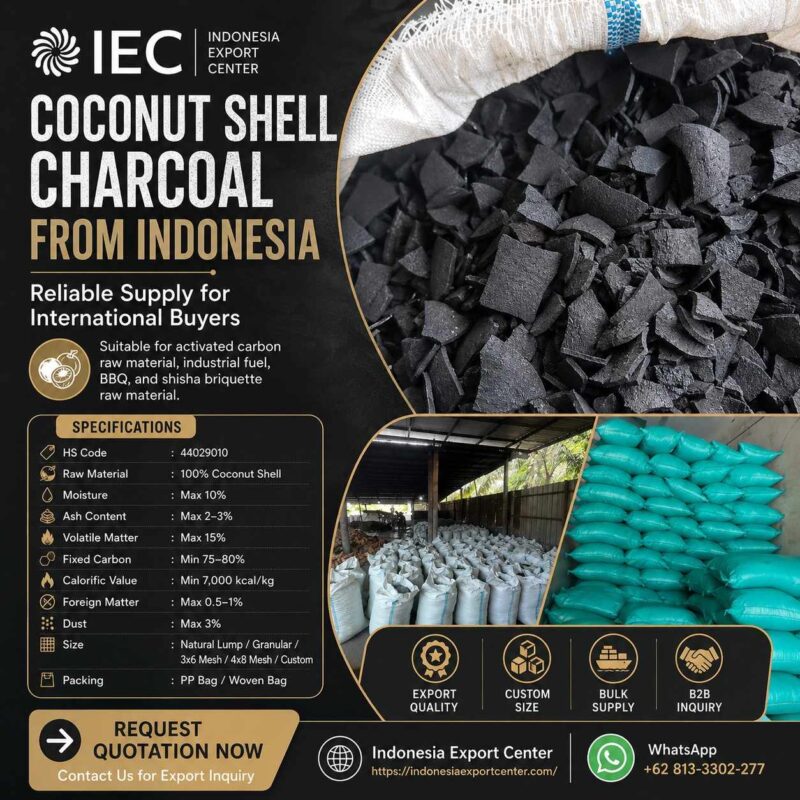
IEC | INDONESIA EXPORT CENTER
COCONUT SHELL CHARCOAL FROM INDONESIA
Reliable Supply for International Buyers
Understanding coconut charcoal ash content is essential when evaluating raw coconut shell charcoal for activated carbon manufacturing, industrial fuel applications, charcoal briquette production, and international bulk procurement.
Ash content is one of the main technical parameters used to assess charcoal quality. However, an ash percentage is only meaningful when the laboratory test method, sample preparation, reporting basis, and product lot are clearly identified.
Indonesia Export Center (IEC) facilitates B2B sourcing and export inquiries for Indonesian raw coconut shell charcoal.
IEC’s supplied raw charcoal specifications include a grade-dependent ash content limit of maximum 2–3%.
This does not mean that every shipment has a verified ash content of 2% or that the same limit applies to finished charcoal briquettes.
For industrial procurement, buyers should establish a measurable ash acceptance limit supported by representative sampling, appropriate laboratory testing, and documented quality procedures.
IEC welcomes inquiries from laboratory analysts, industrial quality control teams, activated carbon manufacturers, commodity traders, and charcoal importers worldwide.
Export Quality • Custom Size • Bulk Supply • B2B Inquiry
Request Coconut Shell Charcoal Quotation:
https://wa.me/628133302277
What Is Ash Content in Coconut Shell Charcoal?
Ash content is the inorganic residue remaining after a charcoal sample undergoes a specified laboratory ashing procedure.
It is commonly reported as a percentage of the sample mass on a defined analytical basis.
Why Ash Content Matters
Ash analysis helps buyers evaluate:
- Raw material quality
- Inorganic residue
- Feedstock consistency
- Supplier specifications
- Batch variation
- Purchase order compliance
Important Clarification
Ash content does not directly measure every possible impurity or contaminant.
Additional chemical or physical tests may be required for specific industrial applications.
IEC’s Coconut Shell Charcoal Ash Specification
IEC’s supplied raw coconut shell charcoal specification states:
Ash Content: Maximum 2–3%
This is a grade-dependent range of maximum limits.
How to Interpret the Range
A particular raw charcoal grade may be specified with a maximum ash content of 2%.
Another grade may have a maximum ash content of 3%.
The applicable limit must be confirmed for the offered grade.
What the Specification Does Not Mean
It does not automatically establish that:
- Every lot has an ash content of 2% or less.
- All available grades have identical ash limits.
- Laboratory reports are available for every shipment.
- Finished charcoal briquettes meet the same ash specification.
- A particular activation yield is guaranteed.
Why Low Ash Is Important for Industrial Charcoal Buyers
Ash content is an important part of raw material evaluation.
Activated Carbon Manufacturing
Activated carbon producers may evaluate ash as part of their feedstock qualification process.
Industrial Fuel
Industrial fuel buyers may consider ash residue when assessing handling and process requirements.
Briquette Manufacturing
Briquette manufacturers may examine raw charcoal ash alongside other properties.
Bulk Trading
Commodity traders may use ash limits to define contractual product grades.
Important Limitation
Lower ash does not automatically guarantee better activated carbon performance, longer burning duration, or higher fixed carbon.
Those properties require separate evaluation.
How Is Coconut Charcoal Ash Content Measured?
Ash content is generally determined by heating a prepared charcoal sample under defined laboratory conditions until the prescribed endpoint is reached.
The remaining residue is measured according to the selected test method.
General Testing Stages
- Collect a representative sample.
- Prepare the sample according to the method.
- Determine the required sample mass.
- Place the sample in a suitable laboratory vessel.
- Apply the specified ashing procedure.
- Cool and weigh the residue as required.
- Calculate the ash percentage.
- Report the result with its analytical basis.
Important Clarification
Exact temperatures, durations, equipment, and endpoints depend on the chosen method.
IEC has not supplied a verified ash testing method for its raw charcoal specification.
Laboratory Methods for Ash Determination
Different laboratories may use different standards or validated methods.
What Buyers Should Confirm
- Method designation
- Method edition
- Applicability to charcoal
- Sample preparation requirements
- Ashing conditions
- Reporting basis
- Laboratory competence
Why Method Selection Matters
Results obtained using different procedures may not be directly comparable.
Buyer Recommendation
Agree on the test method before sample testing or contract acceptance.
Ash Content Calculation Formula
A simplified ash calculation expresses the mass of residue as a percentage of the relevant sample mass.
General Formula
Ash Content (%) = Ash Residue Mass ÷ Sample Mass × 100
The sample mass and any basis corrections must follow the selected analytical method.
Illustrative Example
Suppose:
- Prepared sample mass: 10 g
- Ash residue mass: 0.25 g
Then:
Ash Content = 0.25 ÷ 10 × 100
Ash Content = 2.5%
This is a mathematical example only.
It is not a verified IEC laboratory result.
Understanding Ash Reporting Bases
Ash may be reported on different analytical bases.
As-Received Basis
Ash percentage is expressed relative to the sample mass in its received condition.
Dry Basis
Ash percentage is expressed relative to dry sample mass.
Why the Basis Matters
A sample may have different reported ash percentages depending on the analytical basis.
Buyer Recommendation
Require every ash report to identify its reporting basis.
Dry-Basis Ash Calculation
Where compatible analytical data are available, as-received ash can be converted to a dry basis.
General Formula
Ash (Dry Basis) = Ash (As Received) ÷ (100 − Moisture %) × 100
Illustrative Example
Suppose:
- Ash, as received: 2.5%
- Moisture, as received: 8%
Then:
2.5 ÷ 92 × 100 = approximately 2.72%
This is a mathematical example only.
It does not represent an IEC product test result.
Important Clarification
The conversion requires compatible moisture and ash data.
Ash Content vs. Moisture Content
Ash and moisture are separate quality parameters.
Ash
Represents inorganic residue after the specified ashing procedure.
Moisture
Represents water content determined using an appropriate test method.
Why Both Matter
Moisture affects the reporting of as-received analytical results.
A charcoal sample may meet a moisture limit while failing an ash limit, or vice versa.
Ash Content vs. Fixed Carbon
Fixed carbon is a proximate-analysis parameter.
General Relationship
On a consistent basis:
Fixed Carbon (%) = 100 − Moisture (%) − Ash (%) − Volatile Matter (%)
Why This Matters
Ash is one component used in calculating fixed carbon.
Important Clarification
A low ash result alone does not guarantee a particular fixed carbon percentage.
Moisture and volatile matter also influence the calculation.
Ash Content vs. Volatile Matter
Ash and volatile matter represent different aspects of charcoal composition.
Ash
Inorganic residue measured after a defined ashing procedure.
Volatile Matter
Material released under specified analytical conditions.
Buyer Recommendation
Request separate test results for ash and volatile matter when evaluating raw charcoal quality.
Ash Content vs. Foreign Matter
Ash content and foreign matter are not interchangeable.
Ash Content
Measured through laboratory ashing.
Foreign Matter
May refer to non-charcoal materials identified through agreed inspection or testing procedures.
IEC Reference
IEC’s supplied raw charcoal specification includes:
Foreign Matter: Maximum 0.5–1%
This is a grade-dependent limit.
Important Clarification
Foreign matter acceptance should be defined separately from ash acceptance.
Coconut Shell Charcoal Product Specifications
IEC’s supplied raw coconut shell charcoal specifications are:
| Parameter | Specification |
|---|---|
| HS Code | 44029010 |
| Raw Material | 100% Coconut Shell |
| Moisture | Max 10% |
| Ash Content | Max 2–3% |
| Volatile Matter | Max 15% |
| Fixed Carbon | Min 75–80% |
| Calorific Value | Min 7,000 kcal/kg |
| Foreign Matter | Max 0.5–1% |
| Dust | Max 3% |
| Size | Natural Lump / Granular / 3×6 Mesh / 4×8 Mesh / Custom |
| Packing | PP Bag / Woven Bag |
Specification note: Ash, fixed carbon, and foreign matter values represent grade-dependent ranges of limits.
The exact limits must be confirmed for the offered grade.
The supplied HS code should be verified against applicable customs classification requirements.
Raw Charcoal Ash vs. Finished Briquette Ash
Raw coconut shell charcoal and finished charcoal briquettes are different products.
Raw Coconut Shell Charcoal
IEC’s supplied ash reference is maximum 2–3%, depending on grade.
Finished Charcoal Briquettes
Finished briquettes may contain binders or other formulation components and undergo additional processing.
Important Clarification
The ash content of finished shisha or BBQ briquettes must be determined through finished-product testing.
Raw charcoal results should not automatically be applied to finished briquettes.
Ash Content for Activated Carbon Feedstock
Activated carbon manufacturers may use ash content as part of raw material qualification.
Technical Evaluation Areas
- Ash
- Fixed carbon
- Moisture
- Volatile matter
- Particle size
- Mechanical properties
- Process compatibility
Important Limitation
Ash content alone does not establish:
- Activation yield
- Iodine number
- BET surface area
- Pore structure
- Finished activated carbon hardness
These require separate process trials and finished-product testing.
Ash Content for Industrial Fuel
Industrial fuel buyers may evaluate ash alongside other fuel characteristics.
Important Parameters
- Ash
- Calorific value
- Moisture
- Volatile matter
- Fixed carbon
- Particle size
Buyer Recommendation
Assess the complete technical specification rather than relying on ash alone.
Ash Content for Charcoal Briquette Manufacturing
Briquette manufacturers may require raw charcoal with defined ash characteristics.
Additional Considerations
- Raw charcoal particle size
- Moisture
- Binder formulation
- Finished-product ash
- Mechanical strength
- Burning performance
Important Clarification
Finished briquette quality requires separate testing.
Representative Sampling for Ash Testing
Representative sampling is essential for meaningful laboratory results.
Why Sampling Matters
Ash content may vary between:
- Production batches
- Packaging units
- Material size fractions
- Storage locations
Suggested Sampling Workflow
- Define the product lot.
- Establish a sampling plan.
- Select sampling locations or packaging units.
- Collect samples using an agreed procedure.
- Prepare laboratory samples.
- Preserve sample identification.
- Submit samples for testing.
- Compare results with acceptance criteria.
Sample Preparation for Ash Analysis
Sample preparation may influence laboratory results.
Important Considerations
- Particle-size reduction
- Sample mixing
- Sample splitting
- Contamination control
- Moisture changes
- Sample identification
Buyer Recommendation
Use the preparation procedure required by the selected test method.
Laboratory Quality and Result Traceability
Laboratory results should be traceable to an identified sample.
Important Documentation
- Sample ID
- Lot number
- Sampling date
- Test date
- Laboratory identity
- Test method
- Result
- Reporting basis
Laboratory Competence
Buyers may request information about the laboratory’s competence and relevant accreditation scope.
No specific laboratory accreditation is claimed for IEC’s potential supply arrangements.
Certificate of Analysis for Coconut Charcoal
A Certificate of Analysis (COA) may summarize laboratory results for a defined sample or lot.
COA Review Checklist
-
Correct product
-
Correct grade
-
Sample identification
-
Batch or lot number
-
Test method
-
Reporting basis
-
Ash result
-
Moisture result
-
Fixed carbon result
-
Volatile matter result
-
Laboratory identity
-
Test date
Important Clarification
A COA should not be treated as a blanket guarantee for unrelated production batches.
Batch Consistency and Ash Monitoring
Industrial buyers may require ongoing ash testing.
Potential Monitoring Approaches
- Per production batch
- Per defined lot
- Per shipment
- At agreed inspection intervals
Buyer Recommendation
Specify the testing frequency and acceptance procedure in the purchase agreement.
IEC has not supplied a verified batch ash monitoring program.
Ash Acceptance Criteria for Purchase Orders
A purchase agreement should define a measurable maximum ash limit.
Important Contract Elements
- Maximum ash percentage
- Reporting basis
- Test method
- Sampling plan
- Lot definition
- Inspection location
- Laboratory responsibility
- Retesting procedure
- Acceptance or rejection rules
Example Buyer Specification
Maximum Ash: [Agreed %]
Reporting Basis: [Dry / As Received]
Test Method: [Agreed Method]
Sampling Plan: [Agreed Procedure]
Acceptance Rule: [Agreed Criteria]
IEC’s reference is maximum 2–3%, depending on grade, but the applicable contractual limit must be confirmed.
What Happens If Ash Exceeds the Specification?
A purchase agreement should define how nonconforming results are handled.
Possible Review Steps
- Confirm sample identification.
- Review the test method.
- Check the reporting basis.
- Verify sampling records.
- Consider retesting under agreed conditions.
- Review potential batch variation.
- Apply the contractual acceptance procedure.
Important Clarification
Acceptance, rejection, price adjustment, and dispute remedies depend on the agreed contract.
Loading-Port vs. Destination Ash Results
Different sampling procedures may produce different results.
Possible Causes
- Different samples
- Different particle-size fractions
- Different preparation procedures
- Different test methods
- Different reporting bases
- Material segregation during handling
Buyer Recommendation
Agree in advance on the controlling inspection point and dispute procedure.
Comparing Coconut Charcoal Suppliers by Ash Content
Procurement teams should compare equivalent laboratory results.
Supplier Comparison Matrix
| Parameter | Supplier A | Supplier B | Supplier C |
|---|---|---|---|
| Ash Result | [Result] | [Result] | [Result] |
| Reporting Basis | [Basis] | [Basis] | [Basis] |
| Test Method | [Method] | [Method] | [Method] |
| Sampling Date | [Date] | [Date] | [Date] |
| Batch Identification | [Lot] | [Lot] | [Lot] |
| Moisture | [Result] | [Result] | [Result] |
| Fixed Carbon | [Result] | [Result] | [Result] |
| Volatile Matter | [Result] | [Result] | [Result] |
| Particle Size | [Size] | [Size] | [Size] |
This is an evaluation template, not a list of confirmed IEC suppliers.
Raw Charcoal Sizes and Ash Testing
IEC’s supplied size categories include:
- Natural Lump
- Granular
- 3×6 Mesh
- 4×8 Mesh
- Custom Size
Why Size Matters
Different particle-size fractions may require appropriate sampling and preparation.
Buyer Recommendation
Define whether testing applies to the entire shipment, a particular size fraction, or another agreed material population.
Packaging and Handling Considerations
IEC’s supplied raw charcoal packaging options include:
- PP Bags
- Woven Bags
Buyer Considerations
- Packaging integrity
- Lot identification
- Material segregation
- Contamination control
- Sampling access
- Storage conditions
Exact bag weights and packaging configurations must be confirmed.
MOQ and Wholesale Pricing
IEC has not supplied a fixed MOQ or live wholesale price.
Pricing Factors
- Ash specification
- Fixed carbon requirement
- Moisture
- Particle size
- Dust
- Packaging
- Order quantity
- Testing requirements
- Shipping terms
Commercial Information to Request
- Available grade
- Applicable ash limit
- MOQ
- Price
- Currency
- Laboratory reports
- Packaging
- Lead time
- Incoterm
- Payment terms
Export Shipping and Transport Safety
Bulk charcoal shipments require appropriate logistics arrangements.
Shipping Considerations
- Packaging condition
- Net weight
- Gross weight
- Container type
- Loading arrangement
- Cargo securing
- Documentation
Maritime Transport Safety
Charcoal may present self-heating and fire hazards.
The applicable transport classification, testing, packaging, documentation, and carrier requirements must be verified under the current International Maritime Dangerous Goods (IMDG) Code.
Charcoal should not automatically be treated as unrestricted general cargo.
IEC’s Role in Coconut Charcoal Sourcing
Indonesia Export Center operates as a sourcing and export facilitation intermediary.
IEC receives international buyer requirements and facilitates inquiries about potential raw coconut shell charcoal supply arrangements.
IEC is not represented as a confirmed charcoal manufacturer or independent laboratory.
Actual ash results, sampling procedures, testing documentation, MOQ, packaging, and commercial terms must be confirmed with the relevant supplier.
How to Request Coconut Shell Charcoal with Defined Ash Content
Step 1 – Define the Application
Specify activated carbon manufacturing, industrial fuel, briquette manufacturing, or trading.
Step 2 – Set the Maximum Ash Limit
State the required ash percentage.
Step 3 – Define the Test Method
Specify the required laboratory procedure.
Step 4 – Define the Reporting Basis
Choose the appropriate analytical basis.
Step 5 – Establish Sampling Requirements
Specify lot definition, sampling plan, and inspection point.
Step 6 – Set Other Technical Requirements
Include fixed carbon, moisture, volatile matter, size, dust, and foreign matter.
Step 7 – Provide Quantity and Destination
Include purchasing volume, destination country, and port.
Step 8 – Request Quotation
Contact IEC with your technical requirements.
Coconut Shell Charcoal Ash Content RFQ Template
Subject: RFQ – Coconut Shell Charcoal with Defined Ash Specification
Dear Indonesia Export Center Team,
We are interested in sourcing raw coconut shell charcoal from Indonesia with a defined ash content requirement.
Please advise whether the following specifications can be supported.
Company Name: [Company Name]
Destination Country: [Country]
Destination Port: [Port]
Intended Application: [Activated Carbon / Industrial Fuel / Briquette Manufacturing / Trading]
Product: Raw Coconut Shell Charcoal
Maximum Ash: [Percentage]
Ash Reporting Basis: [Dry / As Received]
Required Ash Test Method: [Method]
Sampling Requirements: [Details]
Inspection Point: [Loading / Destination / Other]
Ash Acceptance Criteria: [Details]
Maximum Moisture: [Percentage]
Minimum Fixed Carbon: [Percentage]
Maximum Volatile Matter: [Percentage]
Minimum Calorific Value: [kcal/kg]
Required Particle Size: [Natural Lump / Granular / Mesh]
Maximum Dust: [Percentage]
Maximum Foreign Matter: [Percentage]
Required Quantity: [Metric Tons]
Packaging: [PP Bag / Woven Bag / Other Request]
Preferred Incoterm: [Specify]
Expected Shipment Date: [Date]
Please provide:
- Available raw charcoal grades
- Applicable ash specification
- Available laboratory ash results
- Ash test method and reporting basis
- Full proximate analysis
- Sample availability
- Sampling and batch identification procedures
- COA availability
- MOQ
- Wholesale pricing
- Packaging options
- Supply lead time
- Pre-shipment inspection options
- Export and shipping arrangements
We look forward to receiving your quotation.
Best regards,
[Your Name]
[Company Name]
[Contact Information]
Send Your Coconut Charcoal RFQ via WhatsApp:
https://wa.me/628133302277
Frequently Asked Questions About Coconut Charcoal Ash Content
What is coconut charcoal ash content?
It is the inorganic residue remaining after a charcoal sample undergoes a defined laboratory ashing procedure.
What is IEC’s ash specification?
IEC’s supplied raw charcoal specification is maximum 2–3%, depending on grade.
Does every IEC-sourced charcoal lot have a maximum ash content of 2%?
No. The applicable limit and actual results must be confirmed for the offered grade and lot.
How is ash content measured?
Ash is measured using an appropriate laboratory ashing procedure with defined sample preparation and reporting conditions.
What is the formula for ash percentage?
A simplified calculation divides ash residue mass by the relevant sample mass and multiplies by 100.
Why does the reporting basis matter?
Ash percentages reported on dry and as-received bases can differ.
Is ash content the same as foreign matter?
No. They are different quality parameters.
Does low ash guarantee high fixed carbon?
No. Moisture and volatile matter also influence fixed carbon calculations.
Does low ash guarantee better activated carbon yield?
No. Activation yield requires separate process-specific testing.
Does the raw charcoal ash specification apply to finished briquettes?
No. Finished briquettes require separate ash testing.
Can I request laboratory ash reports?
Buyers may request available laboratory documentation for the offered material.
Can I request independent testing?
Buyers may specify independent testing requirements, subject to commercial arrangements.
What is a COA?
A Certificate of Analysis documents analytical results for an identified sample or batch.
What happens if ash exceeds the agreed limit?
The contractual acceptance and dispute procedure should determine the next steps.
What sizes are listed?
Natural lump, granular, 3×6 mesh, 4×8 mesh, and custom sizes, subject to availability.
What packaging is listed?
PP bags and woven bags are listed for raw charcoal.
What is the MOQ?
No fixed MOQ has been supplied.
Can international buyers request quotations?
Yes. IEC welcomes global B2B inquiries.
Does IEC manufacture coconut shell charcoal?
IEC is presented as a sourcing and export facilitation intermediary, not a confirmed manufacturer.
How do I request a quotation?
Contact IEC through WhatsApp at +62 813-3302-277 with your maximum ash requirement, test method, reporting basis, sampling requirements, quantity, packaging, and destination.
Request Coconut Shell Charcoal Quotation
Looking for coconut shell charcoal with clearly defined ash specifications and laboratory verification requirements?
Indonesia Export Center (IEC) welcomes B2B sourcing inquiries from activated carbon manufacturers, industrial processors, commodity traders, laboratory-led procurement teams, and international bulk importers.
Sourcing Focus: Raw Coconut Shell Charcoal for Industrial Applications
Raw Material: 100% Coconut Shell
Ash Specification Reference: Maximum 2–3%, Depending on Grade
Quality Focus: Ash Testing • Laboratory Methods • Sampling • COA • Acceptance Criteria
Size Inquiries: Natural Lump • Granular • 3×6 Mesh • 4×8 Mesh • Custom
Packaging Reference: PP Bag • Woven Bag
Origin: Indonesia
Contact IEC to discuss available grades, ash specifications, laboratory documentation, sampling, MOQ, packaging, and export quotations.
Indonesia Export Center (IEC)
Website: https://indonesiaexportcenter.com/
WhatsApp: +62 813-3302-277
Request Quotation via WhatsApp:
https://wa.me/628133302277
Please include your company name, destination country, intended application, required maximum ash percentage, reporting basis, test method, sampling requirements, particle size, purchasing quantity, and expected shipment date.
