

IEC | INDONESIA EXPORT CENTER
COCONUT SHELL ACTIVATED CARBON FOR BEVERAGE FILTRATION
Food-Contact Suitable Carbon | Beverage Refining | Sensory Quality | International B2B Sourcing
Source Application-Qualified Activated Carbon for Beverage Processing
Beverage manufacturers require carefully selected processing materials to achieve consistent product quality, meet food-safety requirements, and maintain the desired sensory characteristics of their finished products.
Coconut shell activated carbon may be evaluated for selected beverage-processing applications where adsorption is appropriate. Depending on the process, qualified activated carbon can help remove certain unwanted compounds, reduce selected color or odor components, or support a controlled purification step.
However, industrial activated carbon is not automatically suitable for food or beverage processing. Food-contact suitability, purity, extractables, documentation, and process compatibility must be established for the actual grade.
Indonesia Export Center (IEC) facilitates sourcing inquiries between international beverage processors, food-ingredient distributors, technical procurement teams, and potential Indonesian activated carbon suppliers.
IEC coordinates supplier inquiries and documentation requests. Product availability, food-contact compliance, and application performance require verification by the manufacturer and buyer.
Understanding Activated Carbon in Beverage Filtration
Activated carbon is a porous adsorbent manufactured through controlled activation of carbonaceous raw materials.
Coconut shells are one possible raw material for producing activated carbon.
The resulting product may have adsorption characteristics relevant to selected beverage-processing operations.
The suitability of a particular grade depends on the substances being targeted, the composition of the beverage, the treatment conditions, and the required finished-product characteristics.
Activated carbon should not be assumed to improve every beverage formulation.
Potential Beverage Processing Applications
Selected Color Reduction
Some beverage or ingredient streams may contain unwanted color compounds.
An appropriately qualified activated carbon grade may be evaluated for controlled color reduction.
However, excessive treatment can also remove desirable color or flavor components.
Odor and Off-Flavor Management
Certain unwanted odor or flavor compounds may be adsorbed under suitable conditions.
Performance must be verified through analytical and sensory testing.
Ingredient Refining
Food-ingredient manufacturers may investigate activated carbon for selected refining processes.
Beverage Process-Water Treatment
Activated carbon may be used in qualified water-treatment systems serving beverage manufacturing facilities.
The requirements for process-water treatment may differ from those for direct contact with a beverage or ingredient.
Specialized Purification
Some beverage-processing operations require highly specific adsorbents and tightly controlled treatment conditions.
These applications require technical qualification rather than generic carbon selection.
Why Food-Contact Suitability Matters
Activated carbon used in a beverage or food-processing stream may introduce impurities if it is not manufactured and controlled appropriately.
Buyers should evaluate:
- Raw-material traceability.
- Manufacturing controls.
- Food-contact suitability.
- Relevant contaminant limits.
- Extractable substances.
- Residual processing chemicals.
- Microbiological considerations.
- Batch consistency.
- Applicable regulatory requirements.
- Product-specific supporting documentation.
Compliance requirements depend on the destination country and the intended use.
IEC does not claim that any proposed grade has been approved for food or beverage processing without supplier evidence.
Technical Specification Checklist
| Parameter | Buyer Requirement |
|---|---|
| Product | Coconut Shell Activated Carbon |
| Intended Application | Beverage filtration |
| Product Form | GAC / PAC, if appropriate |
| Food-Contact Status | Evidence required |
| Iodine Number | If relevant |
| Particle Size | Process-specific |
| Moisture | Maximum % |
| Ash | Maximum % |
| pH | Required range |
| Extractables | Applicable limits |
| Impurity Profile | Buyer-defined |
| Adsorption Performance | Target-compound testing |
| Sensory Impact | Buyer evaluation |
| Packaging | Food-process appropriate |
| Batch COA | Required |
Product Form Selection
Granular Activated Carbon
GAC may be considered for appropriately designed fixed-bed treatment systems.
The buyer must assess particle size, pressure drop, contact time, and cleaning requirements.
Powdered Activated Carbon
PAC may be evaluated for selected batch-treatment applications, provided that the grade is suitable and the process includes effective removal of the carbon after treatment.
PAC availability and suitability must be confirmed.
Sensory Quality and Product Integrity
Beverage filtration must protect the desired characteristics of the finished product.
An adsorption treatment may affect:
- Aroma.
- Flavor.
- Color.
- Appearance.
- Selected functional compounds.
- Product stability.
A treatment that removes an unwanted compound may also remove desirable constituents.
For this reason, sensory testing should accompany analytical evaluation.
Extractables and Purity Testing
Buyers should request testing appropriate to the intended food-processing use.
Depending on the product and applicable regulations, this may include evaluation of:
- Inorganic impurities.
- Residual processing substances.
- Soluble or extractable compounds.
- Relevant metals.
- Other regulated contaminants.
Testing requirements must be determined by the buyer’s quality and regulatory teams.
Laboratory and Pilot Qualification
A suitable evaluation program may include:
Step 1: Characterize the untreated beverage or ingredient.
Step 2: Identify the target compounds.
Step 3: Obtain representative activated carbon samples.
Step 4: Verify food-contact documentation.
Step 5: Conduct controlled adsorption testing.
Step 6: Evaluate analytical and sensory results.
Step 7: Assess carbon separation and product losses.
Step 8: Conduct a pilot trial where appropriate.
Step 9: Establish acceptance criteria.
Step 10: Approve the grade before commercial use.
Quality Assurance for Commercial Orders
Once a product has been approved, the buyer should establish specifications covering batch testing, traceability, manufacturing changes, and shipment acceptance.
An approved laboratory sample does not automatically establish the consistency of every subsequent commercial batch.
IEC Supplier Coordination
IEC may assist with identifying potential Indonesian suppliers and facilitating requests for:
- Product-specific TDS.
- Certificate of Analysis.
- Relevant food-contact documentation.
- Representative samples.
- Manufacturing information.
- Packaging options.
- Commercial quotation.
The buyer remains responsible for food-safety approval and regulatory compliance.
Beverage Filtration Activated Carbon RFQ
Subject: Food-Contact Suitable Coconut Shell Activated Carbon for Beverage Filtration
Dear Indonesia Export Center Team,
We are evaluating Indonesian coconut shell activated carbon for a beverage-processing application.
Buyer Company: [Company Name] Country: [Country] Beverage / Ingredient: [Description] Processing Stage: [Description] Target Compounds: [Details] Required Product Form: [GAC / PAC] Particle Size: [Specification] Food-Contact Requirements: [Applicable Standards] Purity / Extractables Limits: [Details] Required Documentation: [COA / TDS / Compliance Evidence] Sample Quantity: [Amount] Trial Quantity: [Amount] Commercial Quantity: [MT] Packaging: [Requirement] Destination Port: [Port] Preferred Incoterm: [FOB / CFR / CIF]
Please advise whether potential suppliers can provide suitable product documentation, samples, and a commercial offer for technical evaluation.
Best regards,
[Name]
[Company]
Frequently Asked Questions
Can coconut shell activated carbon be used in beverage filtration?
Certain qualified grades may be suitable for selected processes, subject to testing and applicable requirements.
Is ordinary industrial activated carbon food-safe?
Not automatically.
Can activated carbon remove unwanted flavors?
It may adsorb selected compounds, but it may also remove desirable flavor constituents.
Is sensory testing necessary?
It is strongly relevant when the treatment may affect finished-product characteristics.
Can IEC guarantee food-grade certification?
No. Certification and compliance must be verified for the actual product.
Can buyers request samples?
Yes, subject to supplier availability and sample policy.
Request Beverage Filtration Activated Carbon
REQUEST BEVERAGE FILTRATION ACTIVATED CARBON
INDONESIA EXPORT CENTER
Connecting Indonesian Products to Global Markets
Website: https://indonesiaexportcenter.com/
WhatsApp: +62 813-3302-277
Related Resources
Coconut Shell Activated Carbon Samples and COA
Coconut Shell Activated Carbon Custom Specifications
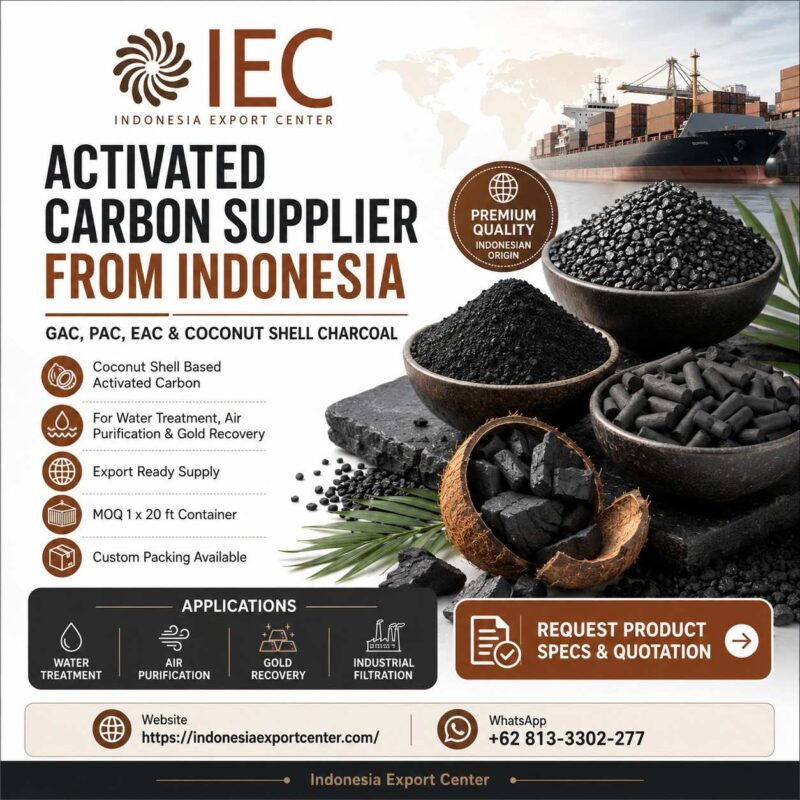
Coconut Shell Activated Carbon Supplier in Indonesia
