

IEC | INDONESIA EXPORT CENTER
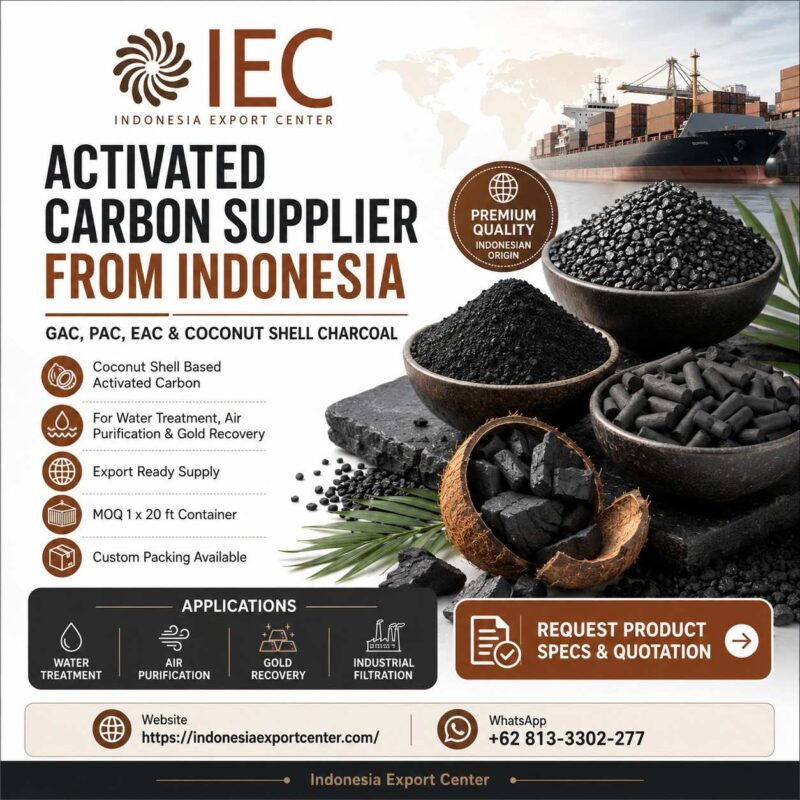
CUSTOM-SPECIFICATION COCONUT SHELL ACTIVATED CARBON
Technical Grade Matching | Particle Size | Adsorption Testing | Engineering Procurement
Source Coconut Shell Activated Carbon to Your Technical Requirements
Industrial buyers often need activated carbon with defined technical characteristics rather than a generic commercial grade.
For filtration manufacturers, engineering contractors, treatment-system operators, and industrial procurement teams, the correct product specification depends on the intended application, target contaminants, process conditions, and equipment design.
Indonesia Export Center (IEC) facilitates sourcing inquiries for potential Indonesian coconut shell activated carbon suppliers capable of reviewing buyer-defined specifications.
IEC does not guarantee that a requested custom grade can be manufactured. Technical feasibility, production capability, MOQ, and commercial terms require supplier confirmation.
Why Custom Specifications Matter
Activated carbon performance depends on more than its raw-material origin.
Different grades may vary in:
- Pore-size distribution.
- Adsorption characteristics.
- Iodine number.
- Particle-size distribution.
- Moisture.
- Ash.
- Hardness.
- Apparent density.
- pH.
- Impurity profile.
- Application performance.
A product suitable for one filtration system may be unsuitable for another.
Step 1: Define the Application
The buyer should identify whether the product is intended for:
- Industrial water treatment.
- Drinking-water treatment.
- Wastewater polishing.
- Air purification.
- VOC adsorption.
- Odor control.
- Gold recovery.
- OEM filtration.
- Other specialized applications.
Each application may require different testing and acceptance criteria.
Step 2: Identify Target Contaminants
Where adsorption performance is important, buyers should identify the substances to be removed or recovered.
Examples may include selected organic contaminants, odor compounds, or specific process substances.
A generic iodine number cannot replace contaminant-specific testing.
Step 3: Define the Product Form
Granular Activated Carbon
GAC may be suitable for packed-bed systems and selected industrial processes.
Powdered Activated Carbon
PAC may be evaluated for dosed treatment applications.
Specialty Activated Carbon
Specialized grades may require additional processing or qualification.
Any supplier’s ability to produce a requested grade must be verified.
Custom Specification Checklist
| Parameter | Buyer-Defined Requirement |
|---|---|
| Raw Material | Coconut shell |
| Product Form | GAC / PAC / Defined Specialty Grade |
| Iodine Number | Target mg/g |
| Mesh / Particle Distribution | Required range |
| Moisture | Maximum % |
| Ash | Maximum % |
| Hardness / Abrasion | Test method and limit |
| Apparent Density | Required range |
| pH | Required range |
| Surface Area | If relevant |
| Pore Characteristics | If relevant |
| Purity | Application-specific |
| Adsorption Test | Target contaminant |
| Packaging | Required format |
| Quantity | Trial and commercial volume |
Iodine Number
Iodine number is commonly used to characterize certain adsorption properties.
However, it is not a universal performance indicator.
The buyer should specify both the required value and the applicable test method.
Mesh and Particle Distribution
Particle size can influence hydraulic behavior, adsorption kinetics, screening, and handling.
Buyers should define the sieve standard, nominal mesh range, and permitted oversize or undersize fractions.
Hardness and Abrasion
Mechanical durability can be important for GAC used in filtration systems or processes involving repeated handling.
The buyer should specify the test method because results may vary between procedures.
Ash, Moisture and Purity
Ash and moisture limits can influence product selection and commercial acceptance.
For sensitive applications, additional impurity testing may be required.
Adsorption Performance Testing
Depending on the application, qualification may require:
- Laboratory adsorption tests.
- Adsorption isotherms.
- Breakthrough studies.
- Pilot trials.
- Contaminant-specific testing.
- Process compatibility evaluation.
The buyer’s engineering team should determine the relevant test program.
Manufacturing Feasibility
Not every requested combination of technical properties can be achieved economically or consistently.
A supplier should assess:
- Raw-material characteristics.
- Activation process.
- Production yield.
- Screening capability.
- Quality-control methods.
- Trial production.
- MOQ.
- Lead time.
- Commercial cost.
Third-Party Quality Control
Where appropriate, buyers may appoint an independent laboratory or inspection company.
The testing scope, sample collection, acceptance criteria, and dispute procedures should be agreed before ordering.
Sample and Pilot Qualification
Custom grades should normally undergo sample evaluation before commercial approval.
The buyer should confirm whether the tested sample is representative of the proposed commercial product.
Contract Specifications
Once a grade is approved, the contract should define:
- Product description.
- Technical limits.
- Test methods.
- Sampling procedures.
- Batch traceability.
- Packaging.
- Inspection.
- Rejection criteria.
- Remedies for nonconformance.
IEC Custom Sourcing Process
Step 1: Buyer submits detailed technical requirements.
Step 2: IEC reviews the inquiry.
Step 3: Potential suppliers are identified.
Step 4: Suppliers assess manufacturing feasibility.
Step 5: Samples and technical documents are requested.
Step 6: Buyer conducts qualification testing.
Step 7: Supplier confirms MOQ, price, and lead time.
Step 8: Contracting parties finalize commercial arrangements.
Custom Activated Carbon RFQ Template
Subject: Custom Specification Coconut Shell Activated Carbon RFQ
Dear IEC Team,
We are seeking potential Indonesian suppliers capable of reviewing our custom activated carbon specification.
Company: [Name] Country: [Country] Application: [Description] Target Contaminants: [Details] Product Form: [GAC / PAC] Iodine Number: [mg/g] Mesh Distribution: [Requirement] Moisture Maximum: [%] Ash Maximum: [%] Hardness: [Requirement] Apparent Density: [Requirement] Purity Requirements: [Details] Performance Tests: [Details] Trial Quantity: [Quantity] Commercial Quantity: [MT] Packaging: [Requirement] Destination Port: [Port] Preferred Incoterm: [Term]
Please advise whether potential suppliers can evaluate manufacturing feasibility and provide samples, technical documentation, and commercial terms.
Best regards,
[Name]
Frequently Asked Questions
Can Indonesian suppliers manufacture custom activated carbon grades?
Some suppliers may have customization capabilities, but these must be verified individually.
Can buyers request specific mesh sizes?
Yes, subject to production feasibility.
Is iodine number sufficient for product selection?
No. Application-specific testing may be required.
Can buyers request independent testing?
Yes, subject to agreed arrangements.
Does IEC guarantee custom-grade availability?
No.
Can buyers request trial production?
Potentially, subject to supplier capability.
Request Custom Activated Carbon Specifications
SUBMIT CUSTOM ACTIVATED CARBON RFQ
INDONESIA EXPORT CENTER
Connecting Indonesian Products to Global Markets
Website: https://indonesiaexportcenter.com/
WhatsApp: +62 813-3302-277
Related Resources
Coconut Shell Activated Carbon Samples and COA
OEM Activated Carbon Filter Media from Indonesia
Granular Coconut Shell Activated Carbon Wholesale
