

INDONESIA EXPORT CENTER (IEC)
Indonesian Coconut Palm Sugar for International Trade
International buyers looking for a coconut palm sugar export supplier need to evaluate product specifications, supplier identity, documentation, packaging, freight arrangements, and destination-market compliance.
Indonesia Export Center (IEC) facilitates sourcing inquiries for coconut sugar products originating from Indonesia.
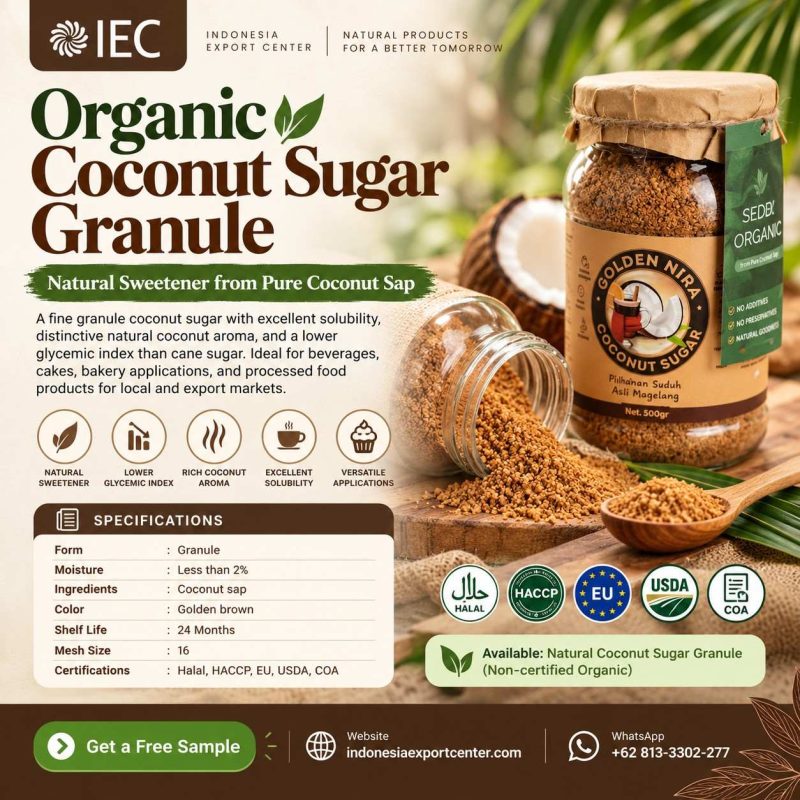
The IEC flyer presents an organic coconut sugar granule product and identifies a natural coconut sugar granule variant.
Commercial export availability, supplier capacity, packaging, certifications, and delivery terms require confirmation.
Coconut Palm Sugar Product Overview
Coconut palm sugar is produced from coconut sap.
The IEC material describes a granulated product with a golden-brown colour, distinctive coconut aroma, and good solubility.
Potential international buyer segments include:
- Food ingredient importers.
- Wholesale distributors.
- Beverage manufacturers.
- Bakery ingredient suppliers.
- Retail product companies.
- Private-label businesses.
- International food traders.
Reported Product Specifications
| Parameter | IEC Flyer Information |
|---|---|
| Form | Granule |
| Ingredient | Coconut Sap |
| Colour | Golden Brown |
| Moisture | Less than 2% |
| Mesh | 16 |
| Shelf Life | 24 Months |
The supplier should confirm the actual offered product’s current specification and COA.
Step 1 – Identify the Product Variant
Specify whether the order requires:
Organic Coconut Sugar Granules
Certified organic status requires valid documentation.
Natural Coconut Sugar Granules
The non-certified-organic variant must be evaluated against its own specification.
Step 2 – Verify the Supplier
Request:
- Legal company name.
- Registered address.
- Manufacturing or processing facility.
- Exporter identity.
- Relevant food safety documents.
- Available certificates.
- Production capacity.
- Contact details.
The manufacturer, seller, and exporter of record may be different entities.
Step 3 – Confirm Product Quality
Buyers should establish:
- Moisture limits.
- Granulation.
- Appearance.
- Aroma.
- Microbiological criteria.
- Relevant contaminant limits.
- Foreign matter criteria.
- Packaging.
- Shelf-life conditions.
Step 4 – Review Export Documentation
Potential documents include:
- Commercial invoice.
- Packing list.
- Transport document.
- Certificate of origin where applicable.
- COA.
- Food safety documents where required.
- Organic transaction documents where applicable.
- Other destination-specific certificates.
The precise document requirements depend on the importing country.
Step 5 – Confirm Customs Classification
Coconut sugar’s customs classification should be verified based on the actual product composition, form, processing, and destination tariff rules.
Do not assume that all coconut sugar products share an identical classification or duty rate.
Step 6 – Choose a Delivery Term
Buyers may request quotations under an appropriate Incoterms rule.
Examples include:
- FCA named place.
- FOB named port for suitable maritime shipments.
- CFR named destination port.
- CIF named destination port.
- Other agreed terms.
The correct term depends on the shipment structure.
Under FOB, CFR, and CIF, risk generally transfers when goods are on board the vessel at the shipment port.
Step 7 – Evaluate Packaging and Freight
Export packaging should consider:
- Moisture protection.
- Food-contact suitability.
- Package integrity.
- Product identification.
- Lot traceability.
- Palletization.
- Transport conditions.
Step 8 – Arrange Inspection
Buyers may request:
- Product sampling.
- Laboratory testing.
- Packaging inspection.
- Quantity verification.
- Container loading checks.
- Document review.
Inspection arrangements should be agreed before shipment.
Export Buyer Checklist
| Requirement | Buyer Action |
|---|---|
| Product Variant | Confirm |
| Supplier Identity | Verify |
| Specifications | Approve |
| COA | Review |
| Certifications | Verify |
| Packaging | Approve |
| MOQ | Confirm |
| Price | Obtain |
| Incoterm | Agree |
| Destination Rules | Verify |
| Shipment Period | Confirm |
| Inspection | Arrange |
Export RFQ Template
Subject: Indonesian Coconut Palm Sugar Export Supply Inquiry
Company: [Name]
Destination Country: [Country]
Product Variant: [Organic / Natural]
Required Quantity: [KG or MT]
Required Specifications: [Details]
Required Certifications: [Details]
Packaging: [Details]
Destination Port: [Port]
Preferred Incoterm: [Term]
Required Documents: [Details]
Target Shipment Period: [Dates]
Please provide available supplier information, current specifications, sample feasibility, MOQ, export documentation, and quotation.
Frequently Asked Questions
Can coconut palm sugar be exported from Indonesia?
Export feasibility depends on the actual supplier, product, and destination requirements.
Is IEC the exporter of record?
That must be established for the proposed transaction.
Are organic certificates automatically accepted worldwide?
No.
Can buyers request CIF pricing?
Yes, subject to freight and supplier confirmation.
Is a COA available?
Availability must be confirmed.
Are samples guaranteed?
No.
Can the supplier arrange private-label packaging?
Feasibility must be verified.
Request Coconut Palm Sugar Export Information
Looking for Indonesian coconut palm sugar for international wholesale or manufacturing?
Contact IEC with your destination, product variant, specifications, quantity, and delivery requirements.
REQUEST COCONUT PALM SUGAR SAMPLE & EXPORT RFQ
INDONESIA EXPORT CENTER (IEC)
Website: https://indonesiaexportcenter.com/
WhatsApp: +62 813-3302-277
Related Resources
Coconut Sugar Supplier Indonesia
Bulk Coconut Sugar Wholesale Indonesia
Coconut Sugar Bulk Export RFQ Guide
