

INDONESIA EXPORT CENTER (IEC)
Confectionery Ingredient Sourcing, Thermal Performance Evaluation, Texture Trials and Wholesale Coconut Blossom Nectar
Coconut Nectar for Confectionery Manufacturing
Confectionery manufacturers require precise ingredient control because sweeteners can influence product structure, texture, sweetness, colour, crystallization, and processing behaviour.
For companies exploring coconut nectar for confectionery, Indonesian coconut blossom nectar syrup may be an ingredient worth investigating.
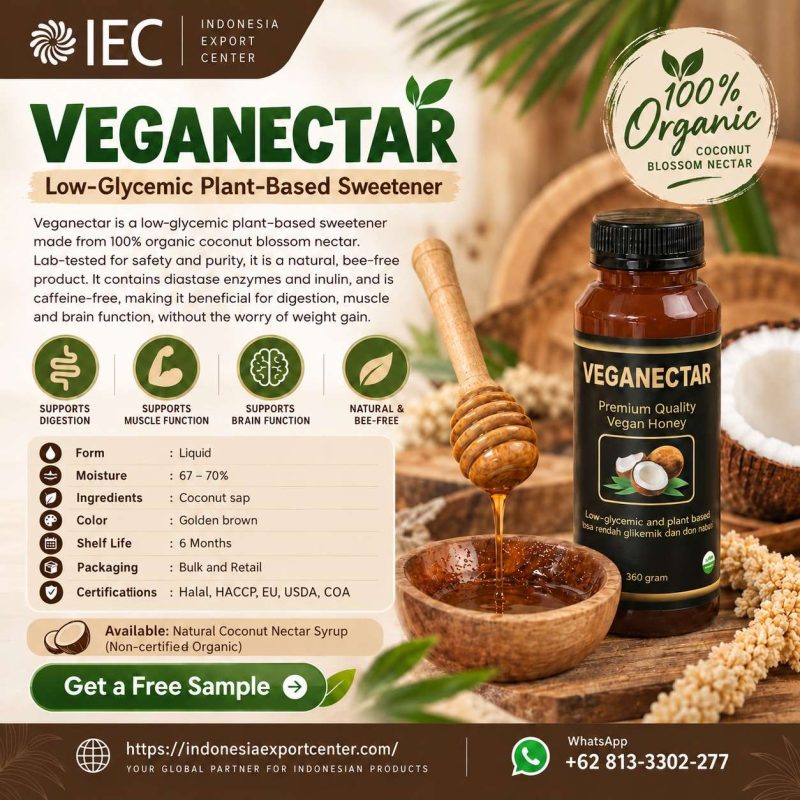
Indonesia Export Center (IEC) facilitates sourcing inquiries for Indonesian coconut nectar syrup, including VEGANECTAR.
The product is described in promotional material as a golden-brown, plant-based liquid sweetener derived from coconut sap.
It may be evaluated in selected confectionery fillings, coatings, sauces, and specialty sweet products.
However, the flyer does not establish its suitability for every candy-making process.
Coconut Blossom Nectar in Confectionery Formulations
Coconut blossom nectar is a liquid sweetening ingredient made from coconut palm sap.
Its water content and sugar composition are important considerations for confectionery manufacturers.
Different confectionery processes require different physical and chemical characteristics.
For example, a syrup suitable for a soft filling may not be suitable for a hard candy without substantial formulation adjustments.
VEGANECTAR Reference Specifications
| Parameter | Promotional Information |
|---|---|
| Product | VEGANECTAR |
| Source | Coconut Sap |
| Ingredient Claim | 100% Organic Coconut Blossom Nectar |
| Form | Liquid |
| Colour | Golden Brown |
| Moisture | 67–70% |
| Shelf Life | 6 Months |
| Packaging | Bulk and Retail |
| Certification References | Halal, HACCP, EU, USDA |
| Alternative | Natural Coconut Nectar Syrup |
The information requires supplier verification.
Potential Confectionery Applications
Soft Candy Formulations
Manufacturers may evaluate coconut nectar in selected soft confectionery products.
Texture and moisture must be tested.
Sweet Fillings
Coconut nectar may be investigated in fillings for confectionery and bakery products.
Chocolate-Related Fillings
Manufacturers may evaluate coconut nectar in compatible fillings or sauces.
It should not be assumed suitable for direct addition to moisture-sensitive chocolate systems.
Confectionery Coatings
Coconut nectar may be tested in selected coating formulations.
Specialty Sweets
Brands may explore coconut nectar in differentiated sweet products, subject to technical validation.
Sugar Composition Matters
Confectionery performance depends on the types and proportions of sugars present.
The VEGANECTAR flyer does not provide a detailed sugar profile.
Buyers may request analytical data for relevant sugar components before designing industrial formulations.
Thermal Performance
Confectionery processing may involve elevated temperatures.
Manufacturers should evaluate coconut nectar’s behaviour during:
- Heating.
- Concentration.
- Mixing.
- Cooling.
- Depositing.
- Setting.
- Storage.
The flyer does not establish specific temperature tolerances or thermal performance.
Moisture and Solids Management
The reported moisture range of 67–70% is particularly relevant.
Confectionery manufacturers may need to adjust processing conditions to achieve the required final solids and water activity.
The appropriate approach depends on the product and manufacturing technology.
Crystallization and Texture
Manufacturers should evaluate whether coconut nectar influences:
- Crystallization.
- Graininess.
- Chewiness.
- Hardness.
- Stickiness.
- Smoothness.
- Texture during storage.
No particular anti-crystallization or texture benefit should be assumed.
Colour and Flavour
VEGANECTAR is described as golden brown.
Its colour and sensory profile may influence the finished confectionery product.
Manufacturers should conduct comparative sensory and appearance trials.
Shelf-Life Validation
The ingredient’s promotional six-month shelf life does not establish finished confectionery shelf life.
Relevant testing may include:
- Water activity.
- Moisture migration.
- Texture.
- Crystallization.
- Microbiological quality.
- Packaging compatibility.
- Flavour stability.
Sample Evaluation Checklist
| Test | Evaluation Purpose |
|---|---|
| Sugar Profile | Understand composition |
| Moisture | Assess water contribution |
| Brix | Review soluble solids |
| Heating | Evaluate thermal behaviour |
| Crystallization | Observe product structure |
| Texture | Measure hardness or chewiness |
| Colour | Assess visual impact |
| Flavour | Evaluate sensory profile |
| Water Activity | Support stability assessment |
| Shelf Life | Validate finished confectionery |
Organic and Natural Product Options
The flyer promotes VEGANECTAR as organic, subject to certification verification.
A natural non-certified organic variant is also referenced.
The variants should not be assumed to have identical composition or performance.
Technical Documentation
Confectionery buyers may request:
- Current product specification.
- Ingredient declaration.
- COA.
- Sugar composition.
- Moisture and Brix.
- Microbiological information.
- Shelf-life evidence.
- Organic certification where claimed.
- Packaging specifications.
Industrial Procurement
Before ordering, manufacturers should confirm:
- Sample feasibility.
- Bulk packaging.
- MOQ.
- Production lead time.
- Available capacity.
- Storage requirements.
- Export documentation.
- Current quotation.
Confectionery Ingredient RFQ Template
Subject: Coconut Nectar Syrup for Confectionery Manufacturing
Company: [Name]
Country: [Country]
Product Category: [Candy / Filling / Coating / Specialty Sweet]
Product: VEGANECTAR Coconut Blossom Nectar
Variant: [Organic / Natural]
Initial Quantity: [KG or MT]
Monthly Demand: [Quantity]
Required Sugar Composition: [Details]
Processing Conditions: [Details]
Packaging: [Details]
Destination Port: [Port]
Please provide current specifications, COA, sugar composition where available, samples, MOQ, packaging, lead time, and quotation.
Frequently Asked Questions
Can coconut nectar be used in confectionery?
It may be evaluated in selected formulations.
Is coconut nectar suitable for hard candy?
Suitability requires detailed technical testing.
Can it be used in confectionery fillings?
Potentially, subject to texture and stability evaluation.
Does coconut nectar prevent crystallization?
No such performance guarantee is established.
Is the ingredient suitable for high-temperature processing?
Thermal behaviour must be tested.
What moisture content is reported?
67–70%.
Is VEGANECTAR organic-certified?
Current certification evidence must be verified.
Can manufacturers request samples?
Sample feasibility requires supplier confirmation.
Request Confectionery Application Samples
Contact IEC to explore coconut nectar syrup for confectionery ingredient development.
REQUEST CONFECTIONERY APPLICATION SAMPLE
INDONESIA EXPORT CENTER (IEC)
Website: https://indonesiaexportcenter.com/
WhatsApp: +62 813-3302-277
Confectionery performance, thermal characteristics, specifications, certifications, samples, packaging, MOQ, and prices require verification.
Related Resources
Coconut Nectar for Food Manufacturers
Coconut Nectar Syrup for Bakeries
Liquid Coconut Sap Sweetener from Indonesia
