

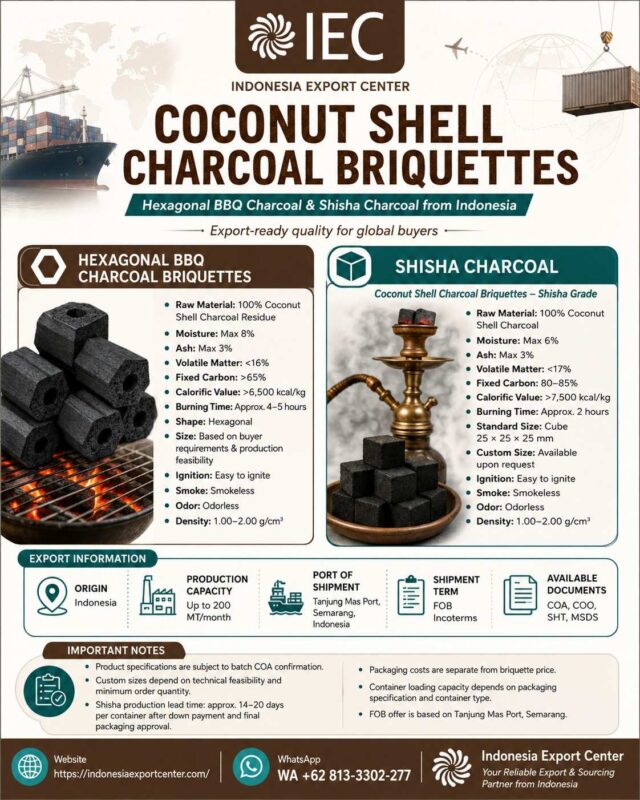
IEC | INDONESIA EXPORT CENTER
COCONUT SHELL CHARCOAL BRIQUETTES
FOB vs CIF Shipping Terms for Indonesian Shisha and BBQ Charcoal Briquettes
Incoterms® 2020 | Freight | Cargo Insurance | Cost Allocation | Risk Transfer | Export Quotations
When purchasing coconut shell charcoal briquettes from Indonesia, international buyers often compare FOB and CIF quotations before confirming an order.
Understanding coconut charcoal briquettes FOB CIF pricing is essential because the quoted price does not tell the whole story.
FOB and CIF allocate transportation responsibilities, costs, and risks differently between the seller and buyer.
A CIF quotation generally includes the seller’s cost of arranging ocean freight and specified cargo insurance to the named destination port. However, this does not mean the seller retains the transit risk until the goods arrive.
Under both FOB and CIF, risk normally transfers when the goods are on board the vessel at the port of shipment, in accordance with Incoterms® 2020.
For coconut charcoal briquettes, buyers must also consider an additional issue: cargo classification and shipping line acceptance.
Charcoal may present self-heating and fire hazards. Freight availability and insurance arrangements should therefore be reviewed together with applicable dangerous goods transport requirements.
Indonesia Export Center (IEC) facilitates sourcing and export inquiries for Indonesian coconut shell charcoal briquettes, including:
- Coconut shisha charcoal cubes
- Hexagonal coconut BBQ charcoal briquettes
IEC’s supplied commercial reference uses FOB Tanjung Mas Port, Semarang, Indonesia. Buyers may inquire about freight-inclusive alternatives, subject to supplier arrangements, transport feasibility, and quotation confirmation.
Request a Coconut Charcoal Briquettes FOB Quotation:
https://wa.me/628133302277
Coconut Charcoal Briquettes FOB vs CIF: Quick Comparison
| Comparison | FOB – Free on Board | CIF – Cost, Insurance and Freight |
|---|---|---|
| Incoterms Version | Incoterms® 2020 | Incoterms® 2020 |
| Transport Mode | Sea and inland waterway | Sea and inland waterway |
| Named Location | Port of shipment | Port of destination |
| Seller’s Delivery Point | Goods on board vessel at shipment port | Goods on board vessel at shipment port |
| Risk Transfer | When goods are on board at shipment port | When goods are on board at shipment port |
| Main Ocean Freight | Buyer arranges and pays | Seller arranges and pays |
| Cargo Insurance | Buyer arranges if desired or required by contract | Seller must procure the minimum cover required by CIF |
| Export Clearance | Seller | Seller |
| Import Clearance | Buyer | Buyer |
| Import Duties and Taxes | Buyer | Buyer |
| Destination Unloading | Depends on carriage contract and applicable terms | Depends on carriage contract and applicable terms |
| Suitable For | Buyers managing their own freight | Buyers seeking seller-arranged freight and minimum insurance |
Key point: CIF includes additional seller obligations for freight and insurance, but the transfer of transit risk remains at the shipment port.
1. What Does FOB Mean for Coconut Charcoal Briquettes?
FOB stands for Free on Board.
Under FOB Incoterms® 2020, the seller delivers the goods by placing them on board the vessel nominated by the buyer at the named port of shipment.
The seller bears the costs and risks until delivery occurs in accordance with the rule.
After that delivery point, the buyer bears the transport risk.
Example FOB Term
FOB Tanjung Mas Port, Semarang, Indonesia – Incoterms® 2020
This term identifies:
- The delivery rule
- The shipment port
- The applicable Incoterms edition
What the Seller Generally Handles Under FOB
The seller is generally responsible for:
- Supplying the contracted goods
- Appropriate export packaging
- Export clearance
- Delivery on board the nominated vessel
- Costs and risks up to the contractual delivery point
What the Buyer Generally Handles Under FOB
The buyer generally handles:
- Nominating the vessel or arranging main carriage
- Paying ocean freight
- Cargo insurance, if required
- Import clearance
- Import duties and taxes
- Destination delivery arrangements
Specific charges should be confirmed in the sales contract and freight arrangements.
2. What Does CIF Mean for Coconut Charcoal Briquettes?
CIF stands for Cost, Insurance and Freight.
Under CIF Incoterms® 2020, the seller delivers the goods on board the vessel at the shipment port, but also contracts and pays for carriage to the named destination port and obtains the cargo insurance required by the CIF rule.
Example CIF Term
CIF [Named Destination Port] – Incoterms® 2020
For example:
CIF Hamburg Port, Germany – Incoterms® 2020
This is an illustration of the Incoterm format, not an IEC freight offer.
What the Seller Generally Handles Under CIF
The seller generally handles:
- Supplying the contracted goods
- Export clearance
- Delivery on board the vessel
- Contracting and paying freight to the named destination port
- Obtaining the insurance required by CIF
- Providing the required transport and insurance documents
What the Buyer Generally Handles Under CIF
The buyer generally handles:
- Import clearance
- Import duties and taxes
- Costs not allocated to the seller under the CIF rule
- Destination transportation
- Any additional insurance coverage desired beyond the contractual minimum
3. The Most Important Difference: Cost vs. Risk
A common misunderstanding is that CIF means the seller bears the risk until the destination port.
That is not how CIF Incoterms® 2020 works.
Under FOB
The seller delivers the goods on board at the shipment port.
Risk transfers to the buyer at that point.
The buyer arranges the main carriage.
Under CIF
The seller also delivers the goods on board at the shipment port.
Risk transfers to the buyer at that point.
However, the seller pays for the main carriage and obtains the required cargo insurance.
Why This Matters
The party paying freight is not necessarily the party bearing the transit risk.
For procurement teams, this distinction is essential when reviewing insurance, cargo damage, and shipment claims.
4. FOB vs CIF Cost Allocation Table
| Cost Item | FOB | CIF |
|---|---|---|
| Product Price | Seller’s contractual supply obligation | Seller’s contractual supply obligation |
| Export Packaging | Seller, subject to contract | Seller, subject to contract |
| Export Clearance | Seller | Seller |
| Delivery on Board | Seller | Seller |
| Main Ocean Freight | Buyer | Seller |
| CIF Minimum Cargo Insurance | Not a seller obligation under FOB | Seller |
| Import Clearance | Buyer | Buyer |
| Import Duties | Buyer | Buyer |
| Import Taxes | Buyer | Buyer |
| Destination Inland Delivery | Buyer | Buyer |
| Additional Cargo Insurance | Buyer if desired | Buyer if desired beyond required CIF cover |
Note: Actual terminal, handling, unloading, and documentation charges should be checked against the carriage contract, terminal tariff, and commercial agreement.
5. Is CIF More Expensive Than FOB?
A CIF quotation often has a higher quoted amount than an otherwise comparable FOB quotation because it includes additional freight and insurance obligations.
However, a higher quoted amount does not necessarily mean a higher total landed cost.
Example: Illustrative Comparison
Assume the following hypothetical costs:
| Cost Component | FOB Purchase | CIF Purchase |
|---|---|---|
| Product and FOB-Stage Costs | USD 20,000 | Included |
| Ocean Freight | USD 2,500 | Included |
| Cargo Insurance | USD 150 | Included |
| Quoted Amount | USD 20,000 | USD 22,900 |
| Freight and Insurance Added by Buyer | USD 2,650 | — |
| Comparable Pre-Destination Total | USD 22,650 | USD 22,900 |
In this illustration:
- The FOB route produces a pre-destination total of USD 22,650.
- The CIF route produces a quoted amount of USD 22,900.
- The difference is USD 250.
These figures are hypothetical and do not represent actual IEC prices, freight rates, or insurance premiums.
Destination charges, customs costs, and inland delivery still need to be considered.
6. How to Compare FOB and CIF Quotations Correctly
Compare quotations using the same commercial assumptions.
Step 1 – Match the Product Specifications
Confirm:
- Product type
- Raw material
- Dimensions
- Moisture
- Ash
- Volatile matter
- Fixed carbon
- Calorific value
- Packaging
Step 2 – Match the Quantity
Confirm whether both quotations refer to the same:
- Metric tonnage
- Container configuration
- Carton count
- Net weight
Step 3 – Match the Shipping Route
Confirm:
- Port of loading
- Destination port
- Routing assumptions
- Container type
Step 4 – Review Freight Inclusions
Identify what is included in the quoted freight.
Step 5 – Review Insurance
For CIF, confirm the required policy or certificate and the coverage actually provided.
Step 6 – Add Destination Costs
Estimate the charges payable after arrival.
Step 7 – Compare Total Landed Cost
Use a consistent cost model rather than comparing only the headline quotation.
7. CIF Cargo Insurance Under Incoterms 2020
Cargo insurance is one of the principal differences between FOB and CIF.
Under CIF Incoterms® 2020, the seller is required to obtain cargo insurance meeting the rule’s minimum requirements.
Minimum Insurance Cover
The CIF rule generally requires minimum cover corresponding to Institute Cargo Clauses (C) or equivalent coverage, subject to the rule and the insurance arrangement.
This is more limited than broad all-risks coverage.
Insured Amount
Under the CIF rule, the insurance generally must cover at least 110% of the contract price, in the contract currency, subject to the applicable requirements.
Important Buyer Considerations
Check:
- Insured amount
- Insured currency
- Coverage clauses
- Exclusions
- Deductibles
- Claims procedures
- Insurance validity
- Named insured or beneficiary
- Covered voyage
Is CIF Insurance Always Enough?
Not necessarily.
Buyers may want additional coverage, depending on the value and risks of the shipment.
Charcoal-Specific Insurance Issues
Charcoal may present self-heating or fire hazards.
Buyers should verify that the insurance arrangement appropriately addresses the correctly declared cargo and applicable policy conditions.
Do not assume that a CIF quotation guarantees coverage for every charcoal-related loss.
8. Does FOB Include Cargo Insurance?
FOB does not require the seller to procure cargo insurance for the buyer.
The buyer should assess whether insurance is appropriate and arrange it according to the contract and risk exposure.
Why Insurance Matters
Potential cargo risks may include:
- Water damage
- Container damage
- Cargo loss
- Fire
- Handling damage
- Other insured transit events
Coverage depends on the insurance policy and exclusions.
9. FOB and CIF for Containerized Charcoal Cargo
Although FOB and CIF are commonly used in commodity trade, they may not always be the most suitable terms for containerized shipments.
Why?
In many container transactions, goods are delivered to a carrier or container terminal before being placed on board the vessel.
FCA as an Alternative
FCA – Free Carrier may better reflect the actual handover where the seller delivers the goods to the carrier before vessel loading.
CIP as an Alternative
CIP – Carriage and Insurance Paid To may be considered when seller-arranged carriage and insurance are desired for a multimodal or containerized movement.
CIP and CIF have different delivery, insurance, and transport-mode provisions.
Buyer Recommendation
Choose the Incoterm that matches the actual delivery and transport arrangements rather than selecting FOB or CIF solely because they are familiar.
10. Coconut Charcoal Briquettes Shipping Safety Under FOB and CIF
Charcoal shipping requires particular attention to transport safety.
Self-Heating Risk
Charcoal may present self-heating and fire hazards.
IMDG Code Review
The applicable maritime dangerous goods classification must be confirmed for the actual cargo.
Carrier Acceptance
The shipping line may require:
- Accurate product description
- Product-specific SDS
- Classification evidence
- Relevant test reports
- Packaging information
- Dangerous goods documentation
- Other supporting records
Does FOB Remove the Seller’s Safety Responsibilities?
No.
Incoterms allocate certain commercial delivery responsibilities, but they do not override applicable transport safety laws or regulatory obligations.
Does CIF Guarantee Shipping Acceptance?
No.
A CIF quotation should not be treated as confirmation that a shipping line has approved the charcoal cargo.
11. Freight Forwarder Coordination
Under FOB, the buyer normally arranges main carriage.
Under CIF, the seller normally arranges main carriage.
In either case, the relevant parties should coordinate:
- Cargo classification
- Shipping documents
- Carrier requirements
- Container type
- Packaging
- Shipment timing
- Port procedures
Avoid Incomplete Freight Requests
Freight inquiries should identify the cargo accurately.
Do not describe finished charcoal briquettes as unrestricted general cargo without a valid classification basis.
12. IEC Shisha Charcoal Product Specifications
IEC’s supplied reference includes coconut shell charcoal briquettes for shisha applications.
| Specification | Reference Details |
|---|---|
| Raw Material | 100% Coconut Shell Charcoal |
| Shape | Cube |
| Standard Size | 25 × 25 × 25 mm |
| Moisture | Maximum 6% |
| Ash | Maximum 3% |
| Volatile Matter | Less than 17% |
| Fixed Carbon | 80–85% |
| Calorific Value | Greater than 7,500 kcal/kg |
| Burning Time | Approximately 2 hours |
| Density | 1.00–2.00 g/cm³ |
| Ignition | Described as easy to ignite |
| Smoke | Described as smokeless |
| Odor | Described as odorless |
These are supplied reference specifications, subject to batch-specific COA confirmation.
13. IEC Hexagonal BBQ Charcoal Specifications
| Specification | Reference Details |
|---|---|
| Raw Material | 100% Coconut Shell Charcoal Residue |
| Shape | Hexagonal |
| Size | Based on buyer requirements and production feasibility |
| Moisture | Maximum 8% |
| Ash | Maximum 3% |
| Volatile Matter | Less than 16% |
| Fixed Carbon | Greater than 65% |
| Calorific Value | Greater than 6,500 kcal/kg |
| Burning Time | Approximately 4–5 hours |
| Density | 1.00–2.00 g/cm³ |
| Ignition | Described as easy to ignite |
| Smoke | Described as smokeless |
| Odor | Described as odorless |
These are supplied reference specifications, subject to batch-specific COA confirmation.
14. Packaging Costs Under FOB and CIF
IEC’s supplied reference states:
Packaging costs are separate from the briquette price.
Why Packaging Matters
Packaging may affect:
- Product cost
- Freight efficiency
- Container loading
- Gross weight
- Cargo protection
- Dangerous goods compliance
Wholesale Packaging
Buyers should specify:
- Carton weight
- Carton dimensions
- Net and gross weight
- Carton material
- Shipping marks
Private-Label Packaging
Additional costs may include:
- Artwork
- Printing
- Custom cartons
- Labeling
- Packaging procurement
Important Note
A FOB or CIF price should clearly state which packaging configuration is included.
15. Container Loading and Freight Calculation
Container loading capacity depends on the actual cargo and packaging arrangement.
Important Variables
- Container type
- Carton dimensions
- Carton weight
- Cargo securing
- Transport restrictions
- Applicable gross weight limits
No Universal Loading Quantity
The supplied IEC reference does not establish a fixed metric tonnage per container.
A shipment-specific loading plan is required.
16. FOB vs CIF and Customs Clearance
Under both FOB and CIF, the buyer generally handles destination import clearance.
Importer Responsibilities
These may include:
- Customs classification
- Import declaration
- Import duties
- Import taxes
- Required permits
- Destination regulatory compliance
HS Code Review
HS heading 4402 may be relevant to coconut shell charcoal products.
However, the final classification for finished briquettes must be confirmed with the destination customs authority or a qualified customs broker.
17. Destination Charges Not Always Included in CIF
A common mistake is assuming that CIF includes every charge at the destination port.
It does not necessarily do so.
Charges to Check
Depending on the carriage contract and destination arrangements, buyers may encounter:
- Terminal handling charges
- Port service charges
- Delivery order fees
- Customs brokerage
- Storage
- Demurrage
- Detention
- Inland transportation
Buyer Recommendation
Request a written breakdown of destination charges before confirming the order.
18. FOB vs CIF for First-Time Importers
When FOB May Be Appropriate
FOB may suit buyers who:
- Have an established freight forwarder
- Prefer direct control over ocean freight
- Can arrange cargo insurance
- Understand destination charges
- Can manage carrier acceptance requirements
When CIF May Be Appropriate
CIF may suit buyers who:
- Prefer seller-arranged ocean freight
- Want a quotation including the required CIF insurance
- Need fewer separate freight arrangements
- Understand that risk still transfers at the shipment port
Important Consideration
The best option depends on the actual transaction, cargo classification, freight market, insurance requirements, and buyer capabilities.
19. Common FOB and CIF Quotation Mistakes
Comparing Different Product Grades
Prices are not directly comparable unless specifications match.
Ignoring Packaging Costs
Custom packaging can materially change the total cost.
Assuming CIF Transfers Risk at Destination
Under CIF, risk normally transfers when the goods are on board at the shipment port.
Assuming CIF Includes Import Duties
CIF does not require the seller to pay the buyer’s import duties.
Assuming CIF Includes All Destination Charges
Some destination charges may remain payable by the buyer.
Ignoring Insurance Exclusions
Insurance coverage should be reviewed, particularly for charcoal-related hazards.
Booking Without Carrier Acceptance
Freight pricing is not the same as approval to transport the cargo.
Using FOB for Every Container Transaction
FCA may be more suitable in some containerized arrangements.
20. FOB vs CIF Quotation Checklist
Before confirming an order, verify:
Product
-
Product type confirmed
-
Technical specifications agreed
-
Dimensions confirmed
-
Quantity confirmed
-
Batch COA requirements agreed
Commercial Terms
-
Currency confirmed
-
Unit price confirmed
-
Packaging costs identified
-
MOQ confirmed
-
Incoterms® 2020 rule specified
-
Named port or place specified
-
Payment terms agreed
-
Quotation validity confirmed
Freight
-
Port of loading confirmed
-
Destination port confirmed
-
Container type confirmed
-
Freight inclusions reviewed
-
Destination charges reviewed
-
Carrier acceptance confirmed
Insurance
-
Insurance responsibility confirmed
-
Insurance coverage reviewed
-
Exclusions reviewed
-
Insured amount confirmed
-
Claims procedures understood
Compliance
-
Customs classification reviewed
-
Cargo transport classification verified
-
Required safety documents identified
-
Packaging requirements confirmed
-
Import regulations checked
21. IEC Export Supply Information
| Export Item | Supplied Reference |
|---|---|
| Country of Origin | Indonesia |
| Stated Production Capacity | Up to 200 MT/month |
| Reference Loading Port | Tanjung Mas Port, Semarang, Indonesia |
| Reference Shipment Term | FOB |
| Identified Documents | COA, COO, SHT, MSDS |
| Shisha Production Lead Time | Approximately 14–20 days per container after down payment and final packaging approval |
| BBQ Production Lead Time | To be confirmed |
| MOQ | To be confirmed |
| Packaging Costs | Separate from briquette price |
| CIF Quotation | Subject to freight feasibility and commercial confirmation |
The stated capacity is subject to confirmation and does not guarantee available stock or reserved production.
22. Why Work with Indonesia Export Center?
Indonesia Export Center (IEC) facilitates sourcing and export inquiries for Indonesian coconut shell charcoal briquettes.
IEC can receive inquiries concerning:
- Product specifications
- Samples
- Quality documentation
- Packaging
- Production availability
- MOQ
- FOB quotations
- Freight-inclusive quotation requests
- Shipping requirements
IEC acts as a sourcing and export facilitation partner. The manufacturer, contractual seller, exporter of record, and logistics responsibilities should be confirmed for each transaction.
Coconut Charcoal Briquettes FOB vs CIF RFQ Template
Subject: Coconut Charcoal Briquettes – FOB vs CIF Quotation Request
Dear Indonesia Export Center Team,
We are interested in importing coconut shell charcoal briquettes from Indonesia.
Please provide a quotation based on the following requirements.
Where feasible, we would like to compare FOB and CIF pricing for the same product specifications and order quantity.
Buyer Information
Company Name: [Company Name]
Country: [Country]
Business Type: [Importer / Distributor / Wholesaler / Procurement Company]
Contact Person: [Name]
Email: [Email]
WhatsApp: [Number]
Product Requirements
Product Type: [Shisha Charcoal / Hexagonal BBQ Charcoal]
Required Shape: [Cube / Hexagonal / Custom]
Required Dimensions: [mm]
Maximum Moisture: [Percentage]
Maximum Ash: [Percentage]
Required Fixed Carbon: [Percentage]
Minimum Calorific Value: [kcal/kg]
Quantity and Packaging
Initial Order Quantity: [Metric Tons]
Expected Monthly Volume: [Metric Tons]
Packaging Type: [Wholesale / Retail / Private Label]
Net Weight per Carton: [kg]
Carton Dimensions: [cm]
Artwork Available: [Yes / No]
Shipping Requirements
Port of Loading: Tanjung Mas Port, Semarang, Indonesia
Destination Port: [Port]
Destination Country: [Country]
Preferred Container Type: [20ft / 40ft / To Be Confirmed]
Requested FOB Term: FOB Tanjung Mas Port, Semarang – Incoterms® 2020
Requested CIF Term: CIF [Destination Port] – Incoterms® 2020
Target Shipment Date: [Date]
Insurance and Safety
CIF Insurance Details Required: [Yes / No]
Additional Insurance Coverage Requested: [Details]
Cargo Classification Evidence Required: [Yes / No]
Product-Specific SDS Required: [Yes / No]
Carrier Acceptance Confirmation Required: [Yes]
Please provide:
- Product specifications
- Sample availability
- Batch COA availability
- MOQ
- Price per metric ton
- Packaging costs
- FOB Semarang quotation
- CIF destination-port quotation, if feasible
- Freight inclusions and exclusions
- Insurance coverage details for CIF
- Container loading estimate
- Production availability
- Production lead time
- Cargo classification documentation
- Carrier acceptance requirements
- Export documentation
- Payment terms
- Quotation validity
We look forward to receiving your quotation and commercial information.
Best regards,
[Your Name]
[Company Name]
[Country]
[Contact Information]
SEND YOUR FOB VS CIF QUOTATION REQUEST VIA WHATSAPP:
https://wa.me/628133302277
Frequently Asked Questions About Coconut Charcoal Briquettes FOB vs CIF
What is the difference between FOB and CIF?
Under FOB, the buyer arranges main ocean carriage. Under CIF, the seller arranges and pays for freight and obtains the required cargo insurance.
What does FOB mean?
FOB means Free on Board.
What does CIF mean?
CIF means Cost, Insurance and Freight.
Which Incoterms version should be used?
The contract should explicitly identify the agreed edition, such as Incoterms® 2020.
When does risk transfer under FOB?
Risk normally transfers when the goods are on board the vessel at the named shipment port.
When does risk transfer under CIF?
Risk normally transfers when the goods are on board the vessel at the shipment port, even though the seller pays freight to the destination port.
Does CIF mean the seller bears all risk until arrival?
No.
Does CIF include ocean freight?
Yes, the seller must contract and pay for the carriage required by the CIF rule.
Does CIF include cargo insurance?
Yes, the seller must obtain the minimum insurance required under CIF.
What insurance coverage is required under CIF Incoterms 2020?
CIF generally requires minimum cover corresponding to Institute Cargo Clauses (C) or equivalent, subject to the rule.
Is CIF insurance always sufficient?
Not necessarily. Buyers may want additional coverage.
Does FOB include cargo insurance?
FOB does not require the seller to obtain cargo insurance for the buyer.
Does CIF include import duties?
No. The buyer generally handles import duties and taxes.
Does CIF include customs clearance at destination?
The buyer generally handles destination import clearance.
Does CIF include every destination port charge?
Not necessarily. Charges depend on the carriage contract and applicable arrangements.
Is CIF always more expensive than FOB?
The CIF quotation usually includes additional freight and insurance costs, but total landed cost must be compared.
Can FOB be used for containerized charcoal briquettes?
FOB may be used, but FCA may be more suitable where cargo is handed over before vessel loading.
What is FCA?
FCA means Free Carrier.
What is CIP?
CIP means Carriage and Insurance Paid To.
Are FOB and CIF suitable for all transport modes?
No. Both are intended for sea and inland waterway transport.
Does FOB determine dangerous goods classification?
No.
Does CIF guarantee shipping line acceptance?
No.
Can coconut charcoal briquettes present self-heating hazards?
Yes. Appropriate transport classification and safety review are important.
What is IEC’s reference loading port?
Tanjung Mas Port, Semarang, Indonesia.
What is IEC’s reference shipment term?
FOB.
Can buyers request CIF quotations from IEC?
Buyers may request them, subject to feasibility and commercial confirmation.
What is the standard shisha charcoal size?
25 × 25 × 25 mm cubes.
What is the BBQ charcoal shape?
Hexagonal.
What is the stated production capacity?
Up to 200 metric tons per month, subject to confirmation.
What is the shisha production lead time?
Approximately 14–20 days per container after down payment and final packaging approval, subject to confirmation.
Are packaging costs included in the briquette price?
No. Packaging costs are separate.
How can I request an FOB or CIF quotation?
Send your product specifications, quantity, packaging requirements, and destination port to IEC via WhatsApp.
Request Coconut Charcoal Briquettes FOB or CIF Quotation
Looking for Indonesian Coconut Charcoal Briquettes for International Import?
Indonesia Export Center (IEC) welcomes inquiries from import purchasing teams, distributors, wholesalers, restaurant suppliers, and hookah brands.
Available Product References:
- Coconut Shisha Charcoal Cubes
- Hexagonal Coconut BBQ Charcoal Briquettes
Origin: Indonesia
Shisha Standard Size: 25 × 25 × 25 mm
BBQ Shape: Hexagonal
Shisha Moisture Reference: Max 6%
BBQ Moisture Reference: Max 8%
Ash Reference: Max 3%
Shisha Fixed Carbon Reference: 80–85%
BBQ Fixed Carbon Reference: Greater than 65%
Shisha Calorific Value Reference: Greater than 7,500 kcal/kg
BBQ Calorific Value Reference: Greater than 6,500 kcal/kg
Reference Shipment Term: FOB
Reference Loading Port: Tanjung Mas Port, Semarang, Indonesia
CIF Quotation: Subject to Feasibility and Confirmation
Cargo Classification: Subject to Product-Specific Verification
Carrier Acceptance: Must Be Confirmed
Stated Production Capacity: Up to 200 MT/Month, Subject to Confirmation
MOQ: To Be Confirmed
Packaging Costs: Separate from Briquette Price
Shisha Production Lead Time: Approximately 14–20 Days per Container After Down Payment and Final Packaging Approval, Subject to Confirmation
BBQ Production Lead Time: To Be Confirmed
Contact IEC to discuss your required product specifications, order quantity, destination port, and preferred shipment terms.
Indonesia Export Center (IEC)
Your Reliable Export & Sourcing Partner from Indonesia
Website: https://indonesiaexportcenter.com/
WhatsApp: +62 813-3302-277
REQUEST FOB OR CIF QUOTATION VIA WHATSAPP:
https://wa.me/628133302277
Please include your company name, destination country, product type, proposed order quantity, packaging requirements, destination port, and preferred Incoterm.
Commercial Disclaimer: This guide provides general information about Incoterms® 2020 and international purchasing. It does not constitute a binding quotation, freight offer, insurance policy, or legal advice. Actual responsibilities depend on the sales contract, selected Incoterm, carriage arrangements, insurance terms, and applicable regulations.
