

INDONESIA EXPORT CENTER (IEC)
Indonesian Coconut Blossom Syrup Sourcing Support for International Importers and Trading Companies
Looking for a Coconut Blossom Syrup Exporter in Indonesia?
International food ingredient importers and trading companies searching for a coconut blossom syrup exporter Indonesia need to evaluate both the product and the commercial entity responsible for the shipment.
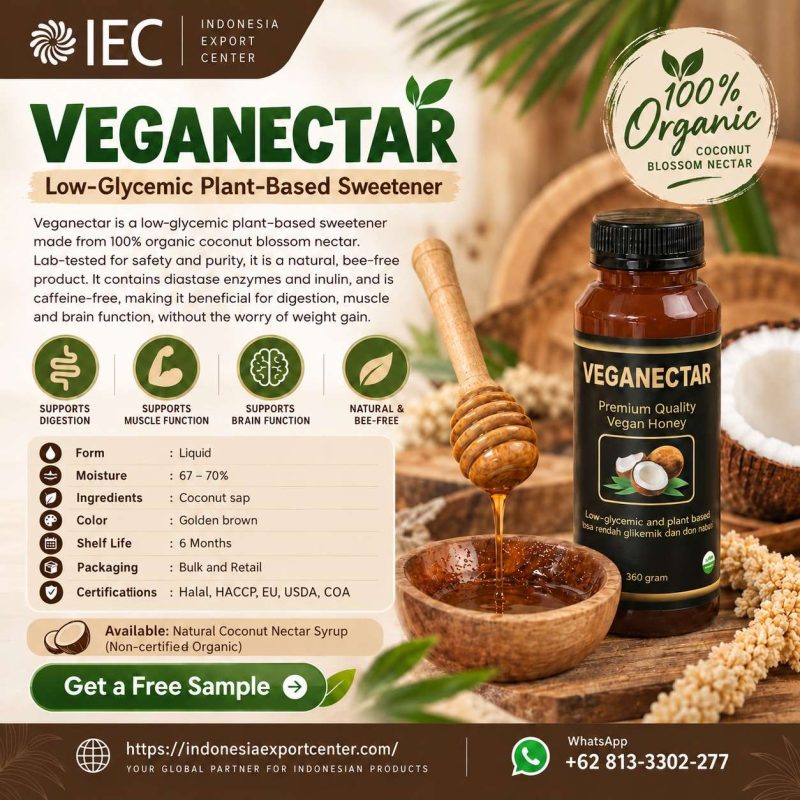
Indonesia Export Center (IEC) facilitates sourcing inquiries for Indonesian coconut blossom nectar syrup, including the VEGANECTAR product described in its promotional material.
IEC’s role is to help buyers explore sourcing options and request technical and commercial information. The identity of the manufacturer, contracting seller, and exporter of record must be confirmed for each transaction.
This distinction is important because international buyers need accurate information about who manufactures the product, who issues the invoice, who is responsible for export clearance, and who provides contractual warranties.
Indonesian Coconut Blossom Syrup
Coconut blossom syrup is a liquid sweetening ingredient derived from coconut palm sap.
The IEC promotional material introduces VEGANECTAR as a golden-brown liquid coconut blossom nectar product.
Potential applications include:
- Beverage manufacturing.
- Bakery and dessert production.
- Foodservice.
- Specialty food ingredients.
- Plant-based foods.
- Retail sweeteners.
Product suitability should be evaluated through appropriate technical and formulation testing.
VEGANECTAR Reference Specifications
| Parameter | Flyer Information |
|---|---|
| Product | VEGANECTAR |
| Ingredient Claim | Organic Coconut Blossom Nectar |
| Source | Coconut Sap |
| Form | Liquid |
| Moisture | 67–70% |
| Colour | Golden Brown |
| Shelf Life | 6 Months |
| Packaging | Bulk and Retail |
| Certification References | Halal, HACCP, EU, USDA |
| Alternative | Natural Coconut Nectar Syrup |
The values are promotional references and require verification.
Understanding the Roles in an Export Transaction
A coconut syrup supply arrangement may involve several parties.
Manufacturer
The company that produces or processes the coconut nectar syrup.
Trading Company
A business that purchases and resells the product.
Exporter of Record
The legal entity responsible for export declarations and related obligations.
Sourcing Facilitator
An organization that assists buyers with identifying and communicating with potential suppliers.
IEC facilitates sourcing inquiries. It should not be assumed to manufacture VEGANECTAR or act as exporter of record unless confirmed in the specific transaction.
Why Exporter Verification Matters
Buyers should know which company is responsible for:
- Product manufacture.
- Quality control.
- Product specifications.
- Export documentation.
- Contractual delivery.
- Payment receipt.
- Shipment arrangements.
- Claims and corrective action.
These responsibilities should be reflected in the commercial agreement.
Step 1: Define Product Requirements
Before requesting an export quotation, buyers should specify:
- Product name.
- Organic or natural variant.
- Intended application.
- Required quantity.
- Packaging.
- Technical specifications.
- Certification requirements.
- Destination country.
- Preferred Incoterm.
- Target shipment date.
Step 2: Verify the Supplier and Exporting Entity
Request information about:
- Legal company identity.
- Manufacturing facility.
- Commercial seller.
- Exporting entity.
- Product authorization.
- Quality management.
- Export experience.
- Applicable registrations.
Buyers should verify the information before committing funds.
Step 3: Review Technical Documentation
A suitable documentation package may include:
- Product specification.
- Ingredient declaration.
- COA.
- Relevant microbiological results.
- Organic certification where claimed.
- Halal certification where required.
- Food safety management evidence.
- Shelf-life documentation.
The exact documents depend on the product and destination.
Step 4: Verify Import Eligibility
The importer should determine whether the product may enter the destination market.
Requirements can include food safety controls, customs classification, labelling, certification, and import documentation.
The exporting supplier should not promise automatic import eligibility.
Step 5: Evaluate Samples
Samples may help buyers evaluate:
- Appearance.
- Aroma.
- Sweetness.
- Soluble solids.
- Viscosity.
- Microbiological quality.
- Application performance.
Sample shipment feasibility must be checked.
Step 6: Confirm Packaging
Liquid sweeteners require suitable packaging.
Buyers should request the available formats and confirm food-contact suitability, closures, lot identification, and transport conditions.
Step 7: Request an Export Quotation
A quotation should identify:
- Seller.
- Product specification.
- Quantity.
- Unit price.
- Currency.
- Packaging.
- Incoterm.
- Named port or place.
- Lead time.
- Payment terms.
- Quotation validity.
No current price or MOQ is provided in the flyer.
Step 8: Agree Shipping Responsibilities
The parties should agree on the applicable Incoterm.
For ocean shipments, FOB or CIF may be considered where appropriate.
For containerized cargo delivered to a carrier before vessel loading, FCA or CIP may be more suitable.
Step 9: Review Export Documentation
Depending on the transaction, documentation may include:
- Commercial invoice.
- Packing list.
- Transport document.
- Customs export declaration.
- Certificate of origin where applicable.
- Product specification.
- COA.
- Certification documents where required.
The importer should confirm destination-specific requirements.
Step 10: Arrange Quality Inspection
A buyer may request inspection before dispatch.
Potential inspection areas include:
- Product identity.
- Packaging.
- Quantity.
- Lot numbers.
- Container condition.
- Loading.
- Documentation.
Inspection arrangements should be agreed in writing.
Managing Commercial Risk
International buyers should consider:
Payment Risk
Verify the contracting entity and banking details.
Quality Risk
Use agreed specifications and appropriate testing.
Logistics Risk
Clarify freight, insurance, and delivery responsibilities.
Regulatory Risk
Confirm destination-market requirements.
Shelf-Life Risk
Review remaining shelf life at dispatch and arrival.
Certification Risk
Verify certificates and transaction scope.
Export Quotation Checklist
| Item | Required Information |
|---|---|
| Seller | Legal entity |
| Manufacturer | Verified facility |
| Product | Approved specification |
| Quantity | KG or MT |
| Packaging | Confirmed format |
| Certification | Relevant evidence |
| Price | Written quotation |
| Incoterm | Named place or port |
| Shipment | Target schedule |
| Documents | Agreed list |
| Payment | Contractual terms |
Coconut Blossom Syrup Export RFQ Template
Subject: Coconut Blossom Syrup Export Inquiry – Indonesia
Company: [Name]
Country: [Country]
Product: Coconut Blossom Nectar Syrup
Preferred Brand: [VEGANECTAR / Other]
Variant: [Organic / Natural]
Quantity: [KG or MT]
Packaging: [Details]
Required Certifications: [Details]
Destination Port: [Port]
Preferred Incoterm: [Term]
Please confirm manufacturer identity, exporting entity, product specifications, COA, available packaging, sample feasibility, MOQ, lead time, and export quotation.
Frequently Asked Questions
Is IEC the manufacturer of VEGANECTAR?
IEC is presented here as a sourcing facilitator; the manufacturer must be confirmed.
Is IEC automatically the exporter of record?
No. The exporting entity must be identified for the transaction.
Can buyers request FOB or CIF quotations?
Yes, subject to supplier and freight confirmation.
Are organic certificates available?
The flyer references them, but current evidence is required.
What is the shelf life?
The flyer states six months, subject to verification.
Can buyers request export samples?
Sample feasibility must be confirmed.
What is the MOQ?
Supplier confirmation is required.
Can IEC assist international trading companies?
IEC can facilitate sourcing inquiries.
Request Coconut Blossom Syrup Export Quotation
Looking for Indonesian coconut blossom syrup for international trade?
Contact IEC with your quantity, destination, product specifications, and documentation requirements.
REQUEST COCONUT BLOSSOM SYRUP EXPORT QUOTATION
INDONESIA EXPORT CENTER (IEC)
Website: https://indonesiaexportcenter.com/
WhatsApp: +62 813-3302-277
Manufacturer identity, exporter-of-record status, certifications, technical specifications, prices, MOQ, samples, and shipping arrangements require verification.
Related Resources
Coconut Blossom Nectar Supplier Indonesia
Bulk Coconut Nectar Syrup Supplier
Coconut Nectar for Food Ingredient Importers
