

IEC | INDONESIA EXPORT CENTER
Your Reliable Export & Sourcing Partner from Indonesia
UNDERSTANDING COCONUT COIR ROPE, TWINE, AND GEOTEXTILES
Product Comparison | Material Selection | Technical Procurement | Indonesian Supplier Matching
Choose the Correct Coconut Coir Product for Your Application
International buyers searching for coconut coir materials may encounter several product names, including coco rope, coir twine, coir yarn, coir netting, and coir geotextiles.
Although these products may originate from coconut husk fiber, they differ in physical form, construction, intended applications, and performance requirements.
Selecting the wrong product can lead to manufacturing difficulties, unsuitable installation, incorrect quotations, or failure to meet a project specification.
Indonesia Export Center (IEC) facilitates sourcing inquiries for Indonesian coir materials and helps buyers clarify the product category before requesting samples and quotations.
What Is Coconut Coir?
Coconut coir is a natural fiber obtained from the coconut husk.
Depending on fiber processing and manufacturing methods, coir can be used to produce rope, twine, yarn, mats, netting, and other manufactured products.
However, the properties of a finished coir product depend on more than the fiber source.
Construction, twist, dimensions, moisture, density, processing, and quality control can affect its performance.
1. What Is Coco Rope?
Coco rope, also called coconut coir rope, is twisted natural fiber cordage.
It may be supplied in coils and used for suitable garden accessories, decorative applications, craft products, and selected manufacturing purposes.
The relevant specifications may include:
- Nominal diameter.
- Diameter tolerance.
- Number of plies.
- Twist construction.
- Coil length.
- Coil weight.
- Breaking load.
- Elongation.
- Moisture.
- Impurity content.
- Packaging.
The required properties depend on the application.
2. What Is Coir Twine?
Coir twine is generally a finer cordage product made from coconut fiber.
It may be considered for selected agricultural tying, craft applications, and manufacturing inputs.
However, suppliers may use the terms twine, yarn, and rope differently.
A buyer should therefore request actual diameter, linear weight, construction, and performance data rather than relying on the product name alone.
3. What Is Coir Yarn?
Coir yarn is a twisted fiber product that may be used as an input in further manufacturing.
For example, some coir netting or other woven products are manufactured using coir yarn.
A finished rope is not automatically suitable as a substitute for manufacturing yarn.
Processing equipment may require particular yarn thickness, twist, flexibility, and linear weight.
4. What Are Coir Geotextiles?
Coir geotextiles are manufactured products designed for specified geotechnical or environmental applications.
They may take the form of woven netting or other engineered coir structures.
Depending on the product, applications may include selected slope protection, soil stabilization, vegetation establishment, or erosion-control systems.
Technical suitability must be established through the relevant product specification, testing, and project engineering approval.
5. Main Differences Between Coir Rope, Twine, and Geotextiles
| Feature | Coir Rope | Coir Twine | Coir Geotextiles |
|---|---|---|---|
| General Form | Twisted cordage | Generally finer cordage | Manufactured sheet or mesh |
| Typical Procurement Unit | Coils | Coils or spools | Rolls or project units |
| Main Specification | Diameter and construction | Linear weight, twist, diameter | Mesh, width, strength, coverage |
| Application | Selected tying, craft, and industrial uses | Selected tying and manufacturing uses | Engineered soil and erosion-control applications |
| Performance Testing | Application-specific | Application-specific | Project- and product-specific |
| Direct Substitution | Not assumed | Not assumed | Not assumed |
6. Reference Indonesian Cocorope Specification
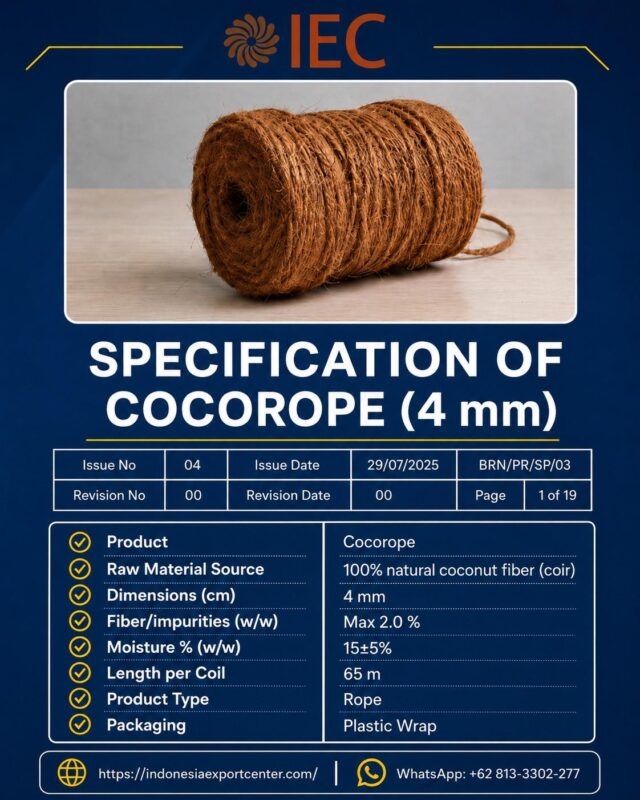
The supplied Cocorope reference provides the following information.
| Specification | Value |
|---|---|
| Product | Cocorope |
| Raw Material | 100% natural coconut fiber |
| Nominal Diameter | 4 mm |
| Coil Length | 65 m |
| Moisture | 15 ± 5% |
| Fiber/Impurities | Maximum 2.0% |
| Product Type | Rope |
| Packaging | Plastic wrap |
Reference: BRN/PR/SP/03, Issue 04, dated 29 July 2025.
This specification describes a rope product. It does not establish the specifications of coir twine, coir yarn, or coir geotextiles.
7. Product Selection by Application
Garden Plant Tying
A buyer should assess whether rope or finer twine is appropriate for the plant, tying method, and expected duration.
Greenhouse Plant Training
The product must meet the cultivation system’s mechanical and handling requirements.
A 4 mm rope should not be assumed suitable for automated greenhouse systems.
Handicrafts and Decoration
Rope or twine may be selected according to texture, appearance, flexibility, and desired visual effect.
Furniture Manufacturing
Material selection depends on whether the rope is decorative or mechanically functional.
Load-bearing uses require separate engineering and performance qualification.
Coir Geotextile Manufacturing
Manufacturers should specify the required yarn or cordage input according to their equipment and finished-product requirements.
Riverbank Rehabilitation
The project designer should specify the appropriate engineered product and relevant performance criteria.
Coastal Restoration
Exposure conditions, installation design, and required service life must be assessed by qualified project professionals.
8. Product Selection Decision Matrix
| Buyer Requirement | Product Category to Investigate |
|---|---|
| Decorative Natural Rope | Coir Rope |
| Fine Plant Tying | Coir Twine |
| Manufacturing Input for Weaving | Coir Yarn |
| Engineered Erosion-Control Mesh | Coir Geotextile Netting |
| Fiber-Filled Restoration Cylinder | Coir Log |
| Natural Fiber Surface Cover | Coir Matting |
This matrix identifies categories for investigation, not guaranteed product suitability.
9. Important Technical Differences
Diameter
Diameter is important for rope and twine, but it does not fully describe geotextile performance.
Ply Construction
Ply count and twist influence rope construction and may affect mechanical properties.
Tensile Strength
Breaking load or tensile properties should be specified according to the actual product and test method.
Moisture Behavior
The reference moisture content does not establish long-term wet-condition durability.
Manufacturing Compatibility
A coir rope may not run correctly through equipment designed for a particular yarn.
Environmental Performance
Natural fiber composition does not independently establish a product’s erosion-control performance, service life, or environmental certification.
10. Why Buyers Should Avoid Product Substitution
A supplier may offer a product with a similar name but a different construction.
For example:
- A finished rope may be too thick for a weaving machine.
- A fine twine may not meet a specified breaking load.
- Ordinary rope may not provide the coverage required by an erosion-control design.
- A coir net may have different mesh dimensions from those specified in a tender.
- A decorative rope may not be suitable for repeated wet exposure.
These differences should be resolved before purchase.
11. Quality Checklist by Product Category
| Requirement | Rope | Twine | Geotextile |
|---|---|---|---|
| Fiber Composition | Check | Check | Check |
| Diameter / Linear Weight | Check | Check | As applicable |
| Ply / Twist | Check | Check | As applicable |
| Coil / Roll Dimensions | Check | Check | Check |
| Breaking Load | As required | As required | As required |
| Mesh Size | Not applicable | Not applicable | Check |
| Coverage / Area | Not applicable | Not applicable | Check |
| Wet Performance | As required | As required | As required |
| Packaging | Check | Check | Check |
| Application Approval | As required | As required | Essential for engineered use |
12. Supplier Verification
Before selecting a supplier, buyers should verify:
- Legal company identity.
- Manufacturer or trader status.
- Actual product category.
- Current technical specification.
- Sample availability.
- Relevant test reports.
- Production capability.
- MOQ.
- Packaging.
- Export readiness.
13. Import Process
The purchasing process should include:
Step 1: Define the intended application.
Step 2: Select the appropriate coir product category.
Step 3: Prepare a technical RFQ.
Step 4: Identify and screen potential suppliers.
Step 5: Request samples and technical evidence.
Step 6: Conduct application-specific testing.
Step 7: Obtain a supplier-approved quotation.
Step 8: Confirm customs and import requirements.
Step 9: Agree on inspection, payment, and delivery terms.
Step 10: Arrange shipment and verify the delivered goods.
14. Logistics and Incoterms
IEC can facilitate quotation requests under appropriate Incoterms 2020, subject to seller and logistics confirmation.
The buyer should specify the destination port, quantity, packaging, shipment date, and preferred Incoterm.
Geotextiles, logs, and rope coils may have different packing dimensions and freight economics, so shipping quotations should be based on the actual product.
15. How IEC Facilitates Product Matching
IEC can help international buyers clarify whether their requirement concerns rope, twine, yarn, netting, or another coir product.
The process may include supplier identification, technical document requests, sample inquiries, and commercial quotation coordination.
IEC does not independently certify product suitability or engineering performance.
16. Product-Matching RFQ Template
Subject: Coconut Coir Product Selection and Supplier Inquiry
Dear Indonesia Export Center Team,
We are seeking a suitable coconut coir product for our application.
Company: [Name]
Country: [Country]
Application: [Description]
Required Product Category: [Rope / Twine / Yarn / Geotextile / Unsure]
Diameter or Linear Weight: [Requirement]
Ply/Twist Construction: [Requirement]
Mesh or Roll Dimensions: [If Applicable]
Coil Length/Weight: [If Applicable]
Order Quantity: [Quantity]
Required Performance: [Details]
Quality/Test Requirements: [Details]
Packaging: [Details]
Destination Port: [Port]
Preferred Incoterm: [Term]
Target Shipment Date: [Date]
Please advise on the appropriate product category, supplier availability, samples, technical documentation, MOQ, and quotation.
Best regards,
[Name]Frequently Asked Questions
Is coco rope the same as coir twine?
No. They may differ in dimensions and construction, although commercial terminology can vary.
Can coir rope be used to manufacture geotextiles?
Possibly in certain manufacturing processes, but compatibility must be verified. Coir yarn may be required instead.
Is 4 mm Cocorope an erosion-control geotextile?
No. The reference identifies it as rope.
Can coir twine replace greenhouse training string?
Only if it meets the specific cultivation and mechanical requirements.
Is coir geotextile suitable for every riverbank project?
No. Suitability depends on the design, site conditions, and relevant engineering specifications.
Can IEC help identify the right product?
IEC can facilitate product clarification and supplier inquiries.
Are samples available?
Sample availability depends on the supplier and product category.
Can buyers request technical test reports?
Yes. Availability and relevance must be verified.
Request a Product-Match Consultation
Find the Appropriate Indonesian Coir Product for Your Procurement Requirements
Whether your business needs coconut coir rope, finer twine, manufacturing yarn, or engineered coir materials, begin with a clear technical specification.
REQUEST COCONUT COIR PRODUCT-MATCH CONSULTATION
IEC | INDONESIA EXPORT CENTER
Your Reliable Export & Sourcing Partner from Indonesia
Website: https://indonesiaexportcenter.com/
WhatsApp: +62 813-3302-277
Related Resources
Coir Rope for Coir Geotextile Fabrication
Coir Twine for Agriculture Suppliers
Coir Rope for Riverbank Rehabilitation
Coco Rope RFQ Checklist for B2B Buyers
