

INDONESIA EXPORT CENTER
Industrial Coal | Brick Manufacturing | Kiln Fuel Specifications | Bulk Sourcing Facilitation
Indonesian Coal for Brick and Ceramics Manufacturing
Brick and ceramics manufacturing involves controlled heating processes that require appropriate fuel and kiln operation.
For facilities designed and legally authorized to use coal, fuel selection can influence firing conditions, product quality, residue management, and operating costs.
Buyers searching for Indonesian coal for brick kilns should evaluate fuel characteristics, particle size, ash content, sulfur, combustion behavior, and the requirements of their kiln technology.
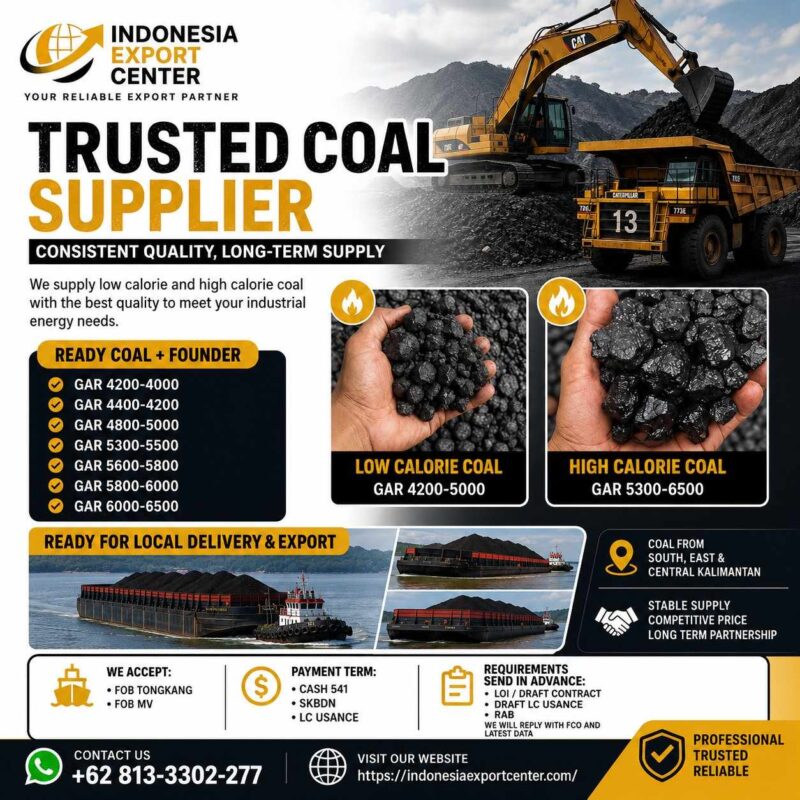
Indonesia Export Center (IEC) facilitates sourcing inquiries between qualified industrial buyers and potential Indonesian coal suppliers.
IEC does not guarantee kiln compatibility, finished-product quality, or coal availability.
Coal Applications in Brick Manufacturing
Coal may be evaluated as a fuel for certain permitted brick and ceramics production systems.
The actual fuel requirements depend on kiln design, heating method, temperature profile, and production process.
Understanding Kiln Fuel Requirements
Brick and ceramics production can involve carefully controlled heating and cooling stages.
The buyer’s technical team should determine whether the proposed coal supports the required firing conditions.
A particular calorific-value category should not be selected without evaluating the complete fuel specification.
Important Coal Quality Parameters
| Parameter | Buyer Requirement |
|---|---|
| Coal Type | Industrial Thermal Coal |
| GAR / NAR | Required value |
| Total Moisture | Maximum |
| Ash | Maximum |
| Ash Composition | If required |
| Total Sulfur | Maximum |
| Volatile Matter | Range |
| Particle Size | Required distribution |
| Ash Fusion | If applicable |
| Quantity | MT |
| Kiln Technology | Identified |
Calorific Value and Heating Requirements
Calorific value affects the fuel’s energy content.
However, the ability to maintain an appropriate kiln temperature profile depends on the combustion system, fuel preparation, airflow, and operating controls.
A higher GAR does not automatically guarantee better firing results.
Ash and Product Contamination
Ash content may influence residue handling and, depending on the kiln process, potential interactions with the product or equipment.
Where relevant, buyers should assess ash composition and the possibility of contamination.
Particle Size and Fuel Feeding
Particle-size requirements depend on the fuel-feeding and combustion system.
The buyer should define the acceptable distribution and permitted proportion of fines.
Moisture and Fuel Handling
Moisture affects as-received heating value and can influence fuel handling.
The maximum moisture limit should be determined by the facility’s technical requirements.
Sulfur and Emissions
Sulfur content is relevant to emissions and may be important to certain manufacturing processes.
The buyer should verify applicable environmental obligations and plant-specific fuel limits.
Coal Blending
Some buyers may evaluate blending different coal sources to achieve required fuel characteristics.
Any proposed blend should be tested and assessed by qualified technical personnel.
IEC does not guarantee the performance of a particular blend.
Supplier Verification
Before purchasing, verify:
- Supplier legal identity.
- Legitimate coal source.
- Authority to sell.
- Export eligibility.
- Relevant COA.
- Cargo availability.
- Loading capability.
- Commercial terms.
Quality Inspection
A contract should define sampling procedures, laboratory methods, acceptance criteria, and dispute-resolution arrangements.
Logistics and Delivered Cost
The buyer should evaluate coal price, freight, insurance, import charges, handling, inland transport, and any fuel preparation costs.
Small industrial buyers should also establish whether the required order quantity is commercially feasible for the proposed supplier and shipping arrangement.
Brick Kiln Coal RFQ Template
Subject: Indonesian Industrial Coal for Brick Kiln – RFQ
Dear IEC Team,
We are evaluating Indonesian industrial coal suppliers for a brick or ceramics manufacturing facility.
Company: [Name] Country: [Country] Product: [Brick / Ceramic Product] Kiln Technology: [Type] Fuel-Feeding System: [Description] Required GAR / NAR: [Value] Total Moisture Maximum: [Value] Ash Maximum: [Value] Sulfur Maximum: [Value] Particle Size: [Requirement] Ash Chemistry: [If Required] Trial Quantity: [MT] Monthly Quantity: [MT] Destination Port: [Port] Preferred Incoterm: [Term] Inspection Requirements: [Details]
Please advise whether potential suppliers can provide relevant quality documentation, confirmed availability, and a preliminary commercial offer.
Best regards,
[Name]
Frequently Asked Questions
Can Indonesian coal be used in brick kilns?
Potentially, where the kiln is designed and authorized for the proposed fuel.
Is GAR the only important parameter?
No.
Why does ash matter for brick production?
Ash may affect residue handling and, in some processes, product or equipment interactions.
Can IEC guarantee finished-brick quality?
No.
Can buyers request a trial quantity?
Yes, subject to supplier minimum-order requirements and logistics.
Does IEC guarantee a specific coal grade?
No. Availability and quality must be verified.
Request Coal Sourcing for Brick and Ceramics Manufacturing
REQUEST BRICK KILN COAL SOURCING
INDONESIA EXPORT CENTER
Website: https://indonesiaexportcenter.com/
WhatsApp: +62 813-3302-277
Related Resources
