

IEC | INDONESIA EXPORT CENTER
A PRACTICAL QUALITY CONTROL GUIDE FOR INTERNATIONAL CLOVE BUYERS
Moisture | Volatile Oil | Foreign Matter | Sampling | Inspection | Contract Tolerances
Understanding Clove Quality Specifications
For international spice buyers, clearly defined clove quality specifications are essential for purchasing, supplier qualification, laboratory testing, and shipment acceptance.
Dried cloves may vary in moisture, aroma, whole-bud integrity, foreign matter, and other characteristics depending on harvesting, drying, processing, and storage.
A commercial description such as Premium, Lalpari, or Export Quality does not provide enough information for a complete purchasing contract.
IEC | Indonesia Export Center facilitates sourcing enquiries for Indonesian cloves and encourages buyers to establish measurable technical requirements before placing an order.
DISCUSS YOUR CLOVE QUALITY REQUIREMENTS
Why Clove Specifications Matter
Technical specifications help buyers:
- Compare supplier offers.
- Determine suitability for processing.
- Establish inspection criteria.
- Identify unacceptable contamination.
- Control storage risks.
- Reduce disputes over grading.
- Verify destination-market compliance.
- Maintain consistency between shipments.
A good specification defines both the target quality and the method used to measure it.
Indonesian Clove Reference Specifications
| Parameter | Reference or Contract Requirement |
|---|---|
| Product | Dried Cloves |
| Botanical Name | Syzygium aromaticum |
| Origin | Indonesia |
| Form | Whole Buds or Agreed Format |
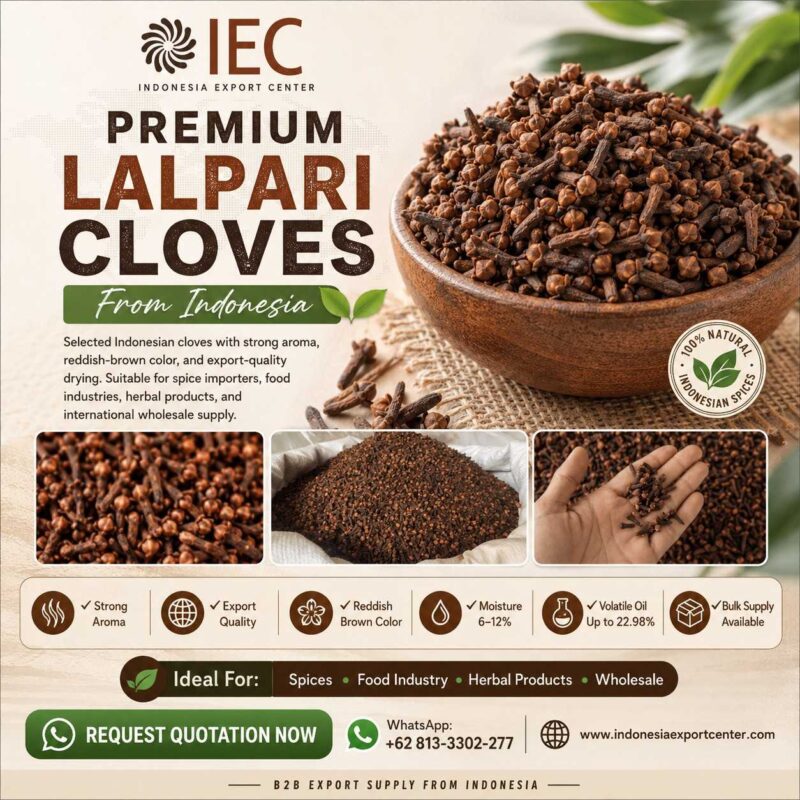
| Promotional Grade | Premium Lalpari |
| Appearance | Reddish-brown |
| Aroma | Strong, characteristic |
| Moisture | 6–12% promotional reference |
| Volatile Oil | Up to 22.98% promotional reference |
| Whole-Bud Percentage | Buyer-defined |
| Broken Buds | Buyer-defined |
| Loose Stems | Buyer-defined |
| Foreign Matter | Buyer-defined |
| Insect Damage | Buyer-defined |
| Microbiology | Applicable buyer and market requirements |
| Pesticide Residues | Applicable destination limits |
| Other Contaminants | Applicable destination limits |
The moisture range and volatile-oil figure are promotional references only. They are not universally applicable clove standards or guarantees.
Moisture Content
Moisture is important because it affects product stability, storage behavior, and commercial acceptance.
Buyers should specify a maximum acceptable moisture content and the test method.
A representative sample should be taken from the proposed lot.
Results should identify the method, sample, laboratory, and reporting basis where relevant.
Volatile Oil Content
Volatile oil contributes to the characteristic aroma of cloves.
However, the presence of volatile oil does not independently establish food safety or overall quality.
The IEC promotional material mentions volatile oil of up to 22.98%. This is not a guaranteed minimum or a substitute for a lot-specific test.
Buyers should define whether volatile-oil testing is required and agree on the analytical method.
Whole-Bud Integrity and Broken Material
The contract should distinguish:
- Intact whole buds.
- Broken buds.
- Loose stems.
- Dust or fines.
- Other foreign material.
The percentage of each category should be measured using an agreed procedure.
Foreign Matter
Foreign matter may include material not belonging to the agreed product grade.
Buyers should define the permitted limit and the method used for physical separation and measurement.
Food safety requirements may prohibit certain contaminants regardless of any general commercial tolerance.
Insect Damage and Mold
Inspection should consider insect activity, damaged material, visible mold, and abnormal odors.
A shipment should not be accepted merely because its average moisture is within the agreed range.
Where contamination is suspected, further investigation and appropriate testing may be necessary.
Microbiological and Chemical Quality
Depending on the intended use and destination, buyers may require testing for relevant foodborne pathogens, pesticide residues, mycotoxins, heavy metals, or other contaminants.
The testing scope should reflect applicable regulations and the buyer’s hazard assessment.
Sampling and Laboratory Methods
Sampling should be representative of the commercial lot.
A practical protocol should define:
- Lot identification
- Number of sampling points
- Sampling equipment
- Sample quantity
- Composite sample preparation
- Sample sealing
- Chain of custody
- Retained sample procedure
- Laboratory selection
- Test methods
- Reporting requirements
Internationally recognized sampling and testing standards may be selected where appropriate.
Buyer Contract Tolerances
A purchasing contract should specify:
| Contract Item | What to Define |
|---|---|
| Product Identity | Botanical species and form |
| Grade | Physical characteristics |
| Moisture | Maximum and test method |
| Volatile Oil | Minimum or range if required |
| Whole-Bud Percentage | Minimum |
| Broken Material | Maximum |
| Foreign Matter | Maximum |
| Food Safety | Applicable limits |
| Sampling | Agreed protocol |
| Inspection | Party, timing, and scope |
| Acceptance | Pass/fail criteria |
| Disputes | Retesting and resolution process |
A specification without an acceptance procedure can leave both buyer and seller exposed to uncertainty.
Packaging, Terms, and Shipping
Packaging should preserve product condition and support lot identification.
FOB, CFR, or CIF quotations may be discussed, with inspection timing and document requirements defined in the contract.
Request a Clove Specification Review
Subject: Indonesian Clove Technical Specification RFQ
Company: [Name]
Product Form: [Whole / Broken / Other]
Quantity: [MT]
Moisture Limit: [%]
Volatile Oil Requirement: [%]
Whole-Bud Percentage: [%]
Foreign Matter Limit: [%]
Microbiological Requirements: [Specify]
Chemical Testing Requirements: [Specify]
Sampling Standard: [Specify]
Packaging: [Specify]
Destination Country: [Country]
Please advise whether potential suppliers can meet the specification and provide relevant samples and laboratory documentation.
Frequently Asked Questions
What moisture content should importers request?
The target should be established based on product use, destination requirements, and the buyer’s storage and quality programme.
Is 22.98% volatile oil guaranteed?
No. It is a promotional reference, and actual results require verification.
Is Lalpari an internationally standardized grade?
The grade definition should be verified with the supplier rather than assumed to be universal.
Can a COA be requested?
Yes, subject to supplier and laboratory arrangements.
Are samples necessary?
Representative samples can support quality approval, although sampling alone does not replace appropriate shipment inspection.
What documents are required?
Technical specifications, relevant laboratory reports, commercial documents, and destination-specific certificates may be needed.
Discuss Your Clove Quality Requirements
IEC | INDONESIA EXPORT CENTER
TECHNICAL SOURCING SUPPORT FOR INTERNATIONAL SPICE BUYERS
REQUEST CLOVE QUALITY DOCUMENTATION
WhatsApp: +62 813-3302-277
Website: https://indonesiaexportcenter.com/
Connecting Indonesian Products to the World.
All commercial specifications must be agreed and verified for the actual lot and destination market.
