

INDONESIA EXPORT CENTER
Indonesian Cinnamon Bark | Botanical Extracts | Spice Ingredient Procurement
Cinnamon Bark Oleoresin for International Industrial Buyers
Cinnamon bark is an established botanical raw material used in spice and flavor applications. Extracting selected constituents from cinnamon bark can produce a concentrated ingredient commonly described as cinnamon bark oleoresin.
For international buyers searching for cinnamon bark oleoresin extract from Indonesia, it is essential to distinguish the raw botanical material from the finished extract and verify the actual manufacturing process.
Indonesia Export Center (IEC) facilitates sourcing inquiries with potential Indonesian suppliers and processors.
Product availability, botanical identity, extraction method, and commercial terms require confirmation from the actual seller.
REQUEST CINNAMON BARK OLEORESIN INFORMATION
What Is Cinnamon Bark Oleoresin?
Cinnamon bark oleoresin is a concentrated preparation derived from cinnamon bark through an extraction process.
Unlike ground cinnamon bark, oleoresin is a processed material whose composition depends on extraction conditions and any subsequent formulation.
It is also distinct from cinnamon essential oil, which is generally produced through a different process and may have a different chemical profile.
Cinnamon Bark as an Indonesian Botanical Raw Material
Indonesia is an important origin for cinnamon, including Cinnamomum burmannii.
However, buyers should verify the species and origin of the raw material used in any offered oleoresin.
The country of raw material origin may differ from the country of extraction or final packaging.
Botanical Identity and Plant Part
| Requirement | Buyer Verification |
|---|---|
| Scientific Name | Confirm exact species |
| Plant Part | Confirm bark |
| Raw Material Origin | Confirm country and traceability |
| Processing Location | Identify extraction facility |
| Extraction Method | Request process information |
| Batch Identification | Confirm traceability |
A bark-specific purchasing requirement should not be fulfilled with an extract made from another plant part without buyer approval.
Preliminary Product Specification
| Parameter | Proposed Reference |
|---|---|
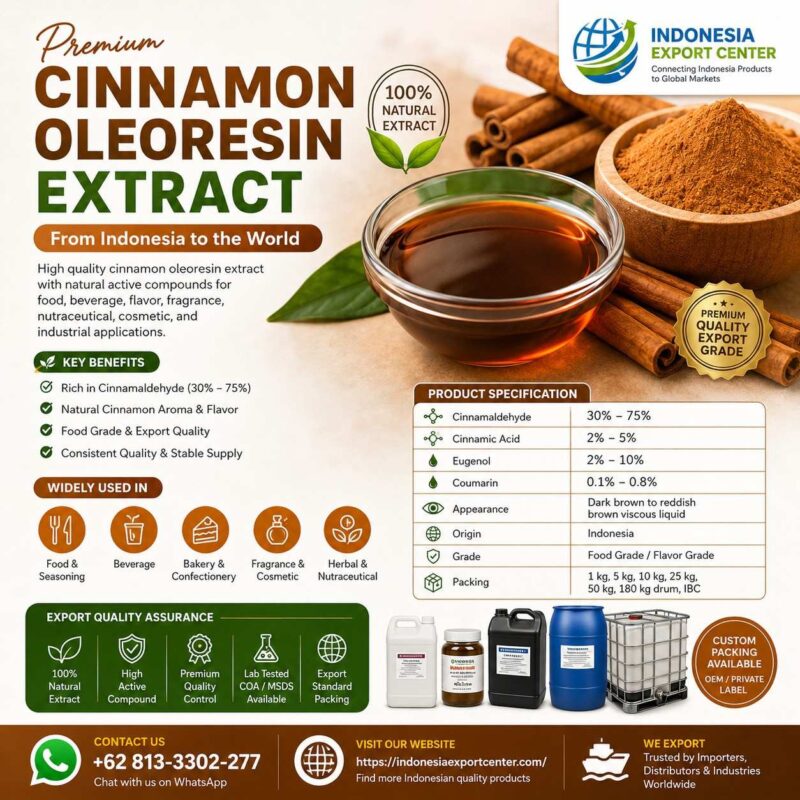
| Product | Cinnamon Bark Oleoresin Extract |
| Botanical Species | To be confirmed |
| Plant Part | Bark; supplier verification required |
| Proposed Origin | Indonesia |
| Appearance | Dark brown to reddish-brown viscous liquid |
| Cinnamaldehyde | 30–75%, unverified |
| Cinnamic Acid | 2–5%, unverified |
| Eugenol | 2–10%, unverified |
| Coumarin | 0.1–0.8%, unverified |
| Extraction Solvent | To be confirmed |
| Solubility | To be confirmed |
| Food/Flavor Suitability | Not established |
| Shelf Life | To be confirmed |
Understanding the Extraction Process
A manufacturer may use a suitable extraction process to recover selected constituents from cinnamon bark.
The resulting composition depends on the solvent, extraction conditions, raw material quality, and post-extraction processing.
Buyers should request sufficient manufacturing information to assess the product’s suitability.
Chemical Composition and Flavor Profile
Cinnamaldehyde is an important cinnamon-related aromatic compound.
Other constituents may also influence the product’s flavor and technical characteristics.
The chemical profile should be established using appropriate analytical testing rather than inferred from the product name.
Coumarin Considerations
Coumarin content can be relevant to food applications involving cassia-type cinnamon.
Buyers should request actual test results and assess their intended use under applicable regulations.
Potential Industrial Applications
Cinnamon bark oleoresin may be evaluated for:
- Bakery flavor systems.
- Confectionery manufacturing.
- Spice and seasoning formulations.
- Beverage flavor development.
- Flavor compounding.
- Selected fragrance applications.
Suitability depends on the finished extract and application-specific requirements.
Required Quality Documentation
Relevant documents may include botanical declaration, TDS, batch COA, extraction information, composition statement, residual solvent analysis, and risk-based contaminant testing.
Packaging and Bulk Supply
The initial product brief proposes 1 kg, 5 kg, 10 kg, 25 kg, 50 kg, 180 kg drums, and IBCs.
The supplier must confirm actual packaging options, MOQ, manufacturing capacity, and lead time.
Sample Evaluation
Buyers should evaluate the actual extract for sensory characteristics, chemical composition, solubility, and formulation compatibility.
Where possible, samples should be linked to a specific batch.
Frequently Asked Questions
Is cinnamon bark oleoresin the same as cinnamon bark powder?
No. Oleoresin is an extracted ingredient, while bark powder is milled botanical material.
Is cinnamon bark oleoresin the same as essential oil?
No. They are different types of preparations.
Is the botanical species always Cinnamomum burmannii?
No. The actual species must be confirmed.
Can IEC arrange bark-specific sourcing inquiries?
Yes. IEC can communicate the buyer’s requirements to potential suppliers.
Is food-grade status guaranteed?
No. The actual product requires technical and regulatory qualification.
Can buyers request bulk quotations?
Yes. IEC can facilitate seller-approved RFQs.
Request Cinnamon Bark Oleoresin from Indonesia
IEC welcomes inquiries from spice extract importers, flavor manufacturers, ingredient distributors, and food processors.
REQUEST BOTANICAL IDENTITY, TDS, COA, SAMPLE AND QUOTATION
INDONESIA EXPORT CENTER
Website: https://indonesiaexportcenter.com/
WhatsApp: +62 813-3302-277
Related Pages
- Cinnamomum burmannii Oleoresin
- Cassia Oleoresin Supplier Indonesia
- Cinnamon Oleoresin Supplier Indonesia
