

IEC | INDONESIA EXPORT CENTER
CONNECTING INDONESIAN PRODUCTS TO THE WORLD
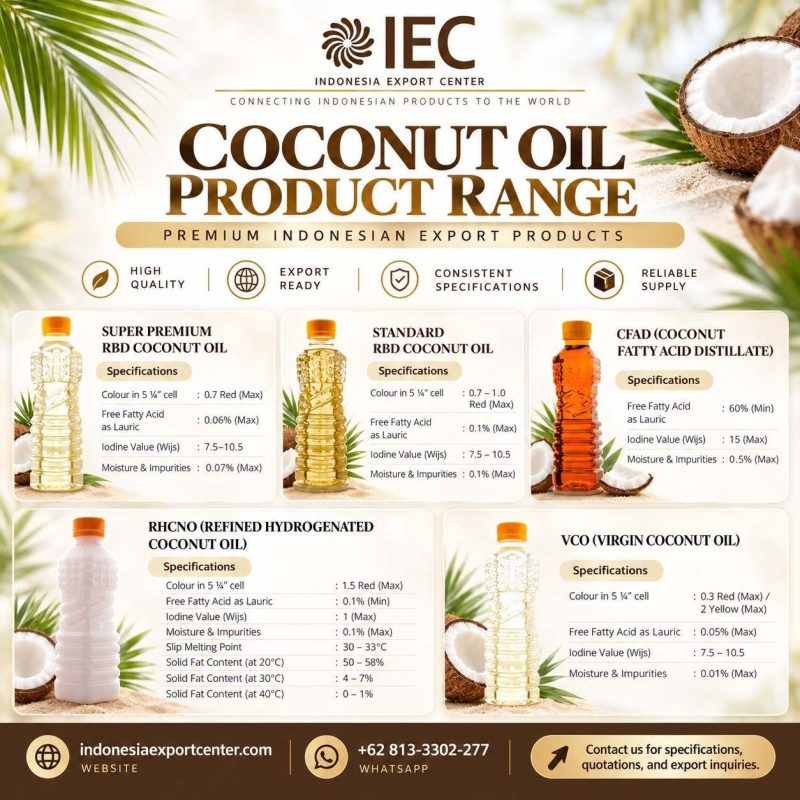
COCONUT OIL PRODUCT RANGE | PREMIUM INDONESIAN EXPORT PRODUCTS
Understanding the Differences Between CFAD and PFAD
When comparing CFAD vs PFAD, industrial buyers should understand that Coconut Fatty Acid Distillate and Palm Fatty Acid Distillate are different raw materials derived from different vegetable oil sources.
Both materials may contain significant amounts of free fatty acids and may be evaluated as feedstocks for suitable industrial processes.
However, their fatty acid composition, processing characteristics, and potential applications can differ substantially.
CFAD is associated with coconut oil refining, while PFAD is associated with palm oil refining.
For oleochemical manufacturers, soap producers, fatty acid processors, and industrial procurement teams, selecting between these materials requires careful evaluation of feedstock identity, fatty acid distribution, quality specifications, process compatibility, and commercial requirements.
IEC | Indonesia Export Center facilitates sourcing and export enquiries for Indonesian coconut-derived industrial raw materials, including potential Coconut Fatty Acid Distillate supply.
Request CFAD technical specifications and a bulk sourcing quotation.
WhatsApp: +62 813-3302-277
Website: https://indonesiaexportcenter.com/
Actual manufacturer, COA, available quantity, MOQ, packaging, certifications, and shipment feasibility must be verified before purchase.
CFAD vs PFAD: Quick Comparison
| Comparison Factor | CFAD | PFAD |
|---|---|---|
| Full Name | Coconut Fatty Acid Distillate | Palm Fatty Acid Distillate |
| Primary Feedstock | Coconut Oil | Palm Oil |
| Material Category | Fatty-Acid-Rich Refining Distillate | Fatty-Acid-Rich Refining Distillate |
| General Fatty Acid Character | Commonly associated with medium-chain and lauric-rich coconut-derived fatty acids | Commonly associated with palmitic- and oleic-rich palm-derived fatty acids |
| Typical Fatty Acid Families | C8, C10, C12, C14 and other fatty acids | C16, C18 and other fatty acids |
| Free Fatty Acid Content | Depends on supplier and lot | Depends on supplier and lot |
| Iodine Value | Depends on specification and lot | Depends on specification and lot |
| Moisture and Impurities | Depends on specification and lot | Depends on specification and lot |
| Unsaponifiable Matter | Requires testing | Requires testing |
| Industrial Suitability | Application-specific | Application-specific |
| Processing Yield | Must be verified | Must be verified |
| Lot-Specific COA | Required for procurement verification | Required for procurement verification |
This table provides a general technical comparison. Actual composition and performance must be established using supplier-specific analytical results.
What Is Coconut Fatty Acid Distillate (CFAD)?
Coconut Fatty Acid Distillate is a fatty-acid-rich material associated with coconut oil refining.
Depending on the actual manufacturing process, CFAD may contain:
- Free fatty acids
- Residual neutral oil or glycerides
- Unsaponifiable constituents
- Moisture
- Other minor components
CFAD is not the same product as refined coconut oil.
It should be evaluated according to its actual composition and industrial specifications.
CFAD Reference Technical Specifications
The supplied IEC reference specifications are:
| Technical Parameter | Reference Specification |
|---|---|
| Free Fatty Acid as Lauric | 60% (Min) |
| Iodine Value (Wijs) | 15 (Max) |
| Moisture & Impurities | 0.5% (Max) |
These figures are reference specification limits, not actual laboratory results from a verified production lot.
No specific CFAD fatty acid distribution, acid value, saponification value, or unsaponifiable matter result has been supplied.
What Is Palm Fatty Acid Distillate (PFAD)?
Palm Fatty Acid Distillate is a fatty-acid-rich material associated with palm oil refining.
Its composition depends on the source material, refining conditions, and production lot.
PFAD may contain free fatty acids, residual glycerides, unsaponifiable constituents, and other components.
PFAD is commonly evaluated as a potential industrial feedstock, but its suitability depends on the actual material and intended application.
Important PFAD Quality Parameters
Buyers may request:
- Free fatty acid content
- Acid value
- Saponification value
- Iodine value
- Moisture and impurities
- Fatty acid composition
- Unsaponifiable matter
- Other process-specific characteristics
No verified PFAD specification or lot-specific COA has been supplied for this comparison.
CFAD vs PFAD Fatty Acid Composition
One of the most important differences between CFAD and PFAD is their fatty acid distribution.
Coconut-derived materials are generally associated with a greater proportion of medium-chain saturated fatty acids, especially lauric acid.
Palm-derived materials are generally associated with larger proportions of palmitic and oleic acids.
However, actual distillate composition may differ from the original oil because of the refining and recovery process.
Fatty Acid Profile Comparison
| Fatty Acid | Carbon Chain | CFAD – General Character | PFAD – General Character |
|---|---|---|---|
| Caprylic Acid | C8:0 | Relevant to coconut-derived composition | Generally a minor consideration |
| Capric Acid | C10:0 | Relevant to coconut-derived composition | Generally a minor consideration |
| Lauric Acid | C12:0 | Important coconut-derived fatty acid | Generally a minor consideration |
| Myristic Acid | C14:0 | Relevant coconut-derived fatty acid | May be present |
| Palmitic Acid | C16:0 | May be present | Important palm-derived fatty acid |
| Stearic Acid | C18:0 | May be present | May be present |
| Oleic Acid | C18:1 | May be present | Important palm-derived fatty acid |
| Linoleic Acid | C18:2 | May be present | May be present |
This table describes general fatty acid characteristics, not actual GC test results or guaranteed concentrations.
Why Composition Matters
The actual fatty acid profile can influence:
- Feedstock suitability
- Processing conditions
- Separation requirements
- Product characteristics
- Recovery potential
- Downstream quality specifications
Buyers should request a lot-specific fatty acid composition report.
CFAD vs PFAD: Lauric Acid and Palmitic Acid
Lauric Acid in CFAD
Lauric acid is an important fatty acid associated with coconut-derived materials.
For processes targeting lauric-rich fractions, CFAD may be a relevant feedstock candidate.
However, the actual C12 concentration must be verified through laboratory analysis.
Palmitic Acid in PFAD
Palmitic acid is an important fatty acid associated with palm-derived materials.
For processes targeting palmitic-rich fractions, PFAD may be a relevant feedstock candidate.
The actual C16 concentration must also be verified.
Important Distinction
FFA as Lauric is not the same as actual lauric acid content.
For example, the supplied CFAD reference specification of 60% minimum FFA as Lauric does not establish that the material contains 60% lauric acid.
CFAD vs PFAD: Free Fatty Acid Content
Both CFAD and PFAD may contain substantial free fatty acid fractions.
However, FFA values should be compared using consistent analytical methods and reporting bases.
CFAD Reference
FFA as Lauric: 60% Minimum
PFAD Reference
No verified PFAD FFA specification has been supplied.
Why Reporting Basis Matters
FFA may be expressed using different fatty acid equivalents.
Comparing values expressed on different bases without conversion can lead to incorrect conclusions.
For technical comparison, buyers should request:
- Actual FFA result
- Reporting basis
- Analytical method
- Acid value, where available
- Lot identification
CFAD vs PFAD: Iodine Value
Iodine value provides information about the degree of unsaturation.
CFAD Reference
Iodine Value (Wijs): 15 Maximum
PFAD Reference
No verified PFAD iodine value specification has been supplied.
Because CFAD and PFAD have different fatty acid distributions, their iodine values may differ.
However, actual iodine values must be measured for each lot.
CFAD vs PFAD: Moisture and Impurities
Moisture and impurities can affect industrial handling, storage, and processing.
CFAD Reference
Moisture & Impurities: 0.5% Maximum
PFAD Reference
No verified PFAD moisture and impurities specification has been supplied.
Why This Matters
Depending on the process, excessive moisture or impurities may affect:
- Feedstock handling
- Processing efficiency
- Storage conditions
- Product quality
- Equipment maintenance
Buyers should compare actual laboratory results rather than relying only on generic product descriptions.
CFAD vs PFAD: Acid Value and Saponification Value
Acid value and saponification value are important parameters for fatty-acid-rich industrial materials.
Acid Value
Acid value expresses the amount of potassium hydroxide required to neutralize free fatty acids in one gram of sample.
Unit: mg KOH/g
Saponification Value
Saponification value expresses the amount of potassium hydroxide required to neutralize free fatty acids and saponify esterified fatty acids in one gram of sample.
Unit: mg KOH/g
Why These Parameters Matter
They can support:
- Feedstock characterization
- Soap manufacturing calculations
- Process evaluation
- Raw material comparisons
No verified acid value or saponification value has been supplied for either material.
CFAD vs PFAD: Unsaponifiable Matter
Unsaponifiable matter refers to constituents that do not form soap under the conditions of a specified saponification test.
Depending on the application, these constituents may influence:
- Feedstock purity
- Downstream separation
- Product recovery
- Residual stream characteristics
- Processing economics
Both CFAD and PFAD should be evaluated using suitable analytical methods.
No verified unsaponifiable matter percentage has been supplied for either product.
CFAD vs PFAD for Soap Manufacturing
Both materials may be evaluated for suitable soap manufacturing applications.
However, they are not automatically interchangeable.
CFAD Considerations
Coconut-derived fatty acid composition may be relevant to soap formulations requiring particular fatty acid characteristics.
PFAD Considerations
Palm-derived fatty acid composition may be relevant to different soap formulation requirements.
Key Evaluation Parameters
- Fatty acid composition
- FFA
- Acid value
- Saponification value
- Unsaponifiable matter
- Moisture and impurities
- Colour and appearance, where required
- Final product performance
Manufacturers should conduct formulation and process trials where necessary.
No specific soap yield, hardness, cleansing performance, or alkali consumption has been verified for the compared materials.
CFAD vs PFAD for Fatty Acid Processing
For fatty acid processing plants, feedstock selection may depend on the target fatty acid fractions.
When CFAD May Be Relevant
CFAD may be evaluated for processes targeting coconut-derived fatty acid fractions, subject to verified composition.
When PFAD May Be Relevant
PFAD may be evaluated for processes targeting palm-derived fatty acid fractions, subject to verified composition.
Recovery and Purity Considerations
Buyers should evaluate:
- Target fatty acid concentration
- Feedstock purity
- Residual neutral oil
- Unsaponifiable matter
- Separation efficiency
- Product recovery
- Energy requirements
- Process losses
A higher FFA value does not automatically guarantee better recovery or lower processing cost.
CFAD vs PFAD: Are They Interchangeable?
Not necessarily.
Although both materials are fatty-acid-rich refining distillates, their composition and processing behavior can differ.
Before Substitution
Industrial buyers should:
- Compare actual fatty acid profiles.
- Review FFA and acid value.
- Review iodine value.
- Compare moisture and impurities.
- Evaluate unsaponifiable matter.
- Check equipment compatibility.
- Conduct laboratory or pilot trials.
- Confirm final product specifications.
CFAD should not be substituted for PFAD, or vice versa, without technical qualification.
CFAD vs PFAD: Procurement and Commercial Considerations
Industrial procurement teams should compare more than the nominal price per metric ton.
Key Commercial Factors
- Product identity
- Actual manufacturer
- Technical specifications
- Lot-specific COA
- Fatty acid composition
- Processing suitability
- MOQ
- Available quantity
- Packaging
- Price per MT
- Shipping arrangements
- Payment terms
- Total landed cost
- Supply consistency
Cost per Usable Feedstock
A lower-priced material may not provide a lower cost per unit of usable target component.
Buyers should consider the actual process performance.
Estimated Cost per MT of Recovered Target Product = Total Relevant Feedstock and Processing Cost ÷ Recovered Target Product Quantity
This calculation requires actual operational data.
CFAD vs PFAD: Technical Comparison Checklist
| Evaluation Parameter | CFAD | PFAD |
|---|---|---|
| Feedstock Origin | Coconut Oil | Palm Oil |
| Manufacturer Identity | Verify | Verify |
| FFA | Verify COA | Verify COA |
| Acid Value | Request Test Result | Request Test Result |
| Saponification Value | Request Test Result | Request Test Result |
| Iodine Value | Verify COA | Verify COA |
| Moisture and Impurities | Verify COA | Verify COA |
| Unsaponifiable Matter | Request Test Result | Request Test Result |
| Fatty Acid Composition | Request GC Analysis | Request GC Analysis |
| Processing Suitability | Trial if Required | Trial if Required |
| MOQ | Confirm | Confirm |
| Packaging | Confirm | Confirm |
| Price per MT | Request Quotation | Request Quotation |
| Shipment Terms | Confirm | Confirm |
Sourcing CFAD from Indonesia
IEC welcomes enquiries from international buyers seeking potential Indonesian Coconut Fatty Acid Distillate supply.
CFAD Sourcing Information
| Item | Status |
|---|---|
| Product | Coconut Fatty Acid Distillate |
| Proposed Sourcing Country | Indonesia |
| Reference FFA as Lauric | 60% (Min) |
| Reference Iodine Value | 15 (Max) |
| Reference Moisture & Impurities | 0.5% (Max) |
| Manufacturer | To Be Verified |
| Lot-Specific COA | To Be Requested and Verified |
| Fatty Acid Composition | To Be Verified |
| Safety Data Sheet | To Be Requested and Verified |
| Certifications | To Be Verified |
| MOQ | To Be Confirmed |
| Available Quantity | To Be Confirmed |
| Packaging | To Be Confirmed |
| Price per MT | Request Quotation |
| Shipment Lead Time | To Be Confirmed |
IEC does not claim verified PFAD supply availability through this page.
Request for Quotation – CFAD for Industrial Procurement
Subject: RFQ – Coconut Fatty Acid Distillate Technical Specifications and Bulk Quotation
Dear IEC | Indonesia Export Center Team,
We are evaluating Coconut Fatty Acid Distillate as a potential industrial feedstock and would like to request technical and commercial information.
Please advise whether a suitable Indonesian manufacturer can provide CFAD meeting our requirements.
BUYER INFORMATION
Company Name: [Company Name] Country: [Country] Business Type: [Oleochemical Manufacturer / Soap Manufacturer / Fatty Acid Processor / Industrial Trader] Contact Person: [Name] Email: [Email] WhatsApp: [Number]
PRODUCT REQUIREMENTS
Product: Coconut Fatty Acid Distillate (CFAD)
Intended Application: [Specify]
Required Quantity: [MT]
Order Frequency: [Trial / One-Time / Monthly / Other]
REFERENCE SPECIFICATIONS
| Parameter | Required Value |
|---|---|
| Free Fatty Acid as Lauric | 60% (Min) |
| Iodine Value (Wijs) | 15 (Max) |
| Moisture & Impurities | 0.5% (Max) |
| Fatty Acid Composition | [Specify / Request GC Analysis] |
| Acid Value | [Specify if required] |
| Saponification Value | [Specify if required] |
| Unsaponifiable Matter | [Specify if required] |
| Other Parameters | [Specify] |
DOCUMENTATION REQUESTED
Please provide, where available:
- Manufacturer legal name and facility location
- Current technical specification
- Lot-specific COA
- Safety Data Sheet
- Fatty acid composition report
- Acid value and saponification value
- Unsaponifiable matter result
- Packaging specifications
- Sample availability
COMMERCIAL REQUIREMENTS
Preferred Packaging: [Specify] Required Quantity: [MT] Destination Country: [Country] Destination Port: [Port] Requested Incoterm: [FCA / FOB / CFR / CIF / CIP / Other] Target Shipment Period: [Month / Year]
Please advise:
- Minimum order quantity
- Available quantity
- Price per MT
- Currency
- Packaging options
- Indonesian origin port
- Production lead time
- Estimated shipment lead time
- Payment terms
- Quotation validity
- Recurring supply capability
We will evaluate the material’s composition and process suitability before commercial approval.
Thank you. We look forward to your response.
Kind regards,
[Your Name] [Company Name] [Country]SEND YOUR CFAD ENQUIRY VIA WHATSAPP
Frequently Asked Questions – CFAD vs PFAD
1. What is the main difference between CFAD and PFAD?
CFAD is derived from coconut oil refining, while PFAD is derived from palm oil refining.
2. Is CFAD the same as PFAD?
No. They are different refining distillates with potentially different fatty acid compositions and industrial properties.
3. Is CFAD richer in lauric acid than PFAD?
Coconut-derived materials are generally associated with higher lauric acid content, but actual CFAD and PFAD concentrations must be verified by analysis.
4. Is PFAD richer in palmitic acid?
Palm-derived materials are generally associated with higher palmitic acid content, but actual PFAD composition must be verified.
5. What is the supplied CFAD FFA specification?
60% minimum, expressed as Lauric.
6. Does 60% FFA as Lauric mean 60% lauric acid?
No. FFA as Lauric is a reporting basis, not a direct measurement of lauric acid composition.
7. What is the supplied CFAD iodine value specification?
15 maximum, using the Wijs method.
8. What is the supplied CFAD moisture and impurities limit?
0.5% maximum.
9. Can CFAD and PFAD be used for soap manufacturing?
Both may be evaluated for suitable soap manufacturing processes, subject to formulation and technical verification.
10. Can CFAD replace PFAD?
Not automatically. Substitution requires evaluation of composition, processing compatibility, and final product requirements.
11. Which material is better for fatty acid processing?
The answer depends on the target fatty acids, actual feedstock composition, processing technology, and required product specifications.
12. Is CFAD always more expensive than PFAD?
No general price relationship should be assumed. Actual quotations and total processing costs must be compared.
13. Can buyers request a CFAD COA?
Yes. Actual availability must be confirmed.
14. Can buyers request a fatty acid composition report?
Yes. Availability must be confirmed with the supplier.
15. Does IEC have verified CFAD stock or PFAD supply availability?
No specific CFAD stock or PFAD supply availability has been independently verified for this page.
Request CFAD Technical Specifications and Bulk Quotation
Understanding CFAD vs PFAD is essential for industrial procurement teams comparing coconut-derived and palm-derived fatty acid feedstocks.
The most important differences involve raw material origin, fatty acid composition, processing compatibility, and target product requirements.
For industrial buyers, the best feedstock choice should be based on verified laboratory results, process trials, and total commercial cost rather than product name alone.
IEC | Indonesia Export Center welcomes international enquiries for potential Indonesian Coconut Fatty Acid Distillate sourcing and export quotations.
IEC | INDONESIA EXPORT CENTER
CONNECTING INDONESIAN PRODUCTS TO THE WORLD
Product: Coconut Fatty Acid Distillate (CFAD)
Product Category: Coconut-Oil-Derived Industrial Raw Material
Proposed Sourcing Country: Indonesia
Target Market: Global
Target Buyers: Industrial Procurement Teams, Oleochemical Manufacturers, Soap Manufacturers, Fatty Acid Processors, and Commodity Traders
Reference FFA as Lauric: 60% (Min)
Reference Iodine Value: 15 (Max)
Reference Moisture & Impurities: 0.5% (Max)
Fatty Acid Composition: To Be Verified
Manufacturer: To Be Verified
Lot-Specific COA: To Be Requested and Verified
Safety Data Sheet: To Be Requested and Verified
Certifications: To Be Verified
MOQ: To Be Confirmed
Available Quantity: To Be Confirmed
Packaging: To Be Confirmed
Price per MT: Request Quotation
Shipment Lead Time: To Be Confirmed
Request CFAD Specifications and Export Quotation
Website: https://indonesiaexportcenter.com/
WhatsApp: +62 813-3302-277
REQUEST CFAD TECHNICAL SPECIFICATIONS AND BULK QUOTATION
Contact us for specifications, quotations, and export inquiries.
Technical and Commercial Disclaimer: This page provides general technical information comparing Coconut Fatty Acid Distillate and Palm Fatty Acid Distillate. The numerical CFAD values shown are supplied reference specifications, not actual lot-specific COA results. No verified PFAD specification, composition report, or supply offer has been provided. No specific CFAD manufacturer, certification, COA, SDS, stock, MOQ, packaging configuration, price, production capacity, or shipment lead time has been independently verified. Technical suitability, fatty acid composition, process performance, and destination-country requirements must be assessed for the actual materials and transactions. IEC facilitates sourcing and export enquiries; the actual manufacturer, contractual seller, and exporter of record must be confirmed for each order.
