

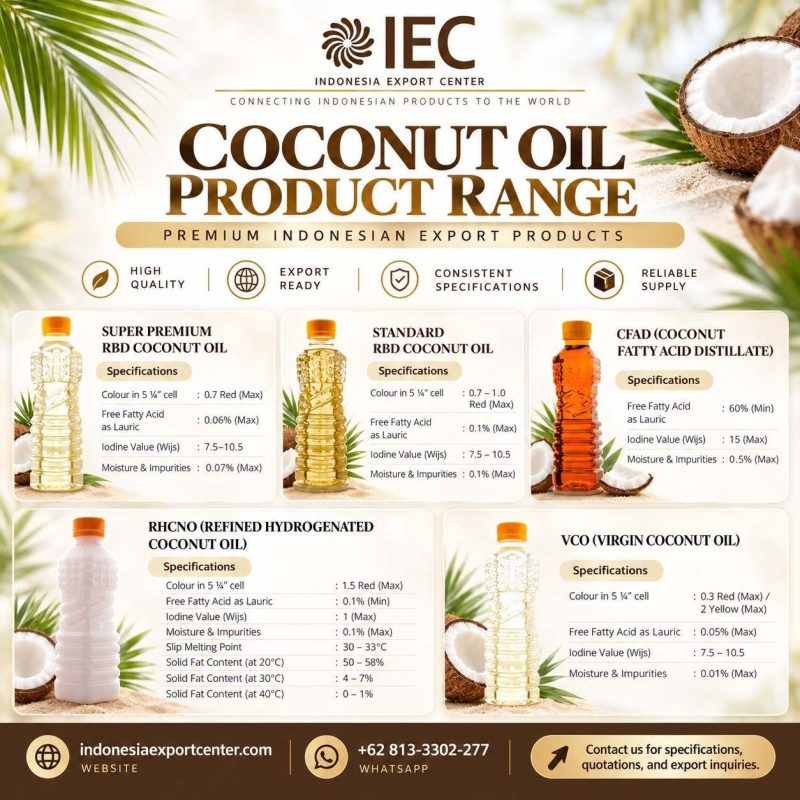
IEC | INDONESIA EXPORT CENTER
CONNECTING INDONESIAN PRODUCTS TO THE WORLD
COCONUT OIL PRODUCT RANGE | PREMIUM INDONESIAN EXPORT PRODUCTS
CFAD Technical Specification for Industrial Buyers and QA Teams
Looking for a reliable CFAD technical specification to evaluate Coconut Fatty Acid Distillate for industrial procurement?
Coconut Fatty Acid Distillate (CFAD) is a coconut-oil-derived material associated with refining and characterized by relatively high free fatty acid content.
For international purchasing managers, quality assurance teams, and oleochemical manufacturers, evaluating CFAD requires more than reviewing a general product description.
Buyers should understand the difference between reference specifications and actual laboratory results, identify appropriate analytical methods, and verify the suitability of each production lot.
IEC | Indonesia Export Center facilitates sourcing and export enquiries for Indonesian Coconut Fatty Acid Distillate, helping industrial buyers request technical documentation, product specifications, and commercial quotations.
This guide explains the key CFAD quality parameters, Certificate of Analysis requirements, and laboratory verification considerations.
Request CFAD technical specifications and supporting quality documentation.
WhatsApp: +62 813-3302-277
Website: https://indonesiaexportcenter.com/
Actual manufacturer, lot-specific COA, testing methods, stock, MOQ, packaging, and certification claims must be verified before purchase.
CFAD Reference Technical Specifications
The following values are supplied reference specifications for Coconut Fatty Acid Distillate.
| Technical Parameter | Reference Specification |
|---|---|
| Free Fatty Acid as Lauric | 60% (Min) |
| Iodine Value (Wijs) | 15 (Max) |
| Moisture & Impurities | 0.5% (Max) |
These figures are specification limits, not actual test results from a verified production lot.
A manufacturer-issued technical data sheet and lot-specific Certificate of Analysis should be requested before final supplier approval.
CFAD Product Information
| Item | Information |
|---|---|
| Product Name | Coconut Fatty Acid Distillate |
| Abbreviation | CFAD |
| Product Category | Coconut-Oil-Derived Industrial Raw Material |
| Proposed Sourcing Country | Indonesia |
| Target Market | Global |
| Primary Buyers | QA and Purchasing Teams |
| Other Buyers | Oleochemical Manufacturers, Chemical Processors, Industrial Distributors |
| Reference FFA as Lauric | 60% (Min) |
| Reference Iodine Value | 15 (Max) |
| Reference Moisture & Impurities | 0.5% (Max) |
| Unsaponifiable Matter | To Be Tested |
| Acid Value | To Be Tested |
| Saponification Value | To Be Tested |
| Fatty Acid Composition | To Be Verified |
| Manufacturer | To Be Verified |
| Lot-Specific COA | To Be Requested and Verified |
| Safety Data Sheet | To Be Requested and Verified |
| MOQ | To Be Confirmed |
| Available Quantity | To Be Confirmed |
| Packaging | To Be Confirmed |
| Price per MT | Request Quotation |
What Is a CFAD Technical Specification?
A CFAD technical specification defines the quality characteristics and acceptance limits required for Coconut Fatty Acid Distillate.
It may be used by:
- Quality assurance teams
- Quality control laboratories
- Purchasing managers
- Oleochemical processors
- Industrial chemical manufacturers
- Raw material distributors
A technical specification helps establish whether the material is suitable for a defined industrial application.
Technical Specification vs Certificate of Analysis
| Document | Purpose |
|---|---|
| Technical Specification | Defines agreed quality requirements and limits |
| Certificate of Analysis (COA) | Reports actual test results for a specific lot |
| Technical Data Sheet (TDS) | Provides broader product characteristics and handling information |
| Safety Data Sheet (SDS) | Provides relevant safety and handling information |
| Certification Document | Supports a specific certification claim |
These documents are not interchangeable.
A generic specification sheet should not be presented as a lot-specific COA.
Free Fatty Acid (FFA) Specification for CFAD
The supplied reference specification is:
Free Fatty Acid as Lauric: 60% Minimum
FFA is one of the principal quality parameters for Coconut Fatty Acid Distillate.
It expresses the free fatty acid content using lauric acid as the calculation basis.
Why FFA Matters
- Helps characterize the material
- Supports incoming raw material evaluation
- Provides information relevant to industrial processing
- Supports comparisons between production lots
- May assist in assessing process suitability
FFA as Lauric Is Not Lauric Acid Composition
FFA expressed as Lauric does not directly indicate the actual percentage of lauric acid in the material.
For example, a CFAD lot meeting 60% minimum FFA as Lauric does not automatically contain 60% lauric acid.
Buyers requiring a specific lauric acid percentage should request a separate fatty acid composition analysis.
Iodine Value (Wijs) Specification
The supplied reference specification is:
Iodine Value (Wijs): 15 Maximum
Iodine value is used to assess the degree of unsaturation in fats, oils, and fatty acid materials.
For CFAD, it can provide useful information about feedstock characteristics.
Why Iodine Value Matters
- Supports material characterization
- Helps assess unsaturation
- Supports batch comparisons
- May be relevant to downstream process requirements
However, iodine value alone does not identify individual fatty acid concentrations.
A fatty acid profile is required for that purpose.
Moisture and Impurities Specification
The supplied reference specification is:
Moisture & Impurities: 0.5% Maximum
Moisture and impurities can affect storage, handling, and industrial processing.
Why This Parameter Matters
- Supports raw material quality control
- Helps evaluate moisture-related processing concerns
- Supports handling and storage decisions
- May influence process efficiency
- Supports incoming lot acceptance
Buyers should confirm whether the reported value is a combined result or based on separate measurements.
The analytical method and actual lot results should be reviewed.
Unsaponifiable Matter in CFAD
Unsaponifiable matter is an important additional parameter for certain industrial applications.
It generally refers to constituents that do not form soap under the conditions of a specified saponification test.
Why Unsaponifiable Matter Matters
Depending on the process, unsaponifiable constituents may influence:
- Feedstock purity
- Downstream separation
- Product recovery
- Residual material characteristics
- Final product specifications
Is There a Verified Unsaponifiable Matter Limit?
No.
The supplied CFAD reference data does not include an unsaponifiable matter specification.
Buyers should define the required acceptance limit and request laboratory testing.
Unsaponifiable matter should not be assigned a numerical specification without supporting supplier or laboratory data.
Acid Value in CFAD Quality Control
Acid value expresses the amount of potassium hydroxide required to neutralize free fatty acids in one gram of sample.
Unit: mg KOH/g
It is relevant to the characterization of fatty-acid-rich materials.
Why Acid Value Is Useful
- Supports evaluation of free acid content
- Helps assess material consistency
- May support process calculations
- Provides information for raw material comparisons
No verified acid value has been supplied.
Buyers should request the actual result and analytical method.
Saponification Value in CFAD Testing
Saponification value expresses the amount of potassium hydroxide required to neutralize free fatty acids and saponify esterified fatty acids in one gram of sample.
Unit: mg KOH/g
It can help characterize the saponifiable fraction of the material.
Why Saponification Value Matters
- Supports raw material characterization
- May assist in process evaluation
- Helps assess total saponification-related alkali requirements
- Supports comparisons between different feedstocks
No verified saponification value has been supplied.
Fatty Acid Composition Testing
CFAD may contain a mixture of fatty acids.
Depending on the application, buyers may request a fatty acid profile that includes:
- Caprylic acid (C8:0)
- Capric acid (C10:0)
- Lauric acid (C12:0)
- Myristic acid (C14:0)
- Palmitic acid (C16:0)
- Stearic acid (C18:0)
- Oleic acid (C18:1)
- Linoleic acid (C18:2)
Why Fatty Acid Composition Matters
The actual fatty acid profile can influence:
- Feedstock suitability
- Processing requirements
- Product recovery
- Downstream product characteristics
- Batch consistency
No verified fatty acid percentages have been supplied for the proposed CFAD.
Laboratory Methods for CFAD Quality Testing
Analytical methods should be selected according to the parameter, sample matrix, and intended use.
Different methods may produce results that are not directly comparable.
The following table identifies common analytical approaches that buyers may discuss with the laboratory.
| Parameter | Common Analytical Approach | Verification Required |
|---|---|---|
| FFA as Lauric | Acid-base titration with an agreed calculation basis | Method and reporting basis |
| Acid Value | Titrimetric acid value determination | Method and units |
| Iodine Value | Wijs iodine value method | Method and conditions |
| Moisture | Suitable moisture determination method | Method suitability |
| Insoluble Impurities | Appropriate gravimetric or other validated method | Definition and method |
| Unsaponifiable Matter | Saponification followed by extraction and measurement | Method suitability |
| Saponification Value | Titrimetric saponification determination | Method and units |
| Fatty Acid Composition | Suitable chromatographic analysis, commonly GC after appropriate sample preparation | Method, calibration and reporting basis |
Specific ISO, AOCS, ASTM, or other standardized methods should be agreed with the manufacturer and laboratory.
No particular laboratory method or accredited test report has been independently verified for an offered CFAD lot.
CFAD Certificate of Analysis Requirements
A lot-specific COA is an important document for industrial procurement.
A suitable COA should identify the material and report actual analytical results.
Core COA Parameters
| Parameter | Reference Limit | Actual Result |
|---|---|---|
| Free Fatty Acid as Lauric | 60% (Min) | To Be Verified |
| Iodine Value (Wijs) | 15 (Max) | To Be Verified |
| Moisture & Impurities | 0.5% (Max) | To Be Verified |
| Unsaponifiable Matter | Buyer to Specify | To Be Tested |
| Acid Value | Buyer to Specify | To Be Tested |
| Saponification Value | Buyer to Specify | To Be Tested |
| Fatty Acid Composition | Buyer to Specify | To Be Verified |
COA Details to Verify
- Manufacturer or laboratory identity
- Product name
- Lot or batch number
- Sampling or testing date
- Analytical methods
- Actual test results
- Units of measurement
- Specification limits
- Date of issue
- Authorized approval
A COA should be traceable to the material being purchased.
How to Verify CFAD COA Authenticity
QA and purchasing teams should establish a document verification process.
Recommended Verification Steps
- Confirm the manufacturer identity.
- Confirm the product name.
- Check the lot or batch number.
- Verify the test date.
- Review analytical methods.
- Compare actual results with specification limits.
- Confirm units and reporting basis.
- Review authorized approval.
- Confirm that the COA corresponds to the supplied material.
- Request clarification or independent testing when necessary.
Independent Testing
For higher-risk or technically demanding applications, buyers may consider testing representative samples through a competent independent laboratory.
The laboratory’s accreditation scope should be checked where accredited testing is required.
CFAD Batch Consistency and Quality Assurance
Consistent feedstock quality can be important for industrial processing.
However, consistency should be demonstrated through actual test data.
Parameters to Monitor Across Lots
- FFA as Lauric
- Iodine value
- Moisture and impurities
- Acid value
- Saponification value
- Unsaponifiable matter
- Fatty acid composition
- Other application-specific parameters
Multiple-Lot Evaluation
Buyers may request COAs from several production lots to assess variability.
A single COA does not establish long-term quality consistency.
Change Control
Where relevant, buyers may request notification of changes in raw material origin, manufacturing process, or product specification.
CFAD Technical Specification vs Actual Processing Performance
A CFAD technical specification provides useful quality information, but it does not guarantee downstream processing performance.
For applications involving fatty acid recovery, purification, soap manufacturing, or other oleochemical processes, buyers may need to evaluate:
- Feedstock composition
- Recoverable yield
- Product purity
- Process losses
- Energy consumption
- Chemical consumption
- Residual streams
- Equipment compatibility
Laboratory or pilot trials may be necessary before commercial approval.
CFAD Packaging and Storage Considerations
Packaging should be selected according to the material’s physical properties and industrial handling requirements.
Potential configurations for evaluation include:
- Industrial drums
- Intermediate Bulk Containers
- Other suitable bulk arrangements
Actual availability must be confirmed.
Information to Request
- Packaging material
- Net weight
- Gross weight
- Closure system
- Material compatibility
- Handling temperature
- Storage conditions
- Loading configuration
- Transport suitability
No specific packaging format or loading arrangement has been verified as available.
CFAD Export Documentation for International Buyers
Depending on the transaction and destination country, buyers may request:
- Manufacturer-issued technical specification
- Lot-specific COA
- Safety Data Sheet
- Fatty acid composition analysis
- Additional laboratory results
- Packaging specifications
- Commercial invoice
- Packing list
- Bill of lading or other transport document
- Certificate of origin, where applicable
- Relevant certification documents, if claimed
- Other destination-specific documentation
The importer should verify applicable chemical regulatory, customs, and transport requirements.
CFAD Technical Qualification Checklist
Before approving a CFAD supplier, QA and purchasing teams should confirm:
-
Manufacturer identity
-
Manufacturing location
-
Product identity as CFAD
-
Intended industrial application
-
Current technical specification
-
Lot-specific COA
-
FFA as Lauric result
-
Iodine value result
-
Moisture and impurities result
-
Unsaponifiable matter result, if required
-
Acid value result, if required
-
Saponification value result, if required
-
Fatty acid composition, if required
-
Analytical methods
-
Test units and reporting basis
-
COA traceability
-
Safety Data Sheet
-
Packaging compatibility
-
MOQ
-
Available quantity
-
Price and currency
-
Incoterm and named place
-
Production lead time
-
Shipment lead time
-
Payment terms
-
Destination-country import requirements
-
Laboratory or pilot trial approval, if required
Request for Quotation – CFAD Technical Specifications and COA
Subject: RFQ – Coconut Fatty Acid Distillate Technical Specification and COA
Dear IEC | Indonesia Export Center Team,
We are interested in sourcing Coconut Fatty Acid Distillate from Indonesia for industrial use.
Please advise whether a suitable manufacturer can provide CFAD meeting our technical and commercial requirements.
BUYER INFORMATION
Company Name: [Company Name] Country: [Country] Business Type: [Oleochemical Manufacturer / Industrial Processor / Chemical Distributor] Contact Person: [Name] Email: [Email] WhatsApp: [Number]
PRODUCT REQUIREMENTS
Product: Coconut Fatty Acid Distillate (CFAD)
Intended Application: [Specify]
Required Quantity: [MT]
Order Frequency: [Trial / One-Time / Monthly / Other]
REFERENCE SPECIFICATIONS
| Parameter | Required Value |
|---|---|
| Free Fatty Acid as Lauric | 60% (Min) |
| Iodine Value (Wijs) | 15 (Max) |
| Moisture & Impurities | 0.5% (Max) |
| Unsaponifiable Matter | [Specify / Request Test Result] |
| Acid Value | [Specify / Request Test Result] |
| Saponification Value | [Specify / Request Test Result] |
| Fatty Acid Composition | [Specify / Request Analysis] |
| Other Parameters | [Specify] |
DOCUMENTATION REQUESTED
Please provide, where available:
- Manufacturer legal name and facility location
- Current CFAD technical specification
- Lot-specific COA
- Safety Data Sheet
- Analytical methods used
- Unsaponifiable matter test result
- Acid value test result
- Saponification value test result
- Fatty acid composition
- Packaging specifications
- Storage and handling recommendations
- Sample availability
COMMERCIAL REQUIREMENTS
Preferred Packaging: [Specify] Required Quantity: [MT] Destination Country: [Country] Destination Port: [Port] Requested Incoterm: [FCA / FOB / CFR / CIF / CIP / Other] Target Shipment Period: [Month / Year]
Please advise:
- Minimum order quantity
- Available quantity
- Price per MT
- Currency
- Packaging options
- Production lead time
- Estimated shipment lead time
- Payment terms
- Quotation validity
- Recurring supply capability
We will evaluate the material through technical documentation review and, where necessary, independent laboratory testing before commercial approval.
Thank you. We look forward to your quotation and supporting documentation.
Kind regards,
[Your Name] [Company Name] [Country]SEND YOUR CFAD TECHNICAL ENQUIRY VIA WHATSAPP
Frequently Asked Questions – CFAD Technical Specifications and COA
1. What is a CFAD technical specification?
A CFAD technical specification defines the required quality parameters and acceptance limits for Coconut Fatty Acid Distillate.
2. What is the supplied CFAD FFA specification?
60% minimum, expressed as Lauric.
3. Does 60% FFA as Lauric mean 60% lauric acid?
No. FFA expressed as Lauric is a reporting basis, not a direct measurement of total lauric acid composition.
4. What is the supplied iodine value specification?
15 maximum, using the Wijs method.
5. What is the supplied moisture and impurities limit?
0.5% maximum.
6. What is unsaponifiable matter?
Unsaponifiable matter refers to constituents that do not form soap under the conditions of a specified saponification test.
7. Is there a verified unsaponifiable matter limit?
No. The supplied reference data does not include a verified limit.
8. What is the difference between a technical specification and a COA?
A technical specification defines quality limits, while a COA reports actual analytical results for a specific lot.
9. Why is acid value important?
Acid value helps characterize free fatty acid content and neutralization requirements.
10. Why is saponification value important?
Saponification value helps characterize the total saponifiable fraction.
11. Can buyers request fatty acid composition testing?
Yes. Availability must be confirmed with the supplier.
12. Can buyers request a lot-specific COA?
Yes. Actual availability must be confirmed.
13. Can buyers request independent laboratory testing?
Yes. Testing arrangements and costs must be agreed between the relevant parties.
14. What is the minimum order quantity?
No fixed MOQ has been verified.
15. Does IEC have verified CFAD COAs or stock?
No specific lot-specific COA or stock availability has been independently verified for this page.
Request CFAD Technical Specifications and COA from Indonesia
A complete CFAD technical specification is essential for evaluating Coconut Fatty Acid Distillate as an industrial raw material.
For QA and purchasing teams, the key considerations include free fatty acid content, iodine value, moisture and impurities, unsaponifiable matter, analytical methods, and traceable lot-specific COA results.
IEC | Indonesia Export Center welcomes international enquiries for potential Indonesian CFAD sourcing and technical documentation requests.
IEC | INDONESIA EXPORT CENTER
CONNECTING INDONESIAN PRODUCTS TO THE WORLD
Product: Coconut Fatty Acid Distillate (CFAD)
Product Category: Coconut-Oil-Derived Industrial Raw Material
Proposed Sourcing Country: Indonesia
Target Market: Global
Target Buyers: QA Teams, Purchasing Managers, Oleochemical Manufacturers, and Industrial Raw Material Distributors
Reference FFA as Lauric: 60% (Min)
Reference Iodine Value: 15 (Max)
Reference Moisture & Impurities: 0.5% (Max)
Unsaponifiable Matter: To Be Tested
Acid Value: To Be Tested
Saponification Value: To Be Tested
Fatty Acid Composition: To Be Verified
Manufacturer: To Be Verified
Lot-Specific COA: To Be Requested and Verified
Safety Data Sheet: To Be Requested and Verified
Certifications: To Be Verified
MOQ: To Be Confirmed
Available Quantity: To Be Confirmed
Packaging: To Be Confirmed
Price per MT: Request Quotation
Shipment Lead Time: To Be Confirmed
Request CFAD Technical Specifications and Bulk Export Quotation
Website: https://indonesiaexportcenter.com/
WhatsApp: +62 813-3302-277
REQUEST CFAD TECHNICAL SPECIFICATIONS AND COA
Contact us for specifications, quotations, and export inquiries.
Technical and Commercial Disclaimer: This page provides general technical and sourcing information about Coconut Fatty Acid Distillate. The numerical values shown are supplied reference specifications, not actual lot-specific COA results. No specific manufacturer, certification, COA, SDS, unsaponifiable matter value, acid value, saponification value, fatty acid composition, stock, MOQ, packaging configuration, price, production capacity, or shipment lead time has been independently verified. Laboratory methods, technical suitability, safety classification, and destination-country regulatory requirements must be assessed for the actual material. IEC facilitates sourcing and export enquiries; the actual manufacturer, contractual seller, and exporter of record must be confirmed for each transaction.
