

IEC | INDONESIA EXPORT CENTER
CONNECTING INDONESIAN PRODUCTS TO THE WORLD
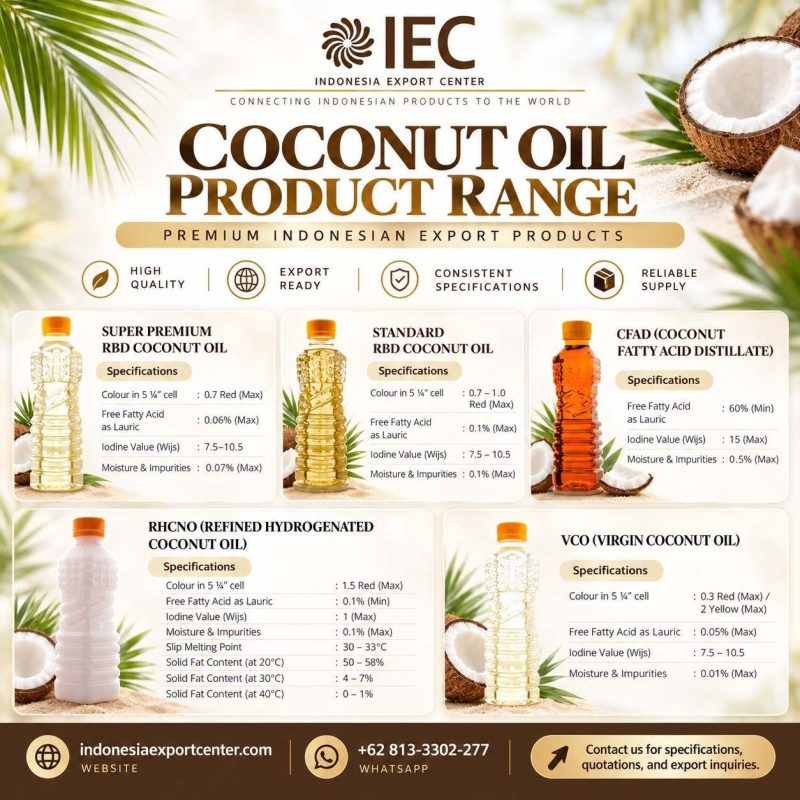
COCONUT OIL PRODUCT RANGE | PREMIUM INDONESIAN EXPORT PRODUCTS
Bulk CFAD Packaging and International Shipping Solutions
Planning CFAD bulk packaging shipping for an industrial raw material order from Indonesia?
Coconut Fatty Acid Distillate (CFAD) is a coconut-oil-derived material used as a potential feedstock in suitable industrial and oleochemical processes.
For international buyers, selecting an appropriate packaging and transportation arrangement is an important part of procurement planning.
Packaging suitability depends on the actual CFAD composition, physical properties, temperature requirements, material compatibility, shipment quantity, and applicable transport regulations.
IEC | Indonesia Export Center facilitates sourcing and export enquiries for Indonesian CFAD, helping international buyers request supplier information, technical documentation, packaging details, and commercial quotations.
IEC welcomes enquiries from commodity logistics buyers, oleochemical manufacturers, chemical traders, industrial importers, and procurement teams.
Request CFAD packaging availability and an export shipping quotation.
WhatsApp: +62 813-3302-277
Website: https://indonesiaexportcenter.com/
Actual packaging options, tank suitability, loading arrangements, MOQ, available quantity, and shipment terms must be verified before booking.
CFAD Reference Technical Specifications
The supplied reference specifications for Coconut Fatty Acid Distillate are:
| Technical Parameter | Reference Specification |
|---|---|
| Free Fatty Acid as Lauric | 60% (Min) |
| Iodine Value (Wijs) | 15 (Max) |
| Moisture & Impurities | 0.5% (Max) |
These values are reference specification limits, not verified results from a particular production lot.
Packaging and transport decisions require additional product information, including physical properties, safety classification, temperature behavior, and compatibility with packaging materials.
CFAD Shipping Overview
| Item | Information |
|---|---|
| Product | Coconut Fatty Acid Distillate |
| Abbreviation | CFAD |
| Product Category | Coconut-Oil-Derived Industrial Raw Material |
| Proposed Sourcing Country | Indonesia |
| Target Market | Global |
| Primary Buyers | Commodity Logistics Buyers |
| Other Buyers | Oleochemical Manufacturers, Chemical Traders, Industrial Importers |
| Reference FFA as Lauric | 60% (Min) |
| Reference Iodine Value | 15 (Max) |
| Reference Moisture & Impurities | 0.5% (Max) |
| Drum Packaging | Availability to Be Confirmed |
| IBC Packaging | Availability to Be Confirmed |
| ISO Tank Shipping | Feasibility to Be Verified |
| Flexitank Shipping | Feasibility to Be Verified |
| Bulk Tank Arrangement | Feasibility to Be Verified |
| Manufacturer | To Be Verified |
| Lot-Specific COA | To Be Requested and Verified |
| Safety Data Sheet | To Be Requested and Verified |
| MOQ | To Be Confirmed |
| Available Quantity | To Be Confirmed |
| Freight Quotation | Request Quotation |
| Shipment Lead Time | To Be Confirmed |
Why CFAD Packaging Selection Matters
CFAD is an industrial material whose transport requirements depend on its actual characteristics.
The selected packaging should protect the product and support safe handling throughout the logistics chain.
Important Considerations
- Chemical compatibility
- Product temperature behavior
- Packaging strength
- Leakage prevention
- Moisture protection
- Loading and unloading requirements
- Storage conditions
- Transport classification
- Destination-country regulations
- Total shipping cost
A packaging method suitable for one fatty acid product may not automatically be suitable for another CFAD lot.
CFAD Drum Packaging
Industrial drums may be considered for CFAD shipments when the packaging material and handling arrangement are suitable.
Drums can provide individually contained cargo units.
However, actual availability and suitability must be confirmed.
Drum Packaging Information to Request
- Drum material
- Net fill per drum
- Gross weight
- Closure system
- Seal type
- Product compatibility
- Temperature requirements
- Palletization arrangement
- Container loading plan
Potential Considerations
Drum shipments may require more individual handling operations than bulk tank arrangements.
Buyers should also evaluate packaging costs and disposal requirements.
No specific drum type, capacity, or net fill has been verified as available for the proposed CFAD.
CFAD IBC Packaging
Intermediate Bulk Containers may be considered for suitable industrial liquid or semi-liquid cargo.
However, IBC compatibility depends on the actual CFAD material and packaging construction.
IBC Evaluation Criteria
- Material compatibility
- Container design
- Temperature limitations
- Filling requirements
- Closure integrity
- Handling equipment
- Transport approval, where required
- Receiving facility compatibility
The buyer should confirm whether the material can be safely filled, transported, stored, and discharged using the proposed IBC.
IBC availability has not been verified.
CFAD ISO Tank Shipping
ISO tank containers may be considered for suitable bulk liquid chemical shipments.
Their use requires careful verification of product compatibility, equipment specifications, and applicable transport rules.
ISO Tank Considerations
- Product safety classification
- Tank material compatibility
- Required tank specification
- Previous cargo and cleaning requirements
- Filling limits
- Heating or insulation requirements, if applicable
- Loading temperature
- Discharge temperature
- Tank operator acceptance
- Port and terminal requirements
Why ISO Tank Suitability Must Be Verified
Not every tank is suitable for every industrial material.
The actual CFAD composition, safety documentation, physical properties, and operating conditions must be reviewed.
IEC does not claim that ISO tank shipping is currently available or approved for the proposed CFAD.
CFAD Flexitank Shipping
Flexitanks are sometimes used for suitable non-hazardous bulk liquid cargo.
However, CFAD should not automatically be assumed eligible for flexitank transport.
Flexitank Feasibility Requirements
Before selecting a flexitank, buyers should verify:
- Actual transport classification
- Manufacturer-issued Safety Data Sheet
- Flexitank manufacturer approval
- Shipping line acceptance
- Product compatibility
- Temperature behavior
- Loading and discharge conditions
- Container suitability
- Destination handling capability
- Applicable insurance requirements
Important Limitation
Flexitank shipping is not appropriate for every industrial chemical or fatty acid material.
If the actual product is classified as dangerous goods for the intended transport mode, a conventional non-dangerous-goods flexitank arrangement must not be assumed acceptable.
No CFAD flexitank compatibility approval or shipping line acceptance has been verified.
CFAD Drum vs IBC vs ISO Tank vs Flexitank
| Packaging or Shipping Method | Potential Use | Main Verification Requirements |
|---|---|---|
| Industrial Drums | Individually packaged industrial cargo | Drum material, closure, net fill, compatibility |
| IBC | Suitable intermediate bulk cargo | IBC construction, compatibility, temperature limits |
| ISO Tank | Suitable bulk liquid chemical transport | Tank specification, classification, operator acceptance |
| Flexitank | Eligible non-dangerous bulk liquid cargo | Product eligibility, compatibility, carrier acceptance |
| Other Bulk Tank Arrangement | Suitable large-volume transport | Equipment suitability, safety, loading and discharge |
This comparison describes potential logistics options, not confirmed CFAD packaging availability.
CFAD Temperature and Physical Handling Requirements
Temperature behavior is an important consideration for certain fatty-acid-rich materials.
Depending on the actual composition, handling temperature may affect:
- Pumpability
- Viscosity
- Filling operations
- Discharge operations
- Storage conditions
- Equipment selection
Information Buyers Should Request
- Physical state at relevant temperatures
- Viscosity data
- Pour point or solidification behavior, where relevant
- Recommended handling temperature
- Storage temperature limitations
- Heating restrictions
- Equipment compatibility
No verified CFAD viscosity, pour point, melting point, or heating requirement has been supplied.
Buyers should not assume that heating is required or permissible without manufacturer guidance.
CFAD Moisture Protection and Contamination Control
The supplied reference specification is:
Moisture & Impurities: 0.5% Maximum
Packaging and handling should aim to prevent contamination during storage and transportation.
Quality Protection Considerations
- Suitable packaging closure
- Clean loading equipment
- Appropriate storage conditions
- Prevention of foreign material contamination
- Protection from unintended moisture exposure
- Proper sampling procedures
- Traceable lot identification
The actual quality requirements should be agreed with the manufacturer and buyer.
Container Loading Planning for CFAD
Container loading depends on the packaging method, shipment quantity, and applicable weight restrictions.
Key Loading Factors
- Net cargo weight
- Packaging tare weight
- Pallet weight, where applicable
- Container tare weight
- Maximum permitted gross mass
- Road weight restrictions
- Cargo distribution
- Securing requirements
- Port and carrier limitations
Basic Net Cargo Calculation
Total Net Cargo Weight = Number of Packaging Units × Net Weight per Unit
Basic Gross Cargo Calculation
Total Gross Cargo Weight = Net Cargo Weight + Packaging Weight + Other Included Cargo Equipment Weight
Actual loading plans should be prepared using verified dimensions, weights, and applicable transport limits.
No fixed number of drums, IBCs, or metric tons per container has been verified for CFAD.
CFAD Export Shipping from Indonesia
International CFAD shipping requires coordination among the supplier, freight forwarder, carrier, and importer.
Origin Port
The origin port should be confirmed according to the actual supplier location and logistics arrangement.
Destination Port
Buyers should specify the intended destination port.
Incoterms
Depending on the transaction, buyers may request quotations under appropriate Incoterms, including:
- FCA
- FOB
- CFR
- CIF
- CIP
The selected rule should identify the named place and applicable responsibilities.
Freight Availability
Freight availability and routing must be confirmed for the actual shipment.
Transit Time
Estimated transit time depends on route, carrier, transshipment arrangements, and operating conditions.
No fixed transit time has been verified.
CFAD Transport Classification and Safety Documentation
Transport classification must be determined from the actual product and applicable regulations.
Documents and Information to Review
- Manufacturer-issued Safety Data Sheet
- Product composition
- Applicable transport classification
- Packaging compatibility
- Storage and handling recommendations
- Carrier acceptance
- Destination-country requirements
The SDS should be reviewed for relevant hazards and transport information.
However, transport classification should not be inferred solely from the product name.
IEC does not claim that all CFAD is non-hazardous or approved for a particular transport mode.
CFAD Export Documentation
Depending on the transaction and destination, buyers may require:
- Commercial invoice
- Packing list
- Bill of lading or other transport document
- Certificate of origin, where applicable
- Manufacturer-issued technical specification
- Lot-specific COA
- Safety Data Sheet
- Packaging specifications
- Relevant transport documentation
- Other destination-specific documents
Actual requirements must be confirmed for the shipment.
CFAD Shipping Cost Considerations
Industrial buyers should compare packaging and freight options based on total logistics cost.
Potential Cost Components
- Product price
- Packaging cost
- Inland transportation
- Loading and handling
- Export documentation
- Freight
- Insurance
- Destination handling
- Customs clearance
- Applicable duties and taxes
- Inland delivery
- Cleaning or equipment-related charges, where applicable
Landed Cost Formula
Estimated Landed Cost = Product Cost + Applicable Packaging and Logistics Costs + Freight + Insurance + Duties and Taxes + Other Applicable Import Charges
Landed Cost per MT = Total Estimated Landed Cost ÷ Net Metric Tons Received
Actual costs should be calculated using verified quotations.
CFAD Packaging and Shipping Checklist
Before confirming a shipment, buyers should verify:
-
Actual manufacturer identity
-
Product identity as CFAD
-
Current technical specification
-
Lot-specific COA
-
Safety Data Sheet
-
Transport classification
-
Packaging availability
-
Packaging compatibility
-
Net weight per unit
-
Gross weight
-
Loading configuration
-
Temperature requirements
-
Storage conditions
-
Carrier acceptance
-
Tank or flexitank approval, if applicable
-
MOQ
-
Available quantity
-
Origin port
-
Destination port
-
Requested Incoterm
-
Freight quotation
-
Insurance arrangements
-
Export documents
-
Destination-country import requirements
-
Shipment lead time
Request for Quotation – CFAD Bulk Packaging and Shipping
Subject: RFQ – CFAD Bulk Packaging and International Shipping from Indonesia
Dear IEC | Indonesia Export Center Team,
We are interested in sourcing Coconut Fatty Acid Distillate from Indonesia and would like to evaluate suitable packaging and shipping arrangements.
Please advise whether a suitable manufacturer can provide CFAD meeting our technical and commercial requirements.
BUYER INFORMATION
Company Name: [Company Name] Country: [Country] Business Type: [Industrial Importer / Oleochemical Manufacturer / Chemical Trader / Logistics Buyer] Contact Person: [Name] Email: [Email] WhatsApp: [Number]
PRODUCT REQUIREMENTS
Product: Coconut Fatty Acid Distillate (CFAD)
Intended Application: [Specify]
Required Quantity: [MT]
Order Frequency: [Trial / One-Time / Monthly / Other]
REFERENCE SPECIFICATIONS
| Parameter | Required Value |
|---|---|
| Free Fatty Acid as Lauric | 60% (Min) |
| Iodine Value (Wijs) | 15 (Max) |
| Moisture & Impurities | 0.5% (Max) |
| Other Parameters | [Specify] |
PACKAGING REQUIREMENTS
Preferred Packaging: [Drums / IBC / ISO Tank / Flexitank / Other]
Please confirm:
- Available packaging options
- Packaging material
- Net weight per unit
- Gross weight
- Container loading configuration
- Product compatibility
- Handling temperature requirements
- Storage recommendations
- Tank or flexitank feasibility, if applicable
- Carrier acceptance requirements
DOCUMENTATION REQUESTED
Please provide, where available:
- Manufacturer-issued technical specification
- Lot-specific COA
- Safety Data Sheet
- Packaging specifications
- Product handling recommendations
- Relevant transport classification information
- Sample availability
SHIPPING REQUIREMENTS
Required Quantity: [MT] Destination Country: [Country] Destination Port: [Port] Requested Incoterm: [FCA / FOB / CFR / CIF / CIP / Other] Target Shipment Period: [Month / Year]
Please advise:
- Minimum order quantity
- Available quantity
- Price per MT
- Packaging costs
- Estimated freight cost
- Production lead time
- Estimated shipment lead time
- Payment terms
- Quotation validity
- Recurring supply capability
We will review packaging suitability and applicable transport requirements before shipment approval.
Thank you. We look forward to your quotation and supporting documentation.
Kind regards,
[Your Name] [Company Name] [Country]SEND YOUR CFAD PACKAGING AND SHIPPING ENQUIRY VIA WHATSAPP
Frequently Asked Questions – CFAD Bulk Packaging and Shipping
1. What packaging options are available for CFAD?
Potential options may include drums, IBCs, or suitable bulk tank arrangements. Actual availability must be confirmed.
2. Can CFAD be shipped in drums?
Drum shipping may be considered if the packaging is compatible and available.
3. Can CFAD be shipped in IBCs?
IBCs may be considered where suitable, subject to compatibility and supplier capability.
4. Can CFAD be shipped in ISO tanks?
ISO tank feasibility must be evaluated based on the actual material and equipment requirements.
5. Can CFAD be shipped in flexitanks?
Only if the actual material is eligible and the flexitank manufacturer, carrier, and relevant parties approve the arrangement.
6. Is CFAD always non-hazardous for transport?
No such universal classification should be assumed. The actual product must be assessed.
7. Does CFAD require heating during shipment?
This depends on the actual physical properties and manufacturer recommendations.
8. What is the supplied CFAD moisture and impurities limit?
0.5% maximum.
9. How many metric tons of CFAD fit in one container?
The loading quantity depends on packaging, cargo weight, container limits, and applicable transport restrictions.
10. Can buyers request a loading plan?
Yes. Availability and preparation must be confirmed with the supplier and logistics provider.
11. Can buyers request a lot-specific COA?
Yes. Actual availability must be confirmed.
12. Can buyers request an SDS?
Yes. Buyers should request the appropriate safety documentation.
13. What is the minimum order quantity?
No fixed MOQ has been verified.
14. Can buyers request CIF quotations?
Yes. Feasibility and commercial terms must be confirmed for the named destination port.
15. Does IEC have verified CFAD tank or flexitank shipping availability?
No specific tank or flexitank arrangement has been independently verified for this page.
Request CFAD Bulk Packaging and Shipping Information from Indonesia
Selecting the right CFAD bulk packaging shipping arrangement requires careful evaluation of material compatibility, product handling characteristics, transport classification, container loading, freight costs, and destination-country requirements.
For commodity logistics buyers and industrial importers, packaging suitability and shipment feasibility should be confirmed before placing a bulk order.
IEC | Indonesia Export Center welcomes international enquiries for potential Indonesian CFAD sourcing, packaging information, and export quotations.
IEC | INDONESIA EXPORT CENTER
CONNECTING INDONESIAN PRODUCTS TO THE WORLD
Product: Coconut Fatty Acid Distillate (CFAD)
Product Category: Coconut-Oil-Derived Industrial Raw Material
Proposed Sourcing Country: Indonesia
Target Market: Global
Target Buyers: Commodity Logistics Buyers, Industrial Importers, Oleochemical Manufacturers, and Chemical Traders
Reference FFA as Lauric: 60% (Min)
Reference Iodine Value: 15 (Max)
Reference Moisture & Impurities: 0.5% (Max)
Drum Packaging: Availability to Be Confirmed
IBC Packaging: Availability to Be Confirmed
ISO Tank Shipping: Feasibility to Be Verified
Flexitank Shipping: Feasibility to Be Verified
Manufacturer: To Be Verified
Lot-Specific COA: To Be Requested and Verified
Safety Data Sheet: To Be Requested and Verified
Transport Classification: To Be Verified
Certifications: To Be Verified
MOQ: To Be Confirmed
Available Quantity: To Be Confirmed
Price per MT: Request Quotation
Freight Cost: Request Quotation
Shipment Lead Time: To Be Confirmed
Request CFAD Bulk Packaging and Export Shipping Quotation
Website: https://indonesiaexportcenter.com/
WhatsApp: +62 813-3302-277
REQUEST CFAD PACKAGING AND SHIPPING QUOTATION
Contact us for specifications, quotations, and export inquiries.
Technical and Commercial Disclaimer: This page provides general sourcing and logistics information about Coconut Fatty Acid Distillate. The numerical values shown are supplied reference specifications, not actual lot-specific COA results. No specific manufacturer, certification, COA, SDS, stock, MOQ, packaging format, tank compatibility, flexitank approval, container loading capacity, price, freight rate, or shipment lead time has been independently verified. Packaging suitability, transport classification, handling conditions, carrier acceptance, and destination-country regulatory requirements must be assessed for the actual material and shipment. IEC facilitates sourcing and export enquiries; the actual manufacturer, contractual seller, and exporter of record must be confirmed for each transaction.
