

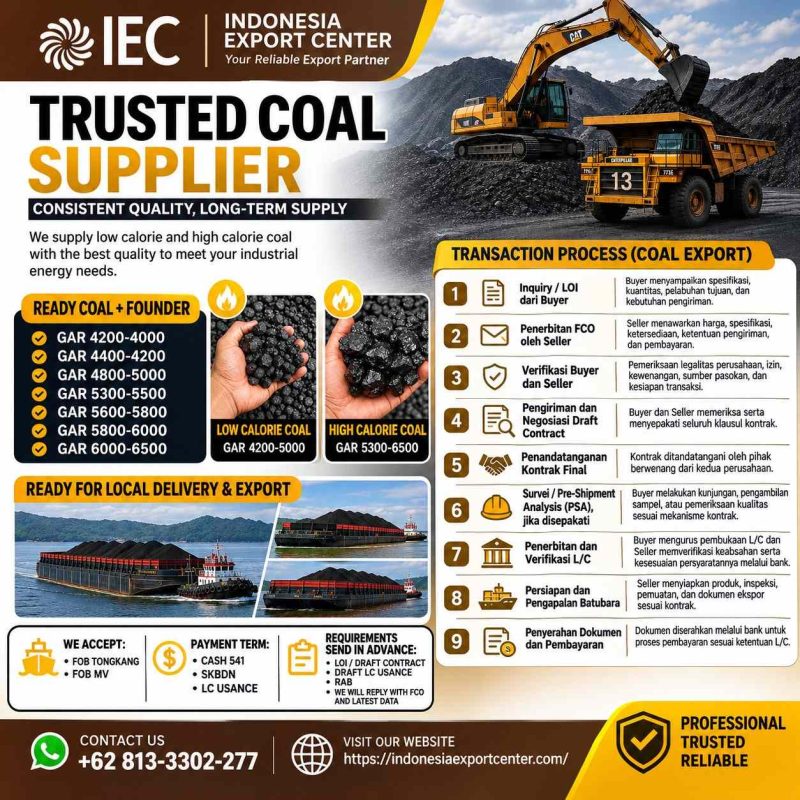
Indonesian Bulk Coal Sourcing for Industrial and Trading Companies
Are you searching for a bulk thermal coal supplier in Indonesia for industrial energy requirements, international commodity trading, or recurring fuel procurement?
Indonesia Export Center (IEC) welcomes inquiries from qualified buyers seeking Indonesian thermal coal in bulk quantities through potential supply networks associated with Kalimantan, Indonesia.
We coordinate commercial inquiries involving coal specifications, proposed purchase quantities, supplier verification, loading arrangements, quality inspection, and payment conditions.
Our objective is to help international buyers identify suitable coal sourcing opportunities while maintaining transparent commercial communication and appropriate transaction safeguards.
Indonesia is an established source of thermal coal for domestic and international markets. Coal purchased for bulk industrial use must meet the specific requirements of the receiving facility, including calorific value, moisture, ash, sulfur, and physical characteristics.
IEC welcomes inquiries for several coal categories, ranging from lower-calorific-value grades to higher-calorific-value thermal coal.
Whether your business requires a single shipment or intends to discuss a longer-term coal procurement program, IEC can review your requirements and coordinate appropriate supplier discussions.
Contact Indonesia Export Center
WhatsApp: +62 813-3302-277
Website: https://indonesiaexportcenter.com/
1. What Is Bulk Thermal Coal?
Bulk thermal coal refers to coal purchased, transported, and delivered in substantial quantities for use as an industrial fuel.
Unlike packaged retail products, bulk coal is typically handled through stockpiles, conveyor systems, trucks, barges, bulk carriers, and dedicated industrial receiving facilities.
The primary purpose of thermal coal is to provide heat energy through combustion in equipment designed for the relevant fuel characteristics.
Typical buyers include electricity generation companies, industrial steam producers, cement manufacturers, processing facilities, and international commodity traders.
Bulk coal transactions require particular attention to cargo quantity, quality consistency, transportation arrangements, and contractual risk allocation.
Because industrial fuel consumption can be substantial, the buyer must establish realistic delivery schedules and reliable procurement procedures.
IEC encourages buyers to define their intended use, quantity, target specifications, and destination before requesting a formal commercial offer.
2. Indonesian Thermal Coal Grades for Bulk Procurement
Indonesian thermal coal is traded under different calorific value categories.
IEC welcomes inquiries for the following indicative sourcing ranges.
| Coal Grade | Target Calorific Value |
|---|---|
| Low Calorie Thermal Coal | GAR 4000–4200 kcal/kg |
| Low Calorie Thermal Coal | GAR 4200–4400 kcal/kg |
| Intermediate Thermal Coal | GAR 4800–5000 kcal/kg |
| Intermediate to Higher Calorie Coal | GAR 5300–5500 kcal/kg |
| Higher Calorie Coal | GAR 5600–5800 kcal/kg |
| Higher Calorie Coal | GAR 5800–6000 kcal/kg |
| High Calorie Coal | GAR 6000–6500 kcal/kg |
These categories represent potential inquiry specifications rather than confirmed cargo inventories.
The exact quality, available quantity, loading location, and delivery schedule must be verified for each proposed supplier.
Buyers should provide complete technical specifications rather than relying on calorific value alone.
3. Why Choose Indonesian Thermal Coal for Bulk Purchasing?
Indonesia has established coal-producing regions and marine transportation infrastructure that support bulk commodity logistics.
For buyers evaluating international coal sourcing options, several commercial considerations are important.
Multiple Coal Quality Categories
Different industrial users require different fuel specifications.
Indonesian coal sourcing opportunities may allow buyers to evaluate several calorific value categories, subject to actual availability.
Maritime Transportation Options
Bulk coal may be transported through inland loading points, barges, transshipment facilities, and ocean-going vessels.
The specific route depends on the production location and available infrastructure.
Industrial Procurement Planning
Bulk purchasing can be structured around individual cargoes or recurring shipment requirements.
Actual supply commitments must be based on verified production, cargo access, and logistical capabilities.
Commercial Flexibility
Buyers may negotiate product specifications, inspection requirements, shipment quantities, delivery arrangements, and payment terms.
These conditions must be accepted by the relevant contracting parties.
IEC supports transparent discussions without representing unverified supply capacity as guaranteed inventory.
4. Bulk Coal Sourcing from Kalimantan
Kalimantan is an important coal-producing region in Indonesia.
IEC focuses on potential supply opportunities associated with South Kalimantan, East Kalimantan, and Central Kalimantan.
Each region includes different mining operations, transportation facilities, coal quality characteristics, and commercial structures.
Some proposed transactions may involve mine operators directly, while others may involve legally authorized trading or supply entities.
The identity and authority of the contracting seller must be verified before a buyer commits to a transaction.
Buyers should also establish whether the proposed coal is already available in a stockpile, is allocated for future production, or depends on additional procurement arrangements.
These distinctions can materially affect delivery reliability.
IEC encourages buyers to request sufficient supplier documentation and product information to support proper commercial evaluation.
5. Wholesale Coal Purchasing and Minimum Order Quantity
One of the most common questions from international buyers is the minimum order quantity for bulk Indonesian coal.
There is no single universal minimum that applies to every supplier.
MOQ depends on the coal source, available stockpile quantity, transportation infrastructure, loading location, and shipping arrangements.
For example, a proposed barge-loading arrangement may involve different operational requirements from a shipment loaded onto an ocean-going bulk carrier.
The buyer’s destination and intended shipment schedule may also influence commercial feasibility.
When requesting a quotation, buyers should state their required quantity per shipment and any recurring monthly volume.
IEC can then coordinate an appropriate review of potential supplier capabilities.
No minimum volume or production capacity should be considered confirmed until established by a specific commercial offer.
6. How Bulk Coal Prices Are Determined
Bulk coal prices depend on numerous factors.
The target calorific value is important, but other quality parameters also affect commercial comparisons.
Total moisture, ash, sulfur, coal size, and required inspection conditions may influence the value of a particular product.
Loading location, cargo quantity, transportation responsibilities, and shipment timing are also relevant.
Buyers should avoid comparing quotations that use different specifications or delivery terms.
For meaningful commercial analysis, each offer should be evaluated on a consistent basis.
The buyer should examine the price per metric ton, gross or net energy content, freight costs, quality adjustment provisions, and payment obligations.
IEC does not publish a universal fixed price for bulk coal because each transaction depends on verified source-specific conditions.
7. Bulk Coal Transportation and Loading
Coal purchased in bulk requires careful logistics coordination.
Depending on the source, transportation may involve trucks, conveyors, stockpile equipment, barges, and larger ocean-going vessels.
Stockpile Management
Stockpiles may be used to accumulate and prepare cargo before loading.
The buyer should establish whether the proposed stockpile corresponds to the contracted coal grade.
Barge Transportation
Barges may transport coal from loading points to designated marine locations.
The contracting parties must define the transportation and risk-transfer responsibilities.
Mother Vessel Loading
For international bulk shipping, coal may be loaded onto ocean-going vessels where suitable infrastructure or transshipment arrangements are available.
The relevant parties should agree on vessel nomination, loading dates, quantity verification, and shipping documents.
Inspection During Loading
Where required, independent inspection may be conducted to evaluate cargo quality and quantity.
All logistics arrangements depend on actual supplier capability and contractual conditions.
8. Bulk Coal Procurement Procedure
IEC recommends a structured transaction process.
Step 1 – Buyer Inquiry: The buyer submits the required product specifications, quantity, destination port, and shipment schedule.
Step 2 – Full Corporate Offer: The seller may issue an FCO covering price, quantity, specifications, delivery terms, and proposed payment conditions.
Step 3 – Verification: Both parties verify company registration, legal authority, supply access, relevant licenses, and transaction capability.
Step 4 – Contract Negotiation: The parties discuss quality guarantees, quantity, shipment obligations, inspections, and payment security.
Step 5 – Final Contract Signing: Authorized representatives execute the agreed contract.
Step 6 – Survey or Pre-Shipment Analysis: Where agreed, inspection, sampling, or supplier visits may be arranged.
Step 7 – Letter of Credit: If L/C payment is agreed, the buyer arranges issuance and the seller verifies the terms through the banking system.
Step 8 – Shipment: Cargo preparation, loading, inspection, and documentation are completed according to the contract.
Step 9 – Payment: Required documents are submitted and payment is processed under the agreed conditions.
The precise transaction procedure may be adapted through mutual agreement.
9. Quality Assurance for Wholesale Coal
Bulk coal purchasing requires reliable quality verification.
Coal can differ in calorific value, moisture, ash, sulfur, and particle-size distribution.
A professional purchase agreement should identify guaranteed values and acceptable tolerances.
Buyers may request independent testing, depending on the transaction.
A certificate of analysis should clearly relate to the material being tested.
For international transactions, parties should agree on the inspection point, sampling method, laboratory standards, and contractual significance of results.
Quality adjustment provisions may also be included where appropriate.
IEC encourages buyers to establish these conditions before shipment.
10. Payment Security and Export Documentation
International coal transactions may involve documentary Letters of Credit or other agreed payment methods.
A documentary L/C establishes payment conditions involving specified documents.
The buyer arranges issuance through a bank, while the seller verifies the instrument and its terms.
Payment is subject to compliant documentary presentation and the applicable banking rules.
Coal export documentation may include a commercial invoice, transport document, quality certificate, quantity certificate, and applicable customs or regulatory documents.
The required documentation depends on the specific transaction and laws in force at the time.
All parties should verify the legally authorized exporter and applicable export procedures before shipment.
11. Long-Term Bulk Coal Supply Agreements
Industrial businesses may require recurring fuel deliveries rather than individual purchases.
A long-term supply agreement may establish monthly quantities, shipment schedules, product specifications, and pricing mechanisms.
However, such arrangements require verification of actual supplier capacity and logistics.
The parties should also agree on quality variation procedures, delivery delays, inspection requirements, and payment conditions.
A proposed supply program should be supported by realistic production or procurement arrangements.
IEC welcomes long-term sourcing discussions but does not guarantee ongoing availability without source-specific confirmation.
12. Frequently Asked Questions
Can IEC coordinate bulk Indonesian thermal coal inquiries?
Yes. IEC welcomes formal sourcing inquiries from qualified industrial and trading buyers.
What coal grades are available for inquiry?
Buyers may request GAR 4200 through GAR 6500 categories, subject to supplier confirmation.
What is the minimum order quantity?
MOQ depends on the source, cargo availability, loading arrangements, and commercial conditions.
Can I request monthly coal shipments?
Recurring procurement proposals may be evaluated after supplier capacity and logistics are verified.
Is independent inspection possible?
Inspection may be arranged where agreed in the contract.
Can I request FOB barge delivery?
FOB barge inquiries are welcome, subject to supplier and logistical confirmation.
Are L/C payments possible?
Documentary credit arrangements may be discussed, subject to seller approval and banking requirements.
13. Request a Bulk Coal Quotation from Indonesia
Are you searching for a bulk Indonesian thermal coal supplier for industrial use, international trading, or recurring procurement?
Indonesia Export Center welcomes serious buyer inquiries.
Please provide your company name, country, complete coal specifications, quantity per shipment, destination port, preferred delivery terms, payment conditions, and shipment schedule.
Where possible, attach a formal Letter of Intent or purchase inquiry.
Our team will review the requirements and coordinate appropriate commercial discussions based on verified sourcing information.
INDONESIA EXPORT CENTER (IEC)
Your Reliable Export Partner
WhatsApp: +62 813-3302-277
Website: https://indonesiaexportcenter.com/
Bulk Thermal Coal Supplier Indonesia | Wholesale Indonesian Coal | Kalimantan Coal Sourcing | International Coal Procurement
Professional • Trusted • Reliable
Disclaimer: Product specifications, prices, quantities, source locations, shipment schedules, payment conditions, and export arrangements require supplier confirmation, applicable regulatory compliance, and contractual agreement. IEC provides sourcing coordination and does not guarantee availability of any particular cargo.
