

IEC | INDONESIA EXPORT CENTER
CONNECTING INDONESIAN PRODUCTS TO THE WORLD
INDONESIAN BLACK PEPPER FOR GERMANY
PREMIUM EXPORT QUALITY
WHOLE BLACK PEPPER | EU FOOD SAFETY REQUIREMENTS | RESIDUE TESTING | B2B EXPORT SOURCING
FOR GERMAN SPICE IMPORTERS, FOOD MANUFACTURERS & WHOLESALE DISTRIBUTORS
Source Indonesian Black Pepper for the German Market
Looking for a black pepper supplier Germany importers can contact for Indonesian whole black pepper sourcing?
Germany is an important European market for spices, food ingredients, seasoning products, and industrial food manufacturing.
For German spice importers, purchasing black pepper from Indonesia requires careful evaluation of product quality, European Union food safety requirements, pesticide residue limits, contaminant testing, supplier traceability, and import documentation.
Buyers must also determine which legal and commercial responsibilities apply to the importer, foreign supplier, exporter, and logistics providers.
IEC | Indonesia Export Center facilitates sourcing and export enquiries for Indonesian agricultural products, including whole black pepper intended for the German market.
IEC can receive your purchasing specifications and seek confirmation of suitable Indonesian suppliers, available grades, product documentation, sampling arrangements, inspection options, and export quotations.
Product availability, EU conformity, laboratory results, supplier qualifications, pricing, and shipment arrangements must be verified for each proposed commercial lot.
Request a Black Pepper Export Quote for Germany
Send your required quantity, product specifications, destination port, residue testing requirements, packaging preferences, and delivery schedule.
REQUEST A BLACK PEPPER QUOTE VIA WHATSAPP
WhatsApp: +62 813-3302-277
Website: https://indonesiaexportcenter.com/
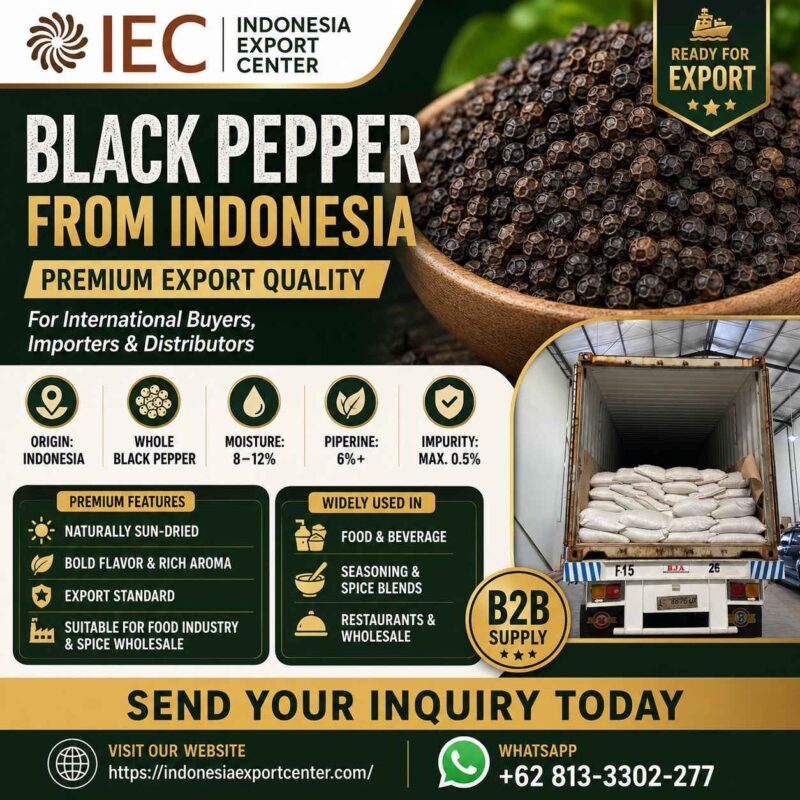
Indonesian Black Pepper – Product Specifications for Germany
| Product Information | Details |
|---|---|
| Product | Whole Black Pepper |
| Botanical Name | Piper nigrum L. |
| Country of Origin | Indonesia |
| Destination Market | Germany / European Union |
| Product Form | Whole Dried Peppercorns |
| Reference Moisture | 8–12% |
| Reference Piperine | 6%+ |
| Reference Impurity | Maximum 0.5% |
| Bulk Density | Buyer-Specified |
| Foreign Matter | Buyer-Specified |
| Defect Tolerance | Buyer-Specified |
| Drying Method | Subject to Lot Verification |
| Microbiological Requirements | Applicable EU and Buyer Requirements |
| Pesticide Residues | Applicable EU Maximum Residue Limits |
| Mycotoxins | Applicable EU Requirements |
| Heavy Metals | Applicable EU Requirements |
| Traceability | To Be Verified |
| Lot-Specific COA | To Be Requested |
| Packaging | To Be Confirmed |
| Minimum Order Quantity | To Be Confirmed |
| Export Price | Request Quotation |
| Destination | German Port or Agreed Delivery Point |
Specification note: Moisture 8–12%, piperine 6%+, and impurity maximum 0.5% are supplied reference values, not independently verified results for an available commercial lot.
Why German Importers Source Black Pepper from Indonesia
Indonesia has a long history of black pepper cultivation and international spice trading.
Indonesian whole black pepper may be considered by German buyers seeking raw materials for spice processing, food manufacturing, and wholesale distribution.
Potential Sourcing Considerations
Established Origin
Indonesia is recognized internationally as a black pepper-producing country.
Whole Peppercorn Supply
Whole peppercorns may be suitable for grinding, packing, blending, or further processing.
Specification-Based Procurement
German buyers can submit requirements for moisture, cleanliness, bulk density, and other measurable parameters.
Wholesale Purchasing
Importers may request bulk and recurring supply quotations.
Quality Documentation
Buyers may request relevant product testing and traceability records.
Actual availability and supplier capabilities must be confirmed.
EU Food Safety Compliance for Black Pepper Imports
Black pepper imported into Germany must comply with applicable European Union food safety requirements.
Germany applies relevant EU food law alongside applicable national rules.
Important EU Regulatory Areas
- General food safety
- Food hygiene
- Pesticide maximum residue limits
- Contaminant limits
- Traceability
- Official controls
- Food labeling, where applicable
- Import documentation
- Additional controls for certain products and origins, where applicable
Key EU Legal Frameworks
Relevant legislation may include:
Regulation (EC) No 178/2002
Establishes general principles and requirements of EU food law, including traceability and food business operator responsibilities.
Regulation (EC) No 852/2004
Addresses food hygiene requirements.
Regulation (EC) No 396/2005
Establishes the EU framework for pesticide maximum residue limits in or on food and feed.
Regulation (EU) 2023/915
Establishes maximum levels for certain contaminants in food.
Regulation (EU) 2017/625
Provides the framework for official controls.
Additional product-specific or origin-specific rules may apply.
Regulatory applicability and current limits must be verified for the actual product and import date.
Pesticide Residue Requirements for Germany
Pesticide residues are a major consideration for German spice importers.
Black pepper must meet applicable EU maximum residue limits (MRLs).
What Are Maximum Residue Limits?
MRLs establish legally permitted residue levels for specific pesticide substances in relevant food commodities.
The applicable limit depends on:
- The pesticide substance
- The food commodity
- The relevant EU classification
- Current regulatory requirements
Recommended Pesticide Residue Verification
- Identify the relevant EU commodity classification.
- Determine applicable MRLs.
- Define the analytical testing panel.
- Agree on the sampling procedure.
- Request laboratory results.
- Review the analytical reporting limits.
- Compare results with the applicable requirements.
- Link the results to the commercial lot.
Important
No universal pesticide residue limit applies to all pesticide substances in black pepper.
The relevant limits must be checked individually.
EU Pesticide Residue Testing – Buyer Checklist
| Testing Requirement | Buyer Consideration |
|---|---|
| Product | Whole Black Pepper |
| Origin | Indonesia |
| Destination | Germany |
| Pesticide Panel | Buyer and EU Requirements |
| Applicable MRLs | Current EU Limits |
| Sampling Method | Agreed Procedure |
| Laboratory | Suitable Laboratory |
| Analytical Method | Documented |
| Reporting Limits | Appropriate for Applicable MRLs |
| Lot Identification | Required |
| Test Report | To Be Requested |
Laboratory Testing
German importers may request testing by a suitably qualified laboratory.
Where accreditation is required by the buyer or relevant procedure, the laboratory’s accreditation and test scope should be checked.
A test report must be reviewed in relation to the actual lot and sampling method.
Mycotoxin Requirements for Black Pepper
Mycotoxins are naturally occurring toxic substances that may be produced by certain fungi under suitable conditions.
For black pepper procurement, relevant mycotoxin considerations may include aflatoxins and ochratoxin A.
Why Mycotoxin Testing Matters
Mycotoxin contamination cannot be reliably assessed through visual inspection alone.
Contamination may also be unevenly distributed within a lot.
Recommended Verification
- Identify applicable EU maximum levels.
- Determine the required mycotoxin panel.
- Agree on representative sampling.
- Specify the analytical method.
- Request relevant laboratory results.
- Review lot identification.
- Confirm product conformity before shipment.
Important
The applicable limits depend on the current EU rules and product classification.
No particular black pepper lot is claimed to meet EU mycotoxin limits without testing.
Heavy Metal and Other Contaminant Requirements
German food importers may need to evaluate heavy metals and other relevant contaminants.
Potential parameters include:
- Lead
- Cadmium
- Other substances covered by applicable rules or buyer risk assessments
Recommended Buyer Questions
- Which contaminants are regulated for the product?
- Which limits apply?
- What testing methods are appropriate?
- Are lot-specific results available?
- Is the laboratory qualified for the required analysis?
Testing requirements should be determined for the actual product and intended application.
Microbiological Safety for German Black Pepper Importers
Dried spices can present microbiological hazards.
Low moisture does not automatically eliminate pathogenic microorganisms.
Potential Microbiological Parameters
| Parameter | Buyer Consideration |
|---|---|
| Salmonella spp. | Relevant Food Safety Hazard |
| Total Aerobic Count | Buyer-Specified |
| Yeasts and Moulds | Buyer-Specified |
| Enterobacteriaceae | Buyer-Specified |
| E. coli | Buyer-Specified |
| Other Relevant Microorganisms | Risk-Based |
Salmonella
Salmonella is an important hazard to consider in black pepper sourcing.
Buyers should establish appropriate acceptance criteria, analytical methods, and verification procedures.
Important
No particular product lot is claimed to be sterilized, Salmonella-free, or microbiologically compliant without appropriate verification.
Cleaning, Sorting and Microbial Reduction
German spice importers may request specific processing conditions.
Cleaned Black Pepper
Physical cleaning may help reduce dust, stones, stems, and other foreign matter.
Sorted Black Pepper
Sorting may help classify peppercorns according to physical characteristics.
Microbially Treated Black Pepper
Certain buyers may require a validated microbial reduction process.
These processes are not interchangeable.
Physical cleaning does not automatically establish microbiological safety.
Actual processing capability and treatment documentation must be confirmed with the supplier.
Quality Control Specifications for German Spice Buyers
German importers should establish a written product specification before purchase.
| Quality Parameter | Reference or Requirement |
|---|---|
| Product | Whole Black Pepper |
| Origin | Indonesia |
| Moisture | 8–12% Reference; Agree Contractual Maximum |
| Piperine | 6%+ Reference; Verify by Testing |
| Impurity | Maximum 0.5% Reference |
| Bulk Density | Buyer-Specified |
| Foreign Matter | Buyer-Specified |
| Broken Peppercorns | Buyer-Specified |
| Defective Peppercorns | Buyer-Specified |
| Salmonella | Applicable Criteria |
| Other Microbiological Parameters | Risk-Based |
| Pesticide Residues | Applicable EU MRLs |
| Mycotoxins | Applicable EU Maximum Levels |
| Heavy Metals | Applicable EU Requirements |
| Packaging | Buyer-Specified |
| Lot Identification | Required |
| COA | To Be Requested |
Buyer-Specified Quality Parameters
Some German spice companies may require stricter specifications than the applicable legal minimums.
The final contractual requirements should be agreed before shipment.
Certificate of Analysis for Germany-Bound Black Pepper
A lot-specific Certificate of Analysis can support product quality verification.
Recommended COA Information
| COA Field | Requested Information |
|---|---|
| Product | Whole Black Pepper |
| Origin | Indonesia |
| Supplier | Identified Supplier |
| Lot Number | Required |
| Sample Identification | Required |
| Moisture | Actual Result |
| Piperine | Actual Result |
| Impurity | Actual Result |
| Bulk Density | If Required |
| Foreign Matter | If Required |
| Salmonella | If Required |
| Other Microbiological Results | If Required |
| Pesticide Residues | If Required |
| Mycotoxins | If Required |
| Heavy Metals | If Required |
| Laboratory | Identified |
| Analytical Methods | Documented |
| Test Date | Recorded |
Important
A COA does not automatically prove compliance with every EU food safety requirement.
It must be assessed against applicable legal limits, sampling procedures, and contractual specifications.
Supplier Qualification for German Importers
German spice importers may require a structured supplier qualification process.
Recommended Supplier Evaluation
- Legal supplier identity
- Processing or packing facility information
- Food safety procedures
- Product specifications
- Cleaning and sorting controls
- Contaminant testing
- Microbiological controls
- Traceability
- Packaging procedures
- Available certifications
- Audit reports, if available
- Corrective action procedures
- Recall procedures
Food Safety Certifications
Some buyers may request:
- HACCP-based food safety controls
- GMP
- ISO 22000
- FSSC 22000
- Other relevant food safety schemes
Actual certification status, scope, and validity must be verified.
Traceability Requirements for Black Pepper Imported into Germany
Traceability is an important element of EU food law.
Food business operators must meet applicable traceability obligations.
Potential Traceability Chain
Agricultural Production → Collection → Drying → Cleaning → Storage → Packing → Export → German Import
Recommended Traceability Records
- Supplier identification
- Country of origin
- Product description
- Lot number
- Relevant processing records
- Storage records
- Packing records
- Laboratory report references
- Commercial documents
- Shipment identification
Actual traceability documentation must be requested from the relevant supplier.
Importer Responsibilities in Germany
The German importer must determine its legal responsibilities under applicable EU and German requirements.
Potential Importer Responsibilities
- Product safety evaluation
- Supplier due diligence
- Compliance with applicable food law
- Pesticide residue conformity
- Contaminant conformity
- Traceability
- Customs procedures
- Import documentation
- Labeling requirements, where applicable
- Cooperation with competent authorities
EU-Based Food Business Operator
The relevant EU-based food business operator must fulfill the obligations applicable to its activities.
IEC’s role as a sourcing enquiry facilitator does not replace the importer’s legal responsibilities.
EU Official Controls and Import Checks
Food imported into the EU may be subject to official controls.
Depending on the product, origin, and current regulations, additional import controls may apply.
Potential Control Measures
- Documentary checks
- Identity checks
- Physical checks
- Sampling
- Laboratory analysis
- Additional certification or notification requirements
Important
The existence and frequency of enhanced controls may change.
German importers should verify whether Indonesian black pepper is subject to any additional controls under the current applicable EU measures.
No particular shipment is claimed to be exempt from inspection.
German Customs and Import Documentation
Commercial black pepper imports require appropriate customs and transport documentation.
Potential Documents
| Document | Purpose |
|---|---|
| Commercial Invoice | Describes the commercial transaction |
| Packing List | Identifies quantities and packaging |
| Bill of Lading | Ocean freight transport document |
| Air Waybill | Air freight transport document |
| Certificate of Origin | Supports origin information where applicable |
| Phytosanitary Certificate | If required |
| Product Specification | Defines agreed quality requirements |
| Certificate of Analysis | Supports quality verification |
| Laboratory Reports | Supports relevant food safety evaluation |
| Insurance Certificate | If required under the agreed terms |
German Import Coordination
Importers should also confirm:
- Importer identification
- EORI requirements
- Customs declaration
- Product tariff classification
- Applicable customs duties
- VAT treatment
- Customs broker arrangements
- Any relevant food import controls
Requirements must be verified for the actual transaction.
Shipping Black Pepper from Indonesia to Germany
International shipments may be arranged through appropriate freight providers.
Potential Shipping Methods
Full Container Load (FCL)
May be suitable for larger wholesale shipments.
Less Than Container Load (LCL)
May be considered for smaller commercial quantities.
Air Freight
May be considered for suitable samples or smaller consignments.
German Destination Options
German importers may request quotations for destinations such as:
- Hamburg
- Bremerhaven
- Other German ports or inland delivery points
Actual service availability, routing, freight rates, and transit times must be confirmed.
Packaging for Indonesian Black Pepper Export to Germany
Packaging should protect the product during transportation and storage.
Potential packaging formats may include:
- Food-compatible woven bags with suitable liners
- Multiwall paper bags with suitable liners
- Other supplier-approved bulk packaging
Actual packaging availability must be confirmed.
Packaging Checklist
| Packaging Requirement | Buyer Specification |
|---|---|
| Packaging Material | [Specify] |
| Net Weight per Bag | [Specify] |
| Inner Liner | [Required / Not Required] |
| Palletization | [Required / Not Required] |
| Lot Marking | Required |
| Product Identification | Required |
| Country of Origin Information | As Applicable |
| Moisture Protection | [Specify] |
| German / EU Labeling Requirements | As Applicable |
Packaging Compliance
Food-contact material requirements and relevant packaging obligations should be reviewed for the intended use and destination.
Black Pepper Wholesale Pricing for Germany
Export pricing depends on the product specification and commercial requirements.
Main Price Drivers
- Product grade
- Moisture specification
- Piperine requirement
- Impurity limit
- Bulk density
- Cleaning and sorting
- Microbiological requirements
- Pesticide residue testing
- Mycotoxin testing
- Other contaminant testing
- Packaging
- Order quantity
- Supplier availability
- Inspection arrangements
- Freight
- Incoterm
- Payment terms
Export Quotation Terms
German importers may request quotations under suitable Incoterms, such as:
- FCA
- FOB
- CFR
- CIF
- CIP
The appropriate term depends on the actual transport arrangement.
No current price, MOQ, or available shipment quantity has been independently verified.
How German Importers Can Source Black Pepper from Indonesia
Step 1: Define Your Product Specification
Specify the required quality parameters, quantity, and intended application.
Step 2: Identify Applicable EU Requirements
Determine pesticide residue limits, contaminant requirements, and other relevant rules.
Step 3: Submit Your RFQ
Provide quantity, destination, packaging, and commercial requirements.
Step 4: Request Supplier Information
Ask for legal supplier identity and relevant processing details.
Step 5: Confirm Product Availability
Request confirmation of the proposed grade, quantity, and lead time.
Step 6: Review Food Safety Documentation
Evaluate available laboratory reports and supplier controls.
Step 7: Request Samples
Where available, assess representative samples.
Step 8: Agree on Inspection
Define the sampling plan, analytical methods, and acceptance criteria.
Step 9: Review Export Pricing
Compare price, Incoterm, payment terms, and freight arrangements.
Step 10: Confirm German Import Documentation
Coordinate customs, EORI, applicable official controls, and relevant shipment documents.
Step 11: Finalize the Purchase Agreement
Identify the contractual seller, exporter of record, importer, and other responsible parties.
Step 12: Coordinate Shipment
Proceed according to the agreed quality, documentation, and logistics requirements.
Ready-to-Send RFQ – Indonesian Black Pepper for Germany
Subject: RFQ – Indonesian Whole Black Pepper for Germany Import
Dear IEC | Indonesia Export Center Team,
We are interested in importing whole black pepper from Indonesia into Germany.
Our purchasing requirements include product quality verification, EU food safety considerations, pesticide residue testing, contaminant documentation, packaging, and commercial export terms.
Please advise whether suitable Indonesian supply options are available.
BUYER INFORMATION
Company Name: [Company Name]
Country: Germany
Business Type: [Spice Importer / Food Manufacturer / Seasoning Factory / Wholesale Distributor]
Contact Person: [Name]
Email: [Email]
WhatsApp: [Number]
Destination Port: [Hamburg / Bremerhaven / Other]
PRODUCT REQUIREMENTS
Product: Whole Black Pepper
Origin: Indonesia
Required Quantity: [MT]
Order Frequency: [Trial / One-Time / Monthly / Quarterly]
Intended Application: [Specify]
TECHNICAL REQUIREMENTS
| Parameter | Requirement |
|---|---|
| Product | Whole Black Pepper |
| Origin | Indonesia |
| Moisture | 8–12% Reference; Confirm Contractual Maximum |
| Piperine | 6%+ Reference; Request Verification |
| Impurity | Maximum 0.5% Reference |
| Bulk Density | [Specify] |
| Foreign Matter | [Specify] |
| Broken Peppercorns | [Specify] |
| Defective Peppercorns | [Specify] |
| Salmonella | [Specify Acceptance Criterion and Method] |
| Other Microbiological Requirements | [Specify] |
| Pesticide Residues | Applicable EU MRLs |
| Mycotoxins | Applicable EU Requirements |
| Heavy Metals | Applicable EU Requirements |
SUPPLIER AND QUALITY DOCUMENTATION REQUESTED
Please advise whether the following can be provided:
- Legal supplier identity.
- Manufacturer or processing facility information.
- Product technical specification.
- Lot-specific COA.
- Pesticide residue test report.
- Mycotoxin test report.
- Microbiological test report.
- Heavy metal test report, if required.
- Traceability information.
- Available food safety certifications.
- Packaging specifications.
- Representative samples.
- Relevant export documentation.
COMMERCIAL REQUIREMENTS
Required Quantity: [MT]
Preferred Packaging: [Specify]
Destination Country: Germany
Destination Port: [Port]
Requested Incoterm: [FCA / FOB / CFR / CIF / CIP / Other]
Target Shipment Period: [Month / Year]
Please confirm:
- Product availability.
- Minimum order quantity.
- Available quantity.
- Sample availability.
- Price per metric ton.
- Available laboratory documentation.
- Inspection arrangements.
- Packaging options.
- Payment terms.
- Shipment lead time.
- Relevant export documentation.
- Quotation validity.
We will review the supplier information, product specifications, EU-related quality documentation, import responsibilities, and commercial terms before proceeding.
Thank you. We look forward to your response.
Kind regards,
[Your Name] [Company Name]Germany
SEND YOUR GERMANY BLACK PEPPER RFQ VIA WHATSAPP
Frequently Asked Questions – Indonesian Black Pepper for Germany
1. Can German companies import black pepper from Indonesia?
Yes. Black pepper may be imported into Germany subject to applicable EU and German food safety, customs, and import requirements.
2. Can IEC help German buyers source Indonesian black pepper?
IEC can receive enquiries and seek confirmation of suitable Indonesian suppliers and export quotations.
3. What pesticide residue limits apply to black pepper in Germany?
Applicable EU MRLs depend on the pesticide substance and relevant food commodity classification.
4. Is pesticide residue testing important?
Yes. Testing may help buyers evaluate conformity with applicable EU residue limits.
5. Are mycotoxins relevant to black pepper imports?
Yes. Buyers should assess relevant mycotoxin requirements and testing needs.
6. Does black pepper need to comply with EU food safety law?
Yes. Food imported into Germany must comply with applicable EU food safety requirements.
7. Is Salmonella testing important?
Yes. Salmonella is an important hazard to consider in dried spice procurement.
8. Does sun-drying guarantee microbiological safety?
No. Sun-drying does not establish pathogen elimination or full microbiological compliance.
9. Can German buyers request a COA?
A lot-specific COA may be requested, subject to supplier and laboratory availability.
10. What is the supplied moisture specification?
8–12% as a reference range. The contractual maximum and actual lot result must be confirmed.
11. What is the supplied piperine specification?
6%+ as a reference value, subject to laboratory verification.
12. Can buyers request third-party inspection?
Inspection may be arranged subject to agreement regarding provider, scope, cost, and timing.
13. Can black pepper be shipped to Hamburg?
Buyers may request quotations for Hamburg. Actual freight availability and commercial terms must be confirmed.
14. Is an EORI number relevant for German importers?
EORI identification is generally relevant to EU customs activities, subject to applicable rules.
15. Are additional EU import controls possible?
Yes. Applicable controls may depend on the product, origin, and current EU measures.
16. What is the minimum order quantity?
No fixed MOQ has been independently verified.
17. Can IEC provide CIF quotations to Germany?
Buyers may request CIF quotations, subject to supplier and logistics confirmation.
18. Does IEC guarantee EU compliance?
No. Compliance must be established for the actual product, supplier, destination, and transaction.
Request Indonesian Black Pepper Export Pricing for Germany
For German businesses searching for a black pepper supplier Germany importers can approach, successful procurement requires verified product quality, supplier due diligence, EU food safety assessment, and properly coordinated import documentation.
IEC | Indonesia Export Center welcomes enquiries from German spice importers, food manufacturers, seasoning companies, and wholesale distributors seeking Indonesian whole black pepper.
Germany Black Pepper Import Enquiry Summary
| Parameter | Details |
|---|---|
| Product | Whole Black Pepper |
| Origin | Indonesia |
| Destination | Germany |
| Reference Moisture | 8–12% |
| Reference Piperine | 6%+ |
| Reference Impurity | Maximum 0.5% |
| Pesticide Residues | Applicable EU MRLs |
| Mycotoxins | Applicable EU Requirements |
| Microbiological Requirements | Applicable Criteria |
| Traceability | To Be Verified |
| Lot-Specific COA | To Be Requested |
| Packaging | To Be Confirmed |
| MOQ | To Be Confirmed |
| Destination Port | Buyer-Specified |
| Export Price | Request Quotation |
IEC | INDONESIA EXPORT CENTER
CONNECTING INDONESIAN PRODUCTS TO THE WORLD
INDONESIAN BLACK PEPPER SOURCING FOR GERMANY
FOR GERMAN SPICE IMPORTERS, FOOD MANUFACTURERS & WHOLESALE DISTRIBUTORS
SEND YOUR GERMANY BLACK PEPPER IMPORT ENQUIRY TODAY
WhatsApp: +62 813-3302-277
Website: https://indonesiaexportcenter.com/
Contact us for specifications, EU-related quality documentation enquiries, quotations, and export inquiries.
Regulatory and Commercial Disclaimer: This page provides general sourcing information, not legal or regulatory advice. Applicable EU pesticide MRLs, contaminant limits, official controls, customs requirements, and importer obligations must be verified for the actual product and shipment under current rules. No specific supplier’s EU compliance, laboratory results, food safety certification, product availability, or shipment eligibility has been independently verified. Moisture, piperine, and impurity values are reference specifications, not tested results for an available lot. IEC facilitates sourcing and export enquiries; the contractual seller, exporter of record, and importer must be identified before shipment.
