

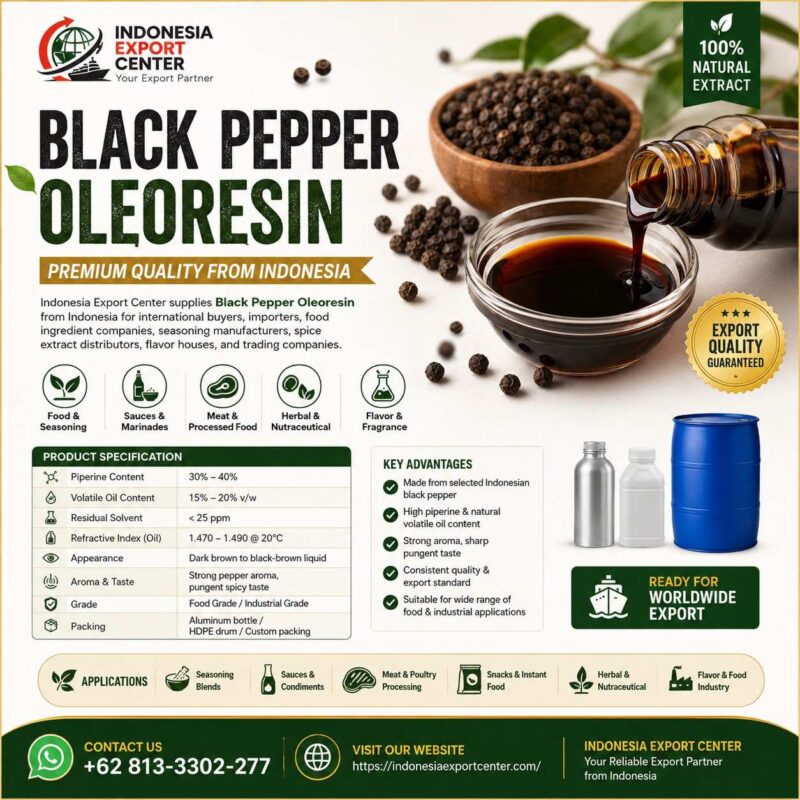
Complete Technical Reference for Black Pepper Oleoresin Buyers
Indonesia Export Center facilitates Black Pepper Oleoresin sourcing inquiries from Indonesia for international importers, food ingredient manufacturers, seasoning companies, flavor houses, and technical procurement teams.
Understanding product specifications is essential when selecting Black Pepper Oleoresin for commercial and industrial applications.
Technical parameters such as piperine concentration, volatile oil content, residual solvent, physical characteristics, and product grade help buyers establish purchasing criteria and evaluate product consistency.
This guide explains the important parameters to consider when sourcing Black Pepper Oleoresin.
What Is Black Pepper Oleoresin?
Black Pepper Oleoresin is a concentrated extract obtained from black pepper (Piper nigrum L.).
It contains characteristic pungent and aromatic components of the original spice.
The extract is commonly evaluated for food seasoning, flavoring, and other suitable industrial applications.
Product composition varies according to:
- Raw material quality.
- Botanical source.
- Extraction technology.
- Solvent selection.
- Processing conditions.
- Concentration and standardization methods.
- Finished product specifications.
Main Black Pepper Oleoresin Specifications
1. Piperine Content
Piperine is one of the main pungent compounds naturally present in black pepper.
Its concentration is an important technical parameter for buyers requiring defined pepper pungency.
Indicative target:
30%–40%
Piperine content should be confirmed through an appropriate analytical method, such as validated HPLC testing.
2. Volatile Oil Content
Volatile oil contributes to the characteristic aromatic properties of black pepper.
It is an important consideration for flavor houses and manufacturers evaluating the aromatic characteristics of oleoresin.
Indicative target:
15%–20% v/w
The analytical method and reporting basis should be confirmed with the supplier.
3. Residual Solvent
Residual solvent testing helps determine the amount of remaining processing solvent in the finished extract.
Indicative target:
Below 25 ppm
This target must be evaluated against the actual solvent used and applicable regulatory requirements.
4. Refractive Index
The refractive index can provide supporting physical characterization information for the oil fraction.
Indicative reference:
1.470–1.490 at 20°C
The measured value and testing method should be verified against the supplier’s technical documentation.
5. Appearance
Black Pepper Oleoresin is generally described as a dark brown to black-brown liquid.
Appearance may vary according to raw material and processing conditions.
6. Aroma and Taste
The product is characterized by:
- Strong black pepper aroma.
- Pungent spicy taste.
- Characteristic pepper sensory profile.
Sensory characteristics should be evaluated through agreed quality assessment procedures.
Indicative Product Specification Table
| Parameter | Indicative Specification |
|---|---|
| Product Name | Black Pepper Oleoresin |
| Botanical Name | Piper nigrum L. |
| Origin | Indonesia, subject to verification |
| Piperine Content | 30%–40% |
| Volatile Oil Content | 15%–20% v/w |
| Residual Solvent | Target below 25 ppm |
| Refractive Index (Oil) | 1.470–1.490 at 20°C |
| Appearance | Dark brown to black-brown liquid |
| Aroma | Strong pepper aroma |
| Taste | Pungent and spicy |
| Grade | Food Grade / Industrial Grade |
| Packaging | Aluminum bottle / HDPE container / Drum |
The table provides indicative target specifications and must be replaced or confirmed using the selected supplier’s official TDS.
Product Grade Variations
Black Pepper Oleoresin may be supplied under different commercial specifications.
Food Grade
Intended for suitable food ingredient applications, subject to applicable food safety and regulatory requirements.
Industrial Grade
Intended for suitable industrial applications according to the manufacturer’s technical specification and the buyer’s intended use.
Piperine-Standardized Oleoresin
A product with a defined piperine concentration to meet specific purchasing and formulation requirements.
Customized Specification
Some buyers may require particular piperine levels, volatile oil characteristics, or other technical parameters. Availability depends on manufacturer capability.
Recommended Quality Testing Parameters
A comprehensive product evaluation may include:
| Test Parameter | Purpose |
|---|---|
| Piperine Assay | Determine piperine concentration |
| Volatile Oil | Evaluate aromatic fraction |
| Residual Solvent | Assess solvent residue |
| Appearance | Evaluate physical characteristics |
| Refractive Index | Support physical characterization |
| Moisture, where relevant | Evaluate applicable product quality criteria |
| Microbiological Tests | Assess applicable food safety requirements |
| Heavy Metals | Evaluate relevant contaminants |
| Pesticide Residues | Assess applicable agricultural contaminant requirements |
Not every parameter is required for every product. Testing should be established according to intended use, buyer specifications, and destination regulations.
Analytical Methods and Testing
For reliable product evaluation, buyers should understand the analytical methods used by the manufacturer.
Examples include:
- HPLC for piperine quantification.
- Appropriate distillation-based or validated methods for volatile oil content.
- Gas chromatography-based methods for residual solvent analysis.
- Refractometry for refractive index determination.
- Appropriate microbiological methods for relevant food safety testing.
The exact analytical method should be documented in the COA or supporting laboratory report.
Understanding COA, TDS, and SDS
Three documents are particularly useful for technical procurement.
COA – Certificate of Analysis
Reports the actual analytical results for a specific production batch.
TDS – Technical Data Sheet
Provides the general technical characteristics and specification limits of the product.
SDS – Safety Data Sheet
Provides safety, handling, storage, and emergency information based on the product’s applicable classification.
Buyers should request all relevant documents before commercial approval.
Applications of Black Pepper Oleoresin
Black Pepper Oleoresin can be evaluated for:
- Seasoning blends.
- Sauces and condiments.
- Meat and poultry processing.
- Snacks and instant food.
- Food flavoring formulations.
- Spice extract manufacturing.
- Selected industrial applications.
Product grade and regulatory suitability must match the intended application.
How to Select the Right Product Specification
Before sourcing, buyers should establish:
- Intended application.
- Required piperine concentration.
- Volatile oil target.
- Residual solvent requirements.
- Physical and sensory requirements.
- Applicable food safety criteria.
- Required analytical methods.
- Packaging preference.
- Commercial purchasing volume.
- Destination-market regulations.
A written product specification helps reduce misunderstandings during supplier negotiations.
Source Black Pepper Oleoresin from Indonesia
Indonesia Export Center facilitates sourcing inquiries for international buyers seeking Black Pepper Oleoresin from Indonesia.
We help coordinate product specifications, supplier information, technical document requests, sample inquiries, and commercial quotations.
Share your required parameters, intended application, quantity, and destination country.
INDONESIA EXPORT CENTER
Your Export Partner from Indonesia
WhatsApp: +62 813-3302-277
Website: https://indonesiaexportcenter.com/
Contact us for Black Pepper Oleoresin product specifications and Indonesian export sourcing assistance.
