

IEC | INDONESIA EXPORT CENTER
CONNECTING INDONESIAN PRODUCTS TO THE WORLD
INDONESIAN BLACK PEPPER FOR THE MEAT PROCESSING INDUSTRY
PREMIUM EXPORT QUALITY
WHOLE BLACK PEPPER | MEAT SEASONING INGREDIENTS | MICROBIOLOGICAL RISK CONTROL | GRIND SIZE REQUIREMENTS | BULK B2B SOURCING
FOR MEAT PROCESSORS, SAUSAGE MANUFACTURERS, POULTRY PROCESSORS, FOOD INGREDIENT BUYERS & INDUSTRIAL SEASONING COMPANIES
Source Indonesian Black Pepper for Industrial Meat Processing
Looking for a black pepper meat processing supplier to support your meat seasoning and industrial ingredient requirements?
Black pepper is a widely used spice in processed meat and poultry products. It contributes characteristic pungency, aroma, and flavour to sausages, burger patties, meatballs, cured meat formulations, marinades, and other savoury products.
For meat processors, selecting a black pepper ingredient requires more than evaluating price and origin.
Manufacturers must consider microbiological risks, particle size, sensory consistency, foreign matter, raw material specifications, and compatibility with the intended production process.
These considerations are especially important when black pepper is added to products that receive limited subsequent heat treatment or are intended for ready-to-eat consumption.
IEC | Indonesia Export Center facilitates sourcing and export enquiries for Indonesian agricultural products, including whole black pepper for international meat processing companies.
IEC can receive your technical and purchasing requirements and seek confirmation of suitable Indonesian suppliers, available product forms, representative samples, quality documentation, packaging, and bulk export quotations.
The supplied reference product is whole dried black pepper. Ground, cracked, or microbiologically treated forms may be requested as sourcing requirements, but their availability and technical characteristics must be confirmed separately.
Product availability, microbial treatment capability, laboratory results, certifications, processing specifications, and shipment arrangements must be verified before purchase.
Request Black Pepper for Meat Processing
Send your intended application, required product form, grind size, microbiological criteria, quantity, and destination.
REQUEST A BLACK PEPPER QUOTE VIA WHATSAPP
WhatsApp: +62 813-3302-277
Website: https://indonesiaexportcenter.com/
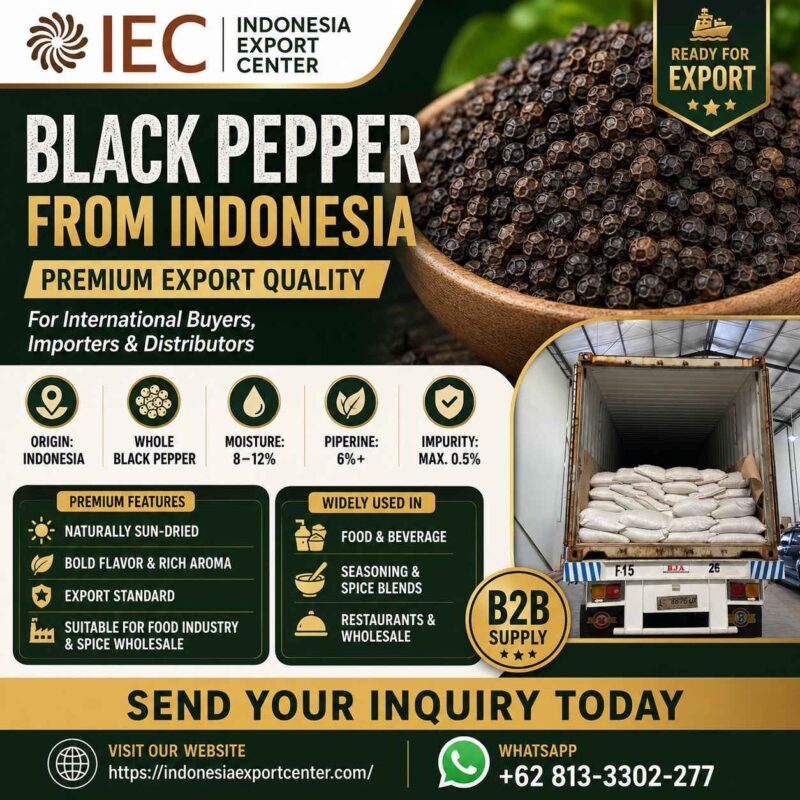
Indonesian Black Pepper – Reference Product Specifications
| Product Information | Details |
|---|---|
| Product | Whole Black Pepper |
| Botanical Name | Piper nigrum L. |
| Country of Origin | Indonesia |
| Reference Moisture | 8–12% |
| Reference Piperine | 6%+ |
| Reference Impurity | Maximum 0.5% |
| Reference Product Form | Whole Dried Peppercorns |
| Ground or Cracked Forms | Subject to Supplier Confirmation |
| Microbially Treated Forms | Subject to Supplier Confirmation |
| Grind Size | Buyer-Specified for Processed Forms |
| Bulk Density | Buyer-Specified |
| Foreign Matter | Buyer-Specified |
| Microbiological Criteria | Application and Market-Specific |
| Pesticide Residues | Applicable Market Requirements |
| Mycotoxins | Applicable Market Requirements |
| Lot-Specific COA | To Be Requested |
| Traceability | To Be Verified |
| Packaging | To Be Confirmed |
| MOQ | To Be Confirmed |
| Export Price | Request Quotation |
| Destination | Global B2B Markets |
Specification note: The supplied moisture, piperine, and impurity values are reference specifications for whole black pepper. They are not independently verified results for an available commercial lot and should not be applied automatically to finished ground or treated products.
Why Black Pepper Is Used in Meat Processing
Black pepper is a common ingredient in meat seasoning systems because of its characteristic flavour and aromatic profile.
Its suitability depends on the finished product and the manufacturer’s processing conditions.
Functional Considerations
Pungency
Piperine contributes to black pepper’s characteristic pungency.
Aroma
Black pepper contains aromatic compounds that contribute to the sensory profile of meat seasonings.
Visual Appearance
Coarse pepper particles may provide visible spice inclusions in certain meat products.
Seasoning Distribution
Ground pepper may be incorporated into seasoning blends or mixed directly into meat formulations.
Formulation Consistency
Controlled ingredient specifications can help manufacturers maintain more predictable finished-product characteristics.
Important
Black pepper is used primarily as a flavouring ingredient. It should not be relied upon as a validated antimicrobial control or substitute for appropriate food safety measures.
Black Pepper Applications in the Meat Processing Industry
1. Sausage Manufacturing
Black pepper is used in many sausage seasoning formulations.
Potential considerations include:
- Pungency
- Aroma
- Particle size
- Seasoning distribution
- Microbiological quality
- Processing compatibility
2. Burger Patties
Black pepper may be incorporated into beef, poultry, or plant-based burger seasoning systems.
Manufacturers may evaluate:
- Flavour intensity
- Ground pepper distribution
- Visible particle characteristics
- Formulation compatibility
- Ingredient safety
3. Meatballs and Formed Meat Products
Ground black pepper may be used in meatball and formed meat formulations.
Relevant parameters include grind size, flavour consistency, and ingredient distribution.
4. Processed Poultry Products
Black pepper may be included in poultry marinades, coatings, and seasoning blends.
Manufacturers should consider the microbiological risks relevant to the specific poultry processing operation.
5. Cured and Fermented Meat Products
Black pepper may be used in certain cured or fermented meat formulations.
These products require careful food safety assessment because processing methods, water activity, fermentation, and subsequent heat treatment may vary.
6. Ready-to-Eat Meat Products
Black pepper may be used in ready-to-eat meat products.
For these applications, the manufacturer should carefully evaluate whether the ingredient is introduced before or after a validated lethality step.
Important
The appropriate black pepper specification depends on the finished product, manufacturing process, and applicable food safety requirements.
Microbiological Risks of Black Pepper in Meat Processing
Dried spices can carry microorganisms despite having relatively low moisture.
For meat processing companies, this is an important food safety consideration.
Potential Microbiological Hazards
- Salmonella spp.
- Other relevant pathogenic microorganisms
- Indicator microorganisms
- Spoilage microorganisms
Why Risk Assessment Matters
The microbiological risk associated with black pepper depends on several factors:
- Incoming ingredient contamination
- Ingredient handling
- Manufacturing environment
- Timing of spice addition
- Subsequent heat treatment
- Risk of post-process contamination
- Finished-product storage conditions
- Intended consumer use
Critical Consideration
Low-moisture black pepper should not be assumed to be pathogen-free.
Manufacturers should address spice-related hazards through their food safety management system.
Salmonella Control for Meat Processing Ingredients
Salmonella is an important hazard to consider when sourcing dried spices for food manufacturing.
The appropriate control strategy depends on the meat product and manufacturing process.
Recommended Risk-Based Approach
- Identify the intended application.
- Determine whether the black pepper will receive a validated lethality treatment.
- Assess the risk of contamination after processing.
- Define appropriate ingredient acceptance criteria.
- Evaluate supplier preventive controls.
- Determine whether microbial reduction treatment is required.
- Verify relevant testing and treatment records.
- Monitor incoming ingredient quality.
Ready-to-Eat Products
For ready-to-eat meat products, spices added after a validated lethality step may require particularly careful control.
The manufacturer should assess whether a validated microbial reduction treatment or other appropriate control is necessary.
Important
A negative result from a limited sample does not guarantee that an entire lot is free from Salmonella.
Testing should support, rather than replace, effective preventive controls.
Microbiological Specifications for Meat Processing Black Pepper
| Parameter | Buyer Consideration |
|---|---|
| Salmonella spp. | Risk-Based Acceptance Criterion |
| Total Aerobic Count | Buyer-Specified |
| Enterobacteriaceae | Buyer-Specified |
| E. coli | Buyer-Specified |
| Yeasts and Moulds | Buyer-Specified |
| Other Relevant Microorganisms | Application-Specific |
| Sampling Plan | Agreed Before Testing |
| Test Method | Agreed and Documented |
| Lot Identification | Required |
Important
No universal microbiological limits are asserted here.
Manufacturers must establish requirements based on applicable law, customer specifications, hazard analysis, and intended use.
Microbial Reduction Treatments for Black Pepper
Some meat processing companies may require black pepper that has undergone a validated microbial reduction treatment.
Potential Treatment Approaches
Depending on the supplier and applicable regulations, options may include:
- Validated steam treatment
- Other legally permitted and validated microbial reduction processes
Information to Request
- Treatment method
- Processing facility
- Validation documentation
- Relevant process controls
- Post-treatment handling procedures
- Lot identification
- Microbiological verification
- Packaging controls
Important
IEC does not claim that steam-treated, sterilized, or otherwise microbially reduced black pepper is currently available.
Treatment capability, legal permissibility, validation, and lot-specific documentation must be confirmed.
Cleaning, sorting, drying, and grinding are not equivalent to validated microbial reduction.
Choosing the Right Black Pepper Grind Size for Meat Products
Particle size can affect the sensory and visual characteristics of processed meat products.
Whole Black Pepper
Whole peppercorns may be suitable for manufacturers that grind spices in-house.
Cracked Black Pepper
Cracked pepper may be suitable for applications where visible particles are desirable.
Coarse Ground Black Pepper
Coarse ground pepper may be used in formulations requiring noticeable pepper particles.
Fine Ground Black Pepper
Fine ground pepper may be suitable for more uniform seasoning distribution.
Important
The availability of cracked or ground forms must be confirmed separately from the supplied whole-pepper reference product.
Grind Size Selection by Meat Processing Application
| Meat Processing Application | Potential Pepper Form | Key Consideration |
|---|---|---|
| Sausages | Fine or Coarse Ground | Flavour and texture |
| Burger Patties | Ground | Seasoning distribution |
| Meatballs | Fine Ground | Uniform incorporation |
| Cured Meat Products | Coarse Ground or Cracked | Visible spice characteristics |
| Poultry Marinades | Ground | Formulation compatibility |
| Dry Meat Rubs | Ground or Cracked | Surface appearance |
| Ready-to-Eat Meat Seasonings | Application-Specific | Microbial control and grind size |
| In-House Spice Grinding | Whole | Raw material quality |
These are general application considerations, not fixed formulation standards.
Manufacturers should validate the selected form in their own production processes.
Defining a Black Pepper Grind Size Specification
Instead of requesting only “fine” or “coarse,” industrial buyers should define measurable particle-size requirements.
Recommended Specification Elements
| Parameter | Buyer Requirement |
|---|---|
| Product Form | Ground / Cracked |
| Target Particle Size | [Specify] |
| Sieve Size | [Specify] |
| Percentage Passing | [Specify] |
| Percentage Retained | [Specify] |
| Oversized Particle Limit | [Specify] |
| Fines Limit | [Specify] |
| Test Method | [Specify] |
| Sampling Procedure | [Specify] |
| Moisture | [Specify] |
| Microbiological Requirements | [Specify] |
Why Sieve Distribution Matters
A single mesh designation may not fully describe the particle-size distribution.
Manufacturers should agree on measurable sieve requirements and acceptance criteria.
Black Pepper Formulation Considerations for Meat Manufacturers
Black pepper should be evaluated in the context of the complete meat formulation.
Key Evaluation Areas
Flavour Intensity
Assess the amount of black pepper required to achieve the desired sensory profile.
Aroma
Evaluate characteristic pepper aroma under the intended processing conditions.
Particle Distribution
Determine whether the ingredient disperses appropriately during mixing.
Visual Appearance
Assess whether visible pepper particles are desirable.
Processing Compatibility
Consider grinding, mixing, cooking, curing, drying, or other processing stages.
Batch Consistency
Compare incoming pepper lots against approved reference specifications.
Recommended Trial Process
- Define the target flavour profile.
- Select a candidate black pepper sample.
- Confirm the required particle size.
- Conduct a small-scale formulation trial.
- Evaluate flavour, aroma, and appearance.
- Review relevant food safety requirements.
- Conduct production-scale validation where appropriate.
- Approve the ingredient specification.
Important
No specific black pepper inclusion rate is recommended universally.
The appropriate dosage depends on the finished product and manufacturer’s formulation.
Piperine and Flavour Consistency
Piperine is an important compound associated with black pepper pungency.
Supplied Reference
Piperine: 6%+
This is a reference specification, not a verified result for a particular lot.
Why Meat Processors May Evaluate Piperine
- Raw material comparison
- Purchasing specifications
- Flavour consistency monitoring
- Supplier performance assessment
Important
Piperine content alone does not fully describe black pepper aroma or sensory performance.
Manufacturers should combine analytical testing with application trials.
Moisture Control for Meat Processing Black Pepper
Moisture is an important parameter for dried spice ingredients.
Supplied Reference
Moisture: 8–12%
For commercial purchasing, the manufacturer should establish a specific maximum moisture limit and agreed test method.
Why Moisture Matters
- Ingredient storage
- Grinding behaviour
- Handling
- Packaging selection
- Raw material stability
Important
Moisture content alone does not establish microbiological safety.
Foreign Matter and Physical Contamination Control
Meat processing companies should evaluate physical contamination risks associated with incoming spices.
Potential Concerns
- Stones
- Soil
- Plant debris
- Other unintended materials
Supplied Reference
Impurity: Maximum 0.5%
The definition of impurity, test method, and actual lot result must be agreed.
Potential Supplier Controls
Buyers may request information about:
- Screening
- Sorting
- Foreign matter removal
- Metal detection, where applicable
- Final inspection
Actual supplier equipment and capabilities must be verified.
Pesticide Residues, Mycotoxins, and Heavy Metals
Meat processors may require testing for relevant chemical contaminants in black pepper.
Potential Testing Areas
- Pesticide residues
- Aflatoxins
- Ochratoxin A, where relevant
- Heavy metals
- Other substances identified through hazard assessment
Recommended Verification
- Identify applicable destination-market requirements.
- Establish acceptance criteria.
- Determine the analytical testing panel.
- Agree on sampling procedures.
- Request laboratory reports.
- Confirm lot identification.
- Review results before commercial acceptance.
No particular black pepper lot is claimed to meet every applicable contaminant limit without verification.
Quality Control Specifications for Meat Processing Companies
| Quality Parameter | Reference or Buyer Requirement |
|---|---|
| Product | Whole Black Pepper |
| Origin | Indonesia |
| Moisture | 8–12% Reference; Agree Maximum |
| Piperine | 6%+ Reference; Verify by Testing |
| Impurity | Maximum 0.5% Reference |
| Product Form | Whole; Other Forms Subject to Confirmation |
| Grind Size | Buyer-Specified for Processed Forms |
| Sieve Distribution | Buyer-Specified |
| Bulk Density | Buyer-Specified |
| Foreign Matter | Buyer-Specified |
| Appearance | Buyer-Specified |
| Aroma | Buyer-Specified |
| Salmonella | Applicable Acceptance Criterion |
| Other Microbiological Parameters | Risk-Based |
| Pesticide Residues | Applicable Market Requirements |
| Mycotoxins | Applicable Market Requirements |
| Heavy Metals | Applicable Market Requirements |
| Microbial Reduction Treatment | If Required and Available |
| Lot Identification | Required |
| COA | To Be Requested |
| Packaging | Buyer-Specified |
Important
The final purchase specification should reflect the intended meat processing application, manufacturing controls, and destination-market requirements.
Certificate of Analysis for Meat Processing Black Pepper
A lot-specific Certificate of Analysis can help meat processors evaluate ingredient quality.
Recommended COA Information
| COA Field | Requested Information |
|---|---|
| Product | Whole Black Pepper or Confirmed Processed Form |
| Origin | Indonesia |
| Supplier | Identified Supplier |
| Lot Number | Required |
| Sample Identification | Required |
| Moisture | Actual Result |
| Piperine | Actual Result |
| Impurity | Actual Result |
| Grind Size | If Applicable |
| Sieve Distribution | If Applicable |
| Salmonella | If Required |
| Other Microbiological Results | If Required |
| Pesticide Residues | If Required |
| Mycotoxins | If Required |
| Heavy Metals | If Required |
| Treatment Information | If Applicable |
| Laboratory | Identified |
| Analytical Methods | Documented |
| Test Date | Recorded |
Important
A COA supports quality assessment but does not independently establish complete food safety compliance.
Supplier Qualification for Meat Processing Companies
Meat processors may require a structured supplier approval process.
Recommended Supplier Evaluation
- Legal supplier identity
- Processing facility information
- Product specifications
- Food safety procedures
- Cleaning and sorting controls
- Grinding controls, if applicable
- Microbial reduction controls, if applicable
- Contaminant testing
- Traceability
- Packaging procedures
- Available certifications
- Audit reports, where available
- Corrective action procedures
- Recall procedures
Food Safety Certifications
Some buyers may request information regarding:
- HACCP-based food safety controls
- GMP
- ISO 22000
- FSSC 22000
- Other relevant food safety schemes
Actual certification status, scope, and validity must be verified.
Traceability and Batch Identification
Traceability helps meat processors connect incoming black pepper with relevant suppliers, processing activities, and commercial shipments.
Potential Supply Chain
Indonesian Producer → Collection → Drying → Cleaning → Packing → Export → Meat Processor
If grinding or microbial reduction treatment is involved, those processing stages should be reflected in the traceability records.
Recommended Traceability Information
- Supplier identity
- Product description
- Country of origin
- Lot number
- Processing records
- Treatment records, if applicable
- Packing records
- Laboratory reports
- Shipment records
- Receiving records
Packaging for Industrial Meat Processing Ingredients
Packaging should help protect black pepper during transportation and storage.
Potential Packaging Options
- Food-compatible woven bags with suitable liners
- Multiwall paper bags with suitable liners
- Other supplier-approved bulk packaging
Actual packaging materials and bag weights must be confirmed.
Packaging Checklist
| Packaging Requirement | Buyer Specification |
|---|---|
| Packaging Material | [Specify] |
| Net Weight per Bag | [Specify] |
| Inner Liner | [Required / Not Required] |
| Palletization | [Required / Not Required] |
| Lot Marking | Required |
| Product Identification | Required |
| Moisture Protection | [Specify] |
| Food-Contact Suitability | Verify |
| Destination-Market Requirements | Verify |
Bulk Black Pepper Supply for Meat Processing Factories
Meat processing companies may request quotations for trial orders, production orders, or recurring procurement.
Commercial Requirements
- Required product form
- Quantity
- Order frequency
- Technical specifications
- Microbiological requirements
- Quality documentation
- Sampling
- Packaging
- Destination
- Incoterm
- Payment terms
- Delivery schedule
Recurring Supply Enquiries
Buyers may request information about potential ongoing supply arrangements.
However, actual supplier capacity, production schedules, inventory, and consistent availability must be verified.
Export Pricing for Meat Processing Black Pepper
Export pricing depends on product specifications and commercial arrangements.
Main Price Drivers
- Product form
- Grade
- Moisture
- Piperine
- Impurity limit
- Bulk density
- Grind size requirements
- Cleaning and sorting
- Grinding or processing requirements, if available
- Microbial reduction treatment, if available
- Microbiological testing
- Contaminant testing
- Packaging
- Order quantity
- Supplier availability
- Inspection arrangements
- Freight
- Incoterm
- Payment terms
Potential Quotation Terms
Buyers may request quotations under suitable Incoterms, including:
- FCA
- FOB
- CFR
- CIF
- CIP
The appropriate term depends on the actual transport arrangement.
No current price, MOQ, supplier capacity, or available shipment quantity has been independently verified.
How Meat Processing Companies Can Source Indonesian Black Pepper
Step 1: Define the Meat Processing Application
Identify the finished product and manufacturing process.
Step 2: Select the Required Product Form
Specify whole, cracked, ground, or another required form.
Step 3: Define Grind Size
For processed forms, establish measurable particle-size acceptance criteria.
Step 4: Establish Microbiological Requirements
Define appropriate criteria based on the intended application and food safety hazard analysis.
Step 5: Establish Quality Specifications
Define moisture, piperine, cleanliness, and contaminant requirements.
Step 6: Submit Your RFQ
Provide quantity, destination, packaging, and commercial requirements.
Step 7: Request Supplier Information
Ask for supplier identity, processing capabilities, and relevant food safety controls.
Step 8: Confirm Product Availability
Request confirmation of the proposed form, grade, quantity, and lead time.
Step 9: Request Samples
Where available, obtain samples for laboratory and formulation testing.
Step 10: Conduct Application Trials
Evaluate the ingredient under relevant production conditions.
Step 11: Review Quality Documentation
Evaluate available COAs, laboratory reports, and supplier controls.
Step 12: Finalize Inspection and Commercial Terms
Define sampling, acceptance criteria, responsible parties, and shipment arrangements.
Ready-to-Send RFQ – Black Pepper for Meat Processing
Subject: RFQ – Indonesian Black Pepper for Industrial Meat Processing
Dear IEC | Indonesia Export Center Team,
We are interested in sourcing Indonesian black pepper for industrial meat processing.
Our purchasing requirements include product quality, grind size, microbiological risk control, application suitability, food safety documentation, and commercial export terms.
Please advise whether suitable Indonesian supply options are available.
BUYER INFORMATION
Company Name: [Company Name]
Country: [Country]
Business Type: [Meat Processor / Sausage Manufacturer / Poultry Processor / Food Ingredient Distributor]
Contact Person: [Name]
Email: [Email]
WhatsApp: [Number]
Destination Port: [Port]
PRODUCT REQUIREMENTS
Product: Black Pepper
Origin: Indonesia
Required Form: [Whole / Cracked / Ground / Other]
Intended Application: [Specify]
Required Quantity: [MT]
Order Frequency: [Trial / One-Time / Monthly / Quarterly]
TECHNICAL REQUIREMENTS
| Parameter | Requirement |
|---|---|
| Product | Black Pepper |
| Origin | Indonesia |
| Required Form | [Specify] |
| Moisture | [Specify] |
| Piperine | [Specify] |
| Impurity | [Specify] |
| Bulk Density | [Specify] |
| Foreign Matter | [Specify] |
| Grind Size | [Specify if Applicable] |
| Sieve Distribution | [Specify if Applicable] |
| Appearance | [Specify] |
| Aroma | [Specify] |
| Salmonella | [Specify Acceptance Criterion and Method] |
| Other Microbiological Requirements | [Specify] |
| Microbial Reduction Treatment | [Required / Not Required / Under Evaluation] |
| Pesticide Residues | Applicable Market Requirements |
| Mycotoxins | Applicable Market Requirements |
| Heavy Metals | Applicable Market Requirements |
APPLICATION INFORMATION
Finished Product: [Specify]
Manufacturing Process: [Specify]
Ready-to-Eat Product: [Yes / No]
Spice Addition Stage: [Before / After Lethality Step / Other]
Subsequent Heat Treatment: [Specify]
Target Sensory Profile: [Specify]
Grind Size Requirements: [Specify]
Special Processing Requirements: [Specify]
SUPPLIER AND QUALITY DOCUMENTATION REQUESTED
Please advise whether the following can be provided:
- Legal supplier identity.
- Processing facility information.
- Product technical specification.
- Lot-specific COA.
- Grind size report, if applicable.
- Microbiological test report.
- Pesticide residue test report, if required.
- Mycotoxin test report, if required.
- Heavy metal test report, if required.
- Microbial reduction treatment information, if applicable.
- Traceability information.
- Available food safety certifications.
- Packaging specifications.
- Representative samples.
- Relevant export documentation.
COMMERCIAL REQUIREMENTS
Required Quantity: [MT]
Preferred Packaging: [Specify]
Destination Country: [Country]
Destination Port: [Port]
Requested Incoterm: [FCA / FOB / CFR / CIF / CIP / Other]
Target Shipment Period: [Month / Year]
Please confirm:
- Product availability.
- Available forms and grades.
- Grind size capability, if applicable.
- Microbial reduction treatment availability, if required.
- Minimum order quantity.
- Available quantity.
- Sample availability.
- Price per metric ton.
- Available laboratory documentation.
- Inspection arrangements.
- Packaging options.
- Payment terms.
- Shipment lead time.
- Relevant export documentation.
- Quotation validity.
We will review the supplier information, product specifications, microbiological requirements, application suitability, food safety documentation, and commercial terms before proceeding.
Thank you. We look forward to your response.
Kind regards,
[Your Name] [Company Name] [Country]SEND YOUR MEAT PROCESSING BLACK PEPPER RFQ VIA WHATSAPP
Frequently Asked Questions – Black Pepper for Meat Processing
1. Can meat processing companies source Indonesian black pepper through IEC?
IEC can receive enquiries and seek confirmation of suitable Indonesian suppliers and export quotations.
2. Is black pepper commonly used in processed meat products?
Yes. Black pepper is used in many meat seasoning formulations, including sausages, burger patties, and other savoury products.
3. Is whole black pepper suitable for meat processing?
Yes. Whole black pepper may be used as a raw material for further grinding and processing.
4. Can buyers request ground black pepper?
Buyers may request ground black pepper sourcing. Actual availability and processing specifications must be confirmed.
5. Can meat processors specify grind size?
Yes. Buyers may define measurable grind size requirements, subject to supplier capability and verification.
6. Why is grind size important?
Grind size can influence flavour perception, visual appearance, and seasoning distribution.
7. Is Salmonella a concern in black pepper?
Yes. Salmonella is an important hazard to consider in dried spice procurement.
8. Does low moisture guarantee microbiological safety?
No. Low moisture does not automatically eliminate pathogens.
9. Can buyers request microbially treated black pepper?
Buyers may request information about treated products, but availability and validation must be confirmed.
10. Is steam-treated black pepper currently available?
No specific availability is confirmed. Buyers should submit their treatment requirements for verification.
11. Can black pepper be added to ready-to-eat meat products?
It may be used, but the manufacturer must assess relevant microbiological risks and establish appropriate controls.
12. Can buyers request a COA?
A lot-specific COA may be requested, subject to supplier and laboratory availability.
13. What is the supplied moisture specification?
8–12% as a reference range. The contractual maximum and actual lot result must be confirmed.
14. What is the supplied piperine specification?
6%+ as a reference value, subject to laboratory verification.
15. Can buyers request representative samples?
Samples may be requested, subject to supplier availability and agreed arrangements.
16. What is the minimum order quantity?
No fixed MOQ has been independently verified.
17. Can buyers request recurring supply?
Recurring supply enquiries may be submitted, subject to supplier capacity and commercial agreement.
18. Does IEC guarantee microbiological compliance?
No. Compliance must be verified for the actual product, supplier, intended application, and destination market.
Request Indonesian Black Pepper for Your Meat Processing Business
For companies searching for a black pepper meat processing supplier, successful procurement requires careful evaluation of microbiological risks, grind size, formulation suitability, supplier controls, and commercial specifications.
IEC | Indonesia Export Center welcomes enquiries from meat processors, sausage manufacturers, poultry processors, food ingredient distributors, and industrial seasoning companies seeking Indonesian black pepper.
Meat Processing Black Pepper Enquiry Summary
| Parameter | Details |
|---|---|
| Product | Black Pepper |
| Origin | Indonesia |
| Reference Form | Whole Black Pepper |
| Other Forms | Subject to Confirmation |
| Reference Moisture | 8–12% |
| Reference Piperine | 6%+ |
| Reference Impurity | Maximum 0.5% |
| Grind Size | Buyer-Specified |
| Application | Meat Processing |
| Microbiological Requirements | Application-Specific |
| Microbial Reduction Treatment | If Required and Available |
| Contaminant Requirements | Applicable Criteria |
| Traceability | To Be Verified |
| Lot-Specific COA | To Be Requested |
| Packaging | To Be Confirmed |
| MOQ | To Be Confirmed |
| Destination | Global |
| Export Price | Request Quotation |
IEC | INDONESIA EXPORT CENTER
CONNECTING INDONESIAN PRODUCTS TO THE WORLD
INDONESIAN BLACK PEPPER FOR INDUSTRIAL MEAT PROCESSING
FOR MEAT MANUFACTURERS, SAUSAGE PROCESSORS, POULTRY PROCESSORS & FOOD INGREDIENT BUYERS
SEND YOUR MEAT PROCESSING BLACK PEPPER ENQUIRY TODAY
WhatsApp: +62 813-3302-277
Website: https://indonesiaexportcenter.com/
Contact us for product specifications, microbiological requirements, grind size enquiries, sample requests, bulk quotations, and export inquiries.
Technical and Commercial Disclaimer: This page provides general sourcing information for the meat processing industry. Actual product forms, grinding capabilities, microbial reduction treatment availability, laboratory results, certifications, supplier capacity, product availability, and shipment arrangements must be verified for each proposed transaction. Moisture, piperine, and impurity values are reference specifications for whole black pepper, not tested results for an available lot or finished ground product. Food safety requirements depend on the intended meat processing application, manufacturing controls, and destination market. IEC facilitates sourcing and export enquiries; the contractual seller, exporter of record, and importer must be identified before shipment.
