

IEC | INDONESIA EXPORT CENTER
CONNECTING INDONESIAN PRODUCTS TO THE WORLD
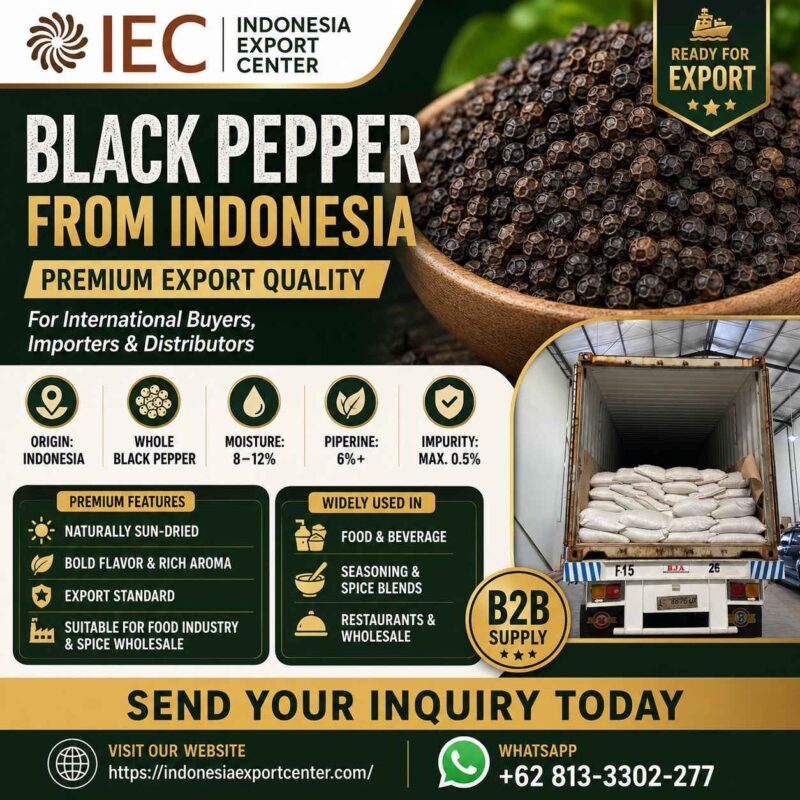
BLACK PEPPER FROM INDONESIA
PREMIUM EXPORT QUALITY
CONTAINER LOADING | OCEAN FREIGHT | MOISTURE PROTECTION | EXPORT DOCUMENTATION | INTERNATIONAL LOGISTICS
For International Importers, Shipping Coordinators, Freight Forwarders, Procurement Teams & Spice Distributors
Black Pepper Container Shipping from Indonesia
Are you planning black pepper container shipping from Indonesia for wholesale distribution, food manufacturing, or international spice trading?
Shipping whole black pepper internationally requires more than booking a container and arranging ocean freight.
Successful export logistics depend on product readiness, appropriate packaging, container condition, moisture management, cargo loading, documentation accuracy, and coordination between the supplier, freight forwarder, carrier, and importer.
Black pepper is a dried agricultural commodity. Although dried peppercorns are generally suitable for conventional dry cargo transport when properly prepared, poor packaging, moisture exposure, container condensation, and unsuitable storage conditions may affect product quality during shipment.
For international buyers, a well-planned loading process helps reduce preventable cargo damage, documentation discrepancies, and delivery complications.
IEC | Indonesia Export Center facilitates Indonesian black pepper sourcing and export enquiries for international B2B buyers.
This guide explains the practical considerations involved in container selection, packaging, moisture protection, cargo stuffing, export documentation, shipping terms, and receiving procedures.
Request Indonesian Black Pepper Container Shipping Information
Share your required quantity, packaging specifications, destination port, shipment schedule, and preferred Incoterm.
REQUEST A BLACK PEPPER EXPORT QUOTE VIA WHATSAPP
WhatsApp: +62 813-3302-277
Website: https://indonesiaexportcenter.com/
Indonesian Black Pepper – Reference Product Specifications
| Parameter | Reference Information |
|---|---|
| Product | Whole Black Pepper |
| Botanical Name | Piper nigrum L. |
| Origin | Indonesia |
| Reference Moisture | 8–12% |
| Reference Piperine | 6%+ |
| Reference Impurity | Maximum 0.5% |
| Product Form | Whole Dried Peppercorns |
| Intended Shipment | International B2B Export |
| Packaging | Buyer-Specified |
| Inner Liner | Subject to Agreement |
| Palletization | Subject to Agreement |
| Container Type | Subject to Logistics Assessment |
| Container Loading Quantity | To Be Calculated |
| Port of Loading | To Be Confirmed |
| Destination Port | Buyer-Specified |
| Shipping Term | Buyer-Specified |
| Export Documentation | Transaction-Specific |
| MOQ | To Be Confirmed |
| Export Price | Request Quotation |
Important: The moisture, piperine, and impurity figures are supplied reference information, not independently verified specifications for a particular commercial lot.
1. Why Container Loading Matters for Black Pepper Export
Black pepper quality can be affected by conditions before, during, and after ocean transportation.
Main Logistics Objectives
Protect Product Quality
Reduce avoidable exposure to moisture, contamination, and physical damage.
Maintain Packaging Integrity
Prevent bag tearing, leakage, and handling damage.
Support Traceability
Ensure that product lots and packages can be identified.
Improve Cargo Stability
Use appropriate loading and securing methods.
Reduce Documentation Errors
Align shipping records with the physical cargo.
Support Efficient Customs Clearance
Prepare the relevant commercial and transport documents.
Important
Good loading practices reduce certain risks but cannot eliminate all transportation hazards.
2. Black Pepper Export Shipping Process
A typical international container shipment may involve the following stages.
- Confirm product specifications.
- Agree on the commercial quantity.
- Confirm packaging requirements.
- Establish the shipping term.
- Identify the port of loading.
- Confirm the destination port.
- Arrange freight booking.
- Prepare the commercial lot.
- Complete agreed quality checks.
- Inspect packaging.
- Inspect the empty container.
- Load and secure the cargo.
- Verify package count and weight.
- Seal the container.
- Complete export documentation.
- Arrange export clearance.
- Deliver the container according to the transport plan.
- Complete vessel shipment.
- Coordinate destination arrival.
- Arrange import clearance and final delivery.
Important
The exact workflow depends on the contractual responsibilities, shipping route, and applicable regulations.
3. Container Types for Black Pepper Export
Whole black pepper may be shipped using conventional dry cargo containers when the product, packaging, and route conditions are suitable.
Common Container Options
| Container Type | General Description | Considerations |
|---|---|---|
| 20-Foot Dry Container | Standard Dry Cargo Container | Cargo weight, volume, handling |
| 40-Foot Dry Container | Larger Standard Dry Cargo Container | Volume, payload, route restrictions |
| 40-Foot High-Cube Container | Additional Internal Height | Cargo volume and loading configuration |
Important
Container dimensions, payload ratings, and usable capacity vary by equipment.
The actual permitted loading quantity must be calculated using the container’s verified specifications, cargo characteristics, and applicable transport limits.
4. How Much Black Pepper Fits in a Container?
The quantity of black pepper that can be loaded depends on several factors.
Main Factors
- Container internal dimensions
- Container maximum payload
- Packaging dimensions
- Net weight per bag
- Gross weight per bag
- Bag stacking arrangement
- Pallet dimensions
- Pallet weight
- Cargo securing requirements
- Applicable road and port weight restrictions
Why Capacity Cannot Be Assumed
Black pepper bulk density does not directly determine the total shipment weight without considering packaging and loading geometry.
A container may reach a weight limit before it reaches its available volume, or vice versa.
Loading Capacity Calculation Framework
Total Cargo Net Weight = Number of Bags × Net Weight per Bag
Total Cargo Gross Weight = Total Cargo Net Weight + Packaging and Other Included Cargo Weight
Container Planning Worksheet
| Parameter | Value |
|---|---|
| Container Type | [Specify] |
| Verified Maximum Payload | [kg] |
| Net Weight per Bag | [kg] |
| Gross Weight per Bag | [kg] |
| Number of Bags | [Specify] |
| Total Net Weight | [kg] |
| Total Gross Cargo Weight | [kg] |
| Pallet Weight, if Applicable | [kg] |
| Securing Material Weight | [kg] |
| Planned Loading Configuration | [Specify] |
Important
Do not use a generic fixed tonnage as a guaranteed loading capacity for all black pepper shipments.
5. Packaging Options for Containerized Black Pepper
Packaging should protect the product and support handling, storage, and shipment.
Potential Packaging Options
Polypropylene Bags
May be used for bulk dry agricultural products, subject to suitability and food-contact requirements.
Jute Bags
May be considered where the buyer specifies this packaging format.
Food-Grade Inner Liners
May provide an additional barrier between the product and the external packaging.
Palletized Bags
May support mechanical handling and organized cargo placement.
Packaging Requirements to Confirm
- Bag material
- Food-contact suitability
- Net weight per bag
- Inner liner specification
- Closure method
- Bag dimensions
- Shipping marks
- Lot identification
- Palletization
- Moisture protection
Important
Packaging availability and suitability must be confirmed for the specific supplier and shipment.
6. Moisture Protection During Ocean Freight
Moisture management is one of the most important considerations in black pepper export logistics.
Potential Sources of Moisture Exposure
- Excessive product moisture
- Wet or damp packaging
- Container water ingress
- Condensation
- Humid loading conditions
- Unsuitable storage before shipment
- Temperature changes during transit
Why Moisture Matters
Excess moisture may contribute to:
- Product deterioration
- Mould growth
- Unpleasant odours
- Packaging damage
- Quality disputes
Recommended Moisture Management Approach
- Confirm the contractual moisture specification.
- Assess product moisture before shipment.
- Ensure packaging is suitable and dry.
- Inspect the container for water ingress.
- Consider condensation risks.
- Evaluate suitable liners or moisture-management measures.
- Avoid loading visibly wet cargo or packaging.
- Maintain appropriate storage conditions before shipment.
Important
The IEC reference moisture range of 8–12% is not a universal shipment acceptance limit.
Buyers should agree on a specific maximum moisture requirement appropriate for their application and destination market.
7. Container Condensation and Container Rain
Container condensation can occur when temperature and humidity conditions cause moisture to condense on interior surfaces.
This phenomenon is sometimes referred to as container rain.
Potential Consequences
- Water droplets on cargo
- Damp packaging
- Staining
- Product quality deterioration
- Increased moisture exposure
Factors Affecting Condensation Risk
- Cargo moisture
- Packaging moisture
- Temperature changes
- Relative humidity
- Container ventilation characteristics
- Voyage conditions
Potential Risk Reduction Measures
- Appropriate product drying
- Suitable packaging
- Dry container selection
- Moisture-resistant barriers
- Cargo stowage planning
- Appropriate moisture-management products where justified
Important
Desiccants and liners are not substitutes for properly dried product or a watertight container.
Their effectiveness depends on the shipment conditions and correct application.
8. Should Black Pepper Be Shipped with Container Desiccants?
Container desiccants may be considered as part of a moisture-management plan.
Potential Purpose
To help manage moisture in the container atmosphere under suitable conditions.
Questions to Evaluate
- What is the cargo moisture condition?
- What is the expected voyage duration?
- What temperature variations may occur?
- Is the packaging moisture-resistant?
- What desiccant type is proposed?
- Is it suitable for the intended use?
- How will it be installed?
- Could it create contamination risks?
Important
No universal desiccant quantity should be assumed.
Selection and placement should follow a suitable technical assessment and the manufacturer’s instructions.
9. Container Inspection Before Loading
An empty container should be checked before cargo is loaded.
Container Inspection Checklist
-
Container identification confirmed.
-
Container appears structurally suitable.
-
Interior is clean.
-
Floor is dry.
-
No visible water ingress.
-
No unusual odours.
-
No visible contamination.
-
Doors operate correctly.
-
Door seals appear suitable.
-
No visible protrusions likely to damage bags.
-
Container condition documented.
Important
Visible inspection has limitations and does not guarantee that no problems will occur during transit.
10. Black Pepper Container Stuffing Procedure
Container stuffing refers to placing cargo inside a shipping container.
A controlled loading process helps maintain cargo stability and documentation accuracy.
Step 1: Confirm the Loading Plan
Review container type, package count, gross weight, and stowage arrangement.
Step 2: Verify the Product Lot
Confirm the cargo corresponds to the agreed commercial lot.
Step 3: Inspect the Packaging
Check for damage, leakage, or moisture exposure.
Step 4: Inspect the Container
Confirm the container is suitable for loading.
Step 5: Load the Cargo
Follow the agreed stowage plan.
Step 6: Distribute Weight Appropriately
Avoid unsafe concentration of cargo weight.
Step 7: Secure the Cargo
Use suitable restraint or securing measures where necessary.
Step 8: Verify the Quantity
Confirm the package count and shipment weight.
Step 9: Record Loading Information
Document container number, lot information, and other relevant details.
Step 10: Seal the Container
Apply the appropriate seal according to the agreed shipping procedure.
Important
Loading must comply with applicable cargo transport safety requirements and equipment limitations.
11. Cargo Weight Distribution and Securing
Improper cargo distribution may create safety risks.
Main Considerations
- Container payload limits
- Cargo centre of gravity
- Weight distribution
- Package stability
- Movement during transport
- Loading equipment limitations
- Road transport restrictions
Potential Securing Methods
Depending on the loading configuration:
- Appropriate dunnage
- Load restraints
- Suitable blocking
- Pallet securing
- Other approved cargo securing arrangements
Important
Cargo securing should follow appropriate professional guidance, including applicable container packing standards and the IMO/ILO/UNECE CTU Code where relevant.
12. Palletized vs. Floor-Loaded Black Pepper
Both palletized and floor-loaded configurations may be considered.
Palletized Loading
Potential Advantages
- Easier forklift handling
- Organized package arrangement
- Potentially faster unloading
Considerations
- Pallet weight
- Pallet dimensions
- Reduced usable volume
- Cargo securing
- Destination pallet requirements
Floor Loading
Potential Advantages
- May improve space utilization
- Does not require pallets for every cargo unit
Considerations
- Manual handling
- Loading time
- Unloading requirements
- Cargo stability
- Package damage risk
Important
The appropriate configuration depends on the shipment and destination handling requirements.
13. Shipping Marks and Lot Identification
Shipping marks support cargo identification and handling.
Potential Information
- Product name
- Country of origin
- Net weight
- Gross weight
- Lot number
- Package number
- Buyer reference
- Handling instructions where applicable
Important
Marking requirements should be agreed with the buyer and checked against applicable destination regulations.
14. Container Seal and Shipment Records
Container seals may help document the closure of a loaded container.
Information to Record
- Container number
- Seal number
- Loading date
- Loading location
- Package count
- Cargo gross weight
- Relevant lot numbers
- Responsible parties
Important
A seal is a security measure, not a guarantee that the cargo has remained free from tampering or damage.
15. Verified Gross Mass (VGM)
The Verified Gross Mass requirement applies to packed containers subject to the relevant SOLAS rules.
Why VGM Matters
The verified gross mass is used in vessel loading and stowage planning.
Main Considerations
- Actual packed container weight
- Applicable weighing or calculation method
- Responsible shipper
- Documentation
- Submission deadlines
Important
The shipper identified under the applicable rules is responsible for obtaining and providing VGM.
The container should not be loaded on a vessel without the required VGM information.
16. Black Pepper Export Shipping Documents
Documentation requirements vary by transaction and destination market.
Common Documents
| Document | General Purpose |
|---|---|
| Commercial Invoice | Commercial Transaction |
| Packing List | Cargo Quantity and Packaging |
| Bill of Lading | Ocean Transport Documentation |
| Certificate of Origin | Origin Documentation Where Applicable |
| Phytosanitary Certificate | Plant Health Documentation Where Required |
| Certificate of Analysis | Quality Test Results |
| Inspection Report | Agreed Inspection Findings |
| Export Customs Declaration | Export Clearance |
| Insurance Document | Where Applicable |
| VGM Declaration | Container Weight Verification |
Important
Not every document is mandatory for every shipment.
Confirm requirements with the relevant customs authorities, freight forwarder, and importer.
17. HS Code for Black Pepper Export
Black pepper is generally classified under HS heading 0904.
Relevant International Subheadings
0904.11
Pepper of the genus Piper, neither crushed nor ground.
0904.12
Pepper of the genus Piper, crushed or ground.
Important
The complete national tariff code must be verified for the relevant country and actual product.
18. FOB, CIF and Other Shipping Terms
Incoterms affect cost responsibilities, delivery obligations, and risk transfer.
Common Terms
| Incoterm | General Application |
|---|---|
| FCA | Delivery to Carrier at Named Place |
| FOB | Delivery on Board Vessel |
| CFR | Seller Pays Freight to Named Destination Port |
| CIF | Seller Pays Freight and Required Insurance |
| CIP | Seller Pays Carriage and Insurance to Named Destination |
| DAP | Delivery to Named Destination |
Important
FOB and CIF are intended for sea and inland waterway transport.
For certain containerized shipments, FCA or CIP may be more appropriate depending on the actual cargo handover arrangement.
19. How to Plan Black Pepper Ocean Freight
Step 1: Confirm the Shipment Quantity
Determine the required net and gross weights.
Step 2: Confirm Packaging
Establish bag dimensions and loading configuration.
Step 3: Select a Suitable Container
Review capacity, payload, and operational constraints.
Step 4: Identify the Ports
Confirm the proposed port of loading and destination port.
Step 5: Request Freight Information
Obtain relevant carrier or forwarder quotations.
Step 6: Review the Shipping Term
Clarify freight, insurance, and delivery responsibilities.
Step 7: Confirm Documentation
Identify required export and import documents.
Step 8: Establish the Loading Schedule
Coordinate product readiness, container availability, and shipping cut-offs.
Step 9: Prepare the Cargo
Complete agreed quality and packaging checks.
Step 10: Complete Loading and Dispatch
Follow the approved logistics plan.
20. Transit Time and Shipping Schedules
Ocean freight transit times depend on the shipping route and operational conditions.
Factors Affecting Transit Time
- Port of loading
- Destination port
- Vessel schedule
- Direct or transshipment service
- Port congestion
- Weather
- Customs procedures
- Carrier operations
Important
Transit times should be treated as estimates unless supported by a specific confirmed service arrangement.
21. Freight Cost Factors for Black Pepper Containers
The freight cost depends on the shipment and prevailing logistics conditions.
Potential Cost Factors
- Container type
- Shipping route
- Port pair
- Carrier availability
- Freight market conditions
- Origin handling charges
- Destination handling charges
- Documentation fees
- Insurance
- Inland transportation
Important
No fixed freight rate applies to every Indonesian black pepper shipment.
Request a current quotation for the actual shipment details.
22. Destination Arrival and Cargo Receiving Inspection
The buyer’s responsibilities continue after the vessel arrives.
Receiving Checks
- Container identification
- Seal condition
- Package count
- Packaging integrity
- Visible moisture damage
- Product lot identification
- Shipment documentation
- Agreed receiving tests
If Damage Is Suspected
- Document visible findings.
- Preserve relevant evidence.
- Notify the responsible parties promptly.
- Follow applicable carrier and insurance claim procedures.
- Arrange appropriate inspection where necessary.
Important
Receiving inspection should follow the purchase contract and relevant claims requirements.
23. Common Black Pepper Container Shipping Mistakes
Mistake 1: Loading Damp Cargo
Excess moisture may contribute to deterioration.
Better approach: Confirm the agreed moisture specification before loading.
Mistake 2: Ignoring Container Condition
An unsuitable container may expose cargo to contamination or water ingress.
Better approach: Inspect before loading.
Mistake 3: Assuming All Containers Have the Same Capacity
Container payloads and dimensions vary.
Better approach: Use verified equipment specifications.
Mistake 4: Using Unsuitable Packaging
Packaging may fail during handling or transit.
Better approach: Specify and inspect appropriate packaging.
Mistake 5: Poor Weight Distribution
Unsafe loading can create transport hazards.
Better approach: Follow an appropriate loading plan.
Mistake 6: Inadequate Cargo Securing
Cargo movement can damage bags and create safety risks.
Better approach: Use suitable securing methods.
Mistake 7: Missing Lot Identification
Product traceability may be weakened.
Better approach: Record lot and package information.
Mistake 8: Inconsistent Documents
Discrepancies may complicate clearance.
Better approach: Cross-check shipment records.
Mistake 9: Assuming CIF Covers All Destination Charges
CIF does not automatically include every destination charge.
Better approach: Clarify cost allocation.
Mistake 10: Failing to Plan for Delays
Shipment schedules may change.
Better approach: Build realistic logistics contingencies.
24. Black Pepper Container Shipping Checklist
Use this checklist before international shipment.
-
Confirm the product specification.
-
Confirm the commercial quantity.
-
Verify the product lot.
-
Confirm the moisture requirement.
-
Review quality documentation.
-
Confirm packaging material.
-
Confirm net weight per bag.
-
Confirm gross weight per bag.
-
Confirm the number of packages.
-
Decide on palletization.
-
Confirm liner requirements.
-
Assess moisture-management needs.
-
Select the container type.
-
Verify container payload.
-
Confirm the loading plan.
-
Inspect the empty container.
-
Check package condition.
-
Arrange appropriate cargo securing.
-
Record the container number.
-
Record the seal number.
-
Verify shipment weight.
-
Complete VGM requirements.
-
Confirm the port of loading.
-
Confirm the destination port.
-
Confirm the Incoterm.
-
Prepare shipping documents.
-
Arrange export clearance.
-
Confirm the vessel booking.
-
Coordinate destination import requirements.
25. Ready-to-Send RFQ – Indonesian Black Pepper Container Shipping
Subject: RFQ – Indonesian Whole Black Pepper Container Export and Logistics
Dear IEC | Indonesia Export Center Team,
We are interested in purchasing Indonesian whole black pepper for international shipment.
Please advise whether suitable supply options are available and provide information regarding product specifications, container loading, packaging, export logistics, and shipping terms.
BUYER INFORMATION
Company Name: [Company Name]
Country: [Country]
Business Type: [Importer / Distributor / Food Manufacturer / Wholesaler]
Contact Person: [Name]
Email: [Email]
WhatsApp: [Number]
PRODUCT REQUIREMENTS
Product: Whole Black Pepper
Origin: Indonesia
Required Quantity: [MT]
Intended Application: [Specify]
TECHNICAL SPECIFICATIONS
| Parameter | Requirement |
|---|---|
| Moisture | [Maximum %] |
| Piperine | [Minimum %] |
| Impurity | [Maximum %] |
| Bulk Density | [Minimum g/L] |
| Foreign Matter | [Maximum %] |
| Microbiological Criteria | [Specify] |
| COA | [Required / If Available] |
PACKAGING REQUIREMENTS
Packaging Type: [Specify]
Net Weight per Bag: [Specify]
Inner Liner: [Required / Not Required]
Palletization: [Required / Not Required]
CONTAINER SHIPPING REQUIREMENTS
Preferred Container Type: [20-Foot / 40-Foot / High-Cube / Please Advise]
Required Shipment Quantity: [MT]
Port of Loading: [Please Advise]
Destination Port: [Port]
Destination Country: [Country]
Preferred Incoterm: [FCA / FOB / CFR / CIF / CIP / Other]
Target Shipment Period: [Month / Year]
LOGISTICS INFORMATION REQUESTED
Please confirm:
- Product availability.
- Available grades.
- Minimum order quantity.
- Price per metric ton.
- Packaging options.
- Proposed loading quantity.
- Container type recommendations.
- Container loading arrangements.
- Moisture protection options.
- Palletization options.
- Export documentation.
- Inspection options.
- Available shipping terms.
- Freight quotation options.
- Estimated shipment lead time.
- Payment terms.
- Quotation validity.
Thank you. We look forward to your quotation and logistics information.
Kind regards,
[Your Name] [Company Name] [Country]SEND YOUR BLACK PEPPER CONTAINER SHIPPING RFQ VIA WHATSAPP
26. Frequently Asked Questions About Black Pepper Container Shipping
1. Can black pepper be shipped in standard dry containers?
Whole black pepper may be shipped in suitable dry containers when the product, packaging, and transport conditions are appropriate.
2. Which container is best for black pepper export?
The choice depends on shipment quantity, packaging, payload limits, and logistics requirements.
3. How many tons of black pepper fit in a 20-foot container?
The quantity must be calculated using actual packaging, container payload, and loading constraints.
4. Can black pepper be shipped in a 40-foot container?
Potentially, subject to cargo volume, weight, and equipment suitability.
5. Is moisture protection necessary?
Moisture risk should be assessed for every shipment.
6. What is container rain?
Condensation that can form inside a container under certain temperature and humidity conditions.
7. Should container desiccants be used?
They may be considered where appropriate, but selection depends on the cargo and voyage conditions.
8. Are polypropylene bags suitable?
They may be suitable when their specifications meet the product and shipment requirements.
9. Can jute bags be used?
They may be considered where agreed and suitable.
10. Is palletization required?
Not necessarily. Requirements depend on the shipment and handling arrangements.
11. What is container stuffing?
The process of loading cargo into a shipping container.
12. What is VGM?
Verified Gross Mass is the verified weight of a packed container required under applicable SOLAS rules.
13. What documents are needed for black pepper export?
Common documents include commercial invoices, packing lists, transport documents, and applicable certificates or declarations.
14. What HS code applies to whole black pepper?
Whole pepper of the genus Piper, neither crushed nor ground, is generally classified under HS subheading 0904.11.
15. Can I request FOB and CIF quotations?
Yes. Buyers may request these quotation formats, subject to commercial and logistics arrangements.
16. How long does shipping take?
Transit time depends on the route, carrier, and operational conditions.
17. Can IEC guarantee container capacity or freight rates?
No. Actual capacity and rates require shipment-specific confirmation.
18. How do I request a black pepper container shipping quotation?
Send your product specifications, quantity, packaging, destination port, and preferred shipping terms to IEC via WhatsApp.
Request Indonesian Black Pepper Container Export Information
For international buyers researching black pepper container shipping Indonesia, successful export logistics require coordinated planning across product quality, packaging, container selection, moisture management, loading procedures, shipping documentation, and destination arrangements.
Container capacity should be based on actual equipment and cargo specifications rather than generic assumptions.
Moisture protection, correct weight distribution, cargo securing, and accurate documentation can help reduce avoidable shipment problems.
IEC | Indonesia Export Center welcomes enquiries from importers, shipping coordinators, freight forwarders, procurement teams, food manufacturers, and spice distributors interested in Indonesian whole black pepper.
Black Pepper Container Shipping Enquiry Summary
| Parameter | Details |
|---|---|
| Product | Whole Black Pepper |
| Origin | Indonesia |
| Reference Moisture | 8–12% |
| Reference Piperine | 6%+ |
| Reference Impurity | Maximum 0.5% |
| Packaging | To Be Confirmed |
| Inner Liner | Subject to Agreement |
| Palletization | Subject to Agreement |
| Container Type | Shipment-Specific |
| Container Loading Quantity | To Be Calculated |
| Moisture Protection | Shipment-Specific |
| Container Inspection | Subject to Arrangement |
| Cargo Securing | Loading Plan Required |
| VGM | Where Applicable |
| Port of Loading | To Be Confirmed |
| Destination Port | Buyer-Specified |
| Incoterm | Buyer-Specified |
| Export Documents | Transaction-Specific |
| Freight | Subject to Quotation |
| MOQ | To Be Confirmed |
| Export Price | Request Quotation |
| Destination | Global |
IEC | INDONESIA EXPORT CENTER
CONNECTING INDONESIAN PRODUCTS TO THE WORLD
INDONESIAN BLACK PEPPER FOR INTERNATIONAL TRADE
CONTAINER LOADING | MOISTURE PROTECTION | OCEAN FREIGHT | EXPORT DOCUMENTATION | BULK SOURCING
SEND YOUR BLACK PEPPER SHIPPING INQUIRY TODAY
WhatsApp: +62 813-3302-277
Website: https://indonesiaexportcenter.com/
Contact us for product specifications, container loading enquiries, packaging requirements, shipping arrangements, bulk quotations, and export inquiries.
Shipping and Logistics Disclaimer: This guide provides general information about containerized black pepper export logistics. Actual container capacity, packaging suitability, moisture-management measures, freight rates, port arrangements, transit times, loading procedures, and documentation requirements depend on the specific shipment. Reference moisture, piperine, and impurity values are not verified lot-specific test results. Container loading must comply with applicable equipment, transport, and safety requirements. IEC facilitates sourcing and export enquiries and does not guarantee cargo capacity, freight availability, transit times, or shipment outcomes.
